Can Simeon Birnbaum break the NCAA 1500/mile “curse” and arrive as Oregon’s next great US distance star?
By Robert Johnson
The 2026 NCAA Outdoor Track & Field Championships take place this week at Hayward Field in Eugene, Ore., with the men’s competition running on Wednesday and Friday. One of the biggest storylines is simple: Can Oregon junior Simeon Birnbaum, who set the NCAA 1500m record of 3:31.69 on April 19, break the NCAA 1500m/mile record-holder “curse” and win his first NCAA title in the men’s 1500?
None of the last 12 men who have set an NCAA 1500 or mile record have won the NCAA 1500 or mile title after setting the record (though a few won NCAA titles in other events). You have to go all the way back to 2009, when Oklahoma State’s German Fernandez won the NCAA 1500m title as a true freshman after breaking the NCAA mile mark indoors (3:55.02), to find a 1500/mile record holder who won.
| The NCAA 1500/mile record “curse” | ||||
| Athlete | Year | Event | Time | NCAA result |
| Miles Batty | 2012 | Mile | 3:54.54i | 3rd mile |
| Chris O’Hare | 2013 | Mile | 3:52.98i | 7th mile |
| Lawi Lalang | 2014 | Mile | 3:52.88i | 2nd 5k, 2nd mile |
| Edward Cheserek | 2017 | Mile | 3:52.01i | 1st 3k/5k, 2nd mile |
| Josh Kerr | 2018 | 1500 | 3:35.01 | 3rd 1500 |
| Cooper Teare | 2021 | Mile | 3:50.39i | 1st DMR, 2nd 3k |
| Sam Tanner | 2021 | 1500 | 3:34.72i | Didn’t make mile final |
| Yared Nuguse | 2021 | 1500 | 3:34.68 | 2nd 1500 |
| Eliud Kipsang | 2022 | 1500 | 3:33.74 | Didn’t make final |
| Ethan Strand | 2025 | 1500i/M | 3:33.41i/3:48.32i | 1st 3k, 2nd 1500 |
| Gary Martin | 2025 | 1500i | 3:33.41i | 2nd 3k, 5th 1500 |
| Liam Murphy | 2025 | 1500 | 3:33.02 | Didn’t make final |
| Simeon Birnbaum | 2026 | 1500 | 3:31.69 | ??? |
If you were looking for the ideal runner to break the “curse,” it would be hard to find a better candidate than Birnbaum.
The Rapid City, S.D., native entered Oregon in the fall of 2023 with huge expectations as he was one of the fastest preps in US history. He ran high school pbs of 3:37.93 in the 1500 (#2 in US HS history), 3:57.53 in the mile (#4), and 8:34.10 in the 2-mile (#2).
After losing most of his freshman year to injury, Birnbaum had modest success last year as a sophomore. He was 74th at NCAA XC before qualifying for the mile indoors (eliminated in the heats) and scoring in the 1500 outdoors (7th). Along the way, he won his first Big 10 title in the 5000 and set pbs of 3:37.02, 3:52.81, and 13:31.87.
During this 2025-2026 academic year, however, the 20-year-old Birnbaum has taken off and started living up to the gaudy expectations accorded him based on his high school exploits. After an All-American showing in XC in the fall (33rd), Birnbaum has really found his stride this year in track. Indoors, he crushed the fields in the 3000 and 5000 at Big 10s before finishing as the runner-up in the 3000 at NCAAs.
Outdoors, Birnbaum has been even better and reached a new level. In early April, he lowered his 5000 pb to 13:19.73. Two weeks later, he smashed the collegiate record in the 1500, using a 53.49 last lap to run 3:31.69. Then he went to the Penn Relays and used a 49.9 last 400 to give Oregon the DMR title.
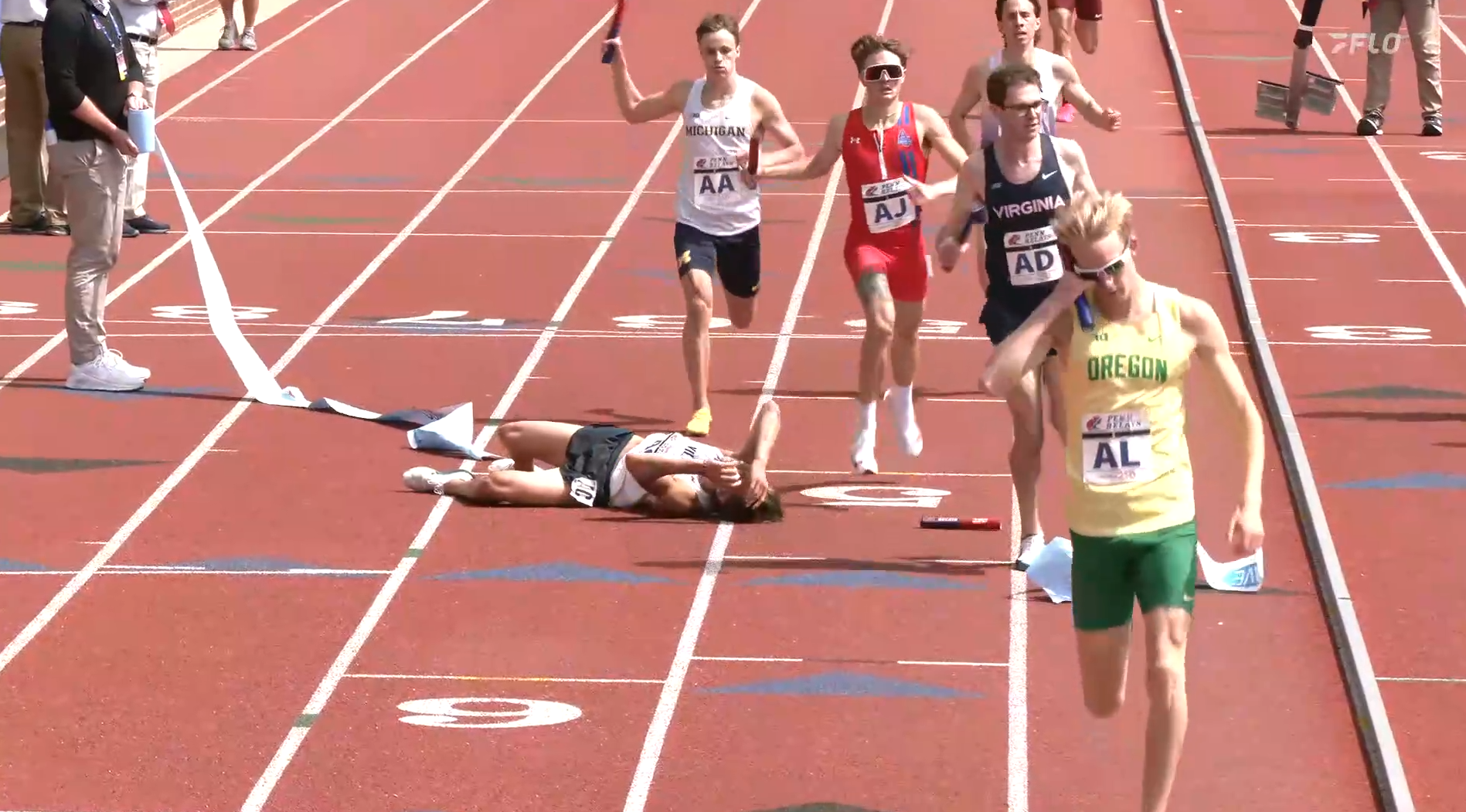 Birnbaum celebrates the DMR win at Penn
On May 8, he blitzed a 1:44.67 pb in the 800 (3rd-fastest in the NCAA this year). A week later, he crushed NCAA mile 3rd placer Trent McFarland of Michigan and everyone else to take the Big 10 1500 crown. Two weeks after that, he finished 0.64 ahead of NCAA mile champ Carter Cutting of BYU to win his 1500 semi at regionals to punch his ticket to Eugene. He also picked up a 5000 qualifier.
Birnbaum’s outdoor season has been near-perfect (he did put himself too far back in the 4 x mile at Penn as Villanova’s Marco Langon held him off even though Birnbaum had the fastest last lap). Can he cap it all off with an NCAA win in the 1500?
He certainly should be considered the favorite.
That being said, positioning and tactics matter in non-rabbited races. Just ask Ethan Strand. Last year, the North Carolina senior was in 3:30 shape (which he ran at USAs, finishing ahead of Cole Hocker) but didn’t win NCAAs as he found himself in last place on the final turn.
If Birnbaum runs a race like he did at Big 10s, where he was up front for the final 1k, it’s hard to see him losing.
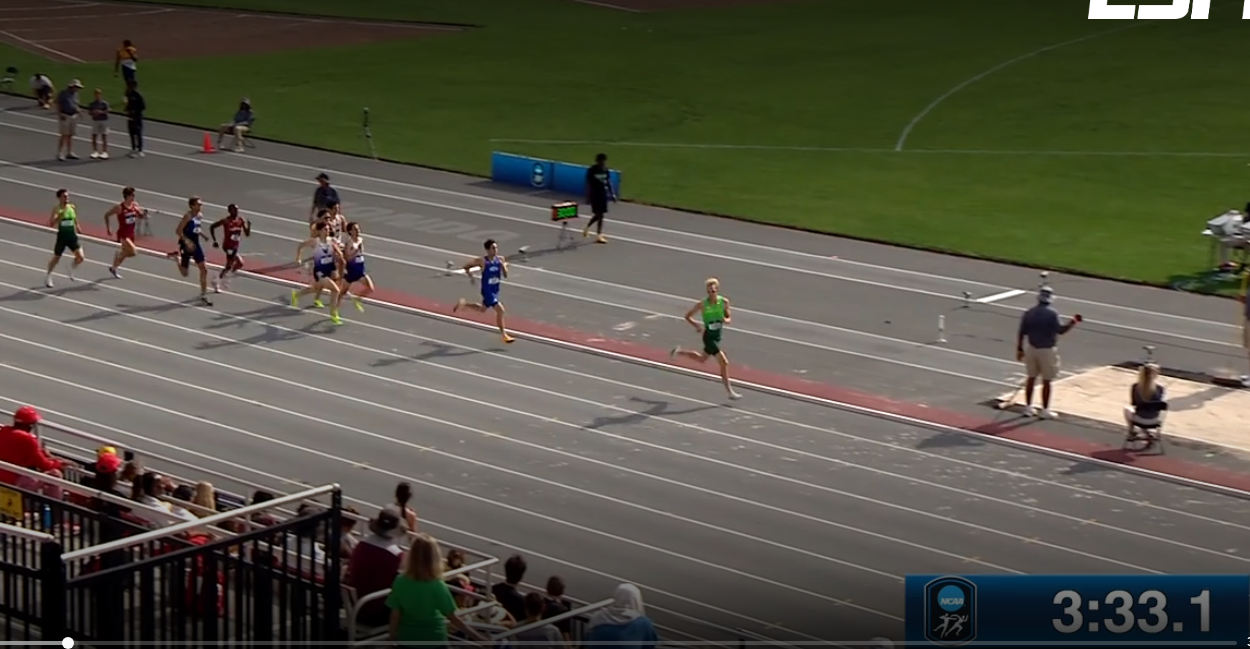
But even if Birnbaum, who likes to avoid trouble and go out in the back of the pack early in championship 1500s, uses the same strategy he used at regionals, he may be good enough to win. At regionals, Birnbaum was next to last with 500 to go, but moved to the lead by the bell and won going away over the surprise indoor champ Cutting.
You never know if someone is going all-out in a regional, but Birnbaum looked like he was cruising and it didn’t look like Cutting was shutting it down (he was in the midst of running a 1500 pb), and yet there was a huge gap between the two.
Are you a Birnbaum fan? He recently was on our Track Talk podcast: Simeon Birnbaum: “No One Cares About Second Place” – His Quest to Win NCAAs
If I was coaching Birnbaum, I’d tell him, “Going out in last to avoid trouble is fine, but move up between 800 and 900. Ideally you don’t want to be 5th at the bell like you were in the 4 x mile at Penn.”
If Birnbaum doesn’t win, who beats him? Cutting is option #1 as he won indoors. But on paper, he shouldn’t touch Birnbaum as Cutting is a 1:47/3:37/13:51 guy (to be fair, he did run 3:52 in the mile indoors).
And there are only four guys in the field who have run within three seconds of Birnbaum this year. On paper, he shouldn’t lose to any of them.
| The 5 Fastest Guys Entered In The 2026 NCAA 1500 | |||||
| Rank | Athlete | Year | Team | Time | Note |
| 1 | Simeon Birnbaum | JR-3 | Oregon | 3:31.69 | He’s the favorite |
| 2 | Trent McFarland | JR-3 | Michigan | 3:33.17 | 3rd placer indoors was crushed by Birnbaum at Big 10s |
| 3 | Brian Masai | SR-4 | Arkansas | 3:33.17 | SEC champ has never scored at NCAAs. PBs pale in comparison to Birnbaum. |
| 4 | Brendan Herger | SO-2 | Michigan | 3:34.06 | Crushed by Birnbaum at Big 10s |
| 5 | Gary Martin | SR-4 | Virginia | 3:34.12 | 3:48 miler was 4th indoors, but didn’t win ACCs |
If Birnbaum breaks the curse, it’s probably time to start wondering if he’s the next great one to come out of Oregon, following up on the lineage of recent NCAA 1500 champions Andrew Wheating (3:30.90 a month after graduation in 2010, back when that made him the 4th fastest man in the world that year), Matthew Centrowitz (Olympic champion in 2016), and Cole Hocker (Olympic champion in 2024).
On a recent episode of the LetsRun.com Track Talk Podcast, our Jonathan Gault said Birnbaum reminds him of Centrowitz as his two-mile prowess in high school suggested he could be a 5000 guy, while in reality, he’s a great miler. Any concerns that Birnbaum isn’t fast enough for the 1500 should officially be over as he’s got a faster 800 pb than Hocker (1:45.13) and is only .05 slower than Centrowitz (1:44.62).
If Birnbaum wins on Friday, it also would be Oregon’s 14th NCAA title in the men’s 1500, breaking a tie with Villanova for most ever in that event. Three of the Ducks’ previous champions — Centrowitz, Hocker, and Joaquim Cruz — went on to win Olympic gold (Cruz’s Olympic gold came in the 800).
Oregon and Villanova are tied with 13 NCAA 1500 titles apiece
| Oregon | Villanova | |||
| Athlete | Year | Athlete | Year | |
| Bill Dellinger | 1954 | Ron Delany | 1956 | |
| Jim Bailey | 1955 | Ron Delany | 1957 | |
| Jim Grelle | 1959 | Ron Delany | 1958 | |
| Dyrol Burleson | 1960 | Dave Patrick | 1966 | |
| Dyrol Burleson | 1961 | Dave Patrick | 1968 | |
| Dyrol Burleson | 1962 | Marty Liquori | 1969 | |
| Joaquim Cruz | 1984 | Marty Liquori | 1970 | |
| Dub Myers | 1986 | Marty Liquori | 1971 | |
| Andy Wheating | 2010 | Eamonn Coghlan | 1975 | |
| Matthew Centrowitz | 2011 | Eamonn Coghlan | 1976 | |
| Mac Fleet | 2013 | Don Paige | 1979 | |
| Mac Fleet | 2014 | Sydney Maree | 1980 | |
| Cole Hocker | 2021 | Sydney Maree | 1981 |
##
Birnbaum also qualified in the men’s 5000, which starts 1 hour and 43 minutes after the men’s 1500 final.
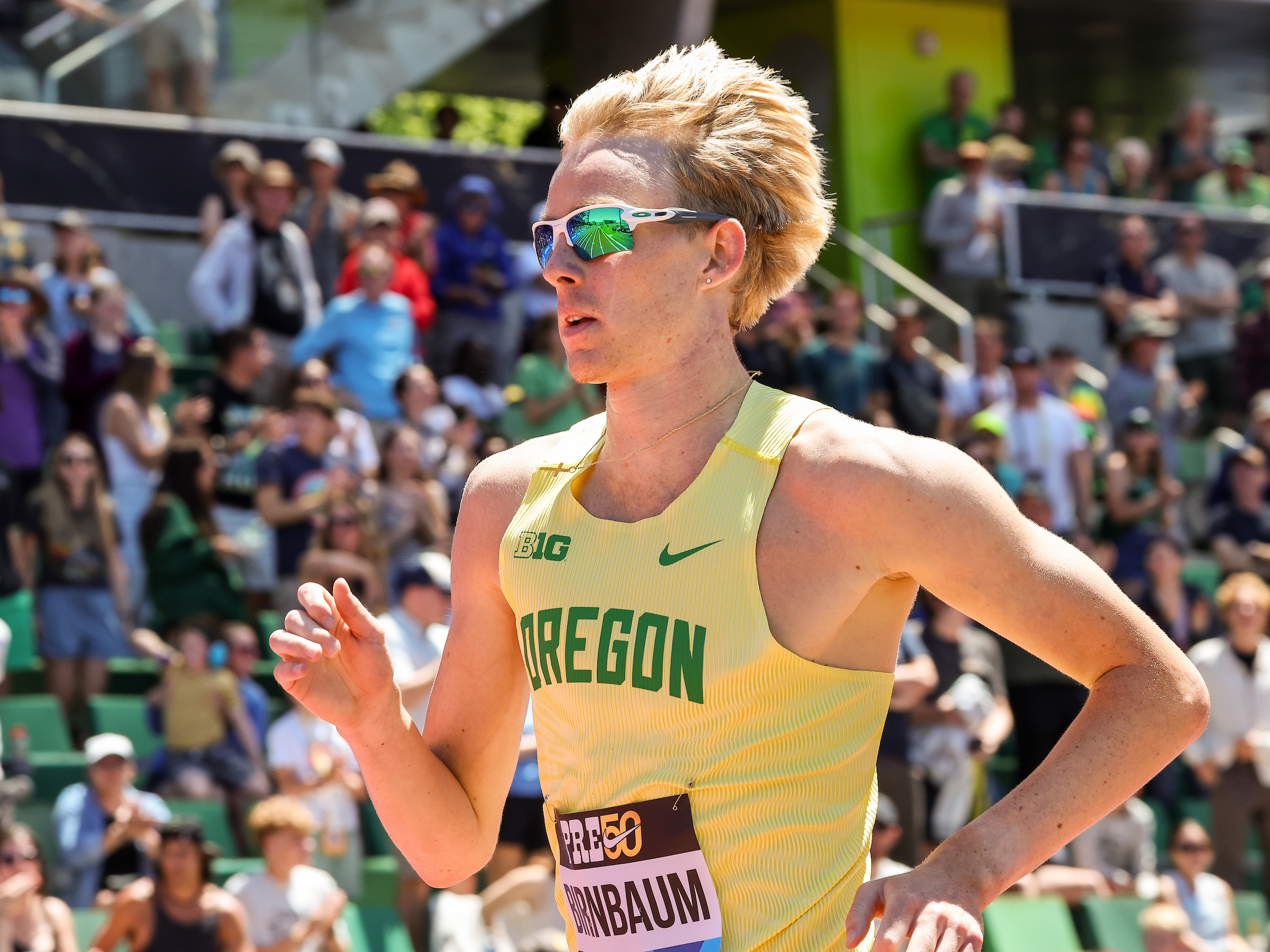 Kevin Morris photo
While it’s true that championship 5000s are often won by 1500 studs — just ask Hocker or Jakob Ingebrigtsen — I don’t expect Birnbaum to contend in the 5000 in Eugene. At NCAAs, the 1500 final and 5000 final are on the same day, whereas at the World Championships and Olympics they are on different days.
Pulling off that type of same-day double against a 12:57 guy like Habtom Samuel and a fresh Marco Langon is EXTREMELY hard to do — next to impossible. I don’t expect Birnbaum to do it, but if he does, then bring out the Cole Hocker comparisons, as it will remind me of a tired Hocker taking down a fresh Cooper Teare in the 3000 after winning the mile at NCAA indoors in 2021.
But even Hocker couldn’t win the 1500/5000 outdoors. After beating Yared Nuguse in a classic NCAA 1500 final in 2021, he finished 4th in the 5000 with the same gap between events.
In fact, in the history of the NCAA championships, no man has ever won the 1500/mile and 5000 at the same meet, and only three men have won both events during the course of their career. Kansas’s Wes Santee won the 5000 in 1952 and the mile in 1953, Oregon’s Bill Dellinger won the mile in 1954 and the 5000 in 1956, and Villanova’s Sydney Maree won the 5000 in 1979 (13:20.63) and 1500 in 1980 (3:38.64) & 1981 (3:35.30).
Who wins the men's 1500 at NCAAs?
-
%
Rojo Prediction: The curse ends. Birnbaum get the win in the 1500. I don’t expect him to be a factor in the 5000. Birnbaum was on the ropes and on the verge of getting dropped at NCAA Regionals in the 5000. He’s not winning the 5000 in Eugene. Unless the Ducks are in it for the team title, I don’t expect him to even start.
Talk about Birnbaum’s chances in the 1500 on our fan forum / messageboard: MB: Will Simeon Birnbaum break the 1500/mile record-holder “curse” and win in Eugene?
Are you a Birnbaum fan? He recently was on our Track Talk podcast: Simeon Birnbaum: “No One Cares About Second Place” – His Quest to Win NCAAs