Fastest Boston Marathon Ever: Korir Destroys Course Record, 13 Men Under 2:06
By Jonathan Gault and Robert Johnson
BOSTON – On a perfect day for running fast, with temperatures in the low 40s and a healthy 9-mile-per-hour tailwind throughout the race, several runners took turns trying to impose their will on the race. Germany’s Hendrik Pfeiffer got things going early, towing the field through 20k on 2:03 pace. 2016 Boston champion Lemi Berhanu Haile, in the midst of a career renaissance, pushed just after that and led through halfway in 61:43. His Ethiopian countryman Milkesa Mengesha answered with an even bigger move of his own and led by as much as 12 seconds at 30k.
But the move, the one that defined the fastest race in the 130-year history of the Boston Marathon, belonged, for the second year in a row, to Kenyan John Korir. The 29-year-old cemented himself as a Boston legend and made his case as the best marathoner in the world right now by launching an attack up Heartbreak Hill, blitzing the uphill 21st mile in 4:42 to open a 22-second gap on the field. It was the same move Korir made last year, when he went 4:40 up the hill en route to victory in 2:04:45.
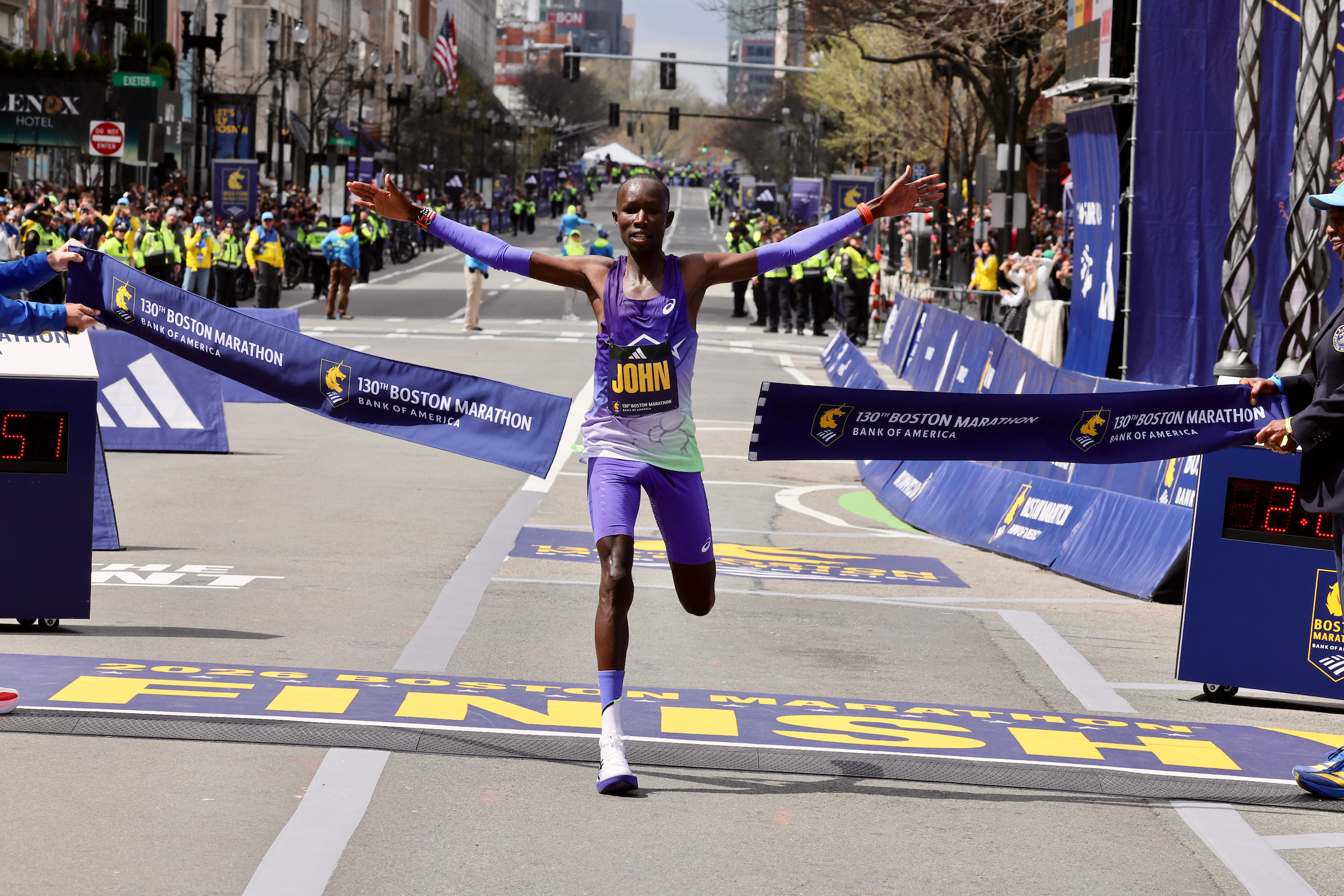 John Korir sets course record 2:01:52 at 2026 Boston Marathon (Kevin Morris photo)
But in 2026, Korir did not stop attacking once he crested Heartbreak. He pushed on the downhills through Beacon Street in Brookline, through Kenmore Square in the shadow of Fenway Park, and did not stop until breaking the tape in 2:01:52, taking more than a minute off Geoffrey Mutai’s course record of 2:03:02.
Korir had an inkling he had done something special as he approached the finish line, sticking his tongue out and throwing his arms wide in celebration. When he found out from B.A.A. CEO Jack Fleming a minute later that he had broken the course record, he wheeled around and began jumping for joy.
“I knew I would defend my title,” Korir said. “But I didn’t know I would run that fast.”
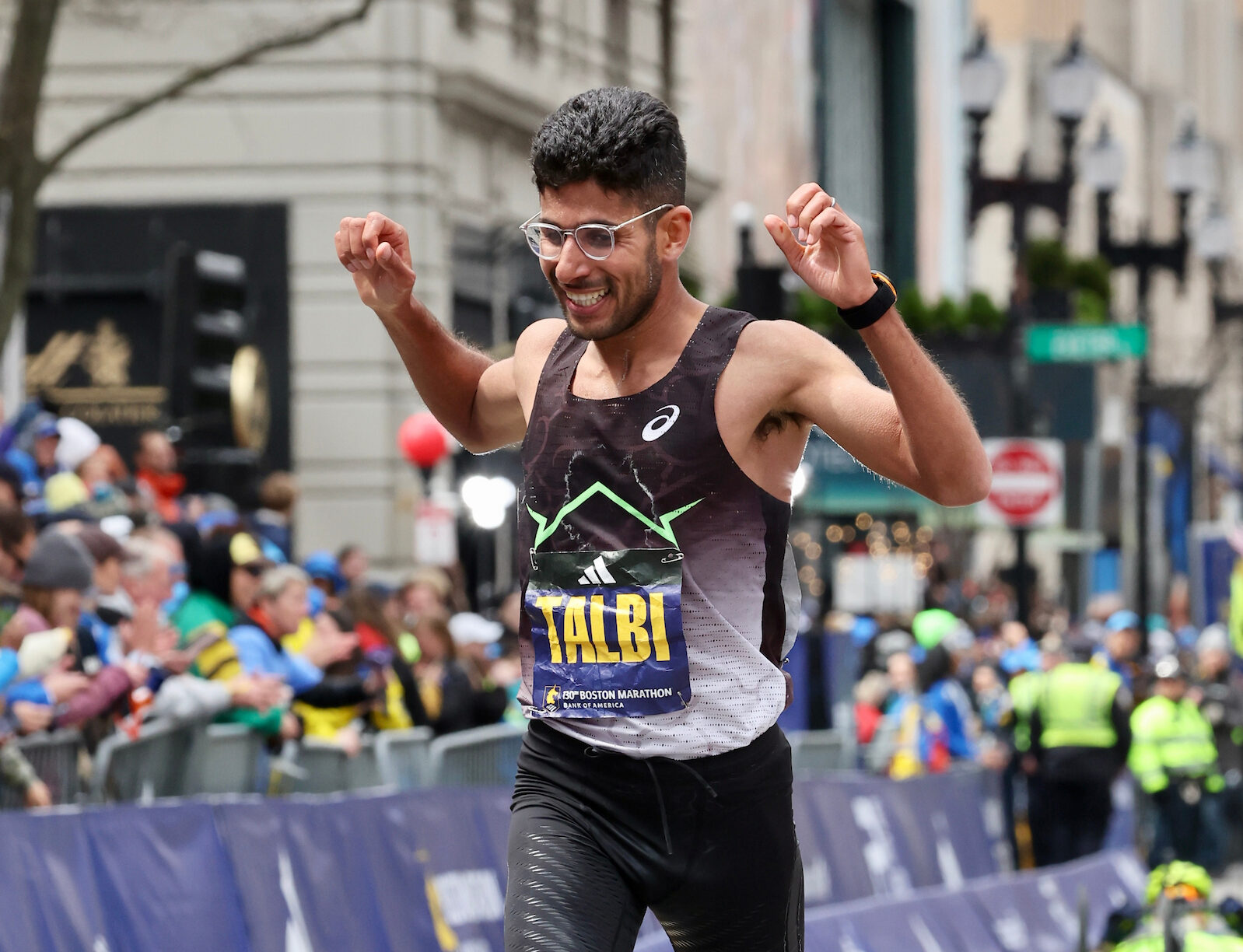 Zouhair Talbi ran the marathon faster than any American ever (Kevin Morris photo)
Korir has a lot to celebrate after one of the most incredible performances in Boston history. Over the decades, runners have won the Boston Marathon by going out hard, by attacking the uphills in Newton, or by pushing the downhills in Brookline.
Korir chose d) all of the above. His halfway split of 61:50 was eight seconds faster than Mutai’s split during his record run. He ran that blazing 4:42 mile up Heartbreak. He split 28:10 for the 10k segment from 30k to 40k. Then he picked it up, covering the final 2.195k from 40k to the finish in 6:04 — the second-fastest close for that segment in marathon history. It all added up to an unreal 60:02 split for Boston’s famously challenging second half.
Mutai’s course record, which had stood for 15 years, the longest in race history and 11 years longer than the current CR at any other World Marathon Major, was blown to smithereens. Runner-up Alphonce Felix Simbu (2:02:47), the world champion from Tanzania, and third-placer Benson Kipruto (2:02:50) were both under the old record as well, and the top seven men all ran under Korir’s 2:04:45 winning time from 2025, which was the second-fastest winning time in Boston history before today.
Analysis below results.
2026 Boston Marathon Men’s Results
| Place | First | Last | Country | Time |
|---|---|---|---|---|
| 1 | John | Korir | 🇰🇪 Kenya | 2:01:52 |
| 2 | Alphonce Felix | Simbu | 🇹🇿 Tanzania | 2:02:47 |
| 3 | Benson | Kipruto | 🇰🇪 Kenya | 2:02:50 |
| 4 | Hailemaryam | Kiros | 🇪🇹 Ethiopia | 2:03:42 |
| 5 | Zouhair | Talbi | 🇺🇸 USA* | 2:03:45 |
| 6 | Tebello | Ramakongoana | 🇱🇸 Lesotho | 2:04:18 |
| 7 | Charles | Hicks | 🇺🇸 USA* | 2:04:35 |
| 8 | Richard | Ringer | 🇩🇪 Germany | 2:04:47 |
| 9 | Alex | Masai | 🇰🇪 Kenya | 2:05:32 |
| 10 | Milkesa | Mengesha | 🇪🇹 Ethiopia | 2:05:35 |
| 11 | Clayton | Young | 🇺🇸 USA | 2:05:41 |
| 12 | Ryan | Ford | 🇺🇸 USA | 2:05:46 |
| 13 | Joe | Klecker | 🇺🇸 USA | 2:05:56 |
| 14 | Rory | Linkletter | 🇨🇦 Canada | 2:06:04 |
| 15 | Yemane | Haileselassie | 🇪🇷 Eritrea | 2:06:06 |
| 16 | Nicholas | Kipkorir | 🇰🇪 Kenya | 2:06:07 |
| 17 | Hendrik | Pfeiffer | 🇩🇪 Germany | 2:06:34 |
| 18 | Sondre | Moen | 🇳🇴 Norway | 2:06:52 |
| 19 | Haftu | Knight | 🇺🇸 USA | 2:07:38 |
| 20 | Wesley | Kiptoo | 🇺🇸 USA | 2:07:55 |
| 21 | Abdi | Nageeye | 🇳🇱 Netherlands | 2:08:13 |
| 22 | Galen | Rupp | 🇺🇸 USA | 2:08:15 |
| 23 | Murphy | Smith | 🇺🇸 USA | 2:08:58 |
| 24 | Robert | Miranda | 🇺🇸 USA | 2:09:40 |
| 25 | Tsegay | Weldlibanos | 🇪🇷 Eritrea | 2:09:44 |
| 26 | Jacob | Thomson | 🇺🇸 USA | 2:09:51 |
| 27 | CJ | Albertson | 🇺🇸 USA | 2:09:59 |
| 28 | Patrick | Tiernan | 🇦🇺 Australia | 2:09:59 |
| 29 | Turner | Wiley | 🇺🇸 USA | 2:10:16 |
| 30 | Ryan | Johnson | 🇺🇸 USA | 2:10:20 |
* American citizens not yet eligible to represent USA internationally
Tracking and results info here.
Talbi & Hicks run faster than any American ever
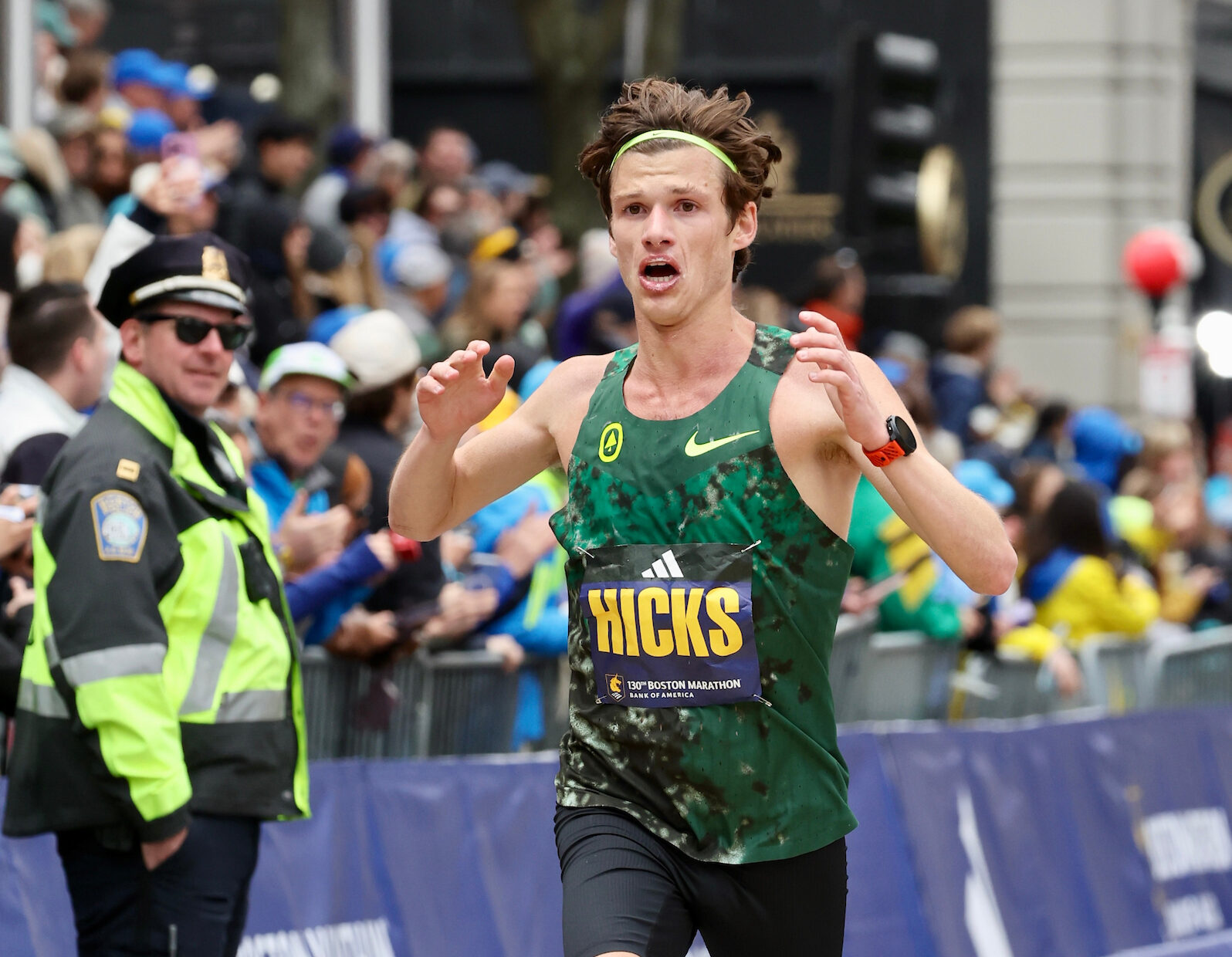 Charles Hicks was excited at the finish (Kevin Morris photo)
Zouhair Talbi, who finished 5th in 2:03:45, and Charles Hicks, who finished 7th in 2:04:35, ran the two fastest marathons ever by American citizens. Both Talbi, who was born in Morocco and became a U.S. citizen in 2025, and Hicks, who was born in England to American parents, are in the process of changing allegiance from their birth countries to the U.S. Talbi will become eligible to represent the U.S. in August 2027, Hicks in July 2026, which means neither would not have been able to set the American record today — but that is academic, since Boston’s point-to-point course is not record-eligible. In all, five Americans broke 2:06 on the day as Clayton Young (11th in 2:05:41), Ryan Ford (12th in 2:05:46), and Joe Klecker (13th in 2:05:56) joined the parade of fast times. Some feat, considering only four Americans had ever broken 2:06, on any course, before today.
The times this year were out of this world
Because of the lack of pacers and the uphills in its second half, the Boston course is regarded as one of the slower major marathon courses. But Boston’s course also features a net elevation loss of around 460 feet, and its point-to-point nature — it runs east or northeast the entire way — means that it can produce some very fast times under the right conditions.
Roughly once in a generation, everything comes together and the leaderboard explodes with personal bests. It happened in 1994, when Cosmas Ndeti ran 2:07:15, missing the world record by 25 seconds and leading 11 men under 2:10. It happened in 2011, when Geoffrey Mutai (2:03:02) and Moses Mosop (2:03:06) both ran almost a minute under the world record and Ryan Hall ran 2:04:58, which remained the fastest marathon by an American on any course until last year.
Now we can add 2026 to the list. The tailwind was not as beneficial as those in 1994 or 2011, both of which reached around 20 miles per hour. But the steady 9 mph tailwind on Monday encouraged the top men to get after it and resulted in a race of unparalleled depth in Boston. More men broke 2:06 in Boston on Monday (13) than in the previous 129 years of Boston Marathons combined (11). That stat is also true for sub-2:05s (8), sub-2:04s (5), and sub-2:03s (3).
| 2026 | Every prior Boston Marathon | |
| Sub-2:03s | 3 | 0 |
| Sub-2:04s | 5 | 2 |
| Sub-2:05s | 8 | 5 |
| Sub-2:06s | 13 | 11 |
So if you were in Boston today and took advantage on a good day, congratulations. If you didn’t, you may have to wait a while for another opportunity like this.
After the race, we caught up with former American Boston course record holder Ryan Hall, and he was very complimentary of the guys who ran fast today, saying, “I feel like we had a way bigger tailwind than they had today. I mean, look at the flags, they’re hardly moving. So I don’t know, there must have been like a wind tunnel going down the course. People were rolling quick. It was super fun to watch. Unbelievable times today.”
Speaking of flags, Robert Johnson was in the lead men’s vehicle and took some videos of flags along the course.
*The start. *Mile 11 *At the finish
John Korir just keeps getting better
John Korir almost gave up on himself early in his marathon career. After debuting in 2:09:14 in Ottawa in 2018, Korir fell out with his older brother — and 2012 Boston champ Wesley — and his coach Ron Mann. He stopped talking to Wesley. Then, at age 23 in 2020, he stopped running and started driving tractors instead.
Eventually, Korir reconciled with his brother and with Mann. And now the headstrong young man has developed into one of the greatest marathoners in the world. Korir announced himself by running 2:02:43 to win Chicago in 2024, and since then, he has won Boston (2:04:45 in 2025), Valencia (2:02:24 in 2025), and now Boston again. His only defeat in his last five marathons came last year in Chicago, where he dropped out after making an ill-advised surge against Jacob Kiplimo.
We caught up with Korir’s coach Ron Mann afterward and asked him if he was shocked by the finishing time or the 60:02 second half.
“No. Not at all,” coach Mann said exclusively to LetsRun.com after the race. “He has the strength. I told you about the strength that he has now. I mean, the amount of mileage and the volume that he’s been running, it didn’t surprise me at all.”
“We knew he was capable. And, you know, today turned out being a beautiful day.”
Mann said the key to Korir moving from an okay pro (one win in his first 8 marathons, no times faster than 2:05:04) to one of the world’s best (4 wins in the last 1.5 years, with 3 of those under 2:03 and the slowest time being his 2:04:45 win last year in Boston) is simple: patience and mileage.
“He wasn’t strong enough. I mean, when we got him, he was running 70 miles a week, and now he’s running 160. So, you know, you don’t do it quick because if you do it quick, you break him,” said Mann. “You know, specific adaptation to imposed demand — you put too much demand on too quickly and you get broken.”
Is Korir the best marathoner in the world? Let’s wait until the end of this week
Korir’s time of 2:01:52 makes him just the fifth man in history to break 2:02, but this was one of the best performances in Boston history, not just because of Korir’s time, but because of how he did it. He won by 55 seconds over a field that included the reigning world champion (Alphonce Felix Simbu) and the reigning NYC champion (2021 Boston champ Benson Kipruto), and that entire gap came from 30k to the finish. Against some of the top marathoners on the planet, Korir was on a different level.
Does that mean he is World #1? That’s always a tough question, especially since the two other contenders for that title — Sabastian Sawe and Jacob Kiplimo — are racing in London on Sunday. Sawe has won all three of his marathons and may have broken the world record last year in Berlin if the weather had cooperated. And Kiplimo beat Korir head-to-head in Chicago last fall after finishing second behind Sawe in his debut last year. If one of those guys does something incredible in London on Sunday, he will have a strong case as World #1 as well.
What is not up for debate is that Korir is an incredible marathon talent who has shown he can excel on both fast courses like Chicago and Valencia and the hills of Boston. With the decline of Eliud Kipchoge and the death of Kelvin Kiptum, there was a void at the top of the marathon ranks in 2024, but over the last two years, Korir, Sawe, and Kiplimo have all risen up to fill it.
As for that loss for Korir last year in Chicago, it had perplexed us. He went out on world-record pace, then picked it up, but didn’t even make it to the 30k split. How could one of the world’s best runners have misjudged his pace so badly?
A source told us today that Korir was greatly impacted by serious stomach issues that caused him to drop out.
Dathan Ritzenhein’s pre-race instructions to his two OAC runners were simple: go for it
“People don’t really die like they used to, so we’ve got to go with the lead pack no matter what.”
That was what coach Dathan Ritzenhein told his OAC runners ahead of Monday’s race.
Now Ritzenhein (2:07:47 marathon pb) no longer has the best marathon pb among the OAC Boulder runners, as Ryan Ford, who ran 2:08:00 for 10th last year, ran 2:05:46 for 12th, and Joe Klecker, who ran 2:10:37 in NYC, ran 2:05:56 for 13th.
Ritz instructed them before the race to be aggressive, they did exactly that, and were rewarded with some fast times. Ford was the more aggressive of the two, as he stayed with the lead pack past 25k, whereas Klecker maintained contact through 15k.
*Post-race athlete interviews from Boston
- Boston Talk: Official 2026 Boston Marathon LIVE Thread
- 2:03. Zouhair Overtakes Mantz as Top American
- Charles Hicks 2:04:35 under previous American Record held by Connor Mantz in his second marathon.
- John MF Korir: I think he could have gone sub 2 today – 60:02 2nd half!!! 2:01:52 FTW!!!
- Joe Klecker 2:05.56
- Can we stop talking about how fast everyone ran today
- Jess McClain was out of the sport and now she’s the fastest American ever in Boston