St. Louis awarded 2028 US Olympic Marathon Trials
St. Louis previously hosted the women's Trials in 2004 and the Olympic marathon in 1904
By Jonathan GaultUSATF announced on Thursday that St. Louis will host the 2028 US Olympic Marathon Trials. The event will select the US Olympic marathon team for the 2028 Olympics in Los Angeles, the first Summer Olympics on US soil in 32 years.
St. Louis beat out Phoenix, the only other city to bid for the right to host. Race organizers said the course will run past the Gateway Arch and will finish inside 22,000-seat Energizer Park, the home of MLS team St. Louis City SC.
The Olympic Marathon Trials will be held on March 25, 2028, with the event broadcast live on NBC starting at 12 p.m. ET (11 a.m. local). March 25 is the latest Trials date since 2008, when the women’s Trials were held in Boston on April 20 (the men’s and women’s Trials were staged as separate events until 2012). In 2028, there will be an 18-week gap between the Trials and the Olympic marathons, which will be held July 29 and 30.
The St. Louis Sports Commission and GO! St. Louis, a local event production organization that stages the Greater St. Louis Marathon (1,400 finishers in 2026), will organize the race. St. Louis previously hosted the women’s Olympic Marathon Trials in 2004.
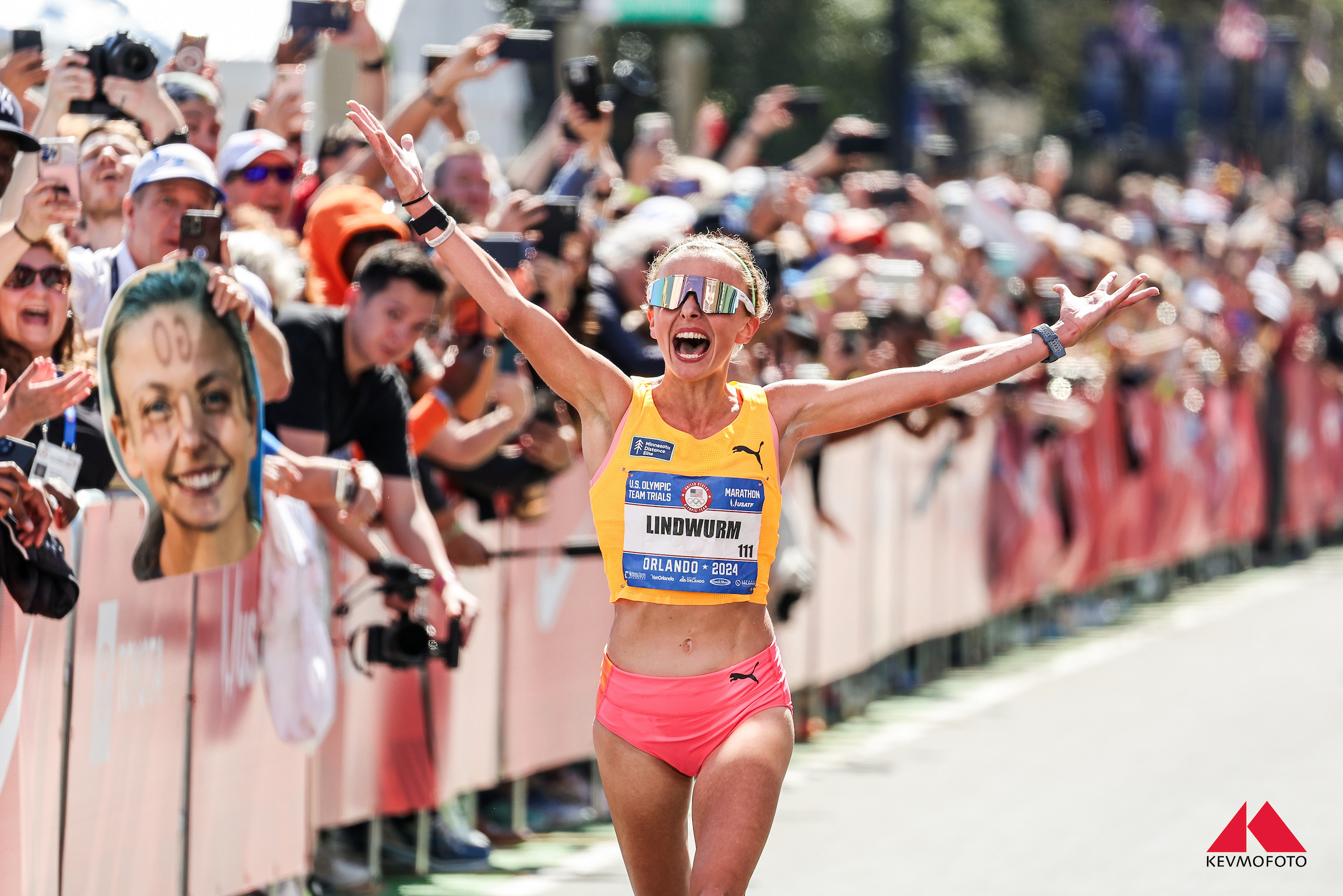 Dakotah Lindwurm was the third member of Team USA at the 2024 Trials in Orlando (Kevin Morris photo)
Below, three thoughts on the announcement.
1) Conditions should be good for racing (but not for replicating the conditions of the Olympic marathon), though the course is likely to be too hilly for standard chasing
Weather isn’t the only – or even a primary – factor in determining an Olympic Trials site, but it can have a big impact on the race itself. For 2028, USATF had the choice between Phoenix, which offered warmer temps in late March that would closely mirror those of the Olympic Marathon in Los Angeles, or St. Louis, which typically has cooler temperatures that might allow athletes to run faster. Now we know the Trials will be going to St. Louis.
From 2016-25, the average temperature in LA on July 29-30 was 68 degrees at 7:15 a.m. (when the Olympic marathons are scheduled to start) and 75 degrees at 9:30, around when we’d expect the races to finish.
Average weather over the last 10 years in St. Louis on March 25 is significantly cooler than that. USATF said the NBC broadcast will start at 11 a.m. CT, so let’s assume the race will take place roughly in the 11 a.m. – 1 p.m. window. Only once in the last decade has the temperature risen above 65 degrees during that span – though that was this past year.
Average temperatures in St. Louis on March 25 from 2017-26
| Year | 11 a.m. | 1 p.m. |
| 2017 | 61 | 62 |
| 2018 | 42 | 44 |
| 2019 | 44 | 46 |
| 2020 | 49 | 54 |
| 2021 | 54 | 57 |
| 2022 | 46 | 54 |
| 2023 | 47 | 51 |
| 2024 | 62 | 65 |
| 2025 | 54 | 61 |
| 2026 | 63 | 73 |
| Average | 52.2 | 56.7 |
Most of those days offer good conditions for racing, though don’t expect super fast times. Organizers have tried to design a fast course, but St. Louis is a fairly hilly city. The course will feature a net downhill of 140 feet over the first eight miles, but the runners will also make a 70-foot climb three times during the loop portion of the course and said the final two miles will be challenging.
All of that is to say that if three Americans don’t have the Olympic standard by the date of the Trials, it is unlikely anyone will achieve it on the day – at least on the men’s side.
Speaking of the standard…
2) We’re still waiting on the 2028 Olympic standards
The hope for everyone is that the top three finishers at the 2028 Trials will be selected to the Olympic team on the day of the race. But with World Athletics making the standards harder and harder during each qualification cycle, we may not have that kind of certainty.
In 2024, only two American men – Conner Mantz and Clayton Young – hit the auto standard during the qualification window. That led to an awkward situation where Mantz and Young had “unlocked” two places in the Olympic marathon for Team USA – places that could be taken from other athletes who didn’t have the standard if they beat Mantz and Young at the Trials in Orlando. Some, including the pair’s coach Ed Eyestone, felt that system was unfair since the US wouldn’t have had any auto spots without Mantz and Young running the time. In the end, Mantz and Young went 1-2 at the Trials anyway.
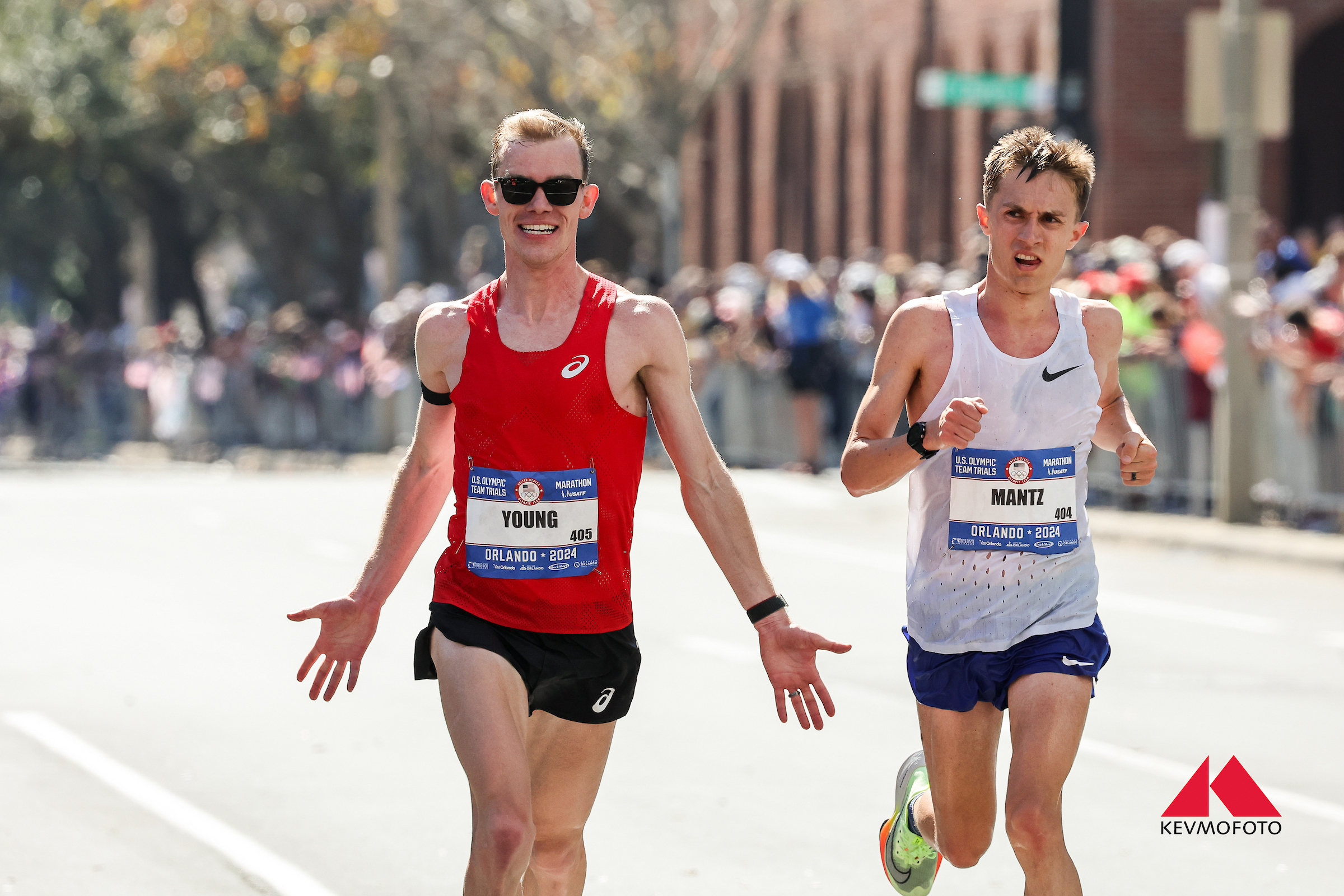 Mantz and Young helped avoid an awkward situation by going 1-2 at the Trials in 2024 (Kevin Morris photo)
But the third placer at the Trials, Leonard Korir, did not have the Olympic standard and had to wait four months to hear his fate. He ultimately got to go to the Olympics via world ranking (technically, USATF earned the spot thanks to CJ Albertson’s world ranking), but only after USATF and other federations successfully lobbied World Athletics to expand the Olympic marathon field.
All of that happened when the Olympic standard was 2:08:10. World Athletics has yet to announce the 2028 standard, but it is likely to be much faster. The auto standards for the 2027 World Championships are 2:06:00 for the men and 2:23:20 for the women – and those are for races with 100 athletes in the field for each sex (the target size for the 2024 Olympic was 80). For 2024, all top-5 finishers at World Athletics Platinum Label Marathons were also granted the standard, a provision that is expected to stay in place for 2028.
Only four American men have ever broken 2:06:00 on a record-eligible course, while 14 women have broken 2:23:20.
The good news is that American marathoners have been getting faster recently. Three of the four sub-2:06’s have come in the last 12 months: Conner Mantz’s 2:04:43 American record in Chicago, Zouhair Talbi’s 2:05:45 in Houston, and Vinny Mauri’s 2:05:54 in Toledo*. Plus, if the standard is super fast, more athletes will be able to qualify via world ranking.
*Toledo meets World Athletics’ elevation requirements but does not appear in World Athletics’ list of certified marathon courses
The 2028 Olympic qualifying window is expected to open this fall (for the 2024 cycle, it opened on November 1, 2022).
3) Get ready to hear a lot about the insane 1904 Olympic marathon
In the press release announcing St. Louis as the site of the 2028 Trials, organizers made several references to St. Louis’s status as the first US city to host an Olympic Games – and an Olympic marathon – in 1904. They didn’t mention that the 1904 Olympic marathon was one of the craziest, most dangerous races in the history of the sport.
A few notable aspects of that race:
- The race distance was a little shy of 25 miles (the official marathon distance of 26 miles, 385 yards was not standardized until the next Olympics).
- It started at 3 p.m. on a day when temperatures cracked 90 degrees Fahrenheit. Much of the course was run on dusty roads, with the lead vehicles kicking up dust clouds behind them, making breathing more difficult. The winning time was 3:28.53, and only 14 of the 32 starters finished the race.
- The race organizer, James E. Sullivan, believed in “purposeful dehydration” – he thought taking on fluids during the race would upset the stomach. So there was little water available in the sweltering conditions – just one aid station at halfway.
- Frederick Lorz, the first man across the finish line, had actually dropped out at nine miles. He got a ride back into town in a car, but after the car broke down, he rejoined the race and was greeted as the champion before admitting he had cheated after being confronted by officials.
- Andarin Carvajal of Cuba may have been the most colorful character of all. Just read the section about him on the race’s Wikipedia entry:
After losing all of his money gambling in New Orleans, he hitchhiked to St. Louis and had to run the event in street clothes that he cut around the legs to make them into shorts. Not having eaten in 40 hours, he saw a spectator eating two peaches. He asked if he could have the peaches, and the spectator declined. He then stole both peaches and ran away. Later, he stopped off in an orchard en route to eat some apples, which turned out to be rotten. The rotten apples caused him to have strong stomach cramps, and he had to lie down and take a nap. Despite his discomfort and the pause, Carvajal still managed to finish in fourth place.
- The winner, American Thomas Hicks, was struggling late in the race when he was fed a combination of brandy, egg whites, and strychnine by his trainers in an attempt to revitalize him. Strychnine – rat poison – was also used as a stimulant at the time, and though he covered the final miles in a daze and his trainers carried him across the line, he was declared the champion.
And the 1904 race did have one lasting effect on the sport: Hicks’ use of strychnine resulted in the IOC adopting its first anti-doping policy. The following was added to the competition rules ahead of the 1908 Olympic marathon in London: “No competitor, either at the start or during, may take or receive any drug. The breach of this rule will operate as a disqualification.”
Given the utter chaos that unfolded in St. Louis, it is a small miracle that the IOC decided to keep the marathon in the Olympic program at all. Fortunately for all of us, they did.
Talk about the decision on the letsrun.com messageboard / fan forum: St. Louis awarded 2028 US Olympic Marathon Trials.