2025 NCAA Indoors Women’s Preview: Juliette Whittaker & Doris Lemngole Lead Deep Fields
With a sub-2:02 800 and sub-4:30 mile required just to qualify for the meet, the women's middle-distance events should be incredible
By Jonathan Gault
Yesterday, we previewed the men’s distance events at NCAA indoors. Now it’s time to look at the women’s events. And just like on the men’s side, there is a ton of young talent in these races. The women’s 800 features three NCAA champions in Juliette Whittaker, Roisin Willis, and Michaela Rose. The women’s mile is led by collegiate record holder Silan Ayyildiz of Oregon (4:23.46) and nine other women who have broken 4:27 this year. In the women’s 5,000, can anyone challenge the Kenyan duo of Doris Lemngole and Hilda Olemomoi, both of whom have run 14:52 this season?
We break down every women’s distance event below, in the order that they occur, then finish the preview with a look at the sprints and team competition.
Here is our men’s preview if you missed it: LRC 2025 NCAA Indoors Men’s Preview: Ethan Strand, Gary Martin, Nathan Green & More Go for Glory
*Schedule, entries & results *TV & Streaming *All LRC 2025 NCAA Indoor coverage
Women’s 5,000m (Friday, 4:42 p.m. ET): Does Lemngole keep rolling?
  1  Doris Lemngole                SO Alabama            14:52.57
  2  Hilda Olemomoi                JR Florida            14:52.84
  3  Lexy Halladay-Lowry           SR BYU                14:57.63
  4  Pamela Kosgei                 FR New Mexico         15:00.36
  5  Amy Bunnage                   SO Stanford           15:00.75
  6  Paityn Noe                    FR Arkansas           15:11.27
  7  Grace Hartman                 SO NC State           15:12.73
  8  Lucy Jenks                    SR Georgetown         15:15.58
  9  Elise Stearns                 SR Northern Ari       15:21.43
 10  Alex Millard                  SR Providence         15:22.71
 11  Chloe Scrimgeour              JR Georgetown         15:22.85
 12  Siona Chisholm                JR Notre Dame         15:23.37
 13  Florence Caron                SR Penn State         15:25.83
 14  Sophia Kennedy                SO Stanford           15:26.14
 15  Ali Upshaw                    SR Northern Ari       15:27.86
 16  Jadyn Keeler                  JR North Dakota       15:28.29
 Kevin Morris photo
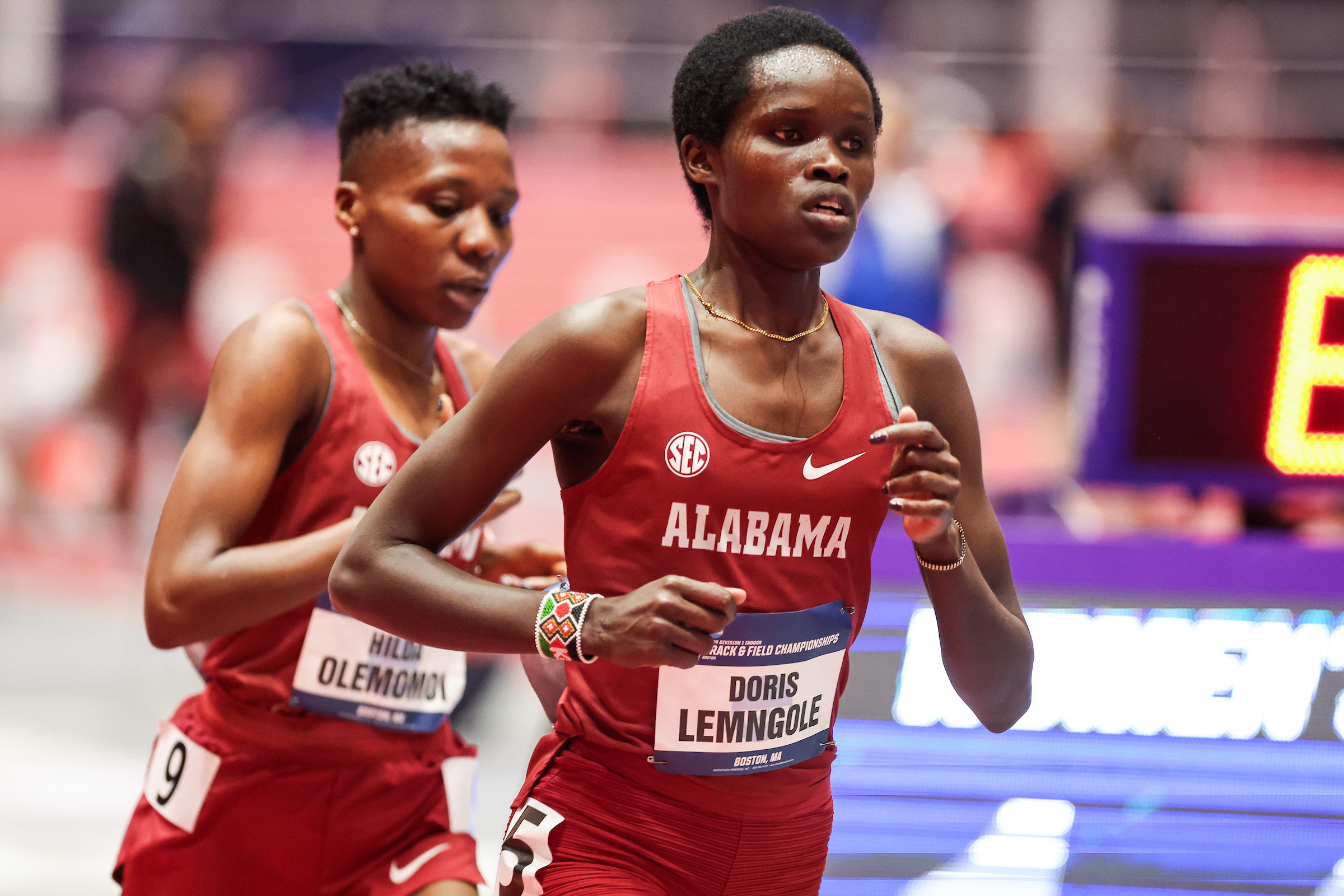
Alabama’s Doris Lemngole won the NCAA cross country title in November, and everything she has done since then says she should be the favorite for this race. Two weeks after NCAA XC, she ran 14:52.57 in Boston to break Parker Valby‘s collegiate indoor record. She returned to Boston in February to run a 3k pb of 8:41 at the Valentine Invite (first among collegians), and she convincingly beat one of her biggest rivals, Florida’s Hilda Olemomoi, by more than two seconds in the 3k at SECs thanks to a killer 28-second last lap (her winning time was 8:55).
Across indoor, outdoor, and XC, Olemomoi has finished in the top 6 in all 10 of her NCAA finals but has never won one. And a two-second deficit is hard to turn around in two weeks. Once again, she may end up just short of the title.
The best bet to upset Lemngole is either BYU’s Lexy Halladay-Lowry or New Mexico’s Pamela Kosgei (in part because, unlike Olemomoi, Lemngole hasn’t beaten them recently). Halladay-Lowry was 5th in this race last year, three seconds behind Lemngole, but since then hasn’t had a real chance to show what she can do at NCAAs. Outdoors, she ran 15:02 in the 5k and 9:22 in the steeple (which would rank #4 in NCAA history) but didn’t run NCAAs because she was redshirting. She did run NCAA XC, finishing 14th, but did so at less than 100%, battling back an injury to lead BYU to the team title. This winter, she has run pbs of 14:57 in the 5k (#4 in NCAA history) and 8:40 in the 3k (#3 in NCAA history and #1 in the NCAA this year). She’s definitely fitter than she was in November, but is that fitness enough to challenge Lemngole?
It’s also worth noting just how much more competitive the NCAA is than last year. In 2024, Valby entered NCAAs with a 14:56 seed time, which made her an overwhelming favorite — and she won the title by more than 22 seconds. In 2025, Halladay-Lowry’s 14:57 seed time is just one second slower than Valby’s, yet she is only ranked third in the field.
Kosgei is the other woman to keep an eye on. As the younger sister of former marathon WR holder Brigid Kosgei and a medalist in the U20 race at World XC in 2023, she is a huge talent, and she is coming off a mile-3k-5k triple at the Mountain West Championships. Though Lemngole did beat Kosgei by 7 seconds in the 5k the last time they raced in Boston in December.
JG prediction: Lemngole, who set the collegiate record in the NCAA steeple final in June and won NCAA XC in November, is a proven championship performer and has been in great shape this winter. I can’t pick against her, though I do think Halladay-Lowry has real upset potential.
Who wins the NCAA women's 5000?
-
%
Women’s distance medley relay (Friday, 5:20 p.m. ET): BYU tries to repeat
  1  BYU                                                 10:37.58
     1) Carmen Alder SR                 2) Meghan Hunter SR
     3) Tessa Buswell FR                4) Riley Chamberlain JR
     5) Carlee Hansen JR                6) Kylie Olsen SO
     7) Sami Oblad SR                   8)
  2  Stanford                                            10:38.93
     1) Juliette Whittaker JR           2) Cate Peters SO
     3) Roisin Willis JR                4) Amy Bunnage SO
     5) Zofia Dudek JR                  6) Sage Hinton SO
     7) Amelia Everett SO               8) Audrey Suarez JR
  3  Northern Arizona                                    10:39.44
     1) Agnes McTighe JR                2) Kyairra Reigh SR
     3) Alex Carlson SR                 4) Maggi Congdon SR
     5) Karrie Baloga SO                6) Kiki Vaughn FR
     7) LiNay Perry SR                  8)
  4  Washington                                          10:40.44
     1) Chloe Foerster JR               2) Anna Terrell SO
     3) Claire Yerby SR                 4) Amina Maatoug SR
     5) Mia Cochran JR                  6) Julia David-Smith JR
     7) Maggie Liebich SR               8)
  5  Oregon                                              10:42.05
     1) Julia Nielsen SR                2) Moriah Oliveira SR
     3) Mia Barnett SR                  4) Silan Ayyildiz JR
     5) Ali Ince FR                     6) Ella Nelson JR
     7) Klaudia Kazimierska SR          8) Ella Clayton SR
  6  Utah                                                10:42.56
     1) Brianna Rinn JR                 2) Emily Martin JR
     3) Kyla Martin SO                  4) Erin Vringer SO
     5) Madison Hulsey JR               6) Mckaylie Caesar SR
     7) Millie Wilcox JR                8)
  7  North Carolina                                      10:44.71
     1) Makayla Paige SR                2) Delea Martins SO
     3) Ella Auderset JR                4) Taryn Parks SR
     5) Alyssa Hernandez SR             6) Reese Dalton FR
     7) Brynn Brown JR                  8) Harley McNeal FR
  8  Georgetown                                          10:47.20
     1) Charlotte Tomkinson JR          2) Rebecca Ochan SR
     3) Charlotte Bell FR               4) Melissa Riggins SR
     5) Almi Nerurkar JR                6) Abbie Huey SO
     7) Angeline Caamano JR             8) Olivia Morganti SR
  9  Harvard                                             10:47.92
     1) Sophia Gorriaran SO             2) Chloe Fair JR
     3) Victoria Bossong SR             4) Penelope Salmon SO
     5) Kaelin Creagh FR                6) Samira Kennedy SO
     7) Ellaney Matarese SR             8) Marianne Mihas SR
 10  NC State                                            10:48.51
     1) Hannah Gapes FR                 2) Jordyn Parker SO
     3) Brooke Rauber JR                4) Grace Hartman SO
     5) Shaune Ingraham FR              6) Kate Putman SO
     7) Angelina Napoleon SO            8)
 11  LSU                                                 10:50.15
     1) Callie Hardy SR                 2) Ella Onojuvwevwo JR
     3) Michaela Rose SR                4) Lorena Rangel Batres SR
     5) Garriel White SR                6) Nasya Williams FR
     7) Edna Chepkemoi FR               8) Natalie Venkataraman FR
 12  Providence                                          10:51.88
     1) Shannon Flockhart SR            2) Jillian Fenerty JR
     3) Maeve O'Neill SO                4) Kimberley May SR
     5) Cara Laverty SO                 6) Chloe Higgins FR
     7) Kiera Hall SO                   8)
 Chamberlain anchored BYU to victory in Boston last year (Kevin Morris photo)
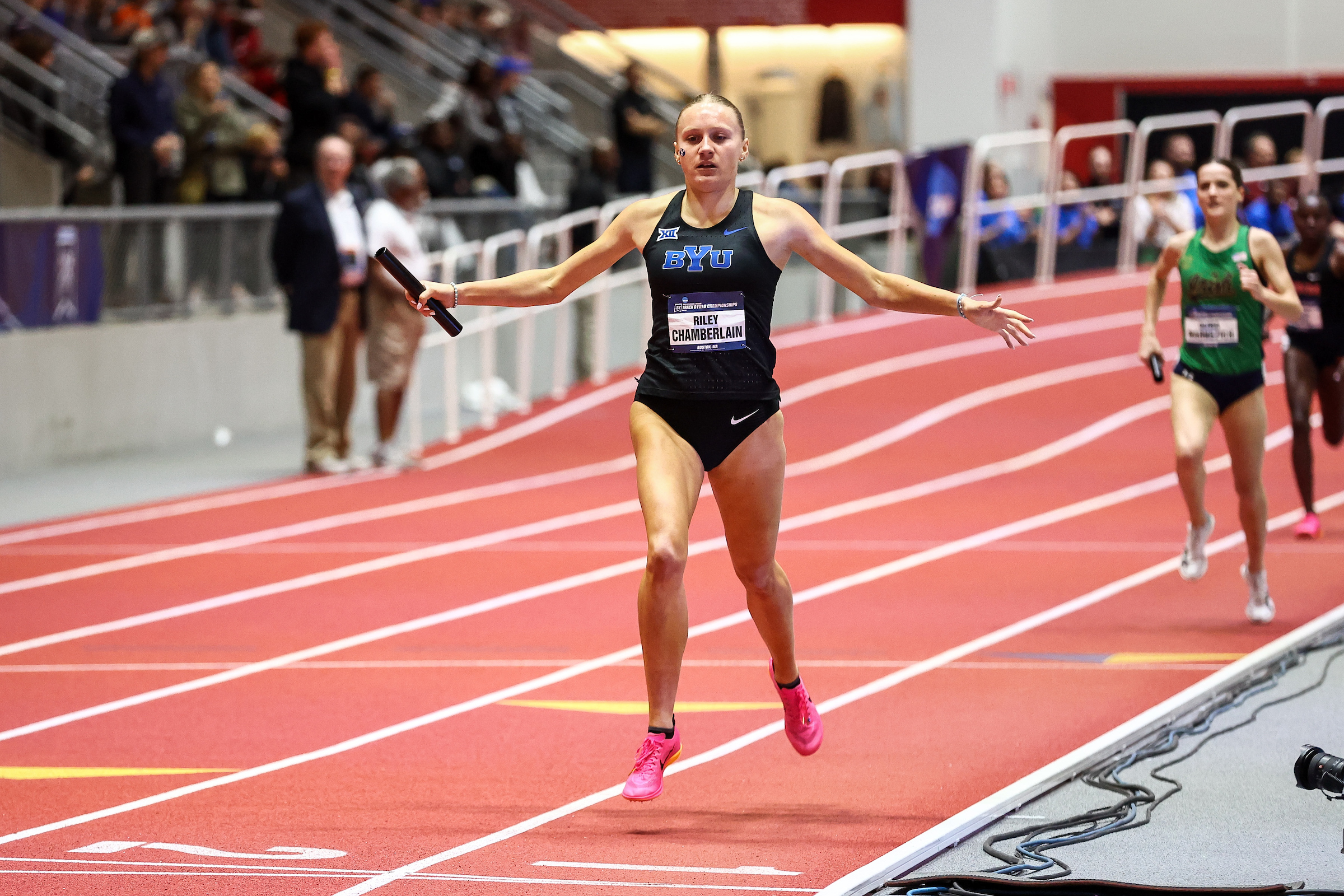
BYU has already made some history this season by running 10:37.58 to slash more than five seconds off the 10:43.39 collegiate record set by Washington last year (which in turn was a 3-second improvement on Washington’s own CR from 2023). The Cougars can make some more in Virginia Beach this weekend. If BYU wins on Friday, they’ll be the first women’s team to repeat in the DMR since Oregon in 2018-19. They’ll also become just the fourth team to win the XC team title and the DMR in the same academic year; Villanova did it in 1994-95 and 2010-11, and BYU most recently did it in 2020-21 (with two entirely different sets of athletes).
But, as has become the norm in the NCAA, a crazy fast time is no guarantee of a title. The previous three teams to set the collegiate record in this event — Oregon in 2017, Washington in 2023 and 2024 — failed to win the NCAA title. And BYU has serious competition considering the six fastest times in NCAA history have all been run in 2025 (five of them in the February 15 race in Seattle where BYU set the record).
BYU has one advantage over many of the top seeds in that their best miler, Riley Chamberlain (who split 4:24 during the record run), is available to anchor the team fresh, just as she did last year. That is not the case for the next four teams on the seed list:
Stanford (10:38.93)
Their anchor from their qualifying squad, Amy Bunnage, is running the 5k so won’t be in the DMR this weekend. And their mid-d superstars Roisin Willis and Juliette Whittaker are both entered in the 800. That said, Stanford did win the DMR two years ago with Whittaker on anchor after Willis and Whittaker both doubled back from the 800 prelims.
Northern Arizona (10:39.44)
NAU has a great anchor in Maggi Congdon, who ran 4:02 for 1500 at the Olympic Trials last year, but Congdon is entered in the mile at NCAAs. And NAU’s other sub-4:30 miler, Alex Carlson, is also entered in the mile.
Washington (10:40.44)
Washington has two 4:26 milers in Amina Maatoug and Chloe Foerster, but both are entered in the mile (and Maatoug is entered in the 3k as well). Washington also has 4:00 1500 runner Sophie O’Sullivan on its roster, but she has been in Australia this winter and won’t rejoin the team until the spring season.
Oregon (10:42.05)
Silan Ayyildiz (4:23 sb), Wilma Nielsen (4:25 sb), and Mia Barnett (4:28 sb) are all running the mile. And Ayyildiz is also entered in the 3k, which makes it unlikely she adds the DMR as well. The Ducks have a potential ace in the hole with 3:59 1500m woman Klaudia Kazimierska, but she hasn’t raced all season so it’s anyone’s guess what kind of shape she is in.
Providence is a potential dark horse. The Friars are very weak on the 400 leg (their best 400 this season is 56.45) and as a result just snuck into the field as the last entrant. But they have NCAA 1500 6th placer Shannon Flockhart to run the 1200 leg, a fresh 2:04 woman for the 800 (Maeve O’Neill) and a fresh NCAA 1500 runner-up Kimberley May to anchor.
JG prediction: Stanford and Oregon’s teams are so good that even if one (or more) of their athletes are doubling back, they could still win it all — particularly if Oregon’s Kazimierska is in shape. But BYU has the fastest time in NCAA history and should have fresh women on the 1200 (where 4:33 woman Carlee Hansen can sub in) and 1600 legs (Chamberlain). I feel more confident in them than any of the other teams — Cougars FTW.
Who wins the NCAA women's DMR?
-
%
Women’s mile (final Saturday, 3:00 p.m. ET): A deep, wide-open race
  1  Silan Ayyildiz                JR Oregon              4:23.46
  2  Melissa Riggins               SR Georgetown          4:24.98
  3  Margot Appleton               SR Virginia            4:25.03
  4  Laura Pellicoro               SR Portland            4:25.60
  5  Wilma Nielsen                 JR Oregon              4:25.78
  6  Judy Kosgei                   SO Clemson             4:26.32
  7  Amina Maatoug                 SR Washington          4:26.39
  8  Chloe Foerster                JR Washington          4:26.54
  9  Lorena Rangel Batres          SR LSU                 4:26.56
 10  Bethan Morley                 JR Florida             4:26.76
 11  Alex Carlson                  SR Northern Ari        4:27.20
 12  Maggi Congdon                 SR Northern Ari        4:27.77
 13  Vera Sjoberg                  JR Boston Unive        4:28.12
 14  Mena Scatchard                SR Princeton           4:28.43
 15  Mia Barnett                   SR Oregon              4:28.77
 16  Carmen Alder                  SR BYU                 4:29.49
As we noted when the entries were announced, the women’s mile has total exploded at the collegiate level in 2025. For the first time in history, you had to break 4:30 just to qualify for NCAAs. In all, 12 women broke 4:27 this season — which is remarkable considering only five collegiate women had ever done it prior to 2025. And the collegiate record went down as well, with Silan Ayyildiz of Oregon (and Turkey) running 4:23.46 to shave almost a second off Katelyn Tuohy‘s mark.
NCAA all-time women’s mile top 10
bold = running the mile at 2025 NCAAs
| Athlete | School | Time | Year |
| Silan Ayyildiz | Oregon | 4:23.46 | 2025 |
| Katelyn Tuohy | NC State | 4:24.26 | 2023 |
| Grace Hartman | NC State | 4:24.76 | 2025 |
| Maia Ramsden | Harvard | 4:24.83 | 2024 |
| Melissa Riggins | Georgetown | 4:24.98 | 2025 |
| Margot Appleton | Virginia | 4:25.03 | 2025 |
| Laura Pellicoro | Portland | 4:25.60 | 2025 |
| Wilma Nielsen | Oregon | 4:25.78 | 2025 |
| Jenny Simpson | Colorado | 4:25.91 | 2009 |
| Riley Chamberlain | BYU | 4:26.19 | 2025 |
In all, seven of the 10 fastest women’s milers in NCAA history have run their pbs this season, though only five will contest the mile in Virginia Beach (Hartman opted for the 3k/5k while Chamberlain is running the 3k/DMR).
Good luck picking a favorite. The 25-year-old Ayyildiz, who won the 5,000 at Big 10s this year, is the fastest on paper, but her history at NCAAs is poor. In 2023, while still at the University of South Carolina, Ayyildiz went out in the prelims in the indoor mile and outdoor 1500. Last year, she went out in the prelims again in the mile and was only 16th in the 5,000. She is a lot faster now, though. Before this season, her best 1500/mile was 4:09.34. Using LRC’s favored 1.08 conversion, her 4:23.46 mile sb is worth around 4:03.94.
The most competitive conference meet this year was the ACC, a wild race where NC State’s Grace Hartman took it out in 2:10 through 809m and the top three all held on to run 4:26. Virginia’s Margot Appleton (4:26.21) held off Clemson’s Judy Kosgei (4:26.32) for the win and has to like her chances at NCAAs after surviving that gauntlet.
(If you’re wondering if that was the most competitive conference mile ever, we’d still go with the 2009 Big 12 meet where Jenny Simpson took down Sally Kipyego, 4:25.91 to 4:27.19, pre-super shoes. Upon her retirement last year, Simpson told us she still views that as one of the best races of her legendary career.)
Georgetown’s Melissa Riggins, the #2 seed, was 4th last year and handily won the 800 at Big Easts. 24-year-old Italian Laura Pellicoro of Portland has run 2:00/4:25 this year. NAU’s Maggi Congdon owns an outdoor pb of 4:02 in the 1500. Almost everyone in the field will go into this one thinking they have a chance of victory.
JG prediction: You may as well throw a dart with this one given how many women have run fast in 2025, but I’ll go with Riggins, who is the top returner from both NCAA indoors and outdoors last year (4th in both races).
Who will win the NCAA women's mile?
-
%
Women’s 800 (final Saturday, 3:30 p.m. ET): NCAA champions Whittaker, Willis, & Rose square off
  1  Juliette Whittaker            JR Stanford            1:59.44
  2  Sanu Jallow                   JR Arkansas            1:59.77
  3  Meghan Hunter                 SR BYU                 2:00.21
  4  Michaela Rose                 SR LSU                 2:00.25
  5  Makayla Paige                 SR North Caroli        2:00.57
  6  Victoria Bossong              SR Harvard             2:00.79
  7  Hayley Kitching               JR Penn State          2:01.14
  8  Star Price                    SR Virginia Tec        2:01.17
  9  Sophia Gorriaran              SO Harvard             2:01.27
 10  Roisin Willis                 JR Stanford            2:01.31
 11  Gladys Chepngetich            SO Clemson             2:01.39
 12  Gabriella Grissom             JR Miami (Fla.)        2:01.60
 13  Analisse Batista              JR Arkansas            2:01.60
 14  Tabitha Ngao                  SO TCU                 2:01.71
 15  Kaylie Politza                JR Oklahoma Sta        2:01.86
 16  Fanny Arendt                  JR Texas Tech          2:01.99
The women’s 800 at NCAAs may be even stronger than the women’s mile. No one has broken the NCAA women’s 800 record this season, but that’s because the 800 record of 1:58.40 is a lot tougher, comparatively — Athing Mu set it in 2021, five months before she won the Olympics. But Mu is the only one of the seven fastest women in collegiate history who won’t be in the field at NCAAs this weekend.
NCAA all-time women’s 800 top 10
bold = running the mile at 2025 NCAAs
| Athlete | School | Time | Year |
| Athing Mu | Texas A&M | 1:58.40 | 2021 |
| Michaela Rose | LSU | 1:59.25 | 2024 |
| Juliette Whittaker | Stanford | 1:59.44 | 2025 |
| Sanu Jallow | Arkansas | 1:59.77 | 2025 |
| Roisin Willis | Stanford | 1:59.93 | 2023 |
| Meghan Hunter | BYU | 2:00.21 | 2025 |
| Makayla Paige | North Carolina | 2:00.57 | 2025 |
| Jazmine Fray | Texas A&M | 2:00.69 | 2017 |
| Aaliyah Miller | Baylor | 2:00.69 | 2021 |
| Nia Akins | Penn | 2:00.71 | 2020 |
That group includes three NCAA champions: Stanford’s Roisin Willis (indoor 2023), LSU’s Michaela Rose (outdoor 2023), and Stanford’s Juliette Whittaker (indoor/outdoor 2024). This is a loaded field.
Whittaker, who ran 1:57 in Paris last year to make the Olympic final as a 20-year-old, is the most accomplished of the bunch. Perhaps because of her very long 2024 season (and the potential for a very long 2025 season), Whittaker began slowly this year — she only ran 2:02.39 in her first 800 at the Terrier Classic on January 31, finishing 6th overall and 3rd among collegians. She also only ran the relays (4×400 and DMR) at ACCs.
But in between those meets, Whittaker managed a 1:59.44 in Seattle on February 15. That’s an indoor pb and the fastest time in the NCAA in 2025. So she’s in good shape.
Both Rose and Jallow, an Olympian last year for The Gambia, like to run from the front, so look for one of them to try to take control of this final early. Rose, who beat Jallow at SECs two weeks ago, has the upper hand. Then it will be up to the likes of Whittaker, Willis, and BYU’s Meghan Hunter to try to run them down.
JG prediction: Let’s not overcomplicate this. Whittaker is the reigning champ, the NCAA leader, and just finished 7th at the freaking Olympics. This field is very strong, but I’m not picking against her.
Who will win the NCAA women's 800?
-
%
Women’s 3000 (final Saturday, 4:00 p.m. ET): Who will double up?
  1  Lexy Halladay-Lowry           SR BYU                 8:40.60
  2  Riley Chamberlain             JR BYU                 8:40.89
  3  Elise Stearns                 SR Northern Ari        8:41.07
  4  Doris Lemngole                SO Alabama             8:41.83
  5  Sophia Kennedy                SO Stanford            8:42.53
  6  Amy Bunnage                   SO Stanford            8:43.82
  7  Pamela Kosgei                 FR New Mexico          8:44.62
  8  Kimberley May                 SR Providence          8:44.73
  9  Shannon Flockhart             SR Providence          8:45.67
 10  Ceili McCabe                  SR West Virgini        8:45.97
 11  Amina Maatoug                 SR Washington          8:46.20
 12  Margot Appleton               SR Virginia            8:46.23
 13  Silan Ayyildiz                JR Oregon              8:46.33
 14  Grace Hartman                 SO NC State            8:46.57
 15  Paityn Noe                    FR Arkansas            8:47.17
 16  Hannah Gapes                  FR NC State            8:48.96
I noted in our men’s preview that the best way to predict the 3,000 is to wait until after Friday’s events are over because the winner is almost always someone who has already won another event at NCAAs. The same holds true on the women’s side: 10 of the last 11 winners of the women’s 3,000 were either doubling back from a win in the 5,000 (6) or DMR (4). The one exception came in 2022, when Oklahoma State’s Taylor Roe took down Katelyn Tuohy and 5k champ Courtney Wayment to win the title.
There are some strong double candidates in 2025. Lemngole, who has been unbeatable against collegiate competition of late, will be in here after running the 5k, but she’s only seeded 4th — and with eight women having run under 8:45 this year, this won’t be an easy race to break open. BYU’s Lexy Halladay-Lowry and Riley Chamberlain are the top two seeds and should be competitive here after running the 5,000 and DMR, respectively, on Friday night. Providence’s Kimberley May, who was 3rd in the mile and 2nd in the 1500 at NCAAs last year, will also be doubling back from the DMR, but she was only 3rd in the 3k at the Big East meet so it’s hard to see her winning this.
JG prediction: Check back after Friday’s events, because the winner is likely whoever wins the 5k or anchors the winning DMR. If my picks are correct, that means Chamberlain or Lemngole. And in that case, I’ll take Lemngole, but it should be a great battle.
Who will win the NCAA women's 3000?
-
%
Other Events to Watch
We focus on the distance events at LetsRun.com, but there should be some great competition in the sprints and in the field this weekend as well. Here are the top three non-distance events to watch:
Women’s 400
This is the best sprint race of the championships. At the SEC Championships, Georgia’s Aaliyah Butler beat Arkansas’ Isabella Whittaker in a classic, 49.78 to 49.90, which made them just the second and third collegians ever under 50 seconds (Arkansas’ Britton Wilson set the collegiate record of 49.48 back in 2023). Butler, who made the US Olympic team in the 400 last year, and Whittaker, the older sister of Stanford 800 star Juliette, also have the top two times in the world this year.
And Whittaker’s teammate Kaylyn Brown, who ran 49.13 last year outdoors as a 19-year-old, is no slouch, either. Arkansas and Georgia will need every point they can get as the team battle is projected to be very tight.
Women’s shot put
Oregon’s Jaida Ross is the defending NCAA outdoor champion and the only collegiate woman in history to eclipse 20 meters. She was also 4th at last summer’s Olympics in Paris. But she’s only the #4 seed at NCAAs and didn’t even win the Big 10 meet this winter as she was beaten by Nebraska’s Axelina Johansson of Sweden (who was 10th at the Olympics). And neither of them are the top seed — that’s Houston’s KeAyla Dove, whose 19.46m sb ranks #3 in NCAA indoor history. Oh, and defending champion Mya Lesnar of Colorado State (daughter of UFC/WWE star Brock Lesnar) is also in the field.
Women’s pole vault
LetsRun.com has a soft spot for twins, and they don’t come much better than Washington’s Moll sisters, Amanda and Hana. Hana is the defending NCAA champ and the #2 seed at 4.81m. Amanda, however, is the collegiate record holder at 4.91m (first collegian over 16 feet), a mark that only seven women in history have ever bettered, indoors or out.
Team Battle
Arkansas hasn’t missed a beat since head coach Lance Harter handed over the reins to Chris Johnson at the end of the 2023 season as the Razorbacks won the NCAA indoor and outdoor titles in 2024. Arkansas has now won two straight indoor championships, and four of the last five.
Arkansas should be in the mix again this weekend, but Jack Pfeifer has them projected for 3rd in his form chart for DyeStat. That said, Arkansas is projected to score 42 points, just two fewer than the projected champions, Oregon. And in all likelihood, a couple of teams will exceed those expectations. No team has won with just 44 points since 2014, and in eight of the last nine years, 44 hasn’t even been good enough for second.
DyeStat projections:
1 Oregon 44
2 Stanford 43
3 Arkansas 42
4 Georgia 39
5 Illinois 36
Talk about 2025 NCAA Indoors on our world-famous messageboard/fan forum. Did you know we have a college-only forum?
More: 2025 NCAA Indoors Men’s Preview: Ethan Strand, Gary Martin, Nathan Green & More Go for Glory