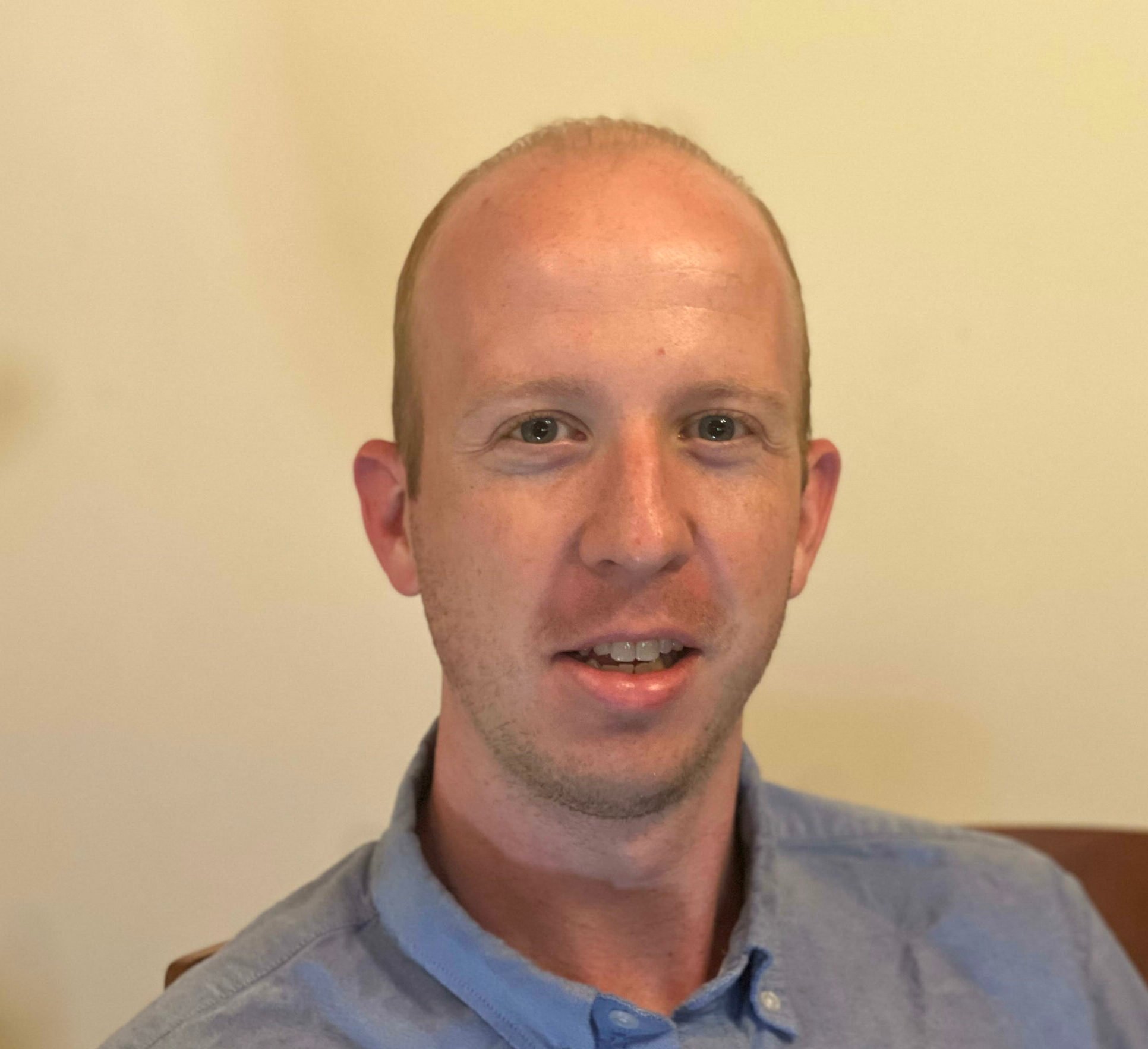
The best comeback of 2025: How Donavan Brazier won the US 800m title after three years away
Midway through 2024, Brazier had begun to accept he may never race again; in 2025, the former world champ returned faster than ever
By Jonathan Gault“I don’t want them to be like man, Donavan, he was such a talent, he could have been such this, he could have been such that…All I really want is a shot, man. I’m not asking for something to be given. I just want at least for someone to be able to say they took it from me.” — Donavan Brazier, March 2023
Back in May, when Donavan Brazier first came to his coach Mike Smith after a practice in Flagstaff and asked him when he would be able to race again, Smith tried to temper expectations. Since he had begun working with Smith in February 2025, Brazier had been making slow but steady gains. Smith had seen flashes of the leg speed and power that had propelled Brazier to an American record and world title in the 800 meters in 2019. But a series of extended injury layoffs meant Brazier’s conditioning was still lacking. Smith’s main concern at that point was keeping Brazier healthy; he did not want to risk sacrificing the progress they had made.
“I was like, Donavan, you might be looking at racing in 2026,” Smith said. “But that’s a good thing. That’s okay.”
But Brazier had the itch. He had not raced at all in 2023 or 2024 as he recovered from a series of Achilles surgeries. The three months under Smith had been, by far, the longest stretch of healthy training Brazier had strung together in the previous three years. By the end of the month, he had decided: it was time to return to competition.
Brazier mentioned this desire to race again to his friend Craig Engels, with whom he had been training in Flagstaff. He told him he wanted something low-key.
“I said, how about a race called Toad Fest?” Engels said.
Toad Fest, staged by Engels’ friend Billy Cvecko, was indeed low-key. The meet would be held at a high school track in Brentwood, Tenn., just south of Nashville. It would not be televised or streamed. Instead of prize money, winners would receive a sculpture of a green toad perched upon a red toadstool. But the meet was World Athletics certified, and Engels was already committed.
Smith was still hesitant, but he agreed that a low-key meet would be best for an opener. Brazier’s last race before his injury had come at the 2022 World Championships at Hayward Field. His first race back would come at Toad Fest.
“We’re not starting at the London Diamond League, we’re starting at the f—ing [chuckles]…every time I say Toad Fest, I just laugh,” Smith said. “Toad Fest? It sounds like an amphibian conference.”
Because Brazier was a late addition to the field, his comeback race attracted little pre-race hype. Smith’s expectations were low. He expected Brazier would run 1:50.
“That’s not me not believing in him,” Smith said. “That’s just, I was the one assigning what he was doing, right? So you look for markers in training. I would have been elated with 1:49.”
Barely 100 meters in, the race plan had already gone sideways; Baylor Franklin, who was meant to serve as the pacer, pulled his hamstring at the end of the first turn and dropped out. But Brazier still looked like Brazier: smooth, refined power.
View this post on Instagram
“I forgot how beautiful watching Donavan Brazier run is,” said Engels, who was watching from the infield. “People go to watch LeBron James play just to see him play. I can’t really explain how watching Donavan Brazier is up close and in person.”
Running completely solo, in his first race in more than 34 months, Brazier ran 1:44.70 to win the race and qualify for the US championships. He crossed the finish line, gave a casual double thumbs-up, and was quickly embraced by Engels, who was on the verge of tears. Apart from Brazier himself, no one in the stadium that night had a better understanding of what he had gone through to reach this point.
“I was like, dude, I’m so proud of you,” Engels said. “Which I truly, genuinely was. You don’t feel that too often for other people.”
In the track world, word spread like wildfire through group chats and message board threads. Brazier’s comeback was treated like a Bigfoot sighting. We had a results page, but in the immediate aftermath, the only videos available were short social media clips from weird angles. Donavan Brazier just ran 1:44 at something called Toad Fest? In the year 2025? Are we sure this is real?
Yes, it was.
Smith was stunned. He has coached NCAA champions, US champions, and Olympians. He has seen his athletes do amazing things. But what Brazier was able to do, after such a long layoff, off of so little training, caused Smith to recalibrate his expectations.
“The mathematical part of your brain as a coach is trying to say this workout equals this result or someone’s ready for this,” Smith said. “I think I’m pretty good at that. But it just doesn’t account for some other variables that you can’t measure in a workout and that was a great lesson I got taught right there.”
Brazier, of course, went on to win the US 800m title two months later in 1:42.16 — faster than his pre-injury personal best from 2019 — yet in the days following the race, Brazier’s victory was a bit overshadowed. That is what happens when a 16-year-old runs 1:42.
But Brazier’s resurrection was one of the stories of the year in 2025. And, considering the quality of the athlete and the time missed due to injury, it’s not hyperbole to describe it as one of the most remarkable comebacks in the history of American track & field. This is how it happened.
Haglund’s deformity and a muscular “anomaly”
During his freshman year at Texas A&M in 2016, Brazier’s physio noticed that he had a tendency to walk on his toes. He told Brazier he was concerned it could eventually lead to foot problems. Then, when Brazier joined the Nike Oregon Project in 2018, his initial examination with a Nike sports doctor revealed the early signs of a Haglund’s deformity in his right foot — a bony bump on the back of the heel that can irritate and fray the Achilles tendon.
Every few months, Brazier would experience irritation in the area. David McHenry, who has served as Brazier’s physical therapist and strength & conditioning coach since he joined the NOP, did his best to mitigate Brazier’s symptoms. But by 2022, both he and Brazier felt surgery was needed.
“These Haglund issues, they don’t happen overnight,” McHenry said. “All of them happen kind of gradually over the course of time. And normally we just see that they get to a point in runners where you can’t continue to baby them and work with them because it just becomes chronically sore and painful and limiting.”
As Brazier explored his options, one of his doctors, Ryan Petering, discovered something interesting during an MRI: an anomaly in Brazier’s right leg. Petering thought it might be an accessory soleus — essentially, an extra version of the soleus muscle that Brazier already had in his calf. Researchers estimate that between 0.7% and 5% of the population has such a muscle.
Initially, McHenry and Brazier’s doctors were concerned about whether the anomaly would impact the post-surgery healing process and wondered whether it needed to be removed (they did not end up removing it). Now, McHenry wonders whether the anomaly might help explain why Brazier can exert such massive amounts of power into the ground when he runs.
The soleus is one of the most important muscles in the leg for running fast: a 2012 study in the Journal of Experimental Biology found that, across four different running speeds, the muscle that had to generate the most force overall as a multiple of body weight was the soleus.
There are several caveats here. If Brazier does have an accessory soleus — his doctors never officially confirmed it — it is a smaller, underdeveloped version of his soleus rather than a “double” soleus. And while it could, in theory, help him put more power into the ground, it could also create more stiffness in Brazier’s ankle. A stiff ankle can help with sprinting (a stiff ankle creates a springier stride) but can also contribute to Achilles issues.
“Some people like to downplay it, other doctors I talk to are like, that’s a secret weapon,” Brazier said. “I don’t know if it actually helps too much, but tell you what: I’d rather have it than not have it.”
Whether his accessory soleus plays a role or not, McHenry said he has never worked with a middle distance runner able to put as much force into ground as Brazier.
“That’s a double-edged sword,” McHenry said. “Putting incredible amounts of power into the ground means that you’re incredibly fast. But that power’s got to be absorbed within your structure. And the thing that makes him – I think – the best 800-meter runner of our generation has also made his feet incredibly vulnerable, just because of the amount of power he’s putting through his wheels.”
The injury that wouldn’t heal
In July 2022, a week after he was eliminated in the first round at the World Championships in Eugene, Brazier underwent surgery on his right Achilles at the Steadman Hawkins Clinic in Englewood, Colo., performed by Dr. Kenneth Hunt, who has worked with many of Nike’s top runners. Hunt used a minimally invasive technique aimed at preserving as much of the attachment between the Achilles and calcaneus (heel bone) as possible.
This was not Brazier’s first significant surgery. In June 2021, he had fractured his left tibia at the Olympic Trials, where he had been in position to make the team with 200 meters to go in the final before his leg gave out. The rehab from that injury had been fairly straightforward. The rehab from Brazier’s Haglund’s surgery was anything but.
Brazier took a cautious approach to his recovery, but after six months, he had seen little progress. Even though his doctors told him his Achilles looked great, it still hurt. Hunt performed a follow-up surgery in February 2023 to clean out scar tissue, but a few months later, his calcaneus was still inflamed and the pain remained.
Another surgeon, Dr. Robert Anderson, suggested that there could still be some bone from Brazier’s calcaneus protruding into his Achilles tendon. So in July 2023, Brazier flew to Charlotte, where Anderson detached the lateral third of his Achilles, smoothed down his calcaneus, and reattached the tendon. And the recovery began anew.
At the end of 2023, Brazier left his training group, coach Pete Julian‘s Union Athletics Club. Throughout his injury layoff, Brazier had often shown up to practice to support the other athletes — “he was an incredible teammate,” McHenry said. But Brazier hated his role of cheerleader. Athletes like Brazier are meant to run, not watch.
“I hated being an athlete that had to use so much of the resources and produce so little results,” Brazier said. “Eventually, I just told him I don’t want to do this anymore.”
Early on in his recovery, Brazier was diligent in his rehab. His mood for the day would be dictated by how much his foot hurt getting out of bed. In late 2023 and early 2024, his morning routine consisted of a series of exercises to warm up his foot. Brazier kept hoping that one day, he’d be able to make it through the exercises with his foot feeling normal. For nine months, it never did.
Long-term injuries can stress the body as well as the mind. Brazier would feel guilty about not training hard enough, even though he knew that if he pushed too hard through the pain, it would only lead to another setback.
“I really enjoy working hard,” Brazier said. “It’s hard to pretend to work hard. And when I was hurt, that’s what I feel like I had to do for the longest time. When in reality, I wasn’t doing shit.”
The low point, Brazier said, came as a fan approached him and Julian outside Hayward Field at a meet in 2023.
“This guy’s like, Donavan?” Brazier said. “And I was like, Hey, how you doing? And he’s like, What happened to you? And I just looked at him, like, good question.
“I know he didn’t mean anything weird by it…but I just took it like, damn, what did happen to me? It was a reflection point of being like, I wasn’t that guy anymore. I wasn’t relevant, I wasn’t competing.”
Brazier traversed the world looking for answers, consulting with doctors in Germany, Ireland, and the United States. At one point, McHenry put together a list of every clinician Brazier had visited. It had 12 names on it.
None of the consultations alleviated the pain in his foot. But they did offer a little peace of mind: the consensus opinion was that Brazier needed to remain patient. His calcaneus was inflamed, and no amount of stretching or strengthening could accelerate the recovery. It was an injury that only time could heal.
It just wasn’t healing. By 2024, as Brazier approached the two-year anniversary of his last race, he grew less and less convinced he would ever race again. He stopped thinking of his rehab in athletic terms. Brazier no longer wanted his foot to stop hurting so he could train on it; he just wanted to be able to get out of bed without limping. When he hopped on the exercise bike, it wasn’t with a running comeback in mind; he just did it so he wouldn’t get fat. He stopped doing his morning foot exercises.
“When you keep doing things over and over and over and your body keeps rejecting it, you just start to accept what your body is willing and able to do,” Brazier said.
Brazier spent the summer of 2024 renovating a cabin he owns in Newaygo, Mich., an hour north of his hometown of Grand Rapids. He started considering his options if he could no longer run. Brazier had turned pro after his freshman year at Texas A&M in 2016; he began reaching out to schools about finishing his bachelor’s degree. He thought about working alongside his cousin in Michigan, who lays roads in the summer and plows them in the winter.
Engels would visit Brazier from time to time during his layoff. They went to see Michigan beat Alabama in the Rose Bowl in 2024 and went fishing off the coast of Florida. They rarely spoke about running, and when they did, Brazier would also redirect the discussion towards Engels’ career.
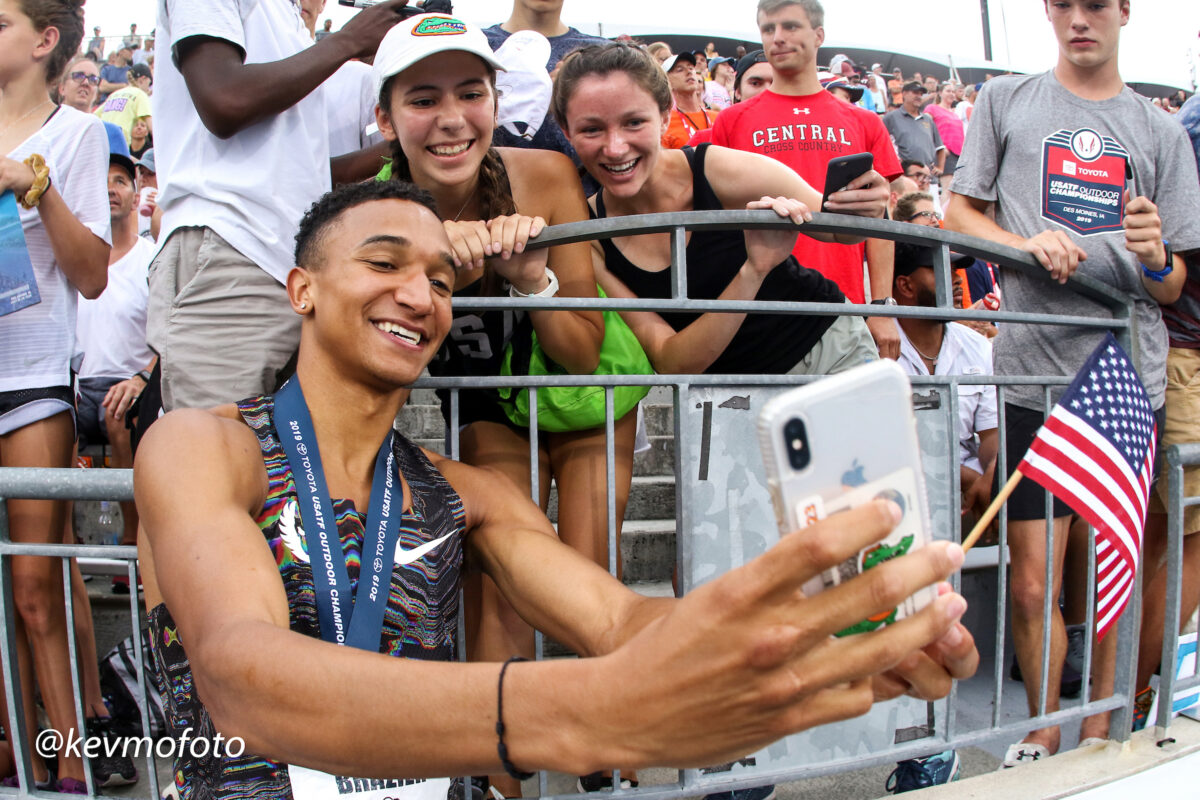 By 2024, Brazier had begun to accept his professional running career might be over (Kevin Morris photo)
“You see a lot of runners get depressed if they’re injured,” Engels said. “Fair enough, it’s a huge portion of all of our lives. But Donavan is going be fine outside of running. He has balance in his life. He loves being outside – he loves hunting, he loves fishing, he loves being on his boat.”
By the end of the summer, as the men Brazier used to race headed off to the Olympics, Brazier had largely removed himself from the sport. He only watched one race from Paris, one of Grant Fisher‘s finals (Fisher, like Brazier, graduated from high school in Michigan in 2015). And as his friends and family stopped by to help him renovate the cabin, Brazier made peace with the possibility that his life as a professional runner may have concluded.
“Even without running, I was always good,” Brazier said. “I don’t want it to seem like I was in this deep, dark place. Because I never got there. I’m not saying I’m nervous about it, but when I’m done with track, I very well might really be done with track. Because I’ve lived that life and I understood, hey, I can live without track. Track can live without me.”
The comeback: modest beginnings
At the end of 2024, 16 months after his final surgery, Brazier’s heel finally started to feel good again. Brazier was hesitant to resume training; would his foot hold up if he started running hard on it again? He got an MRI from Dr. Anderson, who gave him the green light and told him that his calcaneus had never looked better.
“At this point, I had the confidence from the doctor knowing, hey, this bone is healed,” Brazier said.
Brazier’s body was ready to return. But was his mind? He had been out of the sport for so long, he didn’t know how he’d be received. On February 2, he went to the New Balance Indoor Grand Prix in Boston, where he caught up with old friends and rivals like Bryce Hoppel, who had broken Brazier’s American 800m record at the Paris Olympics. Everyone was happy to see him.
“All these guys were just really encouraging,” Brazier said. “And that’s when I started to rewire my brain to think, okay, I’m an athlete again.”
Brazier noticed the success Hoppel had in 2024 after relocating to Flagstaff for altitude training. McHenry was now working with coach Mike Smith as part of the newly-formed Nike Swoosh TC, also based in Flagstaff, and passed along his contact info.
On February 8, Brazier and Smith spoke for an hour on the phone. Brazier had barely run since his initial Haglund’s surgery in 2022, but he wanted to start training again. This presented a new challenge for Smith.
“I was like, why don’t you go to a track and do six 200’s at 32?” Smith said. “Keep in mind what that means for someone who’s run as fast as he has. But where do you start when someone’s telling you I haven’t put on spikes in three years?”
The next day, Brazier texted back. There was a problem: he couldn’t find a track. At the time, Brazier was visiting his fiancée (now wife), Ally Watt, in Orlando, where she had been a professional soccer player for the Orlando Pride since 2022.
“And that just shows you how far I was out from the sport,” said Brazier, who was splitting his time between Orlando and St. Petersburg. “I’ve been living in Florida for all these years and I never really needed a track.”
Brazier found a track the next day and completed the workout. At the end of February, he traveled to Flagstaff for a week, where Smith got to work with him in person for the first time. Smith can still recall the image vividly.
“I’m standing at the NAU track, and this guy walks in,” Smith said. “In 10 years of standing on that track, I’ve seen a lot of people — Ingebrigtsen, you see the best people in the world walk into that facility.
“[Brazier] walks in the door and I instantly am just like, man, that is a human being built on springs. He just had a bounce in his walk that if you watch Donavan walk, the athleticism just pours out of him. His gait and his movement, his musculature, they don’t design a lot of people like that.”
The altitude kicked Brazier’s ass. His body was sore after workouts. But Brazier was making progress. And he wasn’t injured.
At this point, rumors of a Brazier comeback were beginning to circulate in the running world (if you want to keep a comeback quiet, Flagstaff is one of the worst places to do it). Smith tried to downplay them.
“I was so hesitant to make some big announcement because I wanted to protect him,” Smith said. “He’s a former world champion, he’s been out of the sport for three years. I could just put myself in his shoes and imagine that it would be hard to say, I’m coming back. Because what if you didn’t? What if you made it two months and then that was it?”
Plus, Smith still didn’t consider himself to be coaching Brazier at that point. He had sent him workouts, but Smith believes a coach-athlete relationship must go deeper than that. However, Brazier had come highly recommended from another of Smith’s athletes: Galen Rupp, the two-time Olympic medalist who had overlapped with Brazier at NOP and called him one of his favorite teammates ever.
“Galen has a high standard for who he thinks a good teammate is because he wants people to match his level of commitment and intensity,” Smith said. “That stood out to me, because I know his standards are almost unreachable.”
At the end of April, Smith invited Brazier out to Flagstaff for another, longer training camp. By then, he was starting to really feel like Brazier’s coach. And the workouts were getting more serious. Smith’s biggest concern was whether, after three years away, Brazier could still produce the power that had made him one of the world’s most devastating 800-meter runners. In that second Flagstaff camp, it quickly became apparent that he could.
“I’d give him 6 x 100 in 14 working down to 13, and he’d do them all in 12,” Smith said. “…When he started going too fast on certain things, I thought this was a good sign.”
Brazier began to settle into a routine: short speed on Mondays, 1500 pace work on Tuesdays, hills on Thursdays, 800-specific work on Fridays. He does not run more than 35 miles per week. But Brazier has never been a workout hero, which explains why Smith was so shocked by that 1:44 in Nashville.
“If you were to have someone come out and film my workouts, you wouldn’t be impressed at all,” Brazier said. “I wasn’t doing anything that indicated sub-1:45 shape.”
Part of that was because Brazier was still rebuilding his aerobic fitness. But part of it is a deliberate choice on Brazier’s part. There is a level of effort he reserves solely for races. As a result, he rarely wears spikes in workouts. He runs many of his workouts in Nike Pegasus Premiums and will switch to a flat, the Streakfly, for faster stuff.
“I think you need a place to go,” Brazier said. “A lot of these guys, they go there in practice…I’ve just never really seeked great validation through that.”
Brazier can still turn it over pretty quick in Pegs, though.
“Him and I did some 200s, where I think it was a few sets of 200s at 25, and Donavan was running in trainers and dropping me,” Engels said. “And I’m just like, What the heck, dude, you just took three years off!”
Engels is convinced that if Brazier had been able to stay healthy after winning Worlds in 2019, he would have broken the world record by now. Once Brazier was finally able to train again in 2025, it did not take him long to return to his previous level. After his 1:44.70 at Toad Fest, he ran 1:43.81 at the Portland Track Festival on June 15 and 1:43.08 at the London Diamond League on July 19.
Brazier was clicking with Smith’s training, and, most importantly, he had no injury setbacks. But Smith passes credit for Brazier’s rapid improvement to the man himself.
“I don’t know how much of this is coaching,” Smith said. “I think a lot of it is a highly talented athlete that just needed to get healthy. I think a lot of people probably could have guided him to the place he’s in.”
USAs and beyond
The US Championships in August would present a different challenge to the one-off races Brazier had run to that point in the season. The multi-day format would test not just his speed, but his strength and tactical nous. Just as in 2021, there was a global championship in Tokyo on the line. Just as in 2021, there were serious questions about whether Brazier’s body would make it through a prelim, semi, and final.
To make Worlds, Brazier would have to go from running three races in three years to three races in four days against one of the strongest 800m fields ever assembled at USAs. Engels was one of many who felt that was too much of an ask.
“Truly, I thought he was going to bomb,” Engels said. “…It’s crazy how little he did run to come back and run three rounds and win in 1:42. That blows my mind and will blow my mind forever.”
Instead, it was as if Brazier had never left. In third coming off the final turn, the power was still there when he needed it in the final 100 meters, shooting a gap between Hoppel and a fading Josh Hoey to win his third US title in a personal best of 1:42.16. Brazier unleashed a primal scream across the finish line, three years of pent-up frustration exiting his body.
The men’s 800-meter final at USAs was the race of the year, and in the moment, the headlines belonged to the runner-up, Cooper Lutkenhaus, who ran a staggering 1:42.27 at age 16. Lutkenhaus’s run overshadowed one of the greatest comebacks US middle-distance running has ever seen. But even Brazier, in the midst of a cathartic celebration after crossing the finish line, could appreciate what his competitor had accomplished. As soon as he saw their times pop up on the Hayward Field scoreboard, he paused his own celebration and made a beeline to Lutkenhaus to congratulate the teenager.
“I’m glad that I’m 28 and maybe I only have a few years left in me,” Brazier said. “I hopefully won’t have to deal with him in his prime, because that dude is definitely pretty special.”
Brazier was absent from the sport for so long that it is hard to draw comparisons to his comeback. Keira D’Amato spent seven years away from running before returning to set the American record in the marathon, though she was not nearly as accomplished pre-break as Brazier. Kenenisa Bekele rose from the dead to win the Berlin Marathon in 2019, almost breaking the world record in the process, but he never went three years without racing.
Engels likened it to Tiger Woods returning to win the Masters in 2019. If track were more popular, Engels said, people would be talking about Brazier’s comeback as one of the best in any sport.
“You peak in the 800, historically, at like 21 years old,” Engels said. “He comes back at 28 after three years off and runs 1:42. I don’t think people will ever comprehend it.”
If Brazier’s comeback is hard to fully comprehend, it was not hard to appreciate. Fans of track, more than most other sports, become attached to their sport’s phenoms, and Brazier has been one ever since he stormed to the NCAA 800m title as a 19-year-old freshman in 2016. In 2025, Brazier could feel the running community rallying behind him as his comeback gained steam.
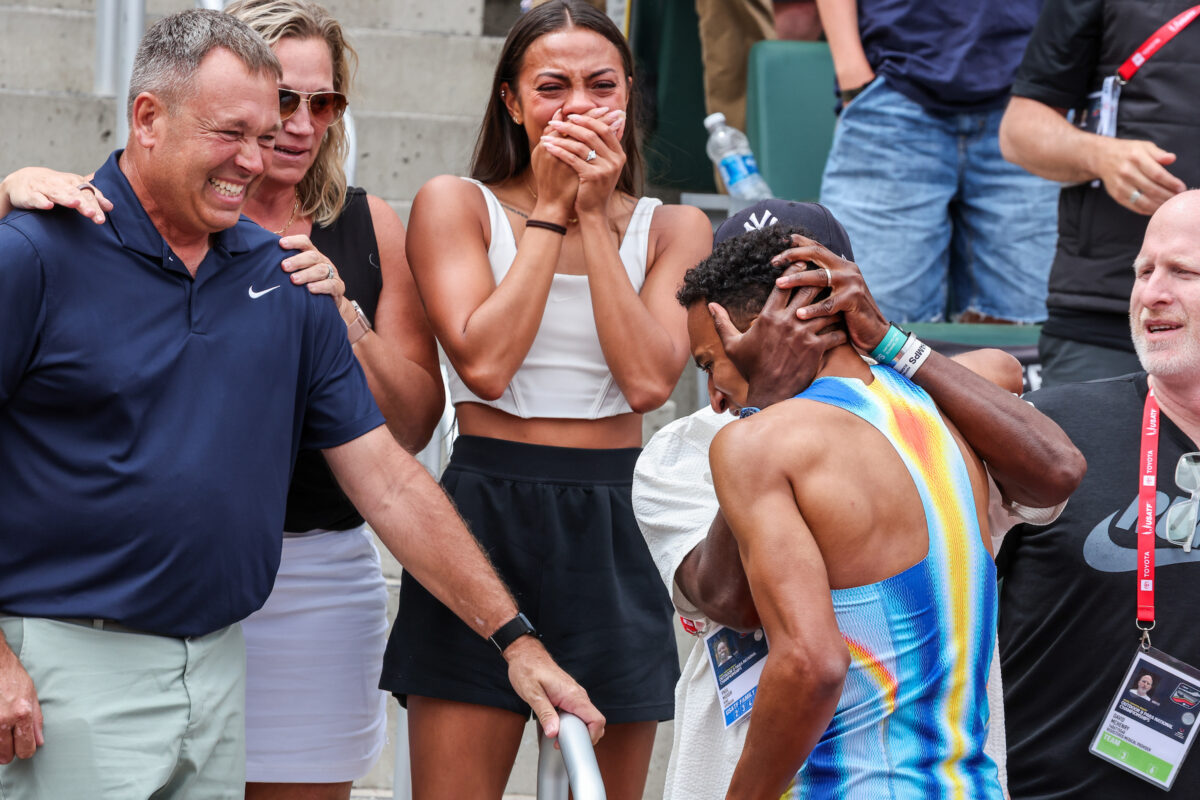 Nike’s Paul Moser embraced Brazier after he won USAs while his family and McHenry (far right) looked on (Kevin Morris photo)
It is rare for an athlete of Brazier’s caliber to enjoy a year free from setting goals, free from expectations, but that is what 2025 was like for him. There may still be pages to write in Brazier’s comeback story, but in 2026, those goals and expectations will be back. He wants to race more on the European circuit, run at the World Ultimate Championships, and keep building to LA 2028, where he hopes to become an Olympian at last. He got married in December and wants to build a new life with Ally in Denver, where she will play for the expansion Denver Summit FC in the NWSL this season. It is an exciting time to be Donavan Brazier.
Recently, Brazier has been at a warm-weather camp in Phoenix as he prepares to open the 2026 season on Saturday by running the 600 meters at the New Balance Indoor Grand Prix in Boston. He knows this year will be different now that he is the defending US champion rather than the underdog returning from a three-year break. Three years ago, he just wanted one more shot to show what he could do. Now, naturally, he wants more. But he will always be grateful for what he experienced in 2025.
“[Smith told me to] enjoy this big push of support you have behind you, because you don’t know if you’re going to get this next year,” Brazier said. “I definitely felt it. I definitely enjoyed it. I definitely soaked it all in.”
Talk about this article on our world-famous fan forum / messageboard: Jonathan Gault’s latest feature: The best comeback of 2025: How Donavan Brazier won the US 800m title after three years away.
Disclosure: This article includes affiliate links, meaning LetsRun.com may receive a commission if a reader makes a purchase. Nike did not sponsor this article and had no role in its reporting, writing, or editorial decisions.