Can 19-year-old Cam Myers run 3:27 this weekend in Stockholm?
The Aussie teenager runs his first Diamond League of 2026 on Sunday
By Jonathan Gault
Cam Myers has generated more buzz than almost any athlete in track & field in 2026. The young Australian has run seven races this year and won them all, several in personal-best times and most by massive margins. The fact that he is still just 19 years old — he turns 20 on Tuesday — has the track world buzzing with anticipation ahead of Myers’ first Diamond League 1500m race of 2026 at the BAUHAUS-galan in Stockholm on Sunday.
My boss, Robert Johnson, has been leading the Myers bandwagon. And frankly, it may be getting a bit out of control.
On this week’s episode of the LetsRun.com Track Talk Podcast, he predicted that Myers will run 3:27 “at a minimum” in Stockholm. He then ran two polls on the LetsRun.com homepage — one asking whether Myers will break the 1500 or mile world records during his career, and one asking whether he would break one of those records in 2026.
The results shocked me. Those records, which stand at 3:26.00 and 3:43.13, were both set almost 30 years ago by Hicham El Guerrouj and have survived Asbel Kiprop, Jakob Ingebrigtsen, super spikes, and bicarb. Yet an incredible 53% of LetsRun.com readers — the smartest fans in track & field — believe Myers will break one of those records. 22% of you — almost one in four! — think Myers will break one of those records this year.
Myers is wildly talented, Australia’s best middle-distance prospect since Herb Elliott in the 1950s. He is also a 19-year-old who has yet to run faster than 3:29.80 or make it out of the first round of a global championship. His future is very, very bright, and he is due for a big personal best in Stockholm against a field that includes 2019 world champion Timothy Cheruiyot, 3:27 man Azeddine Habz, and Americans Yared Nuguse, Hobbs Kessler, Vincent Ciattei, and Nico Young.
But this talk of 3:27? World records? Are we really here already? As Myers opens his Diamond League season, let’s try to take a clear-eyed look at what we can actually expect from him in 2026.
Myers’ scorching start to 2026
There is no denying that Cam Myers has been brilliant so far in his undefeated 2026 season. A three-race American winter tour produced a negative-split 3:49.81 mile in Seattle, a six-second pb of 7:27.57 over 3,000m at the New Balance Indoor Grand Prix, and a 3:47.57 victory at Millrose, where he denied Nuguse a fourth consecutive victory and became the youngest Wanamaker Mile champion for 57 years.
From there, Myers headed home to Australia, where he ran 3:30.42 to win the Maurie Plant Meet 1500, soloed a 3:29.85 to win the Australian championships, and doubled back the next day to win the 5,000 in 13:11.66. After that, he took a seven-week break from racing before opening up his European season with a 1:44.05 win at 800 in Karlsruhe on May 30 — a three-second pb in which he went from last to first over the final 500 meters.
That performance — which is faster than Ingebrigtsen, Nuguse, Cole Hocker, or Josh Kerr has ever run for 800 — prompted Rojo to start frothing at the mouth and ask if the mile world record is next.
LRC Cam Myers runs 1:44.05 at age 19. Could the mile world record be next?
He also noted that most of Myers’ victories this year have come by extraordinary margins.
Cam Myers’ 2026 results
| Date | Race | Result | Margin |
|---|---|---|---|
| Jan. 18 | Seattle mile | 3:49.81 | 4.46 sec |
| Jan. 24 | NBIGP 3000m | 7:27.57 pb | 3.40 sec |
| Feb. 1 | Millrose mile | 3:47.57 | 0.78 sec |
| Mar. 28 | Maurie Plant 1500m | 3:30.42 | 7.09 sec |
| Apr. 10 | Aussie champs 1500m | 3:29.85 | 2.81 sec |
| Apr. 11 | Aussie champs 5000m | 13:11.66 pb | 0.76 sec |
| May 30 | Karlsruhe 800m | 1:44.05 pb | 1.08 sec |
These are the facts of the case. Where Myers goes from here is where the argument begins.
Putting 3:27 in context
I understand why Rojo and LetsRun nation are freaking out about Myers. Running fans love a phenom, and the exciting thing about him is that his performances suggest he still has room for improvement. His 3:29.85 at the Aussie championships was a wire-to-wire effort without a pacer. Only one other man in the history of the world has ever run a wire-to-wire sub-3:30 without a pacer: Timothy Cheruiyot at the 2019 World Championships. And in Myers’ 1:44.05, he ran much of the race in lane 2 or the lane 1/2 border. Surely he is capable of running faster at both distances.
But our sport doesn’t always work that way.
Consider Cheruiyot. His performance in the 2019 World Championship final in Doha was, by almost every metric, even more impressive than Myers’. He ran faster (3:29.26 to Myers’ 3:29.85), he did it on the biggest stage in the sport against the best runners in the world, and he had two rounds in his legs already. Surely if he could solo a 3:29.26, without a pacer, he could run at least 3:27 with a rabbit?
Actually, no. Even though Cheruiyot has raced on the circuit as much as anyone over the past decade — 35 Diamond League 1500s from 2016-25 — his personal best is “only” 3:28.28.
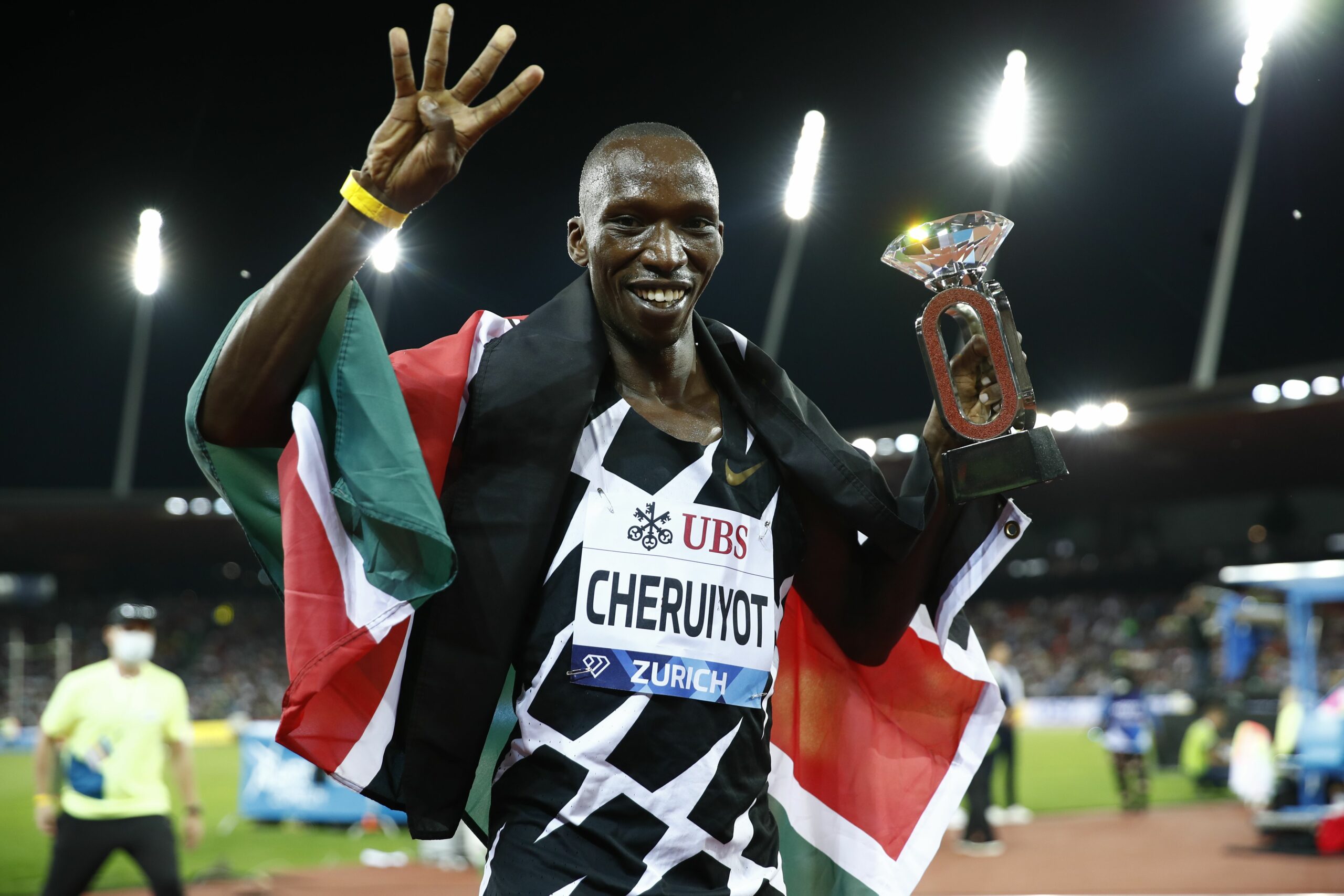 Cheruiyot won four DL 1500 titles but never broke 3:28 (Courtesy Diamond League AG)
How is that possible? One argument is that Cheruiyot’s 3:29.26 in Doha represented the peak of his abilities — a championship final in the prime of his career. So perhaps it is unfair to expect him to be in that sort of fitness year-round.
But running 3:27 is not just about fitness. Of the 11 men to have broken 3:28, six are active right now: Ingebrigtsen, Kerr, Nuguse, Hocker, Habz, and Phanuel Koech. Yet there have only been six sub-3:28 races in the last decade. And five of those six featured Ingebrigtsen pushing the pace. Plus, no one in history has ever broken 3:28 this early in the season. Of the 20 sub-3:28 races in history, 17 came in July or August. One was in September, and two were in June (Ingebrigtsen’s 3:27.95 at 2023 Oslo on June 15 is the earliest on record).
It’s also worth noting that Ingebrigtsen, whose four sub-3:28s rank second all-time behind Hicham El Guerrouj‘s nine, did not break 3:28 until he was 22 years old.
So do I expect Cam Myers, in his first 1500 of the summer, to run a two-second pb, from the front, and break 3:28 more than two full years earlier than Jakob Ingebrigtsen — one of the greatest endurance prodigies ever, who had been training like a pro from the age of 10?
No, I do not. A pacer will help, but Myers will still have to run the final lap or so on his own, with the rest of the field in Stockholm aiming up to shoot at him — including Nuguse, fresh off a win in Rabat and happy for someone else to tow him along. To suggest Myers should run 3:27 “at a minimum” is ludicrous.
And yet…
3:27 ain’t what it used to be. Azeddine Habz, a 31-year-old who has made one global final, ran 3:27.49 in Paris last year (without Ingebrigtsen in the race). If that guy can run 3:27, so can Myers, who is significantly more talented. It just might take more than one Diamond League for it to happen.
Myers isn’t the only teenage star to watch in Stockholm. World Indoor champion Cooper Lutkenhaus will make his Diamond League debut in the men’s 800m against Marco Arop and a loaded field. You can read our article on Lutkenhaus’s chances here.
Who will be king of the 1500 in 2026?
Ingebrigtsen may not have won a global 1500 title from 2022-24, but he reigned as king of the circuit during those three years, racking up 13 Diamond League 1500/mile victories and three straight Diamond League trophies. Last year, with Ingebrigtsen sidelined due to injury for most of the campaign, 20-year-old Niels Laros rose up in his place, winning three DLs, including the final.
The question now, as we head into the heart of the Diamond League season, is who will own the men’s 1500 in 2026?
Stockholm will also feature another highly anticipated Diamond League debut, as 17-year-old world indoor champion Cooper Lutkenhaus steps up to face Olympic silver medalist Marco Arop and a loaded men’s 800m field.
Ingebrigtsen is still on the mend from Achilles surgery in February, and while his agent said this week that he may return to racing as early as July, Ingebrigtsen has said his main focus is on being 100% back in 2027. If we are to see the dominant version of Ingebrigtsen again, it will not be this year.
Laros has yet to race at all since injuring his calf at the World Championships in September. Laros has shown before that he can race well coming off injury, but he remains something of a wild card.
Kerr, who just ran an 800 pb of 1:44.60, has plans to get into world-record shape this summer. But he has also made it clear that he plans on peaking for his mile world record attempt in London, with the aim of carrying that fitness over to the Commonwealth Games (July 27 – August 1) and perhaps the European championships (August 10-16). We may not see him much on the circuit.
Meanwhile, the lack of a traditional global outdoor championship means we could see Olympic champion Hocker hitting the circuit more than in previous years. He has never won a Diamond League, but wins at the Sound Invite and Millrose indoors showed his potential when placing more emphasis on the regular season.
Then you have Nuguse (who now has five DL wins in his career), world champ Isaac Nader (2nd behind Nuguse in Rabat), and Koech, who grabbed a win and two 2nds in his first year on the circuit in 2025.
That is a crowded pool of contenders with whom Myers must wrestle, but he is ready for the challenge. While he has only cracked the top three at a Diamond League once in his career (he was 2nd in Oslo behind Nader last year), he has clearly gone up a level in 2026.
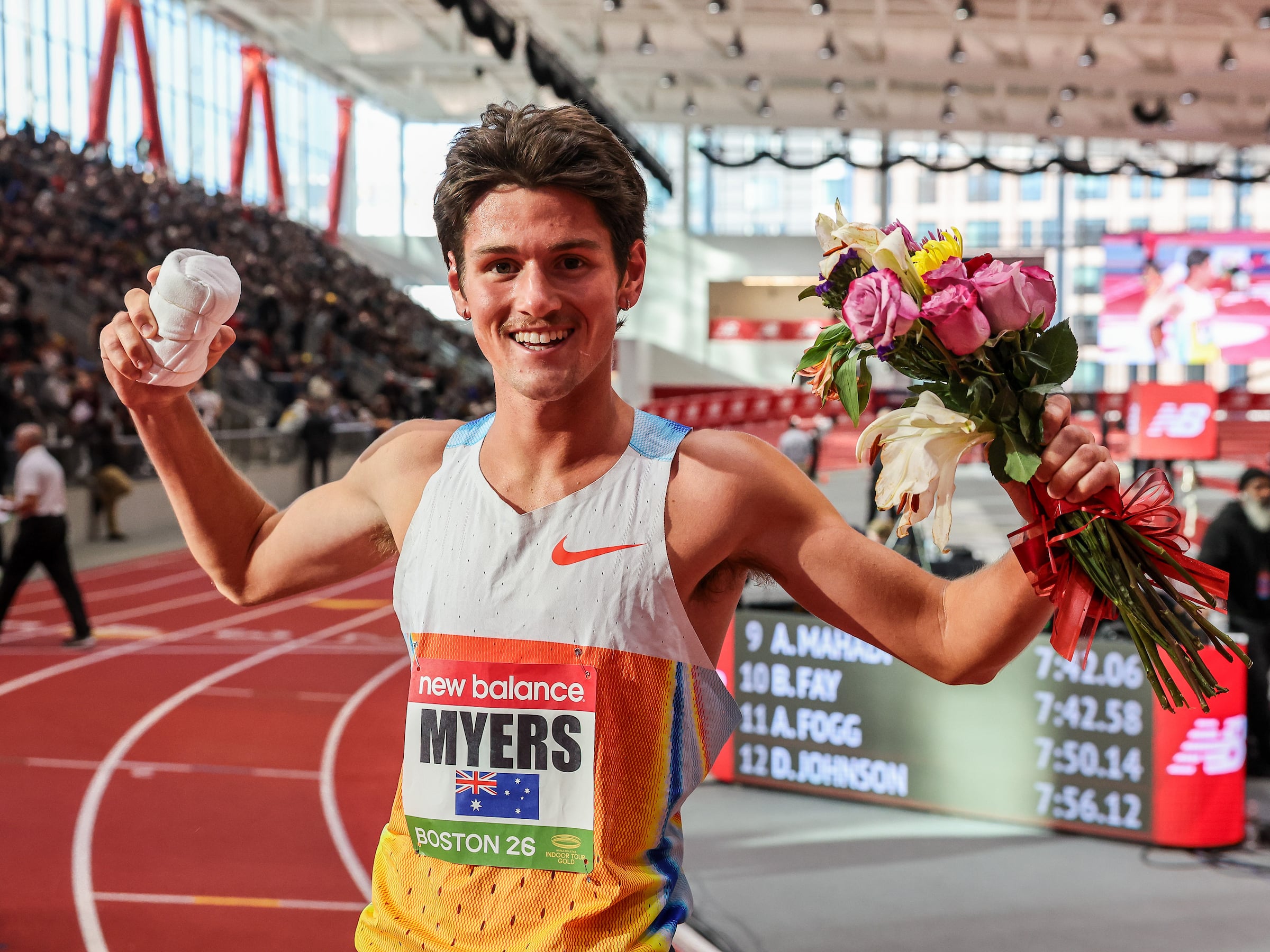 Kevin Morris photo
“The first two years on the circuit, I didn’t have the strength to compete,” Myers said after his 7:27 win in Boston. “I could almost get to 200 meters to go, and I’d be fucked — sorry about my language. I had to really just hone in on the strength side so I could be there with 100 to go and have enough.
“Now I’m there at 100 to go, even 50 to go, but I don’t quite have that top-end gear to get there. And so this year, we’ve tried to actually go back a little bit and try to work on those gears.”
That was in January. Myers’ 1:44 in Karlsruhe last week showed that work is going well. But his best way to win on the circuit this year may be to keep the pace quick and attack Diamond League fields over the last lap, the way Cheruiyot and Ingebrigtsen did at their best.
Is Myers ready to do that in 2026? The signs are promising. But it is easy to get carried away with his potential when it’s been a few months since we’ve seen the likes of Hocker, Laros, and Koech show what they can do. That is not me saying that running fans — and our own Robert Johnson — should not be excited about Myers. Just a reminder to be realistic about expectations in an event that currently features so many special talents.
How fast do you think he’ll run?
Enough of what I think. The crew at LetsRun.com has created a Cam Myers prediction contest on our forums. Tell us how fast you think he can run in this thread here. Whoever comes closest wins a LetsRun.com shirt.
Also read: LRC Can 17-Year-Old World Champion Cooper Lutkenhaus Win His Diamond League Debut?