How did they run so fast in Boston? Inside the fastest race in history
A friendly tailwind helped a lot, but one pro believes race winner John Korir could have run even faster on Monday
By Jonathan Gault
BOSTON – The seeds for the fastest Boston Marathon in the 130-year history of the race were planted a few days before the gun fired in Hopkinton on Monday morning. As the weather forecast came into focus, predicting near-perfect conditions, low-40s temperatures and a 9 mile-per-hour tailwind out of the west, the men’s elite field realized they had an opportunity to run fast this year in Boston. The sort of opportunity that might only come around once in a career.
Want the straight recap of the men’s race? Read our earlier story on John Korir’s 2:01:52 course-record win in the 2026 Boston Marathon.
“They mentioned it a couple times in the meetings before the race that, you know, you’ve got a tailwind, you should go for it,” said Charles Hicks, who ran a five-minute personal best of 2:04:35 to finish 7th. “And I think that got in a lot of people’s heads. So I think it really pushed what people felt they were capable of and also made people front-run in times where they maybe wouldn’t have in another race, because the cost was very negligible.”
Zouhair Talbi, who ran 2:03:45 to finish 5th, the fastest time run by an American marathoner on any course, said he knew the conditions would be good. But without any pacers, it was still up to the runners to take advantage of the conditions.
“A tailwind is an advantage for us to run a fast time,” Talbi said. “But the pace is still determined by the leaders. You just want to follow the pace, and a lot of athletes were pushing the pace early on. Going through the half marathon in 61-high, I was like today is going to be a fast time…Today, everything was clicking. I was like, this is the day, just follow the surges and see what’s going to happen.”
The On Athletics Club’s Dathan Ritzenhein, who coaches Ryan Ford (12th in 2:05:46) and Joe Klecker (13th in 2:05:56), said his pre-race instructions were simple: “We gotta go with the pack no matter what.”
The pace at halfway was quick, 61:43 for leader Lemi Berhanu, with 21 others between 61:50 and 62:00, but not much faster than 2025, when a 16-man lead pack hit halfway in 61:52. The difference this year was that many of those runners kept up the pace for the second half, which includes the famed Newton Hills.
Most of those who went with the pace were rewarded. Sixteen of the top 20 finishers on Monday ran personal bests, several by humongous margins.
| Athlete | Country | Time | Previous pb | Improvement |
| John Korir | Kenya | 2:01:52 | 2:02:24 | 0:32 |
| Alphonce Felix Simbu | Tanzania | 2:02:47 | 2:04:38 | 1:51 |
| Benson Kipruto | Kenya | 2:02:50 | 2:02:16 | N/A |
| Hailemaryam Kiros | Ethiopia | 2:03:42 | 2:04:35 | 0:53 |
| Zouhair Talbi | USA | 2:03:45 | 2:05:45 | 2:00 |
| Tebello Ramakongoana | Lesotho | 2:04:18 | 2:06:18 | 2:00 |
| Charles Hicks | USA | 2:04:35 | 2:08:59 | 4:24 |
| Richard Ringer | Germany | 2:04:47 | 2:05:46 | 0:59 |
| Alex Masai | Kenya | 2:05:32 | 2:04:37 | N/A |
| Milkesa Mengesha | Ethiopia | 2:05:35 | 2:03:17 | N/A |
| Clayton Young | USA | 2:05:41 | 2:07:04 | 1:23 |
| Ryan Ford | USA | 2:05:46 | 2:08:00 | 2:14 |
| Joe Klecker | USA | 2:05:56 | 2:10:37 | 4:41 |
| Rory Linkletter | Canada | 2:06:04 | 2:06:49 | 0:45 |
| Yemane Haileselassie | Eritrea | 2:06:06 | 2:08:25 | 2:19 |
| Nicholas Kipkorir | Kenya | 2:06:07 | Debut | N/A |
| Hendrik Pfeiffer | Germany | 2:06:34 | 2:06:45 | 0:11 |
| Sondre Moen | Norway | 2:06:52 | 2:05:48 | N/A |
| Haftu Knight | USA | 2:07:38 | 2:09:38 | 2:00 |
| Wesley Kiptoo | USA | 2:07:55 | 2:08:54 | 0:59 |
Clearly, the tailwinds had a massive impact on the times in 2026. That is why World Athletics does not consider point-to-point courses eligible for world records, a big tailwind can take minutes off a runner’s time.
Last year’s race featured decent conditions and was one of the fastest races in Boston history. Seven of last year’s top 10 returned in 2026, and apart from Cybrian Kotut, who dropped out after 25k, the others improved by an average of 2:07 from 2025 to 2026. Yet only one of them improved their place from 2025.
| Athlete | Country | 2025 time | 2025 place | 2026 time | 2026 place | Difference |
| John Korir | Kenya | 2:04:45 | 1st | 2:01:52 | 1st | 2:53 |
| Alphonce Felix Simbu | Tanzania | 2:05:04 | 2nd | 2:02:47 | 2nd | 2:17 |
| Tebello Ramakongoana | Lesotho | 2:07:19 | 8th | 2:04:18 | 6th | 3:01 |
| Clayton Young | USA | 2:07:04 | 7th | 2:05:41 | 11th | 1:23 |
| Ryan Ford | USA | 2:08:00 | 10th | 2:05:46 | 12th | 2:14 |
| Rory Linkletter | Canada | 2:07:02 | 6th | 2:06:04 | 14th | 0:58 |
| Cybrian Kotut | Kenya | 2:05:04 | 3rd | DNF | N/A | N/A |
| Average | 2:07 |
Canada’s Rory Linkletter ran 58 seconds faster than last year, but went from 6th in 2025 to 14th in 2026. He said he was bummed by the result because he believes he came into the race fitter than he did last year, which meant he expected to improve by even more than he did.
“This was a B day, that was an A day,” Linkletter said.
Linkletter also said that as fast as Korir ran today, he felt he could have run even faster considering Korir ran a big negative split of 61:50-60:02.
“I’m fully convinced he could have run 2:00 today if he wanted to make the first half more honest, or if someone else had wanted to,” Linkletter said. “I think that John Korir is the best marathon runner in the world right now.”
A fast day for Americans, too
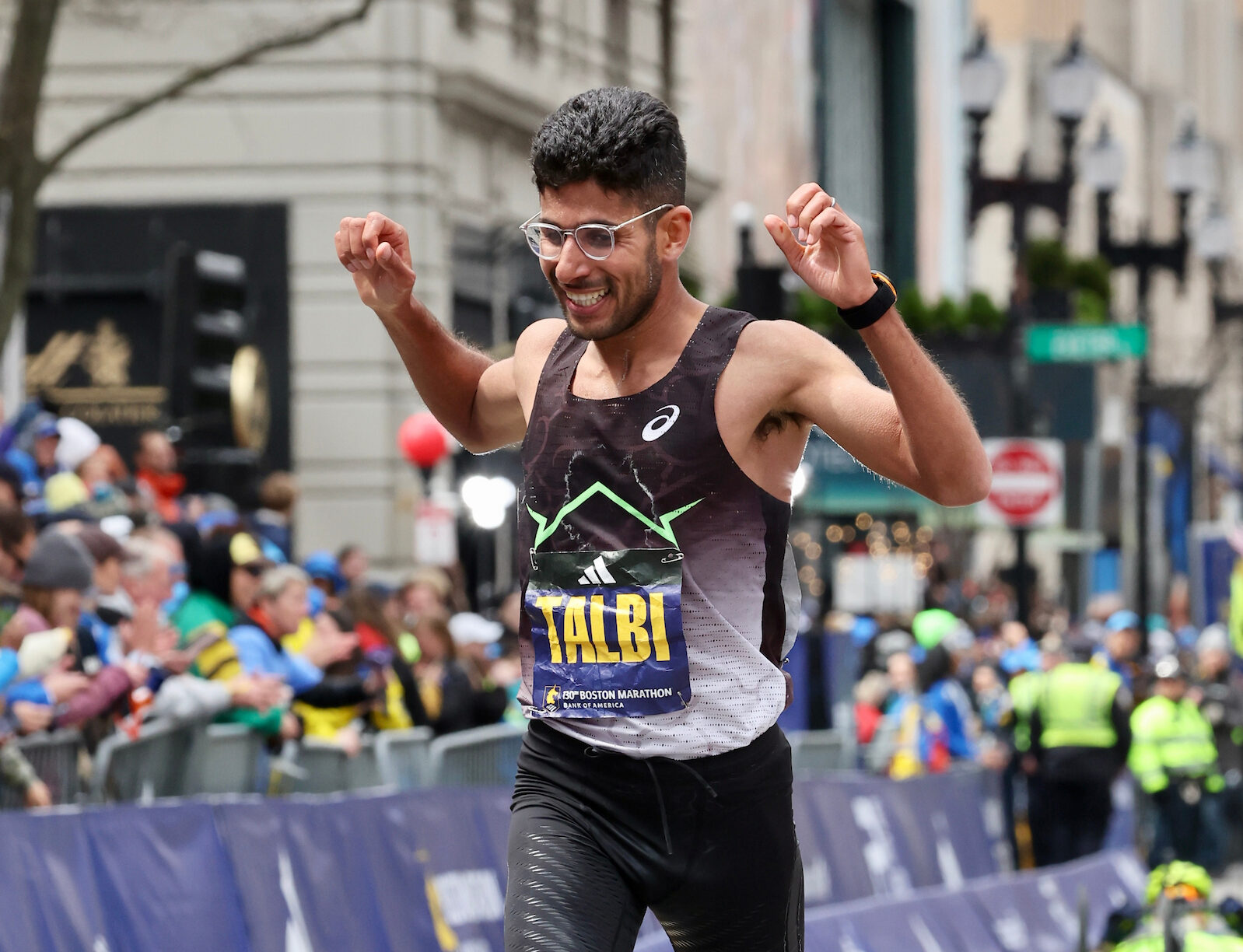 Zouhair Talbi ran the marathon faster than any American ever (Kevin Morris photo)
The fast conditions, coupled with a willingness to get after it, resulted in a complete overhaul of the all-time, all-conditions list of fastest American marathoners. Prior to the race, only four American men had ever broken 2:06 in any marathon. Five men did that in Boston on Monday, with Talbi and Hicks running the two fastest all-conditions marathons ever by US citizens.
US all-time, all-conditions marathon list
| Athlete | Time | Race |
| Zouhair Talbi | 2:03:45* | 2026 Boston |
| Charles Hicks | 2:04:35* | 2026 Boston |
| Conner Mantz | 2:04:43 | 2025 Chicago |
| Ryan Hall | 2:04:58* | 2011 Boston |
| Khalid Khannouchi | 2:05:38 | 2002 London |
| Clayton Young | 2:05:41* | 2026 Boston |
| Ryan Ford | 2:05:46* | 2026 Boston |
| Joe Klecker | 2:05:56* | 2026 Boston |
| Galen Rupp | 2:06:07 | 2018 Prague |
| Abbabiya Simbassa | 2:06:53 | 2024 Valencia |
*Not record-eligible
There are a number of complicating factors. The wind, of course. But even if Boston was record-eligible, neither Talbi nor Hicks would have been able to break the American record today as both are in the process of changing their competitive allegiances. Talbi, who was born and raised in Morocco before coming to the US for college at age 23, became a US citizen in January 2025 after enlisting in the Army Reserve. But because he ran the 2024 Olympic marathon for Morocco, he must wait three years, until August 2027, before he can represent the US internationally.
Hicks, who was born in London to American parents and moved to Florida at age 12, represented Great Britain in international age-group competition, but last year elected to compete for the USA moving forward. His last time representing Great Britain was at the European U23 Championships in July 2023, so he will be eligible to represent the US internationally starting in July 2026.
Both Talbi and Hicks can compete in US domestic championships, but according to USATF rules, one must be able to represent the US internationally in order to set an American record.
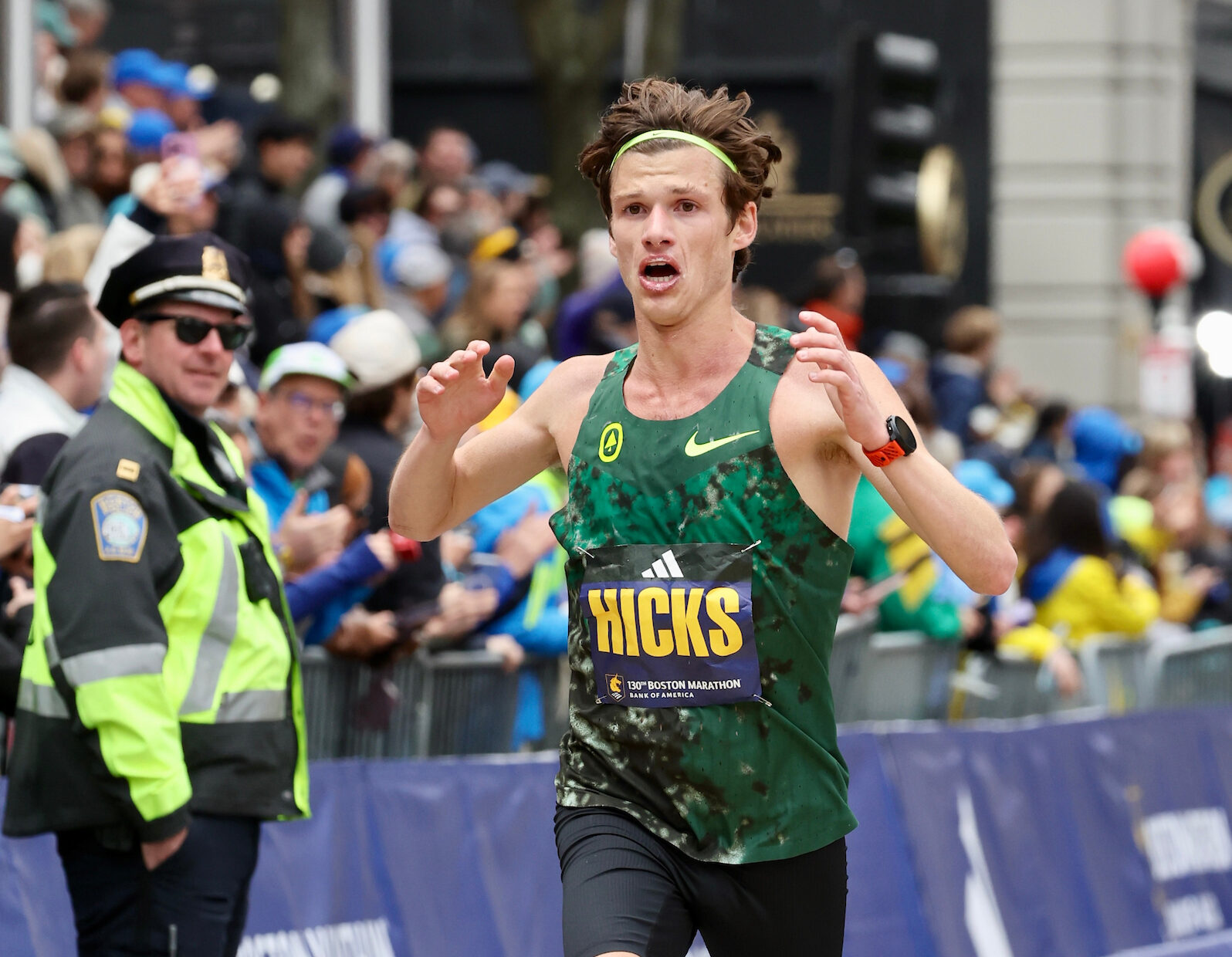 Charles Hicks was excited at the finish (Kevin Morris photo)
While that will have to wait, both Talbi and Hicks will be eligible to compete at the next US Olympic Marathon Trials in March 2028, and both showed on Monday that they are serious threats to make the team. They were the class of an American field that featured many of the top contenders for 2028, and each of them beat 2024 Olympian Clayton Young by more than a minute. One wonders how fast Conner Mantz, who ran 2:05:04 for 4th here last year before setting the American record of 2:04:43 in Chicago, would have been able to run had he not been forced to scratch due to injury.
The 31-year-old Talbi was already a strong marathoner for Morocco, finishing 5th in Boston in 2023 and running 2:06:39 to win the Houston Marathon in 2024. But the emergence of Hicks, the 2022 NCAA cross country champion for Stanford, is a more recent development. He made his debut just five months ago in New York, finishing 7th in 2:08:59, a performance he was overjoyed with at the time.
Hicks, who trains under University of Oregon coach Jerry Schumacher, said he feels his physiological traits, an ability to absorb a high volume of training while staying injury-free, have positioned him well for marathon success at the early age of 24. But he said it helps that he has come to genuinely love the event.
“It’s so much fun, and there’s so much energy around these races that I can really harness,” Hicks said. “I definitely got hearing damage today on the race going through some of those college campuses.”
Even if Hicks goes on to have a great marathon career, it is possible he never runs faster than the 2:04:35 he clocked in Boston today. But Talbi is hoping that the fast times in Boston on Monday, wind-aided though they may be, help push the level of American marathoning higher in the years to come.
“There were five or six of us Americans trying to push the pace, and we ended up with five guys under 2:06, which is amazing to see,” Talbi said. “And I think this is just the start. I think if you run 2:05 or 2:04 or 2:03, my pace, you definitely want to go to a flat course and try to see if you can match the time or run even faster.”
Charles Hicks after running 2:04
Rory Linkletter thought John Korir could have run even faster
Zouhair Talbi’s coach Scott Simmons