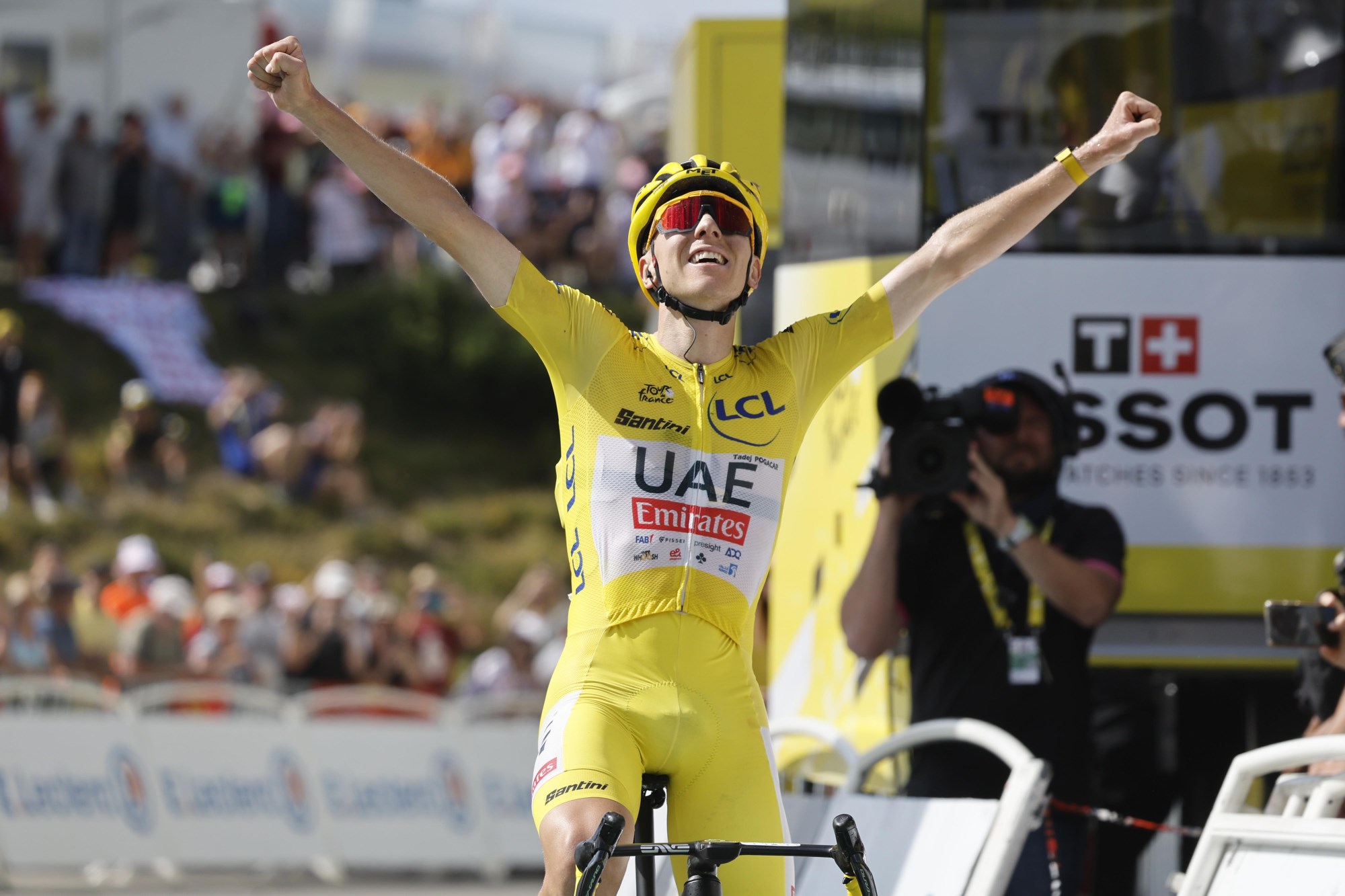
Tadej Pogačar and Jonas Vingegaard both did the best and second-best climbing performance of all time on the Plateau de Beille climb, making this the greatest climbing stage of all time.
If you have a Coros watch then it can tell you your running watts. Don't know how accurate that is but it can help you compare. A 60kg athlete running at 420watts will be 7w/kg.
My very rough guess would be running at around ~2:35min/km for 40min.
Pogacar's stratospheric climbing today would be the running equivalent of a world record 12 min flat 5K. The power to weight that Pogacar put out today has never been reached by far. It's is so laughable, Pogacar's power numbers are way above the top trendline in Lantern Rouge.
I'm sure it has been asked a hundred times, but how is it possible to go 10% faster on a climb than known dopers from 15 years ago? New technology cannot mean that much when air resistance is negligible because you average 10mph.
You have to factor in that he's done this in the middle of a 3 week race as well. He most certainly isn't tapered and fresh before doing this, but has 14 x 4-6 hour stages in his legs.
Seems similar to Kiptum's sub-60 2nd halves of marathons.
Not sure but I'm willing to bet he would average around 6 minute mile pace running. In person some of best cyclists I knew didn't run much but seemed to average that pace when they did run. And after watching Biniam Girmay interview and he stated he would concentrate on sprinting. Cyclists are beast and love to be challenged so I predict Biniam will not win another stage after that statement. They will increase the difficulty for him because they've been openly challenged.
I'm sure it has been asked a hundred times, but how is it possible to go 10% faster on a climb than known dopers from 15 years ago? New technology cannot mean that much when air resistance is negligible because you average 10mph.
There is 2 possible answers:
1) he’s doping(which I don’t think is so)
2) he’s that special once in a generational talent that is able to take what is known to heights before unthinkable. Usain Bolt, Kelvin Kiptum are perfect examples of this.
I would say that this is roughly equivalent to a 60 min half marathon performance. Not world record pace, but in the middle of a three week race it is unthinkably fast. He could probably take 3 minutes of this if he was totally fresh on that climb IMO.
I'm sure it has been asked a hundred times, but how is it possible to go 10% faster on a climb than known dopers from 15 years ago? New technology cannot mean that much when air resistance is negligible because you average 10mph.
It's a good question, because the increase in peformance is a bit shocking. Certainly technology has helped, but even at lower speeds it makes a difference. An improvement of 15-20 watts of aero over an hour saves a non-negligible amount of time. And that's probably about the number we've seen in the sport when you combine all the marginal gains from the bike frame, drivetrain, clothing, positioning, etc.
But probably the biggest difference is the specificity of training and fueling. For a sport that's been around for so long, they had extremely archaic training traditions that held on for so long. Basically put in your 30 hours a week, make sure you get your sprints and elevation in, and may the best rider win. Now you see lactate testing just like in running. And as far as fueling, especially when you consider these crucial climbs are at the end of a long day, it's lead to even greater improvements compared to just a decade ago.
It also has to do with the composition of how the race plays out. There is a huge difference in doing a solo effort up the climb, versus climbing with a group, drafting, and having teammates pace you. You can't control for these factors so it makes it impossible to accurately compare times from one effort to another. Watts are watts though....
Pogacar's stratospheric climbing today would be the running equivalent of a world record 12 min flat 5K. The power to weight that Pogacar put out today has never been reached by far. It's is so laughable, Pogacar's power numbers are way above the top trendline in Lantern Rouge.
Remember Lantern Rouge is not science, it's like Bill's Speed Ratings.
I'm sure it has been asked a hundred times, but how is it possible to go 10% faster on a climb than known dopers from 15 years ago? New technology cannot mean that much when air resistance is negligible because you average 10mph.
But probably the biggest difference is the specificity of training and fueling. For a sport that's been around for so long, they had extremely archaic training traditions that held on for so long. Basically put in your 30 hours a week, make sure you get your sprints and elevation in, and may the best rider win. Now you see lactate testing just like in running. And as far as fueling, especially when you consider these crucial climbs are at the end of a long day, it's lead to even greater improvements compared to just a decade ago.
Definitely this. I have to imagine the evolution in fueling alone, where riders are now taking in way way more carbs (e.g., 100-120g) during hard riding, has had a massive effect on cyclists' ability to train much harder, akin to the way super shoes allow runners to recover better. Then there's the effect on actual race performance on top of that.
Help us build the best running shoe review site for a chance to win a LetsRun t-shirt.Help us build the best running shoe review site for a chance to win one of 10 LetsRun t-shirts.