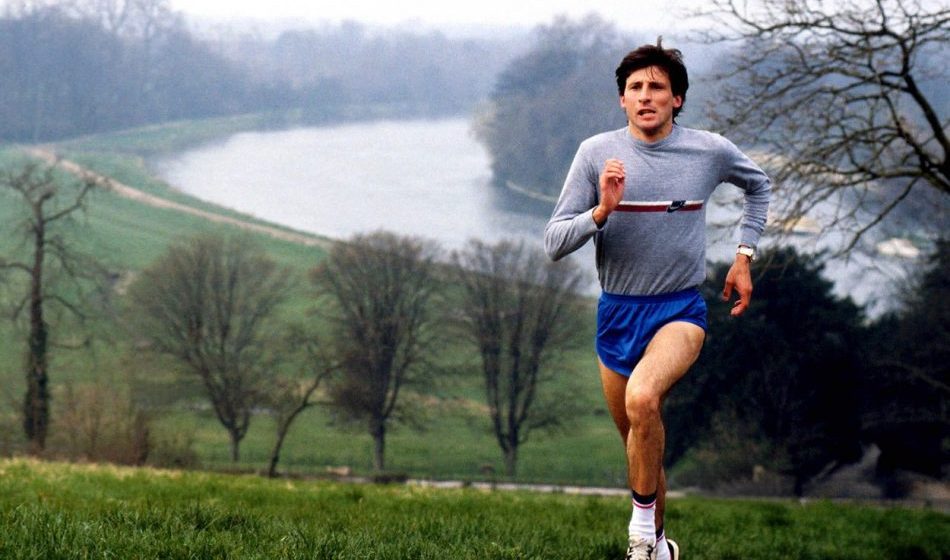
What was Seb Coe's weight room/strength regimen during his base phase? I'm curious because I think I'd like to implement some of his body weight work and perhaps some of his kettlebell routines.
I'm not sure about lifting, but if he did lift, it was light with lots of reps. What he did do, under the direction of George Gandy at Loughborough was box drills, high knees, and lots of other strength-building exercises. If you're really interested in Coe's training, see if you can find interviews from that period where he talks about being coached by his father and working with Gandy in the winter.
I'm not sure about lifting, but if he did lift, it was light with lots of reps. What he did do, under the direction of George Gandy at Loughborough was box drills, high knees, and lots of other strength-building exercises. If you're really interested in Coe's training, see if you can find interviews from that period where he talks about being coached by his father and working with Gandy in the winter.
“Weight training, including barbell curls and bench pressing, was complemented by both circuit and stage training (circuits require exercises to be performed in rotation, stage training requires the same exercise’s reps and sets to be completed before moving onto a different exercise). Plyometric work included box jumps which developed the remarkable power, balance and co-ordination which Coe would become famed for as the 1980s progressed.”
It's often quoted that Seb did "circuit" training, and I've always been a bit skeptical about that claim. In today's world, circuit training usually implies some form of HIIT, as in, short rest between bouts. The above linked article says "circuits require exercises to be performed in rotation, stage training requires the same exercise’s reps and sets to be completed before moving onto a different exercise".
As we know, training terminology changes over time and is never really set in stone. I could be totally wrong, but I think they really are just describing supersets. That is, more than one exercise paired together and alternating them. I do this all time. Squat 5 reps, do 3 box jumps. Do this for 6 sets. The difference between this and the contemporary definition of circuit training is that I take sufficient rest to perform the squats and jumps at a very high (relative) level. If you take short rest, you won't squat much weight and you won't jump as high. Doing tons of box jumps on tired legs won't improve your explosiveness very much, it will increase your ability to remain explosive under fatigue, but that's exactly what all of his running training is for. And his running training is definitely more specific to the task at hand than the weight training. IDK just rambling.
Maybe I'm wrong. But also, Seb wasn't known for being the most honest about all of his training.
The Loughborough Circuit of the late 1970?s 1) One warm-up loop was made on the circuit with 10 repetitions at each station, and only one rope climb. 2) Fifteen minutes of supervised stretching. 3) Two loops of the circuit were undertaken with 30 seconds spent at each station, 15 seconds were allotted for movement between stations, with an additional 10 minute recovery before susequent loops. Circuit Stations 1) Rope Climb. 2) Reverse Splits 3) Balance Beam Rebound Jumps. 4) Back Extensions. 5) Continuous One Legged Step-ups. 6) Parallel Bar Dips. 7) Depth Jumps from vaulting boxes. 8) Push Ups with elevated feet. 9) Low Thrusts (Sprint Starts). 10) Leg Raises while hanging from wall bars. 11) Bent Knee Sit-Ups. 12) Bounding. 13) Burpees.
I'm not sure about lifting, but if he did lift, it was light with lots of reps. What he did do, under the direction of George Gandy at Loughborough was box drills, high knees, and lots of other strength-building exercises. If you're really interested in Coe's training, see if you can find interviews from that period where he talks about being coached by his father and working with Gandy in the winter.
Lots of reps meaning 10?
From page 192 of Training Distance Runners vol 1.
Half squats: ranging from 2 sets of 5x200 to 2 sets of 500 each; recovery equal to the duration of one set.
Bent-knee sit ups: alternating straight trunk curls with oblique trunk curls, alternate elbows touching the opposite knee; one set of 200 to 250 reps.
Push- ups (press ups): with feet elevated to incline the lower limbs; 5 sets of 20 reps.
Back extensions: using a chair and either a friend or some immovable object to stabilize both legs; 3 to 4 x20 to 30 reps; no more than 100 per session.
Step-ups: Done onto a box or low sturdy table; 2x10 each with alternate legs; then 2×20 each with alternate legs; done as one continuous set.
Half squats: ranging from 2 sets of 5x200 to 2 sets of 500 each; recovery equal to the duration of one set.
Bent-knee sit ups: alternating straight trunk curls with oblique trunk curls, alternate elbows touching the opposite knee; one set of 200 to 250 reps.
Push- ups (press ups): with feet elevated to incline the lower limbs; 5 sets of 20 reps.
Back extensions: using a chair and either a friend or some immovable object to stabilize both legs; 3 to 4 x20 to 30 reps; no more than 100 per session.
Step-ups: Done onto a box or low sturdy table; 2x10 each with alternate legs; then 2×20 each with alternate legs; done as one continuous set.
This is Coe's travel routine when gym access was not available and possibly during the racing circuit. Though the books are generalized and his father constantly misled the public on training. He cranked out heavier weight stuff (ie. 150-250 lb squats maybe?), there's pictures of it.
This isn't Seb Coe, this is from the Sub 1:50 thread and contains a lot of information from Gag's plyos and lifts for Mid Distance training. All these were compiled from different pages and I just put them all together.
OLDSUB4 wrote:
PLYOS
Consider either weights and plyos....really work and measure your vertical leap as a measure. Between Dec to Feb at your age you should be able to improve it 4-6 inches. Just imagine adding 4 inches to your stride in an 800m -- 150 strides in that race, add 600 inches which is 50 feet or 16 meters....and that just on just throwing your legs out in front of one another! Then add on better conditioning and strength and you should be able to drop the 6-7 seconds you are looking for
1. 25 Squat thrusts -- EXPLODE into them as fast as possible, then come back down into the push-up position slower to recover....amazing how your core improves on this alone.
2. Cleans to work the glut/ thigh....fairly complicated lift, you have to look up somewhere to get a good instruction on this, but essentially you are taking very little knee bend and exploding your hips through with weight resistance. 3*15 to start to get form (4 weeks), then 3*10 (4 weeks) then 3*5 upping the weight. Repeat cycle...
3. lunges with weight....just to check symmetry and stabilizing muscles on each side--I am left leg dominant like most runners (inside leg of the track) so I really needed to concentrate on my right leg to even out...its the one that always got injured!!! Worked the hamstrings, lower quads (inside of knee) well
4. Last were just some box jumps to put it all together...try one leggers and you will know you are fit
Same thing
lower body--for me it was about low reps, high intensity with dynamic strength (ie fast work, not squats) where you start for 5 weeks doing 3*10 reps, then 5 weeks at 3*8 reps, then 5 weeks at 3*5 reps for the following:
Cleans Lunges (each leg) Leg extension Box jumps (more of a plyo but i did them in the weight room)
PLYOS AND VERTICAL LEAP Focus on your vertical leap. This is a way to see what is working for you best, as it should improve dramatically with some sort of power training, whether it be hills, plyos, or weights. Test every 2-3 weeks to measure. If you can improve by 5 inches imagine what that does to your stride length all else being equal.
I agree with your basic idea that you start "at the top of the pyramid" and work the highest resistance, lowest rep first and build out. You might 3 sets of 6-10 reps of cleans to hypertrophy, then work into plyos where you are doing 25 reps of bounding, stair jumps etc, then into hills where over 20-25 second effort you are taking 40-50 strides....then you are ready for 100-200m striding.
The other thing is to just be really honest about each of our potential. Speed is VERY genetic, and while you can improve it, alot is nervous system wiring, FT concentration, and natural ability. Bob Kennedy truly could not run under 52-53 for the quarter, could not break 1:50 for the 800m, ran "only" 3:56 and set all the American records north of that other than the 10k (which he would have in his prime my guess).
Half squats: ranging from 2 sets of 5x200 to 2 sets of 500 each; recovery equal to the duration of one set.
Bent-knee sit ups: alternating straight trunk curls with oblique trunk curls, alternate elbows touching the opposite knee; one set of 200 to 250 reps.
Push- ups (press ups): with feet elevated to incline the lower limbs; 5 sets of 20 reps.
Back extensions: using a chair and either a friend or some immovable object to stabilize both legs; 3 to 4 x20 to 30 reps; no more than 100 per session.
Step-ups: Done onto a box or low sturdy table; 2x10 each with alternate legs; then 2×20 each with alternate legs; done as one continuous set.
This is Coe's travel routine when gym access was not available and possibly during the racing circuit. Though the books are generalized and his father constantly misled the public on training. He cranked out heavier weight stuff (ie. 150-250 lb squats maybe?), there's pictures of it.
However I was responding to the question regarding how many reps in the circuit. The poster stated/asked "10?"
The book shows him squatting and states that he usually did 5 reps.
Yes these 30 pages of strength training are very general and are confusing if someone thinks that they will be able to replicate his strength program.
This is Coe's travel routine when gym access was not available and possibly during the racing circuit. Though the books are generalized and his father constantly misled the public on training. He cranked out heavier weight stuff (ie. 150-250 lb squats maybe?), there's pictures of it.
However I was responding to the question regarding how many reps in the circuit. The poster stated/asked "10?"
The book shows him squatting and states that he usually did 5 reps.
Yes these 30 pages of strength training are very general and are confusing if someone thinks that they will be able to replicate his strength program.
I really think he did pretty standard weight training most of the time. Medium to heavy weight (1–1.5xbodyweight) for low to medium reps (3–8). Maybe he did these insane circuits way way in the offseason to get a little anaerobic fitness and general conditioning in and mix it up and have some fun. But no way was he doing 500 squats and then cranking hard reps on the track.
Hard to tell what the weight is, but it's not some super light circuit. Assuming the larger plates are 25s and the smaller plates are 5s that looks like 185lb total.
However I was responding to the question regarding how many reps in the circuit. The poster stated/asked "10?"
The book shows him squatting and states that he usually did 5 reps.
Yes these 30 pages of strength training are very general and are confusing if someone thinks that they will be able to replicate his strength program.
I really think he did pretty standard weight training most of the time. Medium to heavy weight (1–1.5xbodyweight) for low to medium reps (3–8). Maybe he did these insane circuits way way in the offseason to get a little anaerobic fitness and general conditioning in and mix it up and have some fun. But no way was he doing 500 squats and then cranking hard reps on the track.
Looking through Peter Coe's book Winning Running he mentions weight traing as well as the circuit traing and stage training. The 7 lifting exercises he supposedly did, with not many reps and sets, were: barbell curls, bent-arm pullovers, barbell bench press, barbell half-squat, barbell alternated front lunges, vertical rowing, barbell step ups (moderate load). Coe states they "are not maximum lifts and are designed to develop strength and endurance."
He also gives us calendars showing strength training done each time of the year. The stage/circuits were not done during the competitive season. It seems that in April he did "pyramid lifting reaching 90-95% max."
It's often quoted that Seb did "circuit" training, and I've always been a bit skeptical about that claim. In today's world, circuit training usually implies some form of HIIT, as in, short rest between bouts. The above linked article says "circuits require exercises to be performed in rotation, stage training requires the same exercise’s reps and sets to be completed before moving onto a different exercise".
As we know, training terminology changes over time and is never really set in stone. I could be totally wrong, but I think they really are just describing supersets. That is, more than one exercise paired together and alternating them. I do this all time. Squat 5 reps, do 3 box jumps. Do this for 6 sets. The difference between this and the contemporary definition of circuit training is that I take sufficient rest to perform the squats and jumps at a very high (relative) level. If you take short rest, you won't squat much weight and you won't jump as high. Doing tons of box jumps on tired legs won't improve your explosiveness very much, it will increase your ability to remain explosive under fatigue, but that's exactly what all of his running training is for. And his running training is definitely more specific to the task at hand than the weight training. IDK just rambling.
No, he did circuits. The Loughborough circuit. Look it up.
And that photo from the AW article is Coe doing perhaps the most effective and specific form of weight training for MD/LD athletes: hills.
I went to Loughborough University and did George Gandys circuit training and weight training. Coe followed Gandys circuit sessions and weights while he was there. I was there a long time after Coe but George said to me it was still broadly the same program Coe followed.
Weight sessions were on Monday. They consisted of:
Squats, cleans and bench press all with free weights, pull ups and dumbbell work including sprinters arms and shoulder press. Some core work. The free weights would start in the base phase with 2 sets of 8-12 reps of relatively light weights to allow the body to adjust to lifting and get used to the exercises. It would then progress to 3 sets of 8 with heavier weights and then to 4 sets of 4-6 reps with heavier weights. We did lift pretty heavy.
A couple of miles warm up and warm down was a good way to introduce double days in training for people start uni who had never done that before.
As track season approached the Monday night weights would be replaced by a running drills and speed development session on the track.
Circuits were on Wednesday. I can't remember all the exercises but they were all body weight ones and included a couple of press ups variations, a couple of sit up variations, dips, box jumps, lunges, calf raises, a calf plyometric jumping exercise, glute bridges, rope climb using two ropes with one hand on each rope to pull yourself up, other some core exercises.
It would start with 2 sets of each exercise with 20 seconds on and 40 seconds recovery and gradually progress to 3 sets of 40 seconds on with 20 seconds recovery. The plyometric exercises were not done for the full time period. The circuit session was again a good way to introduce doubles with a couple of miles warm up and down around the session. Circuits stopped when outdoor track started.
Help us build the best running shoe review site for a chance to win a LetsRun t-shirt.Help us build the best running shoe review site for a chance to win one of 10 LetsRun t-shirts.