Have you run the course? It’s almost a straight line. Crossing the road a few times saves a negligible amount and that is permissible in every majors race I’ve run. Chicago draws a blue line on the course where they measured and you can easily cut better tangents than the measured line. As I said - the root issue is that the turn around is placed in the wrong location.
-
56
-
Some of the responses on this thread remind me of the Netflix movie "Don't Look Up" from a couple years ago
41 -
I’ve run the last two years and studied the cert and my GPS tracks. Christopher995 is spot on here. It’s the turnaround point.
This post was edited 8 minutes after it was posted. Reason provided: Spelling30 -
I guess I’ll also add that I inquired about this “apparent” “possible” shortage due to the turnaround point on the post-race feedback survey, in the most respectful way I could manage. No response from the RD as of yet. It’s disappointing, bc again I agree w/Christoper995 above that it’s an otherwise great race. I really hope they get their act together on this.
This post was edited 56 seconds after it was posted. Reason provided: spelling :/20 -
Now before I ask this, I’d like to get ahead of the fact that I expect other posters here to once again harp on the fact that I appear to be questioning any possibility that the course is short, even if all I’m trying to do is ask reasonable questions because I’m genuinely interested in the answers (fwiw, I also mentioned the potential course measurement issue in the post-race feedback survey and reached out to the race organizers separately and hope they respond).
But if it’s a turnaround issue, have you noticed weird mile 13/14 splits if you’ve used manual laps on your watch instead of auto laps? I used auto laps when running the race so I can’t really say. I did see one poster earlier in this thread say that they did manual laps and didn’t notice anything off, though, which seems a little odd if the turnaround is up to 0.1 miles short of where it should be.
10 -
I agree with you that the turnaround definitely looks short when comparing Strava to the course measurement on the USATF certification, but just find it a little odd that if it’s been the case for several years nobody’s mentioned weird manual splits.
10 -
AnonymousRun wrote:
Now before I ask this, I’d like to get ahead of the fact that I expect other posters here to once again harp on the fact that I appear to be questioning any possibility that the course is short, even if all I’m trying to do is ask reasonable questions because I’m genuinely interested in the answers (fwiw, I also mentioned the potential course measurement issue in the post-race feedback survey and reached out to the race organizers separately and hope they respond).
But if it’s a turnaround issue, have you noticed weird mile 13/14 splits if you’ve used manual laps on your watch instead of auto laps? I used auto laps when running the race so I can’t really say. I did see one poster earlier in this thread say that they did manual laps and didn’t notice anything off, though, which seems a little odd if the turnaround is up to 0.1 miles short of where it should be.
I too inquired about the possible short distance but heard nothing back. As for my mileage my Garmin was pretty spot on for the first half. The second half it definitely was off but I can't remember if it was hitting miles sooner than the markers or after. I also don't know exactly where this started to occur but I'm pretty sure it was after the turnaround. With how short and how tight that turnaround was I'm inclined to believe that was the issue. From what I recall of that point they couldn't have made it any longer before turning around.
00 -
I’m not positive but from what I remember my GPS seemed slightly short since the beginning, but I could be misremembering. I don’t recall that the turnaround was at the furthest possible point but if that is the case then I’m not sure how the certified measurement would’ve had it at a further spot.
Idk, I’m definitely partially in denial that the course was short lol but do believe these are all very valid questions to ask.
00 -
It’s why I’m specifically curious about anyone who was doing manual laps on their watch. That would be the best determinant of whether the turnaround was off.
10 -
AnonymousRun wrote:
It’s why I’m specifically curious about anyone who was doing manual laps on their watch. That would be the best determinant of whether the turnaround was off.
I wish at least they would respond to the inquiries they've gotten.
30 -
Yup, definitely frustrating
20 -
Christopher995 wrote:
It’s not about tangents - that’s just good running. If you look at the certified USATF course - they are not placing the 13.1 turn around in the right place - it should be a couple hundred feet further down the road lining up with the house on the left.
With that said, this is a great marathon - I’m just not sure why year after year they get by with marking the course wrong.
I actually said this in a reply about two weeks ago, and everyone ignored it. Turned around had to be in the wrong spot.
00 -
AnonymousRun wrote:
I agree with you that the turnaround definitely looks short when comparing Strava to the course measurement on the USATF certification, but just find it a little odd that if it’s been the case for several years nobody’s mentioned weird manual splits.
It hasn’t been several years. I ran in 2018 and got 26.3x from the GPS. Turnaround then was further north. The course was changed in 2022: turnaround point was moved south due to road erosion. Supposed to have been compensated by going further south in the first few miles. Point is, the shortage is new for these past two years with the updated course. I recognized it after last year and had just assumed/hoped they’d fix it given that the erosion problem was likely dealt with. No such luck.
20 -
Maybe it’s been worse than usual the last couple years but there were posters in this thread who said they got distances < 26.2 when they’ve run the course before last year as well (I think the Bohannon poster had said in both 2017 and 2019).
00 -
Mittenxc wrote:
The course is legit. Gps is wierd and not to be believed all the time. Great tool but not always accurate. How many times have you done a run with somone and finished and not had same distance? Probably more often than not. The course follows the road along the lake and has lots of gentle turns following the contours of the shore. Gps will sometimes connect straight line dots and not catch the total distance you are running. Essentially you are running a squiggly line and the gps doesn't follow that precisely be cause it doesn't re ORD every second. So when it dies ville t a data point it will just draw a straight line firm the last point. Running a single track trail in the woods with lots of tree cover will exasperate this even more. People in my strava feed were between 26.09 and 26.22. I've run the race previously and found it to be accurate. No mile markers off or wierd splits if you are just using the mile markers instead of your watch which I've done. Weather last 2 years has been just about perfect and the times reflect it. This is a great race. Getting out to the start of the half using the bussing they provide can be interesting but when we ran the half we had somone take us out there and drop us. The full starts and finishes in same spot.
Do the mile markers have clocks like at other races? Cbus had clocks and then removed them. The reason I ask is the clocks can be compared against the Strava to see if there are HUGE discrepancies.
00 -
Whatever28 wrote:
Let’s be honest here. We all love a short course rather than a long one, especially in those podunk 5Ks where measurements are likely to be off anyways. Looks good on your Athlinks! And I don’t post to Strava so I don’t care.
If you’ve ever ran a long course (I once ran a “10k” that measured 6.53 miles and there were no mile markers on the course) you know awful it is, as you start pushing/kicking way too early and ended up dying out in the last half mile.
So congrats to the winner of Bayshore. He beat his competition and that’s all that matters. It’s not like he hopped on the back of the course biker and took a few miles off.
I'm surprised nobody has posted the course vid yet.
00 -
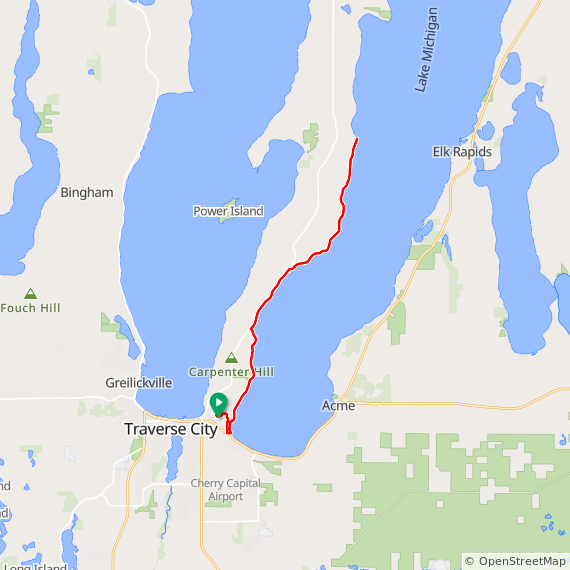
also here is the interactive map:00
-
theSameGuyWhoWonIt wrote:
Suspicious: no. I treat GPS like a mild curiosity, and when it's off, I think nothing of it. After all, the simple difference in running straight lines vs. drifting around etc. accounts for enough discrepancy that it isn't really worth wondering about. Have you seen DCRainMaker's GPS comparisons between watches? He will wear 6 watches at one time and show you the GPS data... just not something I consider authoritative on precise measurements.
Most runners knew the course: I knew it as well--that racers ought to run on the right side of the road--because of the other runners on the course. I had no inkling that there was any cause for concern if a runner drifted to the inside of curves. Also, I don't recall ever consciously thinking "I'm going to run on the other side of the road because it will be faster even though I shouldn't." As I've stated previously, I have a firmly ingrained instinct to run the shortest possible course available to me. Even then, for very nearly the entire time, there were runners coming at me on the left side of the road, so if I were to estimate how much time I actually spent on the left side vs. the middle, it would be quite a bit less than the theoretically possible amount of distance.
One of the most notable missing links in the entire argument about the runners cutting this short is the fact that you are all assuming the runners must have been optimizing every moment of the race. There is a long list of reasons why that isn't likely, not least of which is the fact that there is just as much photo evidence of us running right next to the other runners in the middle. But hard data aside, the bottle tables were on the far right side, and navigating to those required not only being on that side, but also weaving through the half marathon runners who were all on that side. It's probably no more than a miniscule contribution, but I contend that the opposite contribution was also minimal. Overall, the entire argument here hinges on a premise that is so particular that I just find it statistically unlikely.
Namely this: you claim that the abundant proof of concern is in the fact that all the GPS data from runners is short enough to raise concern AND that photo evidence of runners running in restricted areas further proves the point. But we've already confirmed that a great many runners followed only the righthand side of the course and yet still ended with just about the same distance discrepancy. The most logical conclusion is usually the right one, and it remains true that the most logical conclusion is that the GPS data is skewed and that whatever potentially minimal advantage a runner gained by small amounts of time cutting the curves shorter, that advantage was likely returned in fairly equal measure in other instances.
Remember the numbers--my previous note about a 0.5% advantage was a liberal estimation. In reality, it is likely more around 0.3%. That's margin of error territory.
The rule with such deliberations, as always, is that you will never convince your opposition to change their mind, but as stated, I hope those who ran it and are seeing this thread see enough clarity here to feel justified in their great performances and dismiss these narrow criticisms.
If this is truly the winner, thank you for your insight! I'm considering adding it to my bucket list of marathons to run for fun down the road.
Logistically is it an easy race to prep for in terms of hotels and travel? I live in Cbus. It sounds sorta like Grandma's in that sense, a scenic course along a body of water and chances at good weather.
10 -
Baywatch Marathon wrote:
Did the half marathoners coming the other way have to go to the marathon side to get their water bottles? It sounds crazy that they were coming the other way and had to cross over to get water. Why not have water on both sides?
00 -
AnonymousRun wrote:
Now before I ask this, I’d like to get ahead of the fact that I expect other posters here to once again harp on the fact that I appear to be questioning any possibility that the course is short, even if all I’m trying to do is ask reasonable questions because I’m genuinely interested in the answers (fwiw, I also mentioned the potential course measurement issue in the post-race feedback survey and reached out to the race organizers separately and hope they respond).
But if it’s a turnaround issue, have you noticed weird mile 13/14 splits if you’ve used manual laps on your watch instead of auto laps? I used auto laps when running the race so I can’t really say. I did see one poster earlier in this thread say that they did manual laps and didn’t notice anything off, though, which seems a little odd if the turnaround is up to 0.1 miles short of where it should be.
The RD might not be aware of LRC. We are an obscure website. So he might not get many responses about it.
01
What People Are Talking About On LetsRun
No top threads at the moment. Check back soon.