To add, on a quick scan, none of the claims in that patent seem to describe the shape of the plate in the current shoes.
To add, on a quick scan, none of the claims in that patent seem to describe the shape of the plate in the current shoes.
Abdoujaparov wrote:
I read your article and it was very informative!
Do Nike really have a patent on a shape though? I'm not disputing it but i would be fascinated to read that.
Nike has a patent on a lot of it. The curvature of the plate, and also the manufacturing around embedding the plate WITHIN the midsole.
The other companies shoes have the CF plate in different locations.
NB Fuelcell 5280 is directly underneath the foot, on top of the foam
Skechers racing flat is between the rubber and the foam.
Not sure about Saucony/Brooks/Asics protos or Hoka models.
Without the ability to use the whole midsole volume because the plates sit on the top or bottom- the extreme curvature cannot be taken advantage of, which is one of the "tricks" of the vaporfly.
https://www.outsideonline.com/2400514/nike-vaporfly-carbon-plate-presentationI don't know why others have not used PEBAX foam, but my assumption is has to be something legal related as well, or that it is too unstable with the plate at the bottom, or not as effective with the plate on the top
Still haven't seen said patent though.
UA Runner wrote:
zzzz wrote:
Nike has a patent over the part that gives them an advantage over other carbon plated shoes, the extreme curve shape of the shoes. In the current IAAF rules, there is Note (ii) that you didn't copy and paste into your comments along with the main part of the rule. It is here:
Maybe. But Nike isn't winning in the international elite ranks because they have a better curve than Hoka, it's because 9 out of 10 elite runners are wearing Nikes. And when Vaporfly mania started up, there wasn't such dominance yet.. people were responding to Nike's marketing, the breaking2 thing and Kipchoge's dominance.
Contrast the United States, where the shoe contracts are more diverse, you don't see Nikes winning everything.. amongst the American field that is.
Yes, Nike has winning those races because they have the athletes, but their shoe is also faster, and it's due to the patent. Read the media reviews and user reviews of the Hoka Carbon Rocket or Carbon X and other carbon plated shoes like the Skecher prototype, you'll see statements that, reading between the lines, match up with well with things in the Nike study on shape of different shoe plates. Flatter plates, which other companies have to use due to the Nike patent on the extreme curve version, increase ankle push-off moment over non-plated shoes, unlike the extreme curved version, so you need to use more calf. Flatter plates also don't save as much energy in the big toe joint. That's why after the Vaporfly came out, other companies rushed to try to copy it, but were very slow in releasing stuff (see long time before Hoka Carbon Rocket's rumors vs. release, and then poor reviews when compared to Vaporfly). They were tweaking and tweaking the prototypes, but couldn't get the same result without violating the patented shape.
Abdoujaparov wrote:
To add, on a quick scan, none of the claims in that patent seem to describe the shape of the plate in the current shoes.
That is the shape of the plate in the current shoes. Ignore that they call it "spring plate". Whether or not is a spring or not isn't really important. Other companies can't copy that shape in their carbon plates.
"front portion of the spring plate in the forefoot region is downwardly bent relative to a rear portion"
Hutchinson's other article linked above implies strongly that the current plates are "upwardly bent"
At the symposium last week, a team led by Nike’s Emily Farina finally presented some of this kind of data; the abstract is published in Footwear Science. The results show a comparison between four Vaporfly-style shoes, identical in all respects except the carbon fiber plate. One had no plate; one had a nearly flat plate; one had a moderately curved plate; and one had an extremely curved plate akin (from what I can tell) to the actual shoe. The study used a force-measuring plate and 3D gait analysis to assess the mechanics of the ankle and metatarsophalangeal (MTP, but let’s just call it the big toe) joints in five runners.
I am going to cut open an old pair tonight. I will report back!
all mizuno shoes use pebax foam. There are different densities I guess and whays to use it.
Positive Contribution wrote:
HRE wrote:
The Vaporfly will not be banned. Nike has a lot of money, time, and effort invested in creating and marketing that shoe. Nike owns the sport and will not let the people who supposedly run it ban the Vaporfly.
Whether or not it should be banned is a matter of opinion. The problem with technological advances in a sport like athletics is that it makes comparisons of performances difficult. But we generally live with that as a rule though there is precedent for banning a shoe. My memory of this is very hazy, but one company, I think it was Puma, made a track shoe that had brushes in the place where spikes would normally be. Again, I'm very hazy on this, but I believe the brushes were supposed to perform better on the new at the time synthetic tracks than conventional spikes did and they were banned for giving an unfair advantage. Normally though, technology is accepted and even embraced. No one wants to bring back cinder tracks or bamboo vaulting poles, and most people get excited by indoor performances turned in on the new, high tech, tracks.
But the difference between those technologies and something like the Vaporfly is that the new technologies are available to every competitor. It's not like some pole vaulters got to use fiberglass while others had to keep using steel or bamboo. Everyone racing at the BU track or the one at Reggie Lewis Center benefits from those tracks. But the realities and economics of the sport mean that not everyone can race in Vaporflys and if the company some people run for has not created a show that gives a comparable boost, and perhaps cannot do so because of patent laws, those in the Vaporfly have an advantage. I think that is a situation that should be scrutinized, though I cannot believe that it will be.
So what about the Nike Zoom Victory possibly being superior?
I don't know. Superior to what?
https://patents.justia.com/inventor/geng-luoAbdoujaparov wrote:
Still haven't seen said patent though.
Have at it. Geng Luo is a primary mastermind behind the Vaporfly. A lot of the patents he will be on.
I'm not the one insisting Nike have a patent on the shape of the carbon plates currently used in this line of shoes. I acknowledge it's probably out there but surely one of the many people who know this for a fact can just send a link?
Abdoujaparov wrote:
I'm not the one insisting Nike have a patent on the shape of the carbon plates currently used in this line of shoes. I acknowledge it's probably out there but surely one of the many people who know this for a fact can just send a link?
It took 1 minute to dig through and find it. They probably have others, but my guess is this is it.
https://patents.justia.com/patent/20190283355"predetermined shape" last part of abstract.
side tangent- shoutout to person above mentioning pebax used elsewhere. I didn't realize it was so widely used.
https://www.pebaxpowered.com/en/find-product/running/So what is different about the PEBAX that Nike uses? Obviously it is the softest available. Did they develop to blow it out and have protection over that? Or has just no one else determined how to blow it out (inject air to make more soft and flexible)?
I think you're right (chapeau). Wish the drawings were accessible.
https://patents.google.com/?inventor=geng+luo&oq=inventor:(geng+luo)+Abdoujaparov wrote:
I think you're right (chapeau). Wish the drawings were accessible.
looks like searching the patents through google has access to the images.
zzzz wrote:
Abdoujaparov wrote:
This is the text (with my annotations in brackets):
Athletes may compete barefoot or with footwear on one or both feet. The purpose of shoes for competition is to give protection and stability to the feet and a firm grip on the ground. [The preceding sentence is bad drafting (and I say that as someone who drafts for a living). If it's not clear what purpose language serves it shouldn't be there. Nowhere in the rules is the specified "purpose" of shoes given any meaning. Deviating from that purpose doesn't mean they're illegitimate, Hewing to that purpose doesn't make shoes automatically legitimate. Bad bad bad.] Such shoes, however, must not be constructed so as to give athletes any unfair assistance or advantage. [There's no way to say $110 shoes that return X% of energy are fair and don't convey an advantage over a barefoot runner but $250 shoes that return X+10% don't. People want to see wiggle room here but there isn't any. Nike wins any litigation on this point. If you want to regulate their shoes you need tighter rules] Any type of shoe used must be reasonably available to all in the spirit of the universality of athletics. [This is the new bit but again you won't win a price based argument here if the delta is $100-$150 (and no-one's claiming that if Kosgei won in the Alpha%s that would have been ok).]
Here is how I think this portion of the rule should be interpreted and dealt with: "Such shoes, however, must not be constructed so as to give athletes any unfair assistance or advantage"
First of all, it's about the top of the sport. IAAF rules like whereabouts dope testing is really about the top of the sport. So, shoes for hobby joggers isn't really a concern. The "unfair advantage" isn't about $100 shoes vs. $250 shoes. It's also not about historical comparison, like the people here suggesting that any shoe is an advantage over barefoot, so it should be a free for all. It's about runners with different shoe sponsors being on a level playing field.
You might say that other shoe companies also have or are developing carbon plated distance running shoe, so all is fair. However, all the reviews of shoes like the Hoka carbon shoes or the Skechers, etc. indicate that they don't measure up to the Vaporfly models.
Nike has released a study showing how their shoe has an advantage over other shoes, including other carbon plated shoes. I've linked an Outside Online summary article in comments in other threads, but no one has said a word indicated that they've looked it it, so I'll summarize it instead. The study compared four otherwise identical shoes: A shoe with an extremely curved carbon plate (Vaporfly), the same shoe with a moderately curved carbon plate, and the same shoe with a flat carbon plate, and the same shoe with no plate. The extremely curved plate was quite a bit better than the other designs. The relative deficiencies with the flat plate design sounded a lot like what reviewers of the Hoka carbon plated shoes say, when compared to Vaporfly variants.
Nike has a patent over the part that gives them an advantage over other carbon plated shoes, the extreme curve shape of the shoes. In the current IAAF rules, there is Note (ii) that you didn't copy and paste into your comments along with the main part of the rule. It is here:
Note (ii): Where evidence is provided to the IAAF that a type of shoe
being used in competition does not comply with the Rules or the
spirit of them, it may refer the shoe for study and if there is
non-compliance may prohibit such shoes from being used in
competition.
Nike's own study should be submitted to the IAAF as evidence that it doesn't comply with the rules or the spirit of them, because it gives Nike runners an "unfair assistance or advantage" over other shoe sponsored athletes. I suggest that there are two ways for the IAAF to respond. One could be to prohibit the extremely curved plate. However, that's already years out of the bag. Instead, I think they need to pressure Nike to release that extremely curved plate patent for use by other shoe companies in exchange for not having it banned. Whether that patent should be released for a free or a nominal fee doesn't matter so much to me, but it needs to be in the hands of the other shoe makers who are struggling to get their flatter carbon plates to actually work well. That's how I interpret fairness under "Any type of shoe used must be reasonably available to all in the spirit of the universality of athletics. " In this case I see "type" as the extremely curved carbon plate that Nike uses, not a specific model (or banning prototypes that some here seem to want to do).
This seems to simple but I think its a pretty solid case if it was purely a legal argument.
Abdoujaparov wrote:
Hutchinson's other article linked above implies strongly that the current plates are "upwardly bent"
At the symposium last week, a team led by Nike’s Emily Farina finally presented some of this kind of data; the abstract is published in Footwear Science. The results show a comparison between four Vaporfly-style shoes, identical in all respects except the carbon fiber plate. One had no plate; one had a nearly flat plate; one had a moderately curved plate; and one had an extremely curved plate akin (from what I can tell) to the actual shoe. The study used a force-measuring plate and 3D gait analysis to assess the mechanics of the ankle and metatarsophalangeal (MTP, but let’s just call it the big toe) joints in five runners.
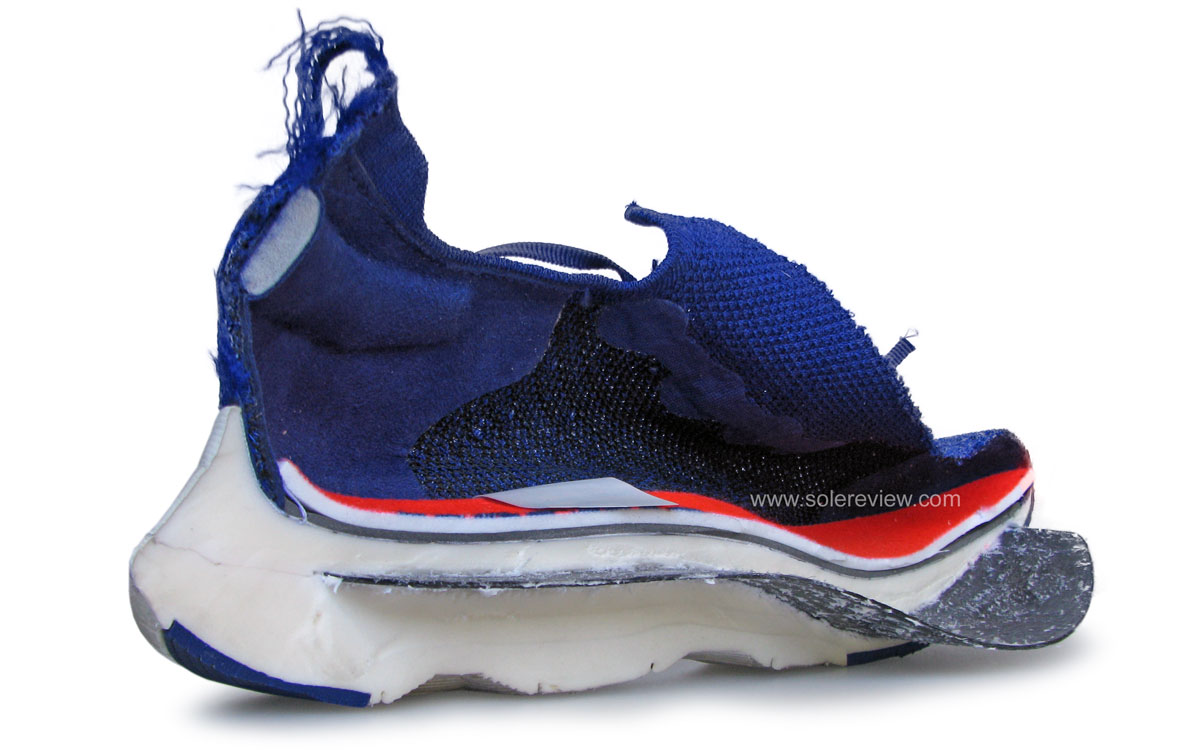
I am going to cut open an old pair tonight. I will report back!
No, the Vaporfly 4% and Next% are both bent downward going into the forefoot, just as the patent describes. I haven't read that other Hutchison article, but "upwardly bent" or downward could be the difference between looking from the front to the back or the back to the front.
Many people have cut the shoes open. You can cut them out of the shoe to see for yourself - looking forward to your report.
The black line painted on the side of the 4% midsole pretty much traces the shape of the plate, and the character line in the Next% midsole looks like it might too. If the Next % character line does in face trace the shape of the plate, it looks like the plate in the Next% is even more curved than the 4%. I'd like to see a comparison of the shape of those two plate when dissected from the shoes.
https://www.solereview.com/wp-content/uploads/2019/06/Nike_Vaporfly_4_Flyknit_cut_open.jpghttps://www.solereview.com/nike-vaporfly-4-flyknit-review/The IAAF will investigate, but it is headed by Sebastian Coe, a long-time Nike employee, so who knows?
A ban is appropriate of all spring-like shoe effects.
zzzz wrote:
Abdoujaparov wrote:
I read your article and it was very informative!
Do Nike really have a patent on a shape though? I'm not disputing it but i would be fascinated to read that.
It's not my article, but thanks for reading it. Yes, Nike has a patent on the spoon shape of the carbon plate. The patent has been mentioned in the LR forum many times since the Vaporfly came out, but people here never focused on the curved shape. The inclination has been to think carbon plates are all the same. But according to the Nike study, the magic is in the curved shape of the carbon plate, where it dips suddenly on the forefoot end. That's why they patented the shape in the first place. Carbon plates have been used in running shoes before, so the mere presence of the carbon plate isn't patentable.
Here's the description of the plate shape in the patent:
"The spring plate may extend through at least medial forefoot and medial midfoot regions and may have an unloaded shape in which a front portion of the spring plate in the forefoot region is downwardly bent relative to a rear portion of the spring plate located rearward of the front portion."
They have several embodiments of what is patented, with an inner sole (midsole) and without (presumeably track spikes), and also a removeable plate version, but all have that same shape.
That shape decreases work done by the big toe joint more than flatter plates, and doesn't have the disadvantage of increase ankle moment (over no plate) that flatter carbon plates do.
https://patents.google.com/patent/WO2016179265A1/en
Download the pdf. Read the descriptions and claims if you will but at all means, go past page 34 and look at the drawings. Downward bend is just downward bend, which is the opposite of the shape of the vaporfly. This patent is actually for a flat or spike with an agressive camber which the athlete has to load in order to get even flat against the track.
I am absolutely positive this patent does not protect the design of any of the vaporflies.
zzzz wrote:
Yes, Nike has winning those races because they have the athletes, but their shoe is also faster, and it's due to the patent. Read the media reviews and user reviews of the Hoka Carbon Rocket or Carbon X and other carbon plated shoes like the Skecher prototype, you'll see statements that, reading between the lines, match up with well with things in the Nike study on shape of different shoe plates. Flatter plates, which other companies have to use due to the Nike patent on the extreme curve version, increase ankle push-off moment over non-plated shoes, unlike the extreme curved version, so you need to use more calf. Flatter plates also don't save as much energy in the big toe joint. That's why after the Vaporfly came out, other companies rushed to try to copy it, but were very slow in releasing stuff (see long time before Hoka Carbon Rocket's rumors vs. release, and then poor reviews when compared to Vaporfly). They were tweaking and tweaking the prototypes, but couldn't get the same result without violating the patented shape.
Well then.. if that is the case, I stand corrected! Patenting the curvature isn't the issue, as they can sell it. But yeah, if the IAAF finds that this patented part of the shoe gives Nike and unfair advantage, then I could see it technically being illegal for competition.. I think? On the surface that sounds right. Trying to think of other shoe companies that have patented parts in their shoes that could give an unfair advantage.
It would take a lot of lab testing to prove this one way or another. Curious how close you can get to the same curvature without infringing on the patent.. because maybe you could make a plate that's almost as effective. I dunno. Cool find though!
And it would probably take a good legal team to build the case and present it with enough evidence that the IAAF can't ignore it. Who would want to do this on their own dime, however, is beyond me.
Patent reader wrote:
zzzz wrote:
It's not my article, but thanks for reading it. Yes, Nike has a patent on the spoon shape of the carbon plate. The patent has been mentioned in the LR forum many times since the Vaporfly came out, but people here never focused on the curved shape. The inclination has been to think carbon plates are all the same. But according to the Nike study, the magic is in the curved shape of the carbon plate, where it dips suddenly on the forefoot end. That's why they patented the shape in the first place. Carbon plates have been used in running shoes before, so the mere presence of the carbon plate isn't patentable.
Here's the description of the plate shape in the patent:
"The spring plate may extend through at least medial forefoot and medial midfoot regions and may have an unloaded shape in which a front portion of the spring plate in the forefoot region is downwardly bent relative to a rear portion of the spring plate located rearward of the front portion."
They have several embodiments of what is patented, with an inner sole (midsole) and without (presumeably track spikes), and also a removeable plate version, but all have that same shape.
That shape decreases work done by the big toe joint more than flatter plates, and doesn't have the disadvantage of increase ankle moment (over no plate) that flatter carbon plates do.
https://patents.google.com/patent/WO2016179265A1/enDownload the pdf. Read the descriptions and claims if you will but at all means, go past page 34 and look at the drawings. Downward bend is just downward bend, which is the opposite of the shape of the vaporfly. This patent is actually for a flat or spike with an agressive camber which the athlete has to load in order to get even flat against the track.
I am absolutely positive this patent does not protect the design of any of the vaporflies.
I downloaded the pdf, and you are right about that patent. There are numerous other patents though. Maybe the particular curve in the Vaporflies is patented, maybe not. Lets see what we can find out. I'll do some more looking.
How about this patent pending? Without seeing any figures, I think it describes the Vaporfly plate:
Abstract
A plate for an article of footwear having a sole structure includes an anterior-most point disposed in a forefoot region of the sole structure, a posterior-most point disposed closer to a heel region of the sole structure than the anterior-most point, and a concave portion extending between the anterior-most point and the posterior-most point. The concave portion includes a constant radius of curvature from the anterior-most point to a metarsophalangeal (MTP) point of the sole structure. The MTP point opposes the MTP joint of a foot during use.
https://patents.google.com/patent/EP3355737A1/en?inventor=Geng+LUO&page=1