You all mentioned most of the people I thought of: Geb, Kipchoge, Coe, Rudisha, Lopes, Shorter, Kipketer. On the men's side, I would add Khalid Khannouchi and Arturo Barrios. There are fewer people I think of on the women's side, perhaps in part because Gidey is so stunningly good form-wise; but, of recent runners (though arguably not belonging in a distance running discussion), Sydney McLaughlin looks great in an open 400. Perhaps this is obvious, but I have *never* seen an unknown recreational runner that even approaches the form of any of these.
Totally subjective! Almost everything *but* form affects how we feel about a runner. Sydney looks like a Gazelle to many. Nuguse looks like a wounded goose to others. So many styles and forms! Zatopek looked like he was doing stations-of-the-cross. (shift)
Dizzy Gillespie looks like exactly what trumpet players were taught *not to do.* Miles pointed his horn to the floor (except for album covers that did not like his “form.”
Good form is a good thing to teach and recognize. But faulting someone—especially the winner—because you don’t like their stride or arm carriage (as recently was a thread here about a hs girl,s stride) is unfair and fatuous.
This post was edited 55 seconds after it was posted.
Reason provided:
Sp
Running form does matter but I also think having/developing a form that is maxed out and can't be improved further isn't that rare either. So, there isn't a single person with best running form.
What we DID notice though is that people with low back kicks and people who's toes pointed inward during their back kick tended to have better running economy than guys with higher back kicks and toes pointing outward during back kick.
The toes-inward, low-back-kick gait pretty much describes Alberto Salazar's form when he was running his best. I think Jack Daniels said that Salazar had the best running economy of all the runners Daniels tested.
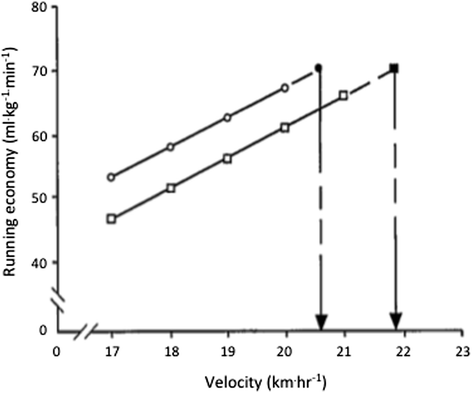
Running economy (RE) is considered an important physiological measure for endurance athletes, especially distance runners. This review considers 1) how RE is defined and measured and 2) physiological and biomechanical factors...
“The lowest reported value for VO2 at 16 km hr−1 is 39.0 ml.kg-1.min−1 in an individual East African runner, capable of running 1500 m in 3:35 with a VO2max of only 63 ml.kg-1.min−1 [19]. However, the current Men’s Half Marathon World Record holder’s (Tadese Zerisenay, 58 min 23 s; VO2max= 83.0 ml.kg-1.min−1) RE was measured at 150 ml.kg-1.km −1 at 19 km.hr−1 (317 m.min−1) which is equivalent to 40.0 ml.kg-1.min−1 at 16 km.hr−1 or 48.2% relative intensity of effort compared to 61.9% of the aforementioned athletes VO2max [26].”
refs [19] and [26] are provided in B&K
On the women's side, there is far less data. Radcliffe had 175 ml/kg/km