Canova and rekrunner back to back? Mr Canova, do you believe managers and coaches should be banned if complicit with doping? Mr Rekrunner, why do you think runners take PED's?
-
30
-
Answer is obvious wrote:
Renato Canova wrote:
Armstronglivs, you don't catch the point. I don't have experience of doping, because I believe in training only. Maybe my athletes could improve with doping, maybe not, because there is no proof of what could happen, everything is pure speculation.
Incredible. In the one sentence you say you have no experience with doping, in the other you say their performance enhancing effects are purely speculative. Just leave this topic to people who do have experience or actually understand the chemistry behind the PEDs.
Secondly, there is never going to be a RCT study comparing doped athletes to natural ones, that is not an ethical study to conduct. That is not an excuse to claim there is no evidence for the efficacy of PEDs, only a moron would suggest that.
You didn't understand what Renato meant.
23 -
Managers and coaches MUST be banned if there is the proof they are part of the organization of the doping of their athletes. This is, for example, what happened in Russia, where the national coaches had specific doping in their training programs for the athletes (I can speak knowing the problem, because in 2016 in Moscow I went for IAAF for 3 days clinic with the Russian coaches for explaining the methodology for long distances without doping).
But honestly I don't know any manager, working with Kenyans, who gives doping to the athletes under contract with his management. The most part of doping in Kenya depends on individual choices, or comes from coaches-not coaches (mainly husbands in case of women), and from doctors and pharmacists who give some illegal substance to the athletes of second level, asking the same percentage of the manager (15 %) in case of prizes athletes can win.
One of the main problems of doping is the mental weakness of athletes who are not fully confident in their qualities, and can be pushed to doping by criminal doctors/pharmacists who take advantage from their weakness and their ignorance.
When we look at big agents, they don't have advantages to dope their athletes, because with doping the managements lose credibility and risks their athletes can't be accepted in several competitions. However, because the organization on the territory, managements with many small training camps (for example Federico Rosa) don't have the possibility to control what all their athletes do, and for that reason sometimes there is somebody using illegal drugs.
At the end, to give responsibility to coaches and managers is a n easy way for trying to move the problem from a (today) widespread individual mentality about doping, and the accusation of foreigner people as main reason of this lack of ethic (something never happened till 10 years ago).
43 -
Renato Canova wrote:
Managers and coaches MUST be banned if there is the proof they are part of the organization of the doping of their athletes. This is, for example, what happened in Russia, where the national coaches had specific doping in their training programs for the athletes (I can speak knowing the problem, because in 2016 in Moscow I went for IAAF for 3 days clinic with the Russian coaches for explaining the methodology for long distances without doping).
But honestly I don't know any manager, working with Kenyans, who gives doping to the athletes under contract with his management. The most part of doping in Kenya depends on individual choices, or comes from coaches-not coaches (mainly husbands in case of women), and from doctors and pharmacists who give some illegal substance to the athletes of second level, asking the same percentage of the manager (15 %) in case of prizes athletes can win.
One of the main problems of doping is the mental weakness of athletes who are not fully confident in their qualities, and can be pushed to doping by criminal doctors/pharmacists who take advantage from their weakness and their ignorance.
When we look at big agents, they don't have advantages to dope their athletes, because with doping the managements lose credibility and risks their athletes can't be accepted in several competitions. However, because the organization on the territory, managements with many small training camps (for example Federico Rosa) don't have the possibility to control what all their athletes do, and for that reason sometimes there is somebody using illegal drugs.
At the end, to give responsibility to coaches and managers is a n easy way for trying to move the problem from a (today) widespread individual mentality about doping, and the accusation of foreigner people as main reason of this lack of ethic (something never happened till 10 years ago).
So it's definitely not the fault of the Italian doctor/manager/coach who makes a lot of money out of exploiting African athletes for their own benefit.
They're the ones you can completely trust. When would an Italian ever be involved in doping? It's almost unheard of.
82 -
Renato Canova wrote:
A moron is who doesn't think possible to beat a WR without doping. This is exactly what happened with some of my athletes. This was not a supposition, but a FACT, and who thinks doping can give big advantage has to explain how was possible to beat some WR in clean way.
Take one of your record-breaking athletes: how can you be sure he couldn't run faster if he doped when you say he has never tried it and you say you have never tried it on your athletes? You are speculating about something that you say neither you nor your athlete has any experience of.
I made the point that as you are not a doctor you will not have the knowledge to know how to treat any of your athletes for sickness, yet you claim to know for a fact that drugs won't aid your athletes when you have no pharmacological or medical expertise. Without that expertise, whether it is medical or pharmacological, you are merely speaking as an amateur - and, what's more, as an amateur with no experience of that which you make pronouncements on. You may be expert on elite training but you know nothing more than the man in the street about performance-enhancing drugs, and less than some.
I'll go with the innumerable athletes who dope, that they know what they are doing, or they wouldn't be doing it in the numbers they do for the decades they have.
This post was edited 1 minute after it was posted.32 -
any1 hear about cole nash and the drug scandal?????
10 -
Renato Canova wrote:
Managers and coaches MUST be banned if there is the proof they are part of the organization of the doping of their athletes. This is, for example, what happened in Russia, where the national coaches had specific doping in their training programs for the athletes (I can speak knowing the problem, because in 2016 in Moscow I went for IAAF for 3 days clinic with the Russian coaches for explaining the methodology for long distances without doping).
But honestly I don't know any manager, working with Kenyans, who gives doping to the athletes under contract with his management. The most part of doping in Kenya depends on individual choices, or comes from coaches-not coaches (mainly husbands in case of women), and from doctors and pharmacists who give some illegal substance to the athletes of second level, asking the same percentage of the manager (15 %) in case of prizes athletes can win.
One of the main problems of doping is the mental weakness of athletes who are not fully confident in their qualities, and can be pushed to doping by criminal doctors/pharmacists who take advantage from their weakness and their ignorance.
When we look at big agents, they don't have advantages to dope their athletes, because with doping the managements lose credibility and risks their athletes can't be accepted in several competitions. However, because the organization on the territory, managements with many small training camps (for example Federico Rosa) don't have the possibility to control what all their athletes do, and for that reason sometimes there is somebody using illegal drugs.
At the end, to give responsibility to coaches and managers is a n easy way for trying to move the problem from a (today) widespread individual mentality about doping, and the accusation of foreigner people as main reason of this lack of ethic (something never happened till 10 years ago).
Recent news: Cole Nash has recently tested positive for several different
NCAA banned narcotics. The NCAA Division 2 athlete with previous All-American titles has
been tested positive for EPO, PEDs, methamphetamines, heroin, LSD, oxycodone, MDMAfentanyl, PCP, cocaine, marijuana, and trebolone. Nash is known for
having violent seizures at local Anchorage house parties where he is seen
injecting syringes into his neck. As he recovers, he then itches back into the
cycle for another. The All-Academic athlete has been down a self-destructive
path with grades failing from his need for a constant fix of his substance
usage. It is CONFIRMED that Cole Nash will not be competing at this years NCAA Championship because of his need for rehab.
Country Course in Joplin, Missouri. There will be a livestream on ncaa.com
starting with the women's race, which will begin at 11 a.m. ET, followed by the
men's race at 12:15 p.m. ET.42 -
Rustylamp wrote:
Recent news: Cole Nash has recently tested positive for several different
NCAA banned narcotics. The NCAA Division 2 athlete with previous All-American titles has
been tested positive for EPO, PEDs, methamphetamines, heroin, LSD, oxycodone, MDMAfentanyl, PCP, cocaine, marijuana, and trebolone. Nash is known for
having violent seizures at local Anchorage house parties where he is seen
injecting syringes into his neck. As he recovers, he then itches back into the
cycle for another. The All-Academic athlete has been down a self-destructive
path with grades failing from his need for a constant fix of his substance
usage. It is CONFIRMED that Cole Nash will not be competing at this years NCAA Championship because of his need for rehab.
Country Course in Joplin, Missouri. There will be a livestream on ncaa.com
starting with the women's race, which will begin at 11 a.m. ET, followed by the
men's race at 12:15 p.m. ET.Sounds like he ate one hell of a dodgy Mexican burrito!
40 -
The problem with your argument, Renato, is that without any experience of training athletes who dope you say Kenyan runners don't need to dope to be the best they can be, and yet we see the country is one of the worst for doping in the sport. It has included some of its very best runners. It is hard to believe this could have come about unless those athletes were getting results above and beyond their training from their doping.
32 -
jacksprat wrote:
Canova and rekrunner back to back? Mr Canova, do you believe managers and coaches should be banned if complicit with doping? Mr Rekrunner, why do you think runners take PED's?
Belief. Hope. Desperation. Lack of self-confidence. Ignorance. Gullibility. Injury. Illness.
23 -
Armstronglivs wrote:
rekrunner wrote:
Did it "work" for everyone else?
That's why they dope in the numbers they do, in every sport, and for decades - that is, unless Lance Armstrong and everyone else who has doped (and their coaches, trainers and physicians - and especially Kenyan distance runners, who dope in their droves), is a simple-minded moron who doesn't realise doping is no more effective than scattering chicken entrails on the ground.
Because you cannot bear the thought that your favourite athletes dope you wrongly infer that a lack of authoritative data on how much drugs will aid marathon runners' performances (because doped runners don't provide that data) allows the inference that drugs don't aid their performances. Wrong. Lack of data on performance doesn't prove there is no performance gain. In essence, your position is that if you don't know something then it doesn't exist. Yet so many athletes still choose to dope. You are then reduced to suggesting they must be gullible dupes - with no evidence for maintaining that. It is an argument based on your ignorance of the subject - if you can't see performance gains the athletes that dope must be fools.
What are you rambling about? It is a yes/no question.
It's not a question about using, but about observable results. Did it work, say for Americans, or Europeans, or Russians, for those that "doped in the numbers they do"? We know Russia doped in large numbers. Maybe steroids worked for Russian, East German, and Chinese women. Seems like an important question to answer given your "rule" that "doping does work for Kenyans, just like everyone else", because without that answer, your "rule" cannot be applied.
Which doping numbers do you mean? Recall there is no real estimate for distance running doping at the top. Remember you keep giving me lists of sprinters, or cyclists, or baseball players, or wrestling or bodybuilding. That is for a reason.
The default position in science is what exists must be observable and then observed, at least indirectly. Even when observed, a competing hypothesis is always the null hypothesis -- that your observations and hypothesized relation may in fact be spurious and not related. Even then, if we say "doping works", this does not mean nothing else "works" (e.g. clean altitude training).
22 -
Armstronglivs wrote:
Take one of your record-breaking athletes: how can you be sure he couldn't run faster if he doped when you say he has never tried it and you say you have never tried it on your athletes? You are speculating about something that you say neither you nor your athlete has any experience of.
I made the point that as you are not a doctor you will not have the knowledge to know how to treat any of your athletes for sickness, yet you claim to know for a fact that drugs won't aid your athletes when you have no pharmacological or medical expertise. Without that expertise, whether it is medical or pharmacological, you are merely speaking as an amateur - and, what's more, as an amateur with no experience of that which you make pronouncements on. You may be expert on elite training but you know nothing more than the man in the street about performance-enhancing drugs, and less than some.
I'll go with the innumerable athletes who dope, that they know what they are doing, or they wouldn't be doing it in the numbers they do for the decades they have.
What are you babbling about? Renato already said "Maybe my athletes could improve with doping" and "I don't have any proof that my athletes couldn't run faster with doping, this is a theory only."
For the same reasons you want to call Renato an amateur, your pharmacological and medical experts are amateurs speculating about elite performance. That's why they often use weasel words and phrases like "potential" and "can be up to" and express limitations and confounders that their limited observations can not be applied to explain elite running performance. Your innumerable athletes are also amateurs in pharmacology and medicine and we don't know if their anecdotes even supports your speculation -- it is an assumption on your part that allows you to conclude the assumption.
22 -
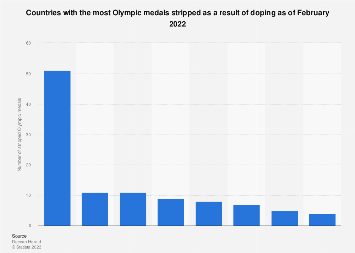
Global AIU List:
94 Russians
64 Kenyans
16 MAR
Countries with the most Olympic medals stripped as a result of doping as of February 2022
They are all countries from the west.
11 -
I will be honest:
I still don't trust this "machination" tried by Coevett and a lot of others.
Its true there is a lot of doping in East Africa but that seems a result of the number of people (popularity of the sport in the country) lack of education, poverty etc but the natural talent is here and none can deny it.
Just look at the statistics.
The day when Europe prove they are relevant U20 World Championships and their presence in marathon/road races and/or someone like Jakob is NOT an unique non repeatable event favorized by a lot of conditions, I will trust them.
12 -
rekrunner wrote:
jacksprat wrote:
Canova and rekrunner back to back? Mr Canova, do you believe managers and coaches should be banned if complicit with doping? Mr Rekrunner, why do you think runners take PED's?
Belief. Hope. Desperation. Lack of self-confidence. Ignorance. Gullibility. Injury. Illness.
So how many doping athletes have you met that you know this? Your usual guesswork based on what you wish to believe.
From the numbers who dope over the decades and the effects it has had on sports the easiest answer is they got superior results.
11 -
rekrunner wrote:
Armstronglivs wrote:
That's why they dope in the numbers they do, in every sport, and for decades - that is, unless Lance Armstrong and everyone else who has doped (and their coaches, trainers and physicians - and especially Kenyan distance runners, who dope in their droves), is a simple-minded moron who doesn't realise doping is no more effective than scattering chicken entrails on the ground.
Because you cannot bear the thought that your favourite athletes dope you wrongly infer that a lack of authoritative data on how much drugs will aid marathon runners' performances (because doped runners don't provide that data) allows the inference that drugs don't aid their performances. Wrong. Lack of data on performance doesn't prove there is no performance gain. In essence, your position is that if you don't know something then it doesn't exist. Yet so many athletes still choose to dope. You are then reduced to suggesting they must be gullible dupes - with no evidence for maintaining that. It is an argument based on your ignorance of the subject - if you can't see performance gains the athletes that dope must be fools.
What are you rambling about? It is a yes/no question.
It's not a question about using, but about observable results. Did it work, say for Americans, or Europeans, or Russians, for those that "doped in the numbers they do"? We know Russia doped in large numbers. Maybe steroids worked for Russian, East German, and Chinese women. Seems like an important question to answer given your "rule" that "doping does work for Kenyans, just like everyone else", because without that answer, your "rule" cannot be applied.
Which doping numbers do you mean? Recall there is no real estimate for distance running doping at the top. Remember you keep giving me lists of sprinters, or cyclists, or baseball players, or wrestling or bodybuilding. That is for a reason.
The default position in science is what exists must be observable and then observed, at least indirectly. Even when observed, a competing hypothesis is always the null hypothesis -- that your observations and hypothesized relation may in fact be spurious and not related. Even then, if we say "doping works", this does not mean nothing else "works" (e.g. clean altitude training).
Your stream of consciousness again. Because you can't find data that establishes the performance gains from doping you infer - wrongly - there won't be performance gains. It is an illicit practice and athletes don't agree to being subjects in doping studies. So we don't have data on how it affected their performances. What we do have is knowledge that the drugs they use are deemed potentially performance enhancing - there is no doubt about that with most, like steroids, blood doping and EPO - and that athletes use these drugs in considerable numbers. If they didn't get results from their doping the practice would largely disappear. It hasn't. We can infer athletes experience gains from doping and anecdotal accounts have confirmed this.
11 -
Armstronglivs wrote:
The problem with your argument, Renato, is that without any experience of training athletes who dope you say Kenyan runners don't need to dope to be the best they can be, and yet we see the country is one of the worst for doping in the sport. It has included some of its very best runners. It is hard to believe this could have come about unless those athletes were getting results above and beyond their training from their doping.
You obviously didn't read what Renato wrote.
01 -
Armstronglivs, you continue not to understand my point.
I'm open to think that some doping (specially steroids) can help 80% of the athletes to achieve better performances, but it seems you, and all the other fighter against doping (not on the ground, but from the keyboard) are not ready to accept that inside the 20% not using any doping we can find the top in the world.
You have reason when say I'm not a doctor, so I can't decide if doping can work or not. But the final application of doping looks at the level of athletic performance, and doctors are not able to know what there is to do for increasing a performance. Doctor are doctor, and coaches/methodologists are the one who prepare training programs and follow the athletes, building the performances of the athletes.
Medicine is not an exact science. When one important person is sick (for example the President of US or the Pope) the staff calls several doctors chosen among the best specialist in the world, for a global consultation, and the proposal for solving the problem (some time the diagnosis itself) frequently are very different from each of them. So, what does it mean "to be a doctor" when we speak about what athletes have to do for improving their performance ? Which type of knowledge doctors have about training ?
The reality is that you make confusion about the roles of doctors/ coaches / managers without knowing exactly which is the type of work everybody has to do, and for that reason you live in a strong convinction that doesn't admit the possibility to give merit to other factors everytime there is a top performance.
21 -
rekrunner wrote:
Armstronglivs wrote:
Take one of your record-breaking athletes: how can you be sure he couldn't run faster if he doped when you say he has never tried it and you say you have never tried it on your athletes? You are speculating about something that you say neither you nor your athlete has any experience of.
I made the point that as you are not a doctor you will not have the knowledge to know how to treat any of your athletes for sickness, yet you claim to know for a fact that drugs won't aid your athletes when you have no pharmacological or medical expertise. Without that expertise, whether it is medical or pharmacological, you are merely speaking as an amateur - and, what's more, as an amateur with no experience of that which you make pronouncements on. You may be expert on elite training but you know nothing more than the man in the street about performance-enhancing drugs, and less than some.
I'll go with the innumerable athletes who dope, that they know what they are doing, or they wouldn't be doing it in the numbers they do for the decades they have.
What are you babbling about? Renato already said "Maybe my athletes could improve with doping" and "I don't have any proof that my athletes couldn't run faster with doping, this is a theory only."
For the same reasons you want to call Renato an amateur, your pharmacological and medical experts are amateurs speculating about elite performance. That's why they often use weasel words and phrases like "potential" and "can be up to" and express limitations and confounders that their limited observations can not be applied to explain elite running performance. Your innumerable athletes are also amateurs in pharmacology and medicine and we don't know if their anecdotes even supports your speculation -- it is an assumption on your part that allows you to conclude the assumption.
Renato has argued that he believes athletes could perform better clean than doped. That is one of his main arguments against doping. It isn't necessary, he says, to achieving the highest level of performance. Yet he has no experience with doping or doped athletes. He is thus an "amateur" on this subject.
The pharmacological experts are not amateurs in terms of their understanding the effects of the drugs on the human body. They don't have to be experts on sporting performance to know what the drugs are capable of doing. If the drugs have a significant effect on human physiology they will affect human performance because the latter cannot be separated from the former. That is why their advice is heeded by WADA.
The athletes that use the drugs aren't speculative "amateurs_ - as you are and indeed Renato is - they have direct experience of that which you and he have none. Thousands of them do. I'll take their experience over your academic - yet baseless - musings any day.
21 -
Hugg wrote:
Armstronglivs wrote:
The problem with your argument, Renato, is that without any experience of training athletes who dope you say Kenyan runners don't need to dope to be the best they can be, and yet we see the country is one of the worst for doping in the sport. It has included some of its very best runners. It is hard to believe this could have come about unless those athletes were getting results above and beyond their training from their doping.
You obviously didn't read what Renato wrote.
I have understood it better than you have. So you think he is saying doping will make them better?
This post was edited 46 seconds after it was posted.11
What People Are Talking About On LetsRun
No top threads at the moment. Check back soon.