I’m a lawyer and can already see the writing on the wall.
I asked GPT to write an amicus brief for a case Im currently following. It did. And it cited specific (and relevant) case law and basically wrote it the entire thing without any incoherence or logical errors.
If you’re not a lawyer, let me put that into context. A decent amicus brief can take days to research and write. It’s substantive legal work.
The GPT brief wasn’t perfect and required some editing but the fact that it wrote 90% of it is absolutely mind blowing.
Not sure what to make of all this. I’m confused and a bit scared. I can’t see a scenario where many professionals (including lawyers) are made obsolete in the coming years.
Feel bad for you if you’ve been using GPT the past two years!
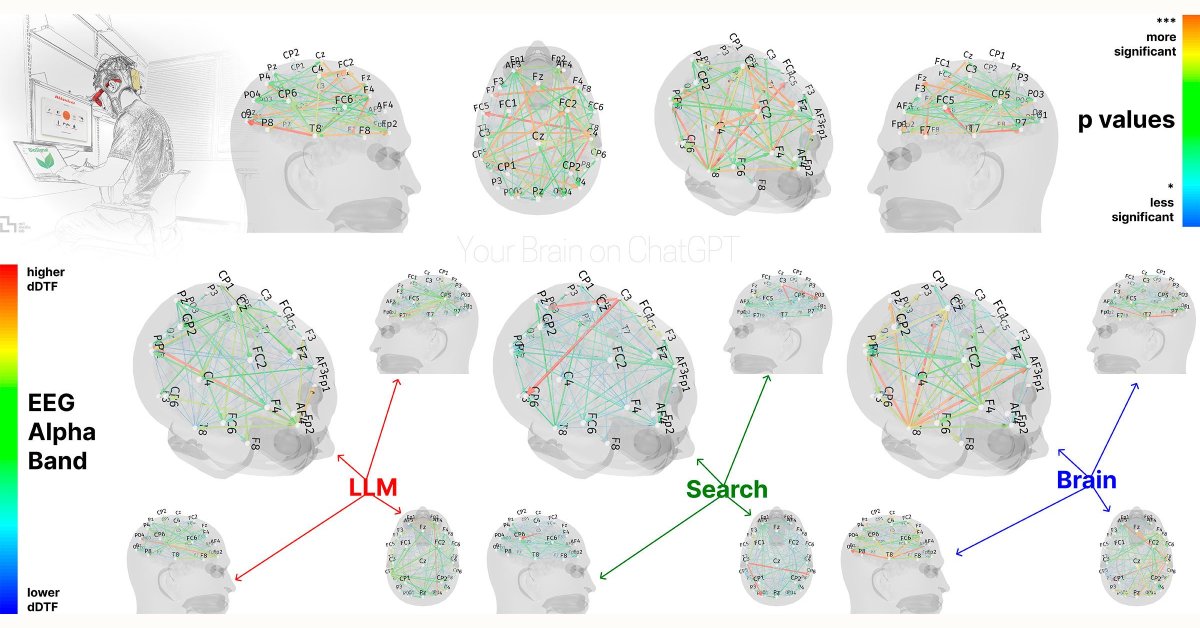
This study explores the neural and behavioral consequences of LLM-assisted essay writing. Participants were divided into three groups: LLM, Search Engine…
Then get together with your partners and make it illegal for AI to Replace Humans or the Compaany Pays a Massive , Massive Tax/Tarriff if they dare to use AI. Simple Matter. Besides, are these AI people stupid or something? How long do they expect to live once they start putting entire sectors out of Work? Talk about low IQ ... JESUS!
In my estimation, AI is a Scam, and Just like ROBOTS ... they Still cannot touch the Burger Boy!
In just the last two years since this thread was started, I have seen enormous improvements in AI in brief writing. Last week, I had AI draft a 10 page Response brief on a relatively complex discovery issue in a complex civil case. Took me maybe 45 minutes of work, and it spit out a brief worthy of a third year associate. AI is absolutely going to significantly affect the demand for legal services. I'm sure it already is. I would be very hesitant to go to law school these days, and I'd be very worried if I was currently a litigation associate at any law firm. You will have a lot of problems finding billable work in the near future.
In just the last two years since this thread was started, I have seen enormous improvements in AI in brief writing. Last week, I had AI draft a 10 page Response brief on a relatively complex discovery issue in a complex civil case. Took me maybe 45 minutes of work, and it spit out a brief worthy of a third year associate. AI is absolutely going to significantly affect the demand for legal services. I'm sure it already is. I would be very hesitant to go to law school these days, and I'd be very worried if I was currently a litigation associate at any law firm. You will have a lot of problems finding billable work in the near future.
Guess you'll have to lower your outrageous rates, what a shame.
Vast majority of people can't get a lawyer's attention. They all complain how overworked they are. So do the courts. Everything takes forever if it happens at all. I don't think anyone's job is at stake just yet.
Here is an update on malmo's ai search. This is the current list of the top sub-4 minute high school miler's from google 'KI': There are obviously numerous omissions, which I will not point out but which do not owe to a lack of recent AI training because Powell is in there, errors in time order(quite the trivial issue to fail on!), as well as inaccuracies in sig figs in a couple cases.
Alan Webb (3:53.43), Jim Ryun (3:55.3), Owen Powell (3:56.66), Colin Sahlman (3:56.24), Drew Hunter (3:57.81i), Matthew Maton (3:59.38), Grant Fisher (3:59.38), Tim Danielson (3:59.40), Marty Liquori (3:59.80), and Lukas Verzbicas (3:59.71)
When you consider just how intricate are the arguments in court cases, it would be madness to rely on AI for them. I was just reading a pre-AI case from about ten years back involving a wrongly-declared loan default involving a major national bank and the judge has such a fine-grained attitude to the law and the arguments on each individual piece, including the relevant real citations, of course, that you would have to be an expert lawyer or work in a team of researchers to get just which precedent goes with what legally accepted interpretation of just which law is controlling, the standards accepted for applying it, and so forth to work and no AI is anywhere near the decision-making level. It can't even in most cases get basic facts right.
Here is an update on malmo's ai search. This is the current list of the top sub-4 minute high school miler's from google 'KI': There are obviously numerous omissions, which I will not point out but which do not owe to a lack of recent AI training because Powell is in there, errors in time order(quite the trivial issue to fail on!), as well as inaccuracies in sig figs in a couple cases.
WTF? When did I do an AI search? Artificial Ignoramus is worthless. I can do that with my own brain.
If 10s of millions will be put out of work in virtually every profession won’t that put extreme downward pressure on labor rates? If in 5 years the country will only need 75% of the lawyers we need today, won’t lawyers start lowering their prices and salary expectations just to stay employed? Won’t this happens for most industries and professions? This will lower tax revenues, which will decrease our ability to service our rapidly growing debt. Isn’t a reset inevitable? AI is massively deflationary. Humanoid robots will likewise be massively deflationary.
And this is where to problem lies. AI/ChatGPT is feeding off past works that are found on the web. How will there be progress? I'm not just talking about law. AI cannot do anything if doesn't have access to information found on the web. Or are they gonna get so much better they will really create and think for themselves? I'm too old so this all won't affect me much. The young ones are cooked.
I have Lexis and they have an AI product that you can ask questions for legal research. I have tried it a bunch of times. It will give you wrong answers whenever the question requires an answer that necessitates any sort of synthesis of what the case law says. And when it gives you a correct answer, the cases it cites are wrong. We have also caught it giving out citations that were hallucinations (citations did not match the case names and were about something completely different than the cite was about). And we have had this AI product for over a year and have seen no improvement.
I have also tried the AI product for transactional documents. It is slightly helpful in that it will suggest provisions that you might not have thought of and did not have in any examples/forms that you usually use. But that is just a slight step up from the Practical Law product they have which is just a bunch of different forms you can use. Instead of having to go through an index to find your form, you can use a prompt to pull it up. The big problem with the transactional product is that it will through in provisions into forms that are completely out of place. I had to review a contract from a fin tech company. It had an all asset security interest provision that would have violated my client's inventory financing agreements which forbid pledging/encumbering the inventory that they financing on a LOC. There was no reason to have an all asset security agreement in this contract. I crossed it out and sent to back to the other side. They admitted that they used AI and did not even realize that it was in there.
AI is helpful in processing data. I have used AI to manage and index large document production and produce timelines. That is a big time saver, but has to be double checked by a human as the AI will mess up every now and then. But for core legal work, AI is not ready for prime time.
AI is also a big problem in the legal world in that pro se litigants get ahold of it and use it to spam the other side. I have a case with a pro se litigant who is resisting debt collection. He has filed over thirty different pleadings in a period of about four to five months. All of those were clearly drafted using AI. We called him out for using AI to the judge. He tried to deny it but got busted when we showed the judge that he filed a 15 page response about 30 minutes after one of the parties filed a motion against him. The response was full of AI slop.
I have Lexis and they have an AI product that you can ask questions for legal research. I have tried it a bunch of times. It will give you wrong answers whenever the question requires an answer that necessitates any sort of synthesis of what the case law says. And when it gives you a correct answer, the cases it cites are wrong. We have also caught it giving out citations that were hallucinations (citations did not match the case names and were about something completely different than the cite was about). And we have had this AI product for over a year and have seen no improvement.
I have also tried the AI product for transactional documents. It is slightly helpful in that it will suggest provisions that you might not have thought of and did not have in any examples/forms that you usually use. But that is just a slight step up from the Practical Law product they have which is just a bunch of different forms you can use. Instead of having to go through an index to find your form, you can use a prompt to pull it up. The big problem with the transactional product is that it will through in provisions into forms that are completely out of place. I had to review a contract from a fin tech company. It had an all asset security interest provision that would have violated my client's inventory financing agreements which forbid pledging/encumbering the inventory that they financing on a LOC. There was no reason to have an all asset security agreement in this contract. I crossed it out and sent to back to the other side. They admitted that they used AI and did not even realize that it was in there.
AI is helpful in processing data. I have used AI to manage and index large document production and produce timelines. That is a big time saver, but has to be double checked by a human as the AI will mess up every now and then. But for core legal work, AI is not ready for prime time.
AI is also a big problem in the legal world in that pro se litigants get ahold of it and use it to spam the other side. I have a case with a pro se litigant who is resisting debt collection. He has filed over thirty different pleadings in a period of about four to five months. All of those were clearly drafted using AI. We called him out for using AI to the judge. He tried to deny it but got busted when we showed the judge that he filed a 15 page response about 30 minutes after one of the parties filed a motion against him. The response was full of AI slop.
Lawyers are generally considered to be the scummiest people in our society according to surveys, usually ranking slightly below used car salesmen. They regard morality, right and wrong, as an intellectual exercise and the law is simply a game to played. I've been close friends with several and as a group they rank near the bottom when it comes to ethics, morality...
I have Lexis and they have an AI product that you can ask questions for legal research. I have tried it a bunch of times. It will give you wrong answers whenever the question requires an answer that necessitates any sort of synthesis of what the case law says. And when it gives you a correct answer, the cases it cites are wrong. We have also caught it giving out citations that were hallucinations (citations did not match the case names and were about something completely different than the cite was about). And we have had this AI product for over a year and have seen no improvement.
I have also tried the AI product for transactional documents. It is slightly helpful in that it will suggest provisions that you might not have thought of and did not have in any examples/forms that you usually use. But that is just a slight step up from the Practical Law product they have which is just a bunch of different forms you can use. Instead of having to go through an index to find your form, you can use a prompt to pull it up. The big problem with the transactional product is that it will through in provisions into forms that are completely out of place. I had to review a contract from a fin tech company. It had an all asset security interest provision that would have violated my client's inventory financing agreements which forbid pledging/encumbering the inventory that they financing on a LOC. There was no reason to have an all asset security agreement in this contract. I crossed it out and sent to back to the other side. They admitted that they used AI and did not even realize that it was in there.
AI is helpful in processing data. I have used AI to manage and index large document production and produce timelines. That is a big time saver, but has to be double checked by a human as the AI will mess up every now and then. But for core legal work, AI is not ready for prime time.
AI is also a big problem in the legal world in that pro se litigants get ahold of it and use it to spam the other side. I have a case with a pro se litigant who is resisting debt collection. He has filed over thirty different pleadings in a period of about four to five months. All of those were clearly drafted using AI. We called him out for using AI to the judge. He tried to deny it but got busted when we showed the judge that he filed a 15 page response about 30 minutes after one of the parties filed a motion against him. The response was full of AI slop.
Lawyers are generally considered to be the scummiest people in our society according to surveys, usually ranking slightly below used car salesmen. They regard morality, right and wrong, as an intellectual exercise and the law is simply a game to played. I've been close friends with several and as a group they rank near the bottom when it comes to ethics, morality...
Did you have judgment entered against you? Or were you eviscerated during cross examination?
I’m a lawyer and can already see the writing on the wall.
I asked GPT to write an amicus brief for a case Im currently following. It did. And it cited specific (and relevant) case law and basically wrote it the entire thing without any incoherence or logical errors.
If you’re not a lawyer, let me put that into context. A decent amicus brief can take days to research and write. It’s substantive legal work.
The GPT brief wasn’t perfect and required some editing but the fact that it wrote 90% of it is absolutely mind blowing.
Not sure what to make of all this. I’m confused and a bit scared. I can’t see a scenario where many professionals (including lawyers) are made obsolete in the coming years.
Oh, absolutely. Medicine is going to be massacred - my surgeon friend thinks he’ll be replaced by a machine within 15 years.
Oh that sucks, he's only going to be able to maybe 30-60 million dollars before an AI robot puts him into comfortable retirement. Poor guy.
Help us build the best running shoe review site for a chance to win a LetsRun t-shirt.Help us build the best running shoe review site for a chance to win one of 10 LetsRun t-shirts.