Little Mermaid
-
61
-
Tarantino's a postmodern director, so if you can't understand that a movie called 'Pulp Fiction' is an ironic mashup and homage to other films, and you ignore the brilliant dialogue, acting, and cinematography, then you're ignoring everything relevant to judging his films.
Airplane is among the funniest movies ever made, despite being virtually a line by line, scene by scene, ripoff of a much older airplane crash movie played straight.
193 -
ricky.rickk wrote:
For me it's "Rambo". I really wanted to watch it again, but I gave up at the 12 minute mark. I watch a lot of modern movies and sometimes I miss something new. I decided to watch foreign films through vpn (after reading https://www.firesticktricks.com/best-vpn-torrenting.html ). It turned out that Korean films are not so bad. I also liked the Spanish ones
C'mon - how can you not enjoy a good Colonel Trautman quote!
30 -
It's nice to see a couple of people mention the 1953 Japanese classic, "Tokyo Story" by Ozu. It's one of the most moving movies I've ever seen. And I've seen hundreds. Anyone who hasn't seen "Tokyo Story" would become a big Yasujiro Ozo fan if they did.
30 -
Actually, after Pulp Fiction, Tarantino tried a traditional film. He adapted an Elmore Leonard novel: Jackie Brown, with lackluster results. After trying and failing in a straight-up style, Tarantino hit his Cuisinart-button and made a series of bad films (both Kill Bills, Deathproof, etc...) Pulp Fiction is clearly his best film, with a snappy dialogue and circular structure, but the structure was lifted from a 1963 Italian horror film (Mario Bava's Black Sabbath) and the dialogue and dance scene with Travolta & Thurman come straight out of Jean Luc Godard's Band of Outsiders (1964.) Since then, Tarantino has tried to reinvent himself. He's tried to break away from his "post-modern" plagiarism (he's been sued multiple times over copyright infringement.) The only problem is he's got nothing to say. That's why his recent films portray history falsely before devolving into celebrations of hyperviolence. Inglorious Basterds treats World War II like Hogan's Heroes (hey, whatever floats your boat.) The trailers for Tarantino's most recent film: Once Upon a Time in Hollywood, looked like a return to form. Here was a story that seemed to fit Tarantino's exaggerations and falsehoods: Hollywood the dream machine in the summer of 1969, the Manson Family and Sharon Tate murders, interspersed with a number of interesting characters (DiCaprio's alcoholic, insecure, TV star.) And up to a point the film works. The imagined fight between Pitt's character and Bruce Lee was excellent and very, very, meta, with Hollywood distorting and embellishing its own myths. By the end, though, all Quentin can show us is an extended celebration of sadism, with the Manson Family being devoured by a pit bull and incinerated with a flame-thrower. A feel-good ending for sure! But it goes on and on for minutes, until it's no longer about righteous vengeance but purely about torture. That's Tarantino's product now, it's what he does, and it's very far-removed from the comic twists of Pulp Fiction.
35 -
Hey Old Guy 76, if you haven't seen Ozu's Late Spring, you need to. It's even better than Tokyo Story, I can assure you.
20 -
Chilhoweee wrote:
Actually, after Pulp Fiction, Tarantino tried a traditional film. He adapted an Elmore Leonard novel: Jackie Brown, with lackluster results. After trying and failing in a straight-up style, Tarantino hit his Cuisinart-button and made a series of bad films (both Kill Bills, Deathproof, etc...) Pulp Fiction is clearly his best film, with a snappy dialogue and circular structure, but the structure was lifted from a 1963 Italian horror film (Mario Bava's Black Sabbath) and the dialogue and dance scene with Travolta & Thurman come straight out of Jean Luc Godard's Band of Outsiders (1964.) Since then, Tarantino has tried to reinvent himself. He's tried to break away from his "post-modern" plagiarism (he's been sued multiple times over copyright infringement.) The only problem is he's got nothing to say. That's why his recent films portray history falsely before devolving into celebrations of hyperviolence. Inglorious Basterds treats World War II like Hogan's Heroes (hey, whatever floats your boat.) The trailers for Tarantino's most recent film: Once Upon a Time in Hollywood, looked like a return to form. Here was a story that seemed to fit Tarantino's exaggerations and falsehoods: Hollywood the dream machine in the summer of 1969, the Manson Family and Sharon Tate murders, interspersed with a number of interesting characters (DiCaprio's alcoholic, insecure, TV star.) And up to a point the film works. The imagined fight between Pitt's character and Bruce Lee was excellent and very, very, meta, with Hollywood distorting and embellishing its own myths. By the end, though, all Quentin can show us is an extended celebration of sadism, with the Manson Family being devoured by a pit bull and incinerated with a flame-thrower. A feel-good ending for sure! But it goes on and on for minutes, until it's no longer about righteous vengeance but purely about torture. That's Tarantino's product now, it's what he does, and it's very far-removed from the comic twists of Pulp Fiction.
Jackie Brown is awesome.
101 -
sepreh wrote:
Scarface. Rambo. Pulp Fiction anything by Tarantino, really). Schindler's list.
On the other hand, rocky and Forrest Gump stand the test of time.
Rambo? I certainly hope you mean 2 and 3. "First Blood" the original film is an absolute masterpiece. A critique on how we treat former soldiers and PTSD in society, that still holds up today. The second and third movies were the complete opposite, they were "rah rah, go USA, kick ass" mindless action films.
172 -
Chilhoweee wrote:
Actually, after Pulp Fiction, Tarantino tried a traditional film. He adapted an Elmore Leonard novel: Jackie Brown, with lackluster results. After trying and failing in a straight-up style, Tarantino hit his Cuisinart-button and made a series of bad films (both Kill Bills, Deathproof, etc...) Pulp Fiction is clearly his best film, with a snappy dialogue and circular structure, but the structure was lifted from a 1963 Italian horror film (Mario Bava's Black Sabbath) and the dialogue and dance scene with Travolta & Thurman come straight out of Jean Luc Godard's Band of Outsiders (1964.) Since then, Tarantino has tried to reinvent himself. He's tried to break away from his "post-modern" plagiarism (he's been sued multiple times over copyright infringement.) The only problem is he's got nothing to say. That's why his recent films portray history falsely before devolving into celebrations of hyperviolence. Inglorious Basterds treats World War II like Hogan's Heroes (hey, whatever floats your boat.) The trailers for Tarantino's most recent film: Once Upon a Time in Hollywood, looked like a return to form. Here was a story that seemed to fit Tarantino's exaggerations and falsehoods: Hollywood the dream machine in the summer of 1969, the Manson Family and Sharon Tate murders, interspersed with a number of interesting characters (DiCaprio's alcoholic, insecure, TV star.) And up to a point the film works. The imagined fight between Pitt's character and Bruce Lee was excellent and very, very, meta, with Hollywood distorting and embellishing its own myths. By the end, though, all Quentin can show us is an extended celebration of sadism, with the Manson Family being devoured by a pit bull and incinerated with a flame-thrower. A feel-good ending for sure! But it goes on and on for minutes, until it's no longer about righteous vengeance but purely about torture. That's Tarantino's product now, it's what he does, and it's very far-removed from the comic twists of Pulp Fiction.
Jackie Brown is his best movie.
71 -
M.C. Confusing wrote:
sepreh wrote:
Scarface. Rambo. Pulp Fiction anything by Tarantino, really). Schindler's list.
On the other hand, rocky and Forrest Gump stand the test of time.
Rambo? I certainly hope you mean 2 and 3. "First Blood" the original film is an absolute masterpiece. A critique on how we treat former soldiers and PTSD in society, that still holds up today. The second and third movies were the complete opposite, they were "rah rah, go USA, kick ass" mindless action films.
Go watch it again. It's like Star Wars level bad.
27 -
psaaf wrote:
Some movies age better than most. Blade Runner comes to mind.
Totally agree with this one; watched it again recently with my son (seeing it for the first time at 21), and we both loved it. The last scene with Roy Batty is still one of my all-time Top Ten movie scenes; just brilliantly done.
For me "Personal Best" is the one that really looks different now. In 1982 when it came out I was a pretty competitive (but not elite level) distance runner; loved the sport and certainly wished I'd been among the elite. Nothing else like this movie back then for someone like me; a small window (however fictionalized) into the elite track world, AND the IMHO super-hot Patrice Donnelly (think Michelle Jenneke with short hair), on whom I had a massive crush. I saw it at least 20 times in the theater.
Just rewatched a couple weeks ago; holy sh*t is that ever a bad movie! ;)
30 -
Chilhoweee wrote:
Actually, after Pulp Fiction, Tarantino tried a traditional film. He adapted an Elmore Leonard novel: Jackie Brown, with lackluster results. After trying and failing in a straight-up style, Tarantino hit his Cuisinart-button and made a series of bad films (both Kill Bills, Deathproof, etc...) Pulp Fiction is clearly his best film, with a snappy dialogue and circular structure, but the structure was lifted from a 1963 Italian horror film (Mario Bava's Black Sabbath) and the dialogue and dance scene with Travolta & Thurman come straight out of Jean Luc Godard's Band of Outsiders (1964.) Since then, Tarantino has tried to reinvent himself. He's tried to break away from his "post-modern" plagiarism (he's been sued multiple times over copyright infringement.) The only problem is he's got nothing to say. That's why his recent films portray history falsely before devolving into celebrations of hyperviolence. Inglorious Basterds treats World War II like Hogan's Heroes (hey, whatever floats your boat.) The trailers for Tarantino's most recent film: Once Upon a Time in Hollywood, looked like a return to form. Here was a story that seemed to fit Tarantino's exaggerations and falsehoods: Hollywood the dream machine in the summer of 1969, the Manson Family and Sharon Tate murders, interspersed with a number of interesting characters (DiCaprio's alcoholic, insecure, TV star.) And up to a point the film works. The imagined fight between Pitt's character and Bruce Lee was excellent and very, very, meta, with Hollywood distorting and embellishing its own myths. By the end, though, all Quentin can show us is an extended celebration of sadism, with the Manson Family being devoured by a pit bull and incinerated with a flame-thrower. A feel-good ending for sure! But it goes on and on for minutes, until it's no longer about righteous vengeance but purely about torture. That's Tarantino's product now, it's what he does, and it's very far-removed from the comic twists of Pulp Fiction.
You're missing the point of his director style - he emphasizes style and aesthetics (both in the dialogue and cinematography) over plot/character development and meaning. That's what makes him "post-modern." You can choose to not like that, but I don't think it's fair to judge his movies on meaning and realism when those aren't the goals of his films.
72 -
Sometimes it's about whether or not the movies still make you feel the same way. Among sports movies, "A League of Their Own" and "Field of Dreams" still feel good and my favorite parts of those still feel the same.
00 -
movie man wrote:
I watched Full Metal Jacket 25 years ago and thought that it kicked ass. I just watched it again this afternoon and was underwhelmed. A quote-factory for 13-year-olds.
And the opposite happened with One Flew Over the Cuckoo's Nest. I saw that 25 years ago and thought it was ok. And I just watched it a few days ago and found it to be astoundingly good.
Attack of the clones
10 -
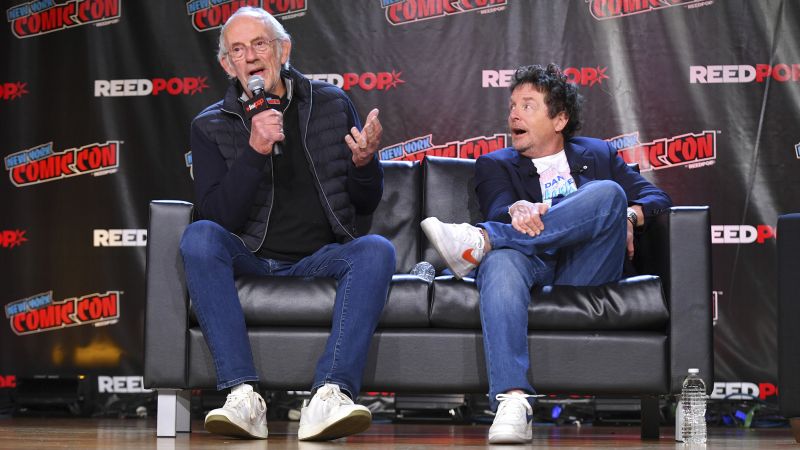
How about Back to the Future?
In fact, Michael J. Fox and Christopher Lloyd were reunited this past weekend at NY Comic Con.
That film would have you believe that Marty was 17-18 and Doc Brown was at least 60. It's always hilarious to me to realize that their real age is only 22 years apart, not 40. Lloyd was only 46 when that was made and Fox was 24.
43 -
Cashiers Du Cinema wrote:
Jogger262 wrote:
Pulp Fiction? That was groundbreaking and still holds up for me.
A B movie cult classic “The Last Starfighter” didn’t hold up as well. My kids wouldn’t watch it, but my brothers and I thought it was awesome in the 80s.
“Tremors”
”Critters”
I guess those were never supposed to be great, so not completely unexpected.
I just wastched Alien all the way through for the first time a few weeks ago. Besides the miss on what technology would look like in the future, it’s still a really good movie.
"Groundbreaking?" Are you kidding me? Quentin Tarantino hasn't had an original thought in his entire life. He's the cinematic equivalent of of a DJ who "writes" music by stitching together samples of other songs. Pulp Fiction's looping-back-on-itself circular plot structure had been used as far back as Dead Of Night, in 1945. Tarantino's career started with an act of blatant plagiarism -Reservoir Dogs was an unauthorized remake of Ringo Lam's City On Fire- that was aided and abetted by the Weinsteins, and everything since then has been derivative, at best.
Tarantino's defenders wil say that he's doing "homage" to the movies he loves but that's BS because the majority of his target audience is clueless about his source material and think they're seeing something brilliantly original.
I really love "Jackie Brown", my favorite Tarantino film with a fantastic soundtrack.
Samuel L. Jackson (showing body in trunk of the car): "That's Beaumont (Chris Tucker)"
DeNiro: "Who he?"
Samuel L. Jackson: "An employee I had to let go"
00 -
Lol. Everything is “lifted” from something else if you go back far enough or look hard enough. If that is your criteria for enjoying something then you will be disappointed. Everything you view/read stands on the shoulders of things that came before it. Do you also dismiss anything that follows the hero’s journey or the seven basic plots? How about 5 act structure? Uniqueness is largely a function of not knowing the past.
41 -
Cashiers Du Cinema wrote:
Jogger262 wrote:
Pulp Fiction? That was groundbreaking and still holds up for me.
A B movie cult classic “The Last Starfighter” didn’t hold up as well. My kids wouldn’t watch it, but my brothers and I thought it was awesome in the 80s.
“Tremors”
”Critters”
I guess those were never supposed to be great, so not completely unexpected.
I just wastched Alien all the way through for the first time a few weeks ago. Besides the miss on what technology would look like in the future, it’s still a really good movie.
"Groundbreaking?" Are you kidding me? Quentin Tarantino hasn't had an original thought in his entire life. He's the cinematic equivalent of of a DJ who "writes" music by stitching together samples of other songs. Pulp Fiction's looping-back-on-itself circular plot structure had been used as far back as Dead Of Night, in 1945. Tarantino's career started with an act of blatant plagiarism -Reservoir Dogs was an unauthorized remake of Ringo Lam's City On Fire- that was aided and abetted by the Weinsteins, and everything since then has been derivative, at best.
Tarantino's defenders wil say that he's doing "homage" to the movies he loves but that's BS because the majority of his target audience is clueless about his source material and think they're seeing something brilliantly original.
I had no idea of this, but was never really a big fan of his to began with.
00 -
samcallan wrote:
King of the World! wrote:
Titanic. Now that I know the ship is going to sink it takes out all of the suspense.
You did not know the ship sank when you first saw it?
Years ago,I was watching Apollo 13 with my than girlfriend, and she thought it was the most suspenseful movie…cause she didn’t know if the astronauts would get home safe or not!😂😂😂
30 -
Couldnt believe it wrote:
samcallan wrote:
You did not know the ship sank when you first saw it?
Years ago,I was watching Apollo 13 with my than girlfriend, and she thought it was the most suspenseful movie…cause she didn’t know if the astronauts would get home safe or not!😂😂😂
Thankfully you dumped her.
00
What People Are Talking About On LetsRun
No top threads at the moment. Check back soon.