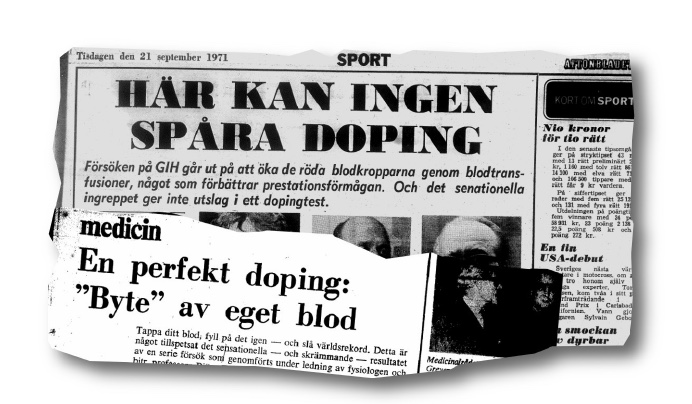
"When the editor-in-chief was asked about details by well-known journalist Antero Raevuori, he revealed that a competitor of Jouko Kuha had revealed to him that Kuha had been treated with a transfusion in 1968 for the world record run. The other incident he knew took place in 1970 when a well-known unnamed Finnish MD had told Risto Taimi that Juha Väätäinen had been also treated with a transfusion before he broke the 10,000m national record. (Raevuori, 1971) While the alleged incident took place a year before the 1971 games, a year after the games one Finnish doctor affiliated with the sports circles told knowing for certain that a number of Finnish runners had taken advantages of transfusion already for the 1971 European Championships, and Track & Field News correspondent Cordner Nelson recalled also having heard whispering about double gold medallist Väätäinen having used blood transfusions. (Nelson, 1972)
Väätäinen wasn’t available for the comments, but he was later dismissive about the benefits of blood doping and always maintained that ”naturally” obtained altitude red blood cells were the safest and best ones. While Jouko Kuha specifically denied the allegation, he mentioned having been familiar with the procedure and some other athletes, coaches physiologists told also that they knew that transfusions had taken place in Finland. MD Kaarlo Hartiala, the future Finnish member of the International Olympic Committee Medical Commission also told that the issue wasn’t totally new.” On a theoretical level, the subject has been known for a long time”, he remarked mysteriously. (Raevuori, 1971) Interestingly Tapio Videman – who had conducted the first known attempt outside GIH to research blood doping – also later recalled having heard ”amazingly sounding” rumors about athletes taking transfusions in the late 1960s. (Siukonen, 2001)
With all this evidence, there is an apparent mystery there – how could the method that was revealed in September 1971 be in use first time up to three years before that and how come the Finnish sports circles were aware of the method beforehand?
There are many possible answers to this question. Aside of the possibility that the Finns had invented the method on their own, they could’ve built upon the Swedish research having heard about the line of research, because dozens of Finnish exercise physiologists and sports MDs participated in the 1966 conference held in Finland where the first inconclusive results of Ekblom and Åstrand were discussed. Kaarlo Hartiala – who was the 1968 chief doctor of the Finnish summer Olympic team – also participated in the conference and was very well connected with the Swedish researchers relating to the high altitude adaptation research."
Väätäinen wasn’t available for the comments, but he was later dismissive about the benefits of blood doping and always maintained that ”naturally” obtained altitude red blood cells were the safest and best ones. While Jouko Kuha specifically denied the allegation, he mentioned having been familiar with the procedure and some other athletes, coaches physiologists told also that they knew that transfusions had taken place in Finland. MD Kaarlo Hartiala, the future Finnish member of the International Olympic Committee Medical Commission also told that the issue wasn’t totally new.” On a theoretical level, the subject has been known for a long time”, he remarked mysteriously. (Raevuori, 1971) Interestingly Tapio Videman – who had conducted the first known attempt outside GIH to research blood doping – also later recalled having heard ”amazingly sounding” rumors about athletes taking transfusions in the late 1960s. (Siukonen, 2001)
With all this evidence, there is an apparent mystery there – how could the method that was revealed in September 1971 be in use first time up to three years before that and how come the Finnish sports circles were aware of the method beforehand?
There are many possible answers to this question. Aside of the possibility that the Finns had invented the method on their own, they could’ve built upon the Swedish research having heard about the line of research, because dozens of Finnish exercise physiologists and sports MDs participated in the 1966 conference held in Finland where the first inconclusive results of Ekblom and Åstrand were discussed. Kaarlo Hartiala – who was the 1968 chief doctor of the Finnish summer Olympic team – also participated in the conference and was very well connected with the Swedish researchers relating to the high altitude adaptation research."