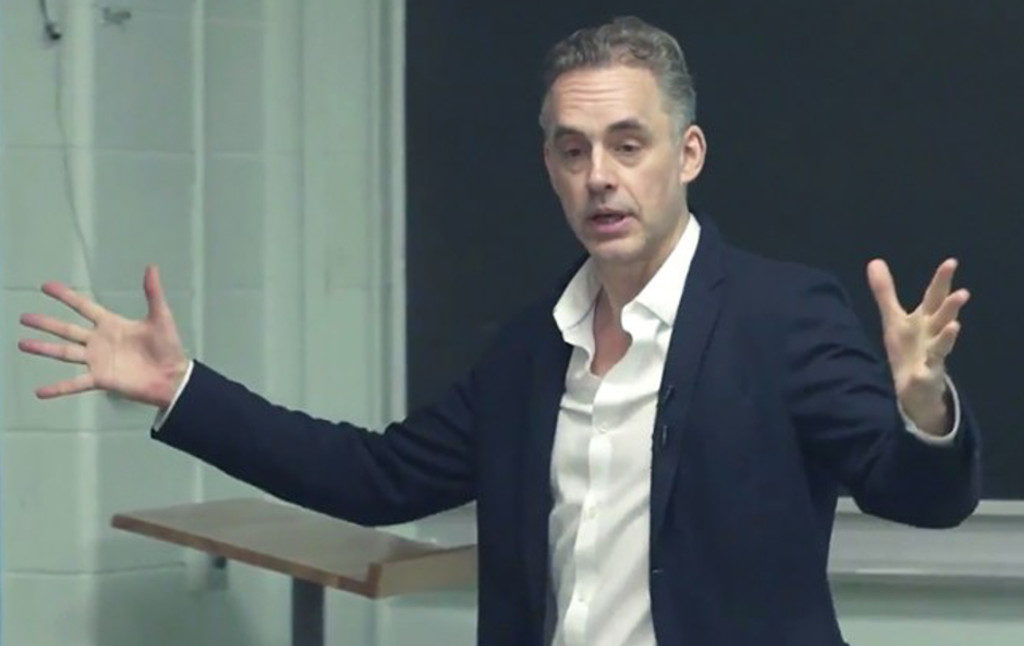
There's a great article about JBP, link below, here are some great highlights:
Nathan J Robinson wrote:
If you want to appear very profound and convince people to take you seriously, but have nothing of value to say, there is a tried and tested method. First, take some extremely obvious platitude or truism. Make sure it actually does contain some insight, though it can be rather vague. Something like “if you’re too conciliatory, you will sometimes get taken advantage of” or “many moral values are similar across human societies.” Then, try to restate your platitude using as many words as possible, as unintelligibly as possible, while never repeating yourself exactly. Use highly technical language drawn from many different academic disciplines, so that no one person will ever have adequate training to fully evaluate your work. Construct elaborate theories with many parts. Draw diagrams. Use italics liberally to indicate that you are using words in a highly specific and idiosyncratic sense. Never say anything too specific, and if you do, qualify it heavily so that you can always insist you meant the opposite. Then evangelize: speak as confidently as possible, as if you are sharing God’s own truth. Accept no criticisms: insist that any skeptic has either misinterpreted you or has actually already admitted that you are correct. Talk as much as possible and listen as little as possible. Follow these steps, and your success will be assured. (It does help if you are male and Caucasian.)
Nathan J Robinson wrote:
A few more Petersonisms:
“There is no being without imperfection.” No s***.
“To share does not mean to give away something you value and get nothing back. That is instead what every child who refuses to share fears it means. To share means, properly, to initiate the process of trade.” Could mean anything, depending on interpretation: if I share my food with a hungry person, and ask for nothing in return, I may still have “gotten something.” But the maxim could also be interpreted as a defense of avarice. You can find a justification in it for whatever your worldview already is.
“You can’t make rules for the exceptional.” By definition.
“The future is the place of all potential monsters.” The future is the place for all potential everything.
“People do not care whether or not they succeed; they care about whether or not they fail.” Which is apparently different.
“People aren’t after happiness, they’re after not hurting.” I’m actually after happiness, thanks.
“Life is suffering. That’s clear. There is no more basic, irrefutable truth.” Anything is “irrefutable” if it’s not clear what we mean by it.
“You cannot be protected from the things that frighten you and hurt you, but if you identify with the part of your being that is responsible for transformation, then you are always the equal, or more than the equal of the things that frighten you.” Unless you are frightened of leopards, and are subsequently eaten by leopards.
Nathan J Robinson wrote:
This much should be obvious from even a cursory reading of him: If Jordan Peterson is the most influential intellectual in the Western world, the Western world has lost its damn mind. And since Jordan Peterson does indeed have a good claim to being the most influential intellectual in the Western world, we need to think seriously about what has gone wrong. What have we done to end up with this man? His success is our failure, and while it’s easy to scoff at him, it’s more important to inquire into how we got to this point. He is a symptom. He shows a culture bereft of ideas, a politics without inspiration or principle. Jordan Peterson may not be the intellectual we want. But he is probably the intellectual we deserve.