Kids being left with druggie parents because the baby boomers defunded child protection once they became parents themselves?
-
00
-
I do wonder how RFk will even recognize a cause for autism, if indeed scientists do find a cause, because RFK routinely ignores science that is legit.
50 -
here ye here ye wrote:
Newname wrote:
You do know the people doing the investigations do have those qualifications?
But the person appropriating the funding does not have any qualifications. That is the main point. I am not afraid of anything, as you suggest. And I am not doing research, nor have I lost a job. I am retired.
Who was the HHS head under Biden?
Xavier Becerra. A lawyer. Not a doctor.
Did you challenge his qualifications?
06 -
here ye here ye wrote:
Newname wrote:
How much money is being taken away? From what "legitimate and ongoing research"? Why do you seem to think this research will not be "likely to pan out"? You seem to be afraid that the cause/causes will be found out. Why does that scare you?
I guess you have not been paying attention.
In other words, you cannot answer
05 -
MAGA 45 wrote:
I hope we all get Autism.
MAGA
Libs would lose their heads. Haha, I love it.
12 -
Newname wrote:
here ye here ye wrote:
I guess you have not been paying attention.
In other words, you cannot answer
Oh yes, I can answer. Why go down this rabbit hole.
00 -
Newname wrote:
here ye here ye wrote:
But the person appropriating the funding does not have any qualifications. That is the main point. I am not afraid of anything, as you suggest. And I am not doing research, nor have I lost a job. I am retired.
Who was the HHS head under Biden?
Xavier Becerra. A lawyer. Not a doctor.
Did you challenge his qualifications?
No I did not, but he was not declared crazy by the New York Post either. He deferred to the science experts when it came to major funding decisions, instead of neutering them. The difference is, RFK is masquerading as knowing something that all the scientists do not.
40 -
Newname wrote:
here ye here ye wrote:
I guess you have not been paying attention.
In other words, you cannot answer
50 -
Newname wrote:
here ye here ye wrote:
I guess you have not been paying attention.
In other words, you cannot answer
00 -
Newname wrote:
here ye here ye wrote:
I guess you have not been paying attention.
In other words, you cannot answer
RFK did say a while back that we should take a 10 year break in infectious disease research. I am sure that will end well.
30 -
Here's one from the libs at Forbes:10
-
Newname wrote:
here ye here ye wrote:
I guess you have not been paying attention.
In other words, you cannot answer
"Robert F. Kennedy, though, has already noted that 20% of the 10,000 dismissals were made erroneously. “Personnel that should not have been cut, were cut. We’re reinstating them. And that was always the plan,” Kennedy said."
10 -
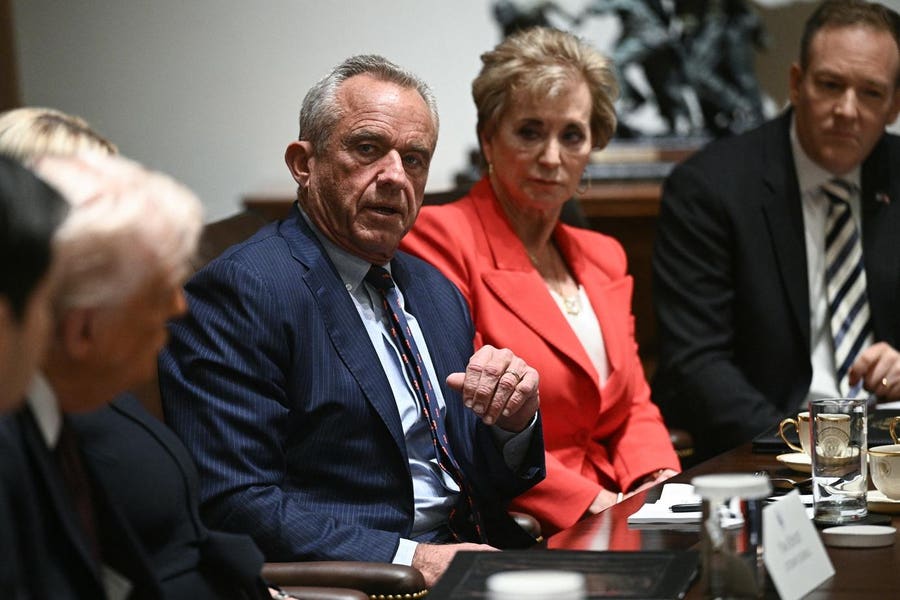
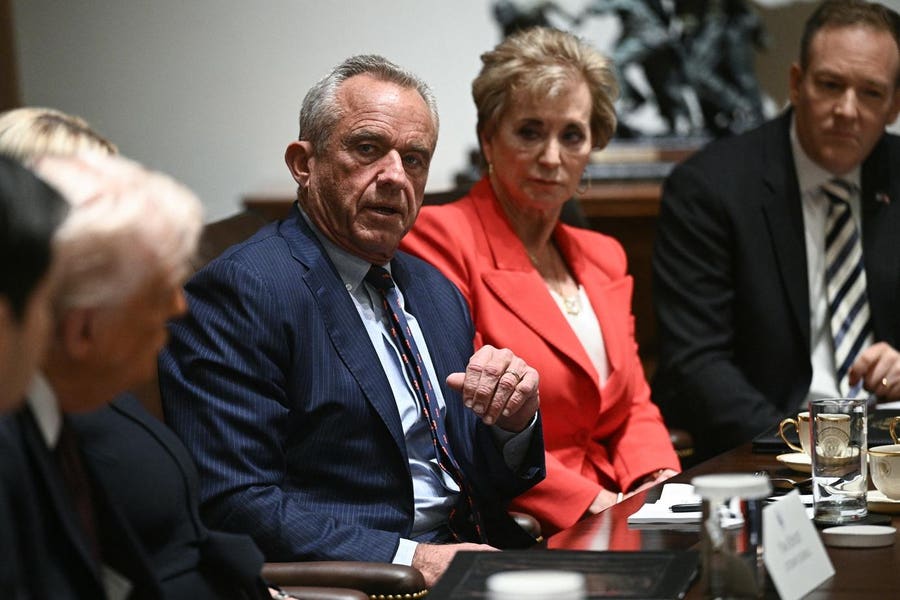
It is ironic that RFK is sitting next the person who aims to remake elementary education - something she knows nothing about - with a tool that she also knows nothing about.
00 -
do you realize how ridiculous it is to give normal epidemiology a budget buzzcut while funding followup study on a subject where the wakefield study got retracted.
this country is starting to become orwellian. like if we had FDA hiring tobacco scientists to study whether smoking gives cancer, so that an administration who wanted that to not be true, could say that much.
40 -
just so people understand the playbook, as with finding 1 gay book in the library so rich people can get a tax cut and defund the libraries (while hiding behind a culture war excuse), the game here is that vaccines are often taxpayer subsidized and/or government required. you imply there is something wrong with the vaccines. you say based on the lame study we will no longer fund broad vaccination. you tell people they can take the thing if they want but no one is legally required to take it anymore.
and then people start dying of diseases that were gone decades ago, smallpox, measles, etc.
you can then try to survive unnecessary plagues by vaccinating yourself and your kids, but herd immunity no longer works, the immunocompromised are exposed, and we rack up dead people.
but you have your choice, and they have their excuse for tax cuts. and we then ignore the connection between, say, a bunch of workers out, the lack of food and goods on shelves, and everyone getting sick or dying of stuff. maybe even blame the lockdowns.
and then the irony will be most of the GOP will vaccinate their own kids, because they aren't stupid, they just don't like government or taxes, and wanted an excuse to get government out of the vaccine business.
just like, until this stupid gay book political nonsense, no sane person had much reason to hate a library.
50 -
example, you strain studies to try and say flouride costs your kid an IQ point, you then ignore the effects of rotten teeth, cavities, infections, etc. apparently weighing competing risks is not scientific.
and meanwhile government starts backing out of the water purifying business and gives someone a tax cut. and you can just deal with what comes out of the tap. or buy water from the market. what are you, a socialist, wanting cheap, clean water?
00 -
Antivaxxers: all studies are confounded and flawed, so we simply must ignore every result that shows vaccines are safe and effective (such as the Danish study showing no link to autism).
Antivaxxers: this n=29 study from an Iranian university that doesn’t actually exist PROVES vaccines are actually the devil!!!
71 -
It is easy to be antivaxx when you live in a Foxhole.
30 -
here ye here ye wrote:
Newname wrote:
In other words, you cannot answer
RFK did say a while back that we should take a 10 year break in infectious disease research. I am sure that will end well.
Let's see what RFK actually says.
U.S. Health and Human Services (HHS) Secretary Robert F. Kennedy Jr. today criticized mainstream media for pushing the narrative that rising autism rates are just a result of better diagnosis.
“One of the things that I think we need to move away from today is this ideology that autism diagnosis, that the autism prevalence increases, are simply artifacts of better diagnosis, better recognition, or changing diagnostic criteria,” Kennedy said at his first press conference since taking office.
HHS called the press conference to share results of the latest study by the Centers for Disease Control and Prevention (CDC) on autism prevalence, published yesterday.
An estimated 1 in 31 (3.22%) 8-year-old children had an autism spectrum disorder (ASD) diagnosis in 2022 — up from 1 in 36 (2.8%) in 2020, the CDC said in its latest report from the Autism and Developmental Disabilities Monitoring Network (ADDM), which is published every two years.
Overall, the prevalence of autism in U.S. children rose approximately 17% between 2020 and 2022, continuing a decades-long trend.
The mainstream media responded in lockstep to yesterday’s report by denying that autism is an epidemic and doubling down on the argument that rising rates are simply the outcome of better diagnosis. The Washington Post called the 17% increase “small,” and The Hill labeled it a “slight” increase.
Kennedy responded today, saying the rate increases “are real,” and that each year there has been “a steady, relentless increase.” Kennedy said that while some people may be genetically predisposed to autism, it takes an environmental exposure to trigger the condition.
He added:
“This epidemic denial has become a feature in the mainstream media, and it’s based on an industry canard. Obviously, there are people who don’t want us to look at environmental exposures.”
Kennedy shared data from other previous studies on autism prevalence, including a 1987 study from North Dakota, in which researchers attempted to identify every child with autism in the state. In 1987, 330 out of every 1 million kids were diagnosed with autism. “Today there are 27,777 for every million,” he said.
“If you accept the epidemic denier’s narrative, you have to believe that researchers in North Dakota missed 98.8% of the children with autism,” Kennedy added. “Thousands of profoundly disabled children were somehow invisible to doctors, teachers and parents.”
“Doctors and therapists in the past were not stupid,” Kennedy added. “They weren’t missing all these cases.”
Kennedy also underscored that a high and growing percentage of children diagnosed with autism were severe cases. In a press release Tuesday, HHS outlined specific numbers:
“The increase in autism spectrum disorder (ASD) prevalence cannot be solely attributed to the expansion of diagnoses to include higher functioning children. On the contrary, the percentage of ASD cases with higher IQs (> 85) has decreased steadily over the last six ADDM reports to 36.1% in the 2022 survey. Nearly two-thirds of children with ASD in the latest survey had either severe or borderline intellectual disability (ID).”
“So we know what the historic numbers are and we know what the numbers are today, and it’s time for everybody to stop attributing this to this ideology of epidemic denial,” Kennedy said today.
He called out the National Institutes of Health for spending 10 to 20 times more on research into genetic causes than into environmental ones, and pledged that under his leadership, that will change. He said HHS will make grants available to university scientists and others to research the environmental causes of autism.
“People will know they can research and they can follow the science no matter what it says, without any kind of fear that they’re going to be censored, that they’re going to be gaslighted, that they’re going to be silenced, or that they’re going to be delicensed.”
“This is a preventable disease,” Kennedy said. “We know it’s an environmental exposure. It has to be. Genes do not cause epidemics.”11 -
Since RFK Jr's medical condition makes it hard to listen to him for 30 minutes, I used NoteGPT to create a transcript of RFK Jr's recent speech on autism. Then, I asked it to create a summary. Here it is. Some key points were...
1) The rise in autism is not due to changes in diagnosis criteria or increased reporting.
2) The rise in autism is not genetic.
3) The rise is speculated to relate to environmental toxins rather than being strictly genetic or a result of increased awareness.
4) There’s a call to action for further scientific investigations into environmental causes, with plans for new studies to identify potential toxins linked to autism.
NoteGPT wrote:
### Summary
The video discusses alarming increases in autism prevalence based on the ADDM (Autism and Developmental Disabilities Monitoring) report. Current statistics indicate that one in 31 eight-year-olds is diagnosed with autism, and the risk rate for boys has reached as high as one in 20. Over the past few decades, autism diagnoses have surged from one in 150 children in 1992 to one in 31 today, with some suggestions that environmental factors contribute to this rising trend. The video critiques the notion that these increasing rates are solely a result of improved diagnostic criteria and awareness, emphasizing the need for immediate responses to this public health issue rather than delayed reactions typical of diagnostic trends. The presentation also highlights the severe range of symptoms exhibited by many diagnosed children, alongside perspectives from expert researchers stressing the reality of the autism epidemic, the need for a focus on environmental triggers, and an urgent need for comprehensive public health measures.
### Highlights
- 📈 **Autism Prevalence**: The autism diagnosis rate for eight-year-olds is now one in 31, with boys at a severe risk of one in 20.
- ⏳ **Data Lags**: Current studies are two years behind, emphasizing the necessity for real-time data to address the crisis effectively.
- 🔍 **Historic Comparisons**: Past research shows a dramatic increase in autism prevalence, suggesting more than just improved diagnostic methods at work.
- 🌍 **Environmental Exposures**: The prevalence is speculated to relate to environmental toxins rather than being strictly genetic or a result of increased awareness.
- 💸 **Financial Burden**: Treatment costs associated with autism could reach a trillion dollars annually by 2035, increasing the urgency to address the burgeoning crisis.
- 🧒 **Impact on Families**: Autism not only affects the diagnosed children but also devastates families and communities economically and socially.
- 🧪 **Research Direction**: There's a call to action for further scientific investigations into environmental causes, with plans for new studies to identify potential toxins linked to autism.
### Key Insights
- 🔍 **Critical Increase in Diagnosis**: The rise from one in 150 to one in 31 in a short span indicates real changes in prevalence rather than mere enhancements in diagnostic practices. This substantial increase captures the attention of health professionals, prompting an urgent examination of the potential environmental factors driving the epidemic.
- 🧪 **Debunking Epidemic Denial**: The idea that better diagnostic criteria alone account for increased autism rates has been discredited in various studies. The presentation stresses that the dramatic rise cannot purely be attributed to increased awareness and recognition. This narrative can distort the underlying issues and delay the necessary actions required to address the crisis effectively.
- 📊 **Identification of Environmental Toxins**: Discussions in the video highlight the impact that environmental factors may have on the rising incidence of autism. Alternative hypotheses, such as genetic predisposition, although relevant, rely heavily on establishing the presence of environmental risks contributing to the condition. The need for a thorough examination of these external factors has never been more pressing.
- 🤝 **Societal Responsibility**: The ramifications of autism extend beyond individual families; many children affected by autism may struggle with basic life skills and are often unable to contribute to society effectively. The persistent increase in diagnoses signifies that public health responses must evolve to address the demands faced by affected communities.
- 🧩 **Growing Recognition of Community Needs**: The report’s findings relate to enhanced services and resources among minority communities, suggesting an improvement in diagnostics and recognition among groups historically underserved in healthcare. Yet, this does not negate the existence of a broader epidemic; rather, it indicates an overwhelming need to ensure these services are accessible to all.
- 💰 **Financial Implications**: The projected annual costs of autism treatment reaching a trillion dollars signal not just a healthcare challenge, but an economic crisis that will require systemic change. The alarming cost estimates necessitate urgent policy responses to mitigate both social and financial repercussions.
- 🔄 **Need for Comprehensive Research**: Future frameworks for research must remain agnostic, seeking all potential exposures without prejudice towards existing hypotheses. By accumulating data from credible scientists while maintaining an atmosphere of inquiry, there is hope for unlocking answers about the roots of this epidemic.
### Conclusion
The insight gathered from the video reflects a significant public health concern regarding the rapid rise in autism diagnoses. Relying heavily on historical data to ground contemporary findings, the discussion emphasizes the necessity of recognizing this trend as a genuine epidemic, deserving prompt and robust responses. Encouraging research into environmental factors is critical to identifying the origins of this increase, thus positioning society to mount effective preventive strategies against autism. The trajectory towards understanding must include comprehensive investigations capable of addressing the root causes, ultimately aiming to alleviate the pressures faced by children, families, and society at large due to rising autism prevalence.This post was edited 2 minutes after it was posted.02
What People Are Talking About On LetsRun
No top threads at the moment. Check back soon.