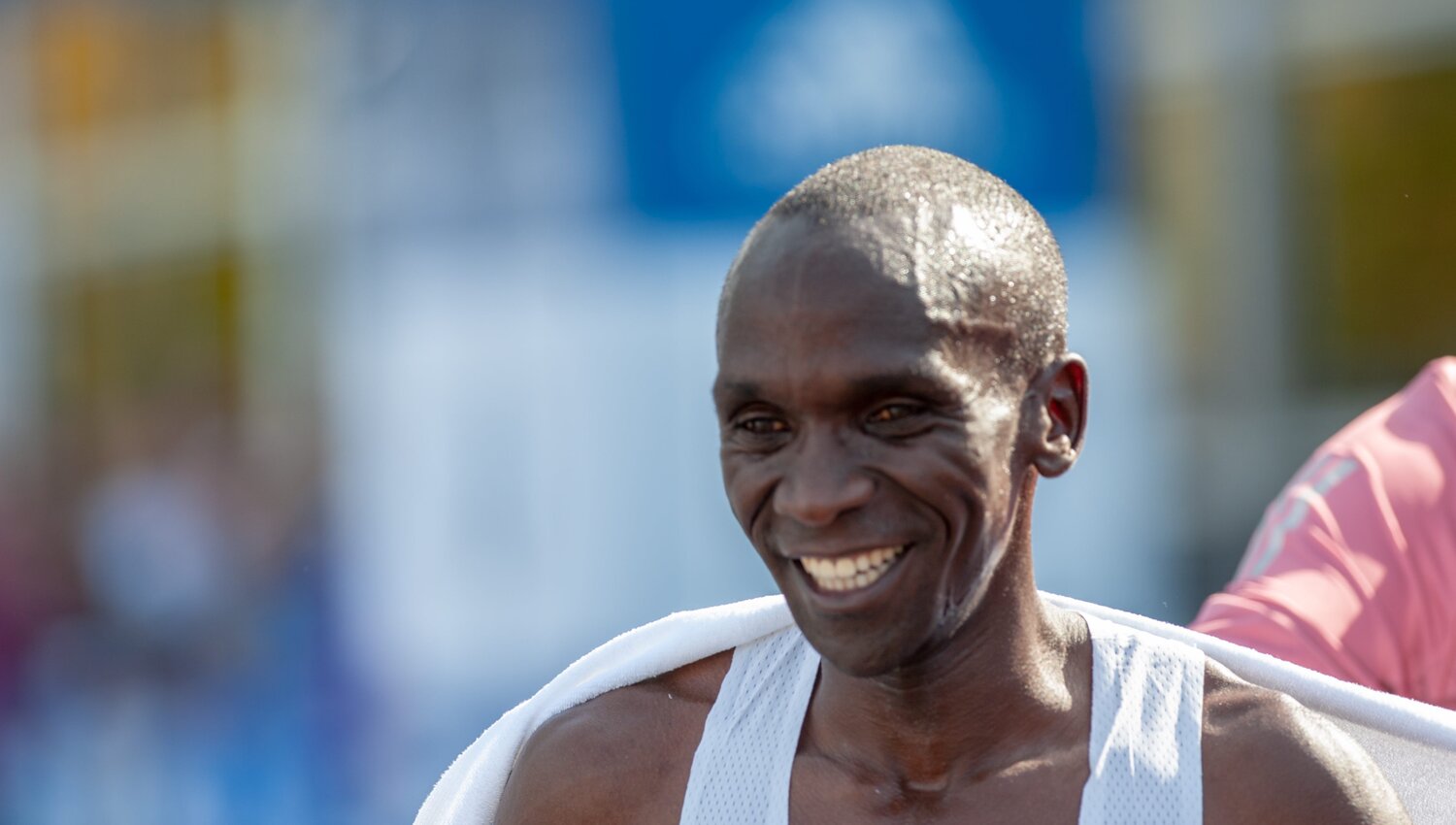
So just checking, but is everyone who is convinced he's dirty also convinced that Bekele is dirty?
I mean, he's also run 2:01 for a marathon. So I don't actually see Kipchoge as that much of an outlier in terms of time (in terms of consistency, sure...).
Are we also not taking into effect the fact that the new shoe technology let's you train faster without adding more wear and tear on your body? That's also a factor here.
Ok, Bekele’s dirty, sure.
I'll tell you a story about Jos Hermens with respect to Bekele. Some time in 2003-04 Daniel Wessfelt started the "Association of Athletics Managers" group which was a collection of the worlds leading track and field managers/agents. The purpose of the group was to create collective advocacy when dealing with the IAAF and meeting directors in terms of prize and appearance money and other general negotiations etc.
So in Hengelo 2004 after Bekele ran his WR, the group were sitting round a table at the meet hotel and Jos walks up. Someone in the table says to Jos "hey Jos, come on - enough is enough with Bekele - that was ridiculous" - Jos with a wry smile says "what do you mean" and the table is like "you know what we mean". Jos just started laughing and walked away.
Take away from that what you will - I would be STUNNED if at some point in KB's career something hadn't entered his bloodstream that shouldn't have. Stunned.
What about when you consider the pacing? I think most people here agree he could have run well under 2:01 with a more conservative first half. To run so fast in the first half and still hold on for a low 2:01 suggests to me he’s reached a higher level.
honestly world records will always bring this sort of attention. Innocent until proven guilty is my stance for anyone. Even when "guilty" I don't always think they intentionally doped.(gay, ajee, shelby, brenda)
No, I never said he will stop improving at 40. I still ran PBs up to age 45. I'm not putting arbitrary limits on his physiology. As we get older, maximal oxygen uptake decreases only very slightly. It doesn't increase, he isn't using more energy to run faster he is using energy more efficiently.
The improvement is in the VO2 plateau. You can go for longer at a certain intensity with the right training. This stuff has been known for more than 50 years, but most posters here have no clue or willingness to learn.
His running economy was measured before the first sub 2 attempt where he ran 2.00.25 at Monza. He was capable of 21kmh at around 90% VO2max, which is sustainable for around 2 hours. Since then perhaps the shoe technology has improved.
His VO2 max isn't high compared to millions of other runners. It's a combination of basic speed and basic endurance. He's not even a genetic freak in that regard.
You seem to be his personal doctor. What's his VO2Max before heading into Berlin may I ask. Do you have documents to show us?
VO2Max is only ONE indicator of running performance.
Please be specific and not just talk rubbish and expect people to take you seriously.
honestly world records will always bring this sort of attention. Innocent until proven guilty is my stance for anyone. Even when "guilty" I don't always think they intentionally doped.(gay, ajee, shelby, brenda)
11 pages into this thread, and as far as I can tell, only 1 person answered the OP's question (replying on the first page '2003', hahaha).
So if Kipchoge continues breaking his own WR for several more years, and breaks sub 2 hours, maybe runs 1:58 at age 41 or 42, it still wont raise any red flags at all, and you'll all continue to be 'inspired'?
This line of believing presupposes that such a PED exists, for the marathon runner, young or old, or that such a threshold exists, that can clearly separate dirty performances from the upper ceiling of clean performances.
If such a PED truly existed for the aging East African marathon runner, it must also exist for the non-East African runner, and we should be able to find comparable examples in history of similar improvements, as precedents, or as confirmation.
In 1985, Carlos Lopes and Steve Jones ran 2:07:12 and 2:07:13 respectively. These were world record performances at the time, but relatively slow times by today's modern marathon standards. What has happened among non-East Africans since? In the following 37 years, among the non-East African population, a total of 51 athletes have run as fast or faster, a total of 75 times. This population includes Russians, Moroccans, Bahranians, Spanish and other Europeans, Chinese, Japanese, Indians, Oceanians, and North and South and Central Americans. The fastest among them is a Moroccan Bahranian who ran 2:04:43, or 2m30s faster. A Japanese runner, a country not often suspected of doping, has run a similar time of 2:04:56. The fastest European runner is a Norwegian runner who has run 2:05:48, or 1m25s faster . The fastest American, disregarding the wind-aided 2:04:58, is a Moroccan (2:05:38), and the fastest non-African American is 2:06:07, only 1m05s faster.
All 51 of these athletes were at most 2m30s faster than the 1985 performances of Steve Jones, and Carlos Lopes. This represents the cumulative benefit of any doping improvements, fast courses, incentivized paced races, super shoes, and event specialization, among the worldwide population of non-East Africans, for the 37 years since. Compare this to a total of 304 East Africans running as fast or faster, a total of 733 times, now the fastest being 6m03s faster.
The old "doping doesn't work" for African runners argument, because you can't work out where to draw the line between a doped and a clean performance. The line is that drugs are widely used - and we see especially by Africans - and typically not detected. The athletes clearly know what you don't about the effects of drugs.
Did I make any argument about Africans? I gave a bunch of historical facts about non-East Africans and their fastest marathon performances since 1985. You are the first one to say that athletes worldwide in every sport will do everything that works. These collection of strong beliefs don't seem to be able to predict what actually happened over the last nearly four decades.
It's not just me that can't work out if such a line even exists.
Once again, you appeal to this fictitious group of athletes who you presume possess the knowledge that would confirm your long-held beliefs. Maybe "the athletes" clearly know which one of us is right, but I'm sure you don't possess that knowledge.
Thank you, this is helpful context. I referenced her in my second comment on page 1. Never heard of her before last weekend. I think most people would agree her progression is suspicious.
That's not progression, that a meteor
It is hard cause we are missing 2 years of progression. I don't know if she was injured or COVID messed her up.
Again though when did she start doping? To run 68:30, 67:30 or 2:15? I mean when a guy goes from 14:38 to 14:20/27:30 in like 18 months it is pretty clear when the doping started. But was she clean when she ran 1:59? What about 68:30? Or 67:30? Feels odd to start doping after those type of performances but if she was already doping to run 67:30, why did she get so much faster.
Obviously the weird part of this story is who runs 54 flat/1:59 as 20 year old and then decides screw it I am going to skip the 1500/3000/5000/10000 and move up to the marathon? We missed seeing her run a 14:30s 5000 and the like. Now maybe she did the financial math and it mades no sense to do distance on the track but it isn't a path we normally see. I will not pretend to understand her situation (maybe she realized she could be a 14:30 gal and only make 10k on the track and making a WC team would be a crap shoot, maybe a lot of leg issues from sprinting).
Of course if I had to bet my life, I am going to on drugs for pretty much every Ethiopian runner... Too much incentive and not enough testing.
It's interesting how people who raise topics related to exercise physiology so readily accept the idea that performance potential magically ceases to exist at age 35 (or 36 or 37, etc.). Certainly aerobic performance decreases with age, but consistent training reduces the decline, and psychological effects can be huge; is there a more diligent and positive endurance athlete on the planet than Kipchoge? Given the limited historical precedent for older athletes dedicating themselves to this level of performance (the guy is practically an athletic monk), it seems a little odd to be dismissive.
honestly world records will always bring this sort of attention. Innocent until proven guilty is my stance for anyone. Even when "guilty" I don't always think they intentionally doped.(gay, ajee, shelby, brenda)
11 pages into this thread, and as far as I can tell, only 1 person answered the OP's question (replying on the first page '2003', hahaha).
So if Kipchoge continues breaking his own WR for several more years, and breaks sub 2 hours, maybe runs 1:58 at age 41 or 42, it still wont raise any red flags at all, and you'll all continue to be 'inspired'?
It is kind of nonsense question, based on a poor understanding of how performance works. There is no real answer when the question presumes so much.
It's interesting how people who raise topics related to exercise physiology so readily accept the idea that performance potential magically ceases to exist at age 35 (or 36 or 37, etc.). Certainly aerobic performance decreases with age, but consistent training reduces the decline, and psychological effects can be huge; is there a more diligent and positive endurance athlete on the planet than Kipchoge? Given the limited historical precedent for older athletes dedicating themselves to this level of performance (the guy is practically an athletic monk), it seems a little odd to be dismissive.
Yes, I understand there are different ways of seeing this, which is why I created this thread to see what other people think. My line of belief got crossed. What’s yours?
Simply being a global medalist in the 5000 during the epo boom years when there wasn’t a test for it is enough suspicion. Either he is such a genetic outlier that he could beat the most doped athletes of all time or Ockham’s razor.
Only racing a couple times a year now is relatively safer. It is possible to drain a couple blood bags and be ready to go.
As much as I want to believe, objectively it is very unlikely.
No, I never said he will stop improving at 40. I still ran PBs up to age 45. I'm not putting arbitrary limits on his physiology. As we get older, maximal oxygen uptake decreases only very slightly. It doesn't increase, he isn't using more energy to run faster he is using energy more efficiently.
The improvement is in the VO2 plateau. You can go for longer at a certain intensity with the right training. This stuff has been known for more than 50 years, but most posters here have no clue or willingness to learn.
His running economy was measured before the first sub 2 attempt where he ran 2.00.25 at Monza. He was capable of 21kmh at around 90% VO2max, which is sustainable for around 2 hours. Since then perhaps the shoe technology has improved.
His VO2 max isn't high compared to millions of other runners. It's a combination of basic speed and basic endurance. He's not even a genetic freak in that regard.
You seem to be his personal doctor. What's his VO2Max before heading into Berlin may I ask. Do you have documents to show us?
VO2Max is only ONE indicator of running performance.
Please be specific and not just talk rubbish and expect people to take you seriously.
The man you want to speak to is his Oxygen Kinetics tester Professor Andy Jones.
Jones et alumni tested Kipchoge and other East African runners for the Nike sub 2 project. Kipchoge's VO2 at 21kmh was 65.5 ml/kg/min.
It's interesting how people who raise topics related to exercise physiology so readily accept the idea that performance potential magically ceases to exist at age 35 (or 36 or 37, etc.). Certainly aerobic performance decreases with age, but consistent training reduces the decline, and psychological effects can be huge; is there a more diligent and positive endurance athlete on the planet than Kipchoge? Given the limited historical precedent for older athletes dedicating themselves to this level of performance (the guy is practically an athletic monk), it seems a little odd to be dismissive.
Yes, we retain much of our absolute aerobic capacity for many years, because we must retain cardiac function just to stay healthy. Aerobic Endurance is a different matter. Obviously we do lose that very quickly without the right training.
But retaining the motivation that younger athletes have requires a certain mindset. It gets easier to lose that every year.
It's interesting how people who raise topics related to exercise physiology so readily accept the idea that performance potential magically ceases to exist at age 35 (or 36 or 37, etc.). Certainly aerobic performance decreases with age, but consistent training reduces the decline, and psychological effects can be huge; is there a more diligent and positive endurance athlete on the planet than Kipchoge? Given the limited historical precedent for older athletes dedicating themselves to this level of performance (the guy is practically an athletic monk), it seems a little odd to be dismissive.
Yes, I understand there are different ways of seeing this, which is why I created this thread to see what other people think. My line of belief got crossed. What’s yours?
Why don't you read the post you quoted?
You seem either jaded or somewhat delusional. Or both.
Help us build the best running shoe review site for a chance to win a LetsRun t-shirt.Help us build the best running shoe review site for a chance to win one of 10 LetsRun t-shirts.