The essential difference was Hocker was on rail and squeezed thru on final straight, so he had shorter path. Kerr ran wide and further distance. Also Hocker was faster on the day and ran a better race, and it wasn't due to shape of the track.
-
80
-
Rojo saw this
put a rage bait title on it
and closed the computer knowing every click on this thread would bring him cash
110 -
Curious_Cat wrote:
rojo wrote:
Do you agree or disagree?
it's only 0.11 of difference, but that all happened in the last 100m and the gap kept widening. It's not likely Kerr could've beaten Hocker even on a standard track. That said, however, if Jakob had held the line, Hocker would've come in third.
Track: There is no way an athlete at 1500m speed would feel the difference between a 120m and 121m turn. In the 200m? Maybe. That is why they don't put a runner in lane 1. In other words, being in lane 2 is an advantage in this respect.
Kerr, Inge, Hocker: Inge moved in to shut down Hocker's inside move. Hocker checked and got right behind Inge. Whichever way Inge went, Hocker was in a position to move. Given his speed on that second move, it is extremely likely that he could have moved between Inge and Kerr and still won. Kerr tied up in the last 15m, Inge had no response to any of the 3 who passed him. Only Neguse nearly matched Hocker's speed, but started from 1-2m back. The 5000m WC this year proves his speed is unmatched. In Paris he started a kick, checked, re-launched and still won. VERY few runners can do that when their momentum is interrupted.
Here is a good overhead angle of the race.
51 -
YearsOfExperience wrote:
Track: There is no way an athlete at 1500m speed would feel the difference between a 120m and 121m turn. In the 200m? Maybe. That is why they don't put a runner in lane 1. In other words, being in lane 2 is an advantage in this respect.
Kerr, Inge, Hocker: Inge moved in to shut down Hocker's inside move. Hocker checked and got right behind Inge. Whichever way Inge went, Hocker was in a position to move. Given his speed on that second move, it is extremely likely that he could have moved between Inge and Kerr and still won. Kerr tied up in the last 15m, Inge had no response to any of the 3 who passed him. Only Neguse nearly matched Hocker's speed, but started from 1-2m back. The 5000m WC this year proves his speed is unmatched. In Paris he started a kick, checked, re-launched and still won. VERY few runners can do that when their momentum is interrupted.
Here is a good overhead angle of the race.
I doubt so legally.
Where, when and how is he moving between Jakob and Kerr? In that final 60m Jakob is running on the inside of lane 2 and Josh on the outside. If that scenario is replicated in lane 1 how exactly is Hocker getting to the front? Splitting them? A track lane is 4 feet wide and you had two bodies in it with swinging arms attached to them - zero chance.
This is a different issue to his strength and speed in this race which was obviously the best, but multiple things can be true at once - he could easily have not won this race despite being the physically best guy in it. If Jakob does not make that half lane move wide in response to Kerrs presence, Hocker has no choice but to do the dreaded "parallel parking" exit move - the very move he avoided in Tokyo by stupidly crowbarring himself through a gap that wasn't there. If that happens there is no way he wins that race. The extra distance plus momentary burst of energy with only 50m to go - highly doubt that.
Get this feeling that there always this push to discredit him - that's the stupid premise of the "centrifugal force" argument and then there is always this "got lucky, therefore..." narrative. Well he did get lucky but so what! So many huge sporting moments are decided by fortune going one way or another, you still have to be great enough to capitalize on that fortune and he was. But we can also be honest and say that there was a real possibility here that it might not have gone his way and outcome something different.
51 -
cramister wrote:
Rojo saw this
put a rage bait title on it
and closed the computer knowing every click on this thread would bring him cash
Don't know how anyone uses this site without an adblocker
40 -
Salvitore Stitchmo wrote:
YearsOfExperience wrote:
Track: There is no way an athlete at 1500m speed would feel the difference between a 120m and 121m turn. In the 200m? Maybe. That is why they don't put a runner in lane 1. In other words, being in lane 2 is an advantage in this respect.
Kerr, Inge, Hocker: Inge moved in to shut down Hocker's inside move. Hocker checked and got right behind Inge. Whichever way Inge went, Hocker was in a position to move. Given his speed on that second move, it is extremely likely that he could have moved between Inge and Kerr and still won. Kerr tied up in the last 15m, Inge had no response to any of the 3 who passed him. Only Neguse nearly matched Hocker's speed, but started from 1-2m back. The 5000m WC this year proves his speed is unmatched. In Paris he started a kick, checked, re-launched and still won. VERY few runners can do that when their momentum is interrupted.
Here is a good overhead angle of the race.
Well he did get lucky but so what!
It really had very little to do with luck-
A] his "taking a chance on the inside lane" strategy actually cost him at first. He was flying and had to completely cut his stride and slow down when it did not open up at first when Jakob moved to the inside. This gave Kerr a big jump on him, and Cole had to reaccelerate, which is very hard to do at that point. His risky strategy hurt him as much as it helped him.
2] it is very common in the final stretch for the leader to drift to the second lane when people are passing him. So it happens a lot, And therefore can't really be considered some unusual lucky break.
3] His gold in the WC 5000m this year, and his many US titles, simply shows that he is a true winner. He finds a way to win at the highest level, when it matters most.
"Luck" had very little to do with his olympic 1500 meter gold. Period.
83 -
adblock bro wrote:
cramister wrote:
Rojo saw this
put a rage bait title on it
and closed the computer knowing every click on this thread would bring him cash
Don't know how anyone uses this site without an adblocker
the ad revenue was probably next to nothing. Display ad companies charge a little over a dollar per 1000 ad placements, and not all of that dollar is passed on to the sites that display them. So if 100 people clicked on this thread and saw an ad, it would be about 10 cents.
Maybe more if it shows more than 1 ad at once.
Monetized social media influencers get way more traffic, I'm sure
21 -
Only if Centro's has a **
11 -
bullsh*t!!!
00 -
Richard Feynman wrote:
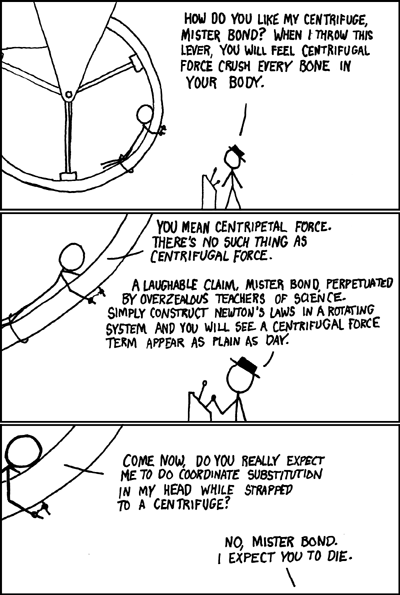
Put an asterisk next to that guys physics and mathematics degrees. Centrifugal force is not real. Its imaginary. Physics 101.
You should've taken 102. Centrifugal force is as real as other forces (in a sense they are all imaginary, but in another sense they all exist).
The real Feynman had no trouble using 'centrifugal force' to explain physics.
real Richard Feynman wrote:
When we are rotating, there is centrifugal force on the weights. They are trying to fly out, so when we are going around we have to pull the weights in against the centrifugal force. So, the work we do against the centrifugal force ought to agree with the difference in rotational energy, and of course it does. That is where the extra kinetic energy comes from.from https://www.feynmanlectures.caltech.edu/I_19.html - many other examples
See also41 -
nah, dodgy narrative, coulda wooda shoulda
goose closed faster than hocker and kerr.. and he ran a bit wide, slightly broke stride with guys in the way..
goose puts on meters even while hocker is making the big move.
42 -
Tyrone ReXXXing wrote:
Salvitore Stitchmo wrote:
Well he did get lucky but so what!
It really had very little to do with luck-
A] his "taking a chance on the inside lane" strategy actually cost him at first. He was flying and had to completely cut his stride and slow down when it did not open up at first when Jakob moved to the inside. This gave Kerr a big jump on him, and Cole had to reaccelerate, which is very hard to do at that point. His risky strategy hurt him as much as it helped him.
2] it is very common in the final stretch for the leader to drift to the second lane when people are passing him. So it happens a lot, And therefore can't really be considered some unusual lucky break.
3] His gold in the WC 5000m this year, and his many US titles, simply shows that he is a true winner. He finds a way to win at the highest level, when it matters most.
"Luck" had very little to do with his olympic 1500 meter gold. Period.
Dude, literally none of that changes the fact that his win was largely due to Jakob drifting out to lane 2. That is the very definition of luck. Of course it doesn’t matter though, because he capitalized and made a correct tactical decision.
22 -
Salvitore Stitchmo wrote:
YearsOfExperience wrote:
Track: There is no way an athlete at 1500m speed would feel the difference between a 120m and 121m turn. In the 200m? Maybe. That is why they don't put a runner in lane 1. In other words, being in lane 2 is an advantage in this respect.
Kerr, Inge, Hocker: Inge moved in to shut down Hocker's inside move. Hocker checked and got right behind Inge. Whichever way Inge went, Hocker was in a position to move. Given his speed on that second move, it is extremely likely that he could have moved between Inge and Kerr and still won. Kerr tied up in the last 15m, Inge had no response to any of the 3 who passed him. Only Neguse nearly matched Hocker's speed, but started from 1-2m back. The 5000m WC this year proves his speed is unmatched. In Paris he started a kick, checked, re-launched and still won. VERY few runners can do that when their momentum is interrupted.
Here is a good overhead angle of the race.
I doubt so legally.
Where, when and how is he moving between Jakob and Kerr? In that final 60m Jakob is running on the inside of lane 2 and Josh on the outside. If that scenario is replicated in lane 1 how exactly is Hocker getting to the front? Splitting them? A track lane is 4 feet wide and you had two bodies in it with swinging arms attached to them - zero chance.
This is a different issue to his strength and speed in this race which was obviously the best, but multiple things can be true at once - he could easily have not won this race despite being the physically best guy in it. If Jakob does not make that half lane move wide in response to Kerrs presence, Hocker has no choice but to do the dreaded "parallel parking" exit move - the very move he avoided in Tokyo by stupidly crowbarring himself through a gap that wasn't there. If that happens there is no way he wins that race. The extra distance plus momentary burst of energy with only 50m to go - highly doubt that.
Get this feeling that there always this push to discredit him - that's the stupid premise of the "centrifugal force" argument and then there is always this "got lucky, therefore..." narrative. Well he did get lucky but so what! So many huge sporting moments are decided by fortune going one way or another, you still have to be great enough to capitalize on that fortune and he was. But we can also be honest and say that there was a real possibility here that it might not have gone his way and outcome something different.
Hocker wasn’t the best guy physically. Jakob was. 3:28.24 from the front.
45 -
Richard Feynman wrote:
Put an asterisk next to that guys physics and mathematics degrees. Centrifugal force is not real. Its imaginary. Physics 101.
I love how people just repeat some gotchas they read online and think they’re so smart.
Centrifugal force is a perfectly valid way to describe/calculate what is happening to a person/object in a non-inertial frame of reference in a more intuitive way for layman consumption.
40 -
snowflakes wrote:
Salvitore Stitchmo wrote:
I doubt so legally.
Where, when and how is he moving between Jakob and Kerr? In that final 60m Jakob is running on the inside of lane 2 and Josh on the outside. If that scenario is replicated in lane 1 how exactly is Hocker getting to the front? Splitting them? A track lane is 4 feet wide and you had two bodies in it with swinging arms attached to them - zero chance.
This is a different issue to his strength and speed in this race which was obviously the best, but multiple things can be true at once - he could easily have not won this race despite being the physically best guy in it. If Jakob does not make that half lane move wide in response to Kerrs presence, Hocker has no choice but to do the dreaded "parallel parking" exit move - the very move he avoided in Tokyo by stupidly crowbarring himself through a gap that wasn't there. If that happens there is no way he wins that race. The extra distance plus momentary burst of energy with only 50m to go - highly doubt that.
Get this feeling that there always this push to discredit him - that's the stupid premise of the "centrifugal force" argument and then there is always this "got lucky, therefore..." narrative. Well he did get lucky but so what! So many huge sporting moments are decided by fortune going one way or another, you still have to be great enough to capitalize on that fortune and he was. But we can also be honest and say that there was a real possibility here that it might not have gone his way and outcome something different.
Hocker wasn’t the best guy physically. Jakob was. 3:28.24 from the front.
ya, the other guys know that, and off a way too fast first lap.
30 -
But the track was still 400m, right?
10 -
longjazz wrote:
nah, dodgy narrative, coulda wooda shoulda
goose closed faster than hocker and kerr.. and he ran a bit wide, slightly broke stride with guys in the way..
goose puts on meters even while hocker is making the big move.
Goose ran the final 100 in the same time as Hocker … but Nuguse didn’t have to slow down and reaccelerate as Hocker did. It was Hocker doing the stutter stepping while Nuguse had a fairly clean run down the straight. You wokesters really fall all over each other trying to get into Nuguse’s jock. 😂
44 -
What a Load LOL wrote:
longjazz wrote:
nah, dodgy narrative, coulda wooda shoulda
goose closed faster than hocker and kerr.. and he ran a bit wide, slightly broke stride with guys in the way..
goose puts on meters even while hocker is making the big move.
Goose ran the final 100 in the same time as Hocker … but Nuguse didn’t have to slow down and reaccelerate as Hocker did. It was Hocker doing the stutter stepping while Nuguse had a fairly clean run down the straight. You wokesters really fall all over each other trying to get into Nuguse’s jock. 😂
That’s true. It really bothers these guys that Cole generally beats Nuguse in championship races. Cole did have slow for a few strides while Yared did a slingshot off the curve but Cole still won. What bothers them even more is Cole now has two global gold medals.
32 -
are you Somalian?
02 -
rojo wrote:
Do you agree or disagree?
Canadian running wrote:
Because the Stade de France also hosted rugby competitions during the Games, the athletics track was apparently built with a slightly altered radius–one metre longer on the bends and three metres shorter on the straights in comparison to a standard athletics track.Amandine Aftalion, a mathematician at Université Paris-Saclay who studies the physics and statistics of human kinetics, says this subtle design change may have given the eventual Olympic champion, Cole Hocker of the U.S, an advantage.
According to Aftalion, the longer bend increases the centrifugal force, which is the outward force a person, object or thing experiences while turning. Centrifugal force makes it tougher to maintain speed in the curve. In the final 200 metres of the Olympic final, Kerr used Lane 2 to move ahead of Norway’s Jakob Ingebrigtsen, while Hocker hugged the inside of Lane 1 and waited for a hole to open up.
“The longer bend meant more time under force,” Aftalion said. “Kerr’s move into Lane 2 [the longer route] may have cost him momentum, while Hocker conserved speed and energy by staying tight on the inside.”
She adds that on a standard track, with shorter turns, Kerr might have been able hold off Hocker. But that extra metre could have been the margin that put the gold into Hocker’s tactical hands. The two athletes were separated by just over a tenth of a second, with Hocker winning gold in an Olympic record of 3:27.65, and Kerr taking silver in 3:27.77.
The way you go out of your way to eliminate Lagat out of American 1500m conversations even when regarding what he did as an American. You got Cole over 2007 Lagat and didn't even want to talk about him last pod. I expect the same level of effort in disqualifying Cole lol.
00
What People Are Talking About On LetsRun
No top threads at the moment. Check back soon.