It’s time for World Athletics to eliminate the World Championship bye for defending champions
By Jonathan GaultThe 2025 World Athletics Championships begin on Saturday in Tokyo. It’s going to be the best meet of the year, because the World Championships is always the best meet of the year: all the stars competing with the highest stakes. It’s almost perfect.
But there is one thing that needs to change. World Athletics needs to stop giving every defending champion an automatic bye to Worlds.
This move would not do anything to improve the World Championships, but it will add jeopardy to track & field’s regular season. And in a sport where most regular-season meets are glorified exhibitions, jeopardy is a good thing.
Cards on the table: LetsRun.com is American running website. So I’m a little biased. One of the main aims of this proposal is to improve the US championships.
The US championships is already one of the best meets in the world every year, but not all US championships are created equal. When there is no team to make — an “off” year, like 2026 — many of the top stars choose not to prioritize USAs or skip it entirely. Olympic Trials years are incredible — everyone shows up, and everyone goes all-out to make the team.
In a World Championship year like 2025, the US championships rests somewhere between those two extremes. Some events are just as compelling as the Olympic Trials (at least to track fans). But others lack the same jeopardy because many of the biggest stars have a safety net in the form of the World Championship bye.
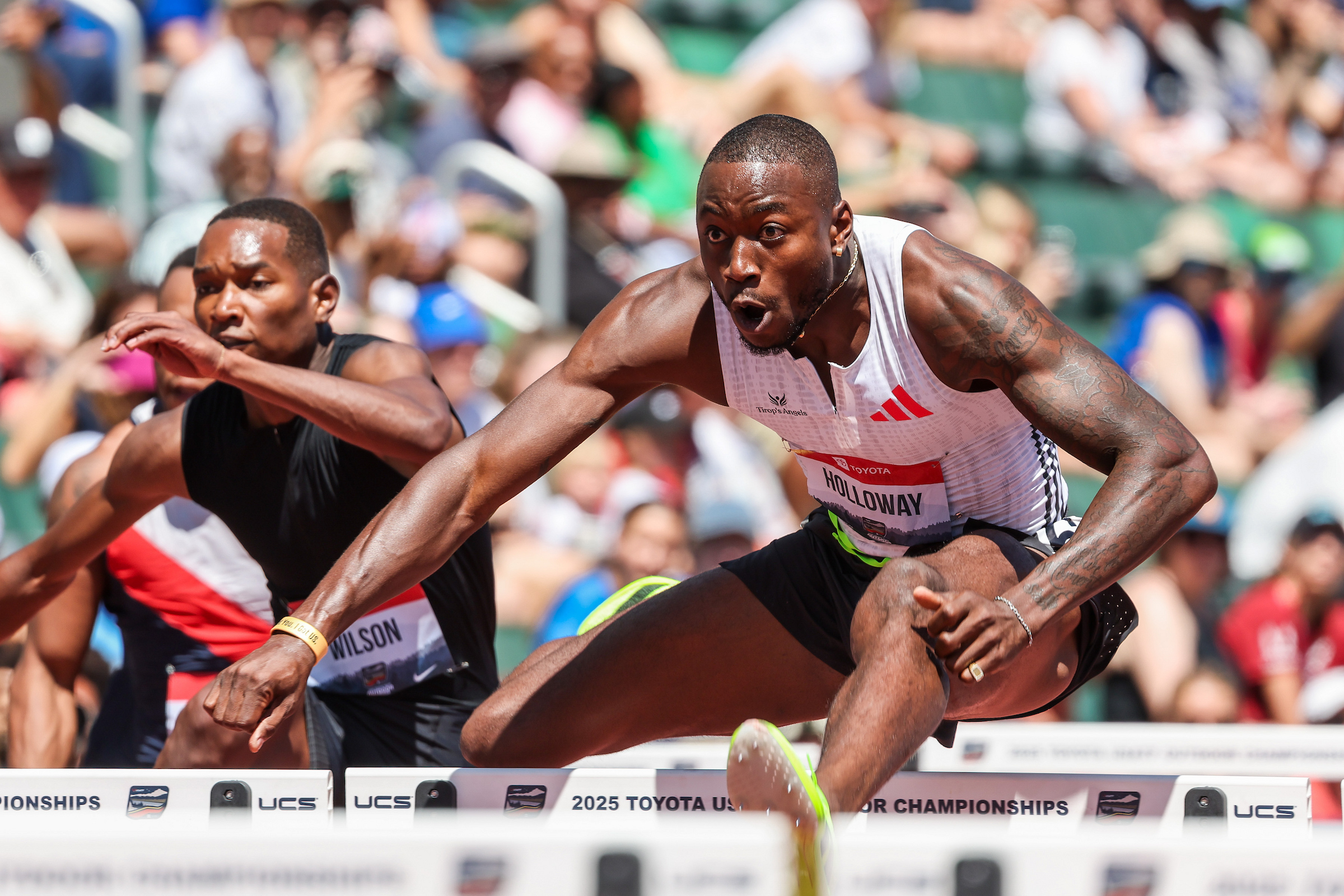 Holloway ran the first two rounds at USAs this year but skipped the final (Kevin Morris photo)
Consider the 110-meter hurdles at USAs this year. American star Grant Holloway has had an uneven season since winning the world indoor title in March. His season’s best of 13.11 ranks him 13th in the world — but just seventh among Americans. Seeing whether Holloway, one of the greatest hurdlers ever, could make the team in America’s most loaded event, would have been one of the stories of USAs.
Instead, because he had the bye, Holloway didn’t even race the final. He didn’t run the US final in 2022 or 2023 either. If the system allows one of the sport’s biggest stars to skip what is meant to be one of the few races each year that truly matters, then there is a problem with the system.
This is not meant to single out Holloway, who competes as much as any major star. This is a guy who has raced in six countries already in 2025 and who runs a full indoor season, year after year. He is hardly the only American to take this option at USAs. Christian Coleman didn’t run the 100m final at USAs when he had the bye in 2022. Nor did Justin Gatlin or the late Tori Bowie in 2019.
Over the past four USAs in World Championship years (2019, 2022, 2023, 2025), the US has had 21 reigning world champions in running events. Here is what each elected to do at USAs when they had the bye:
Competed seriously in primary event at USAs
| Athlete | Year | Event | Result |
| Emma Coburn | 2019 | Steeplechase | 1st |
| Noah Lyles | 2022 | 200 | 1st |
| Sydney McLaughlin-Levrone | 2023 | 400* | 1st |
| Noah Lyles | 2025 | 200 | 1st |
*McLaughlin-Levrone had the bye in the 400 hurdles but I’m considering the 400 her “primary event” in 2023 since that is the one she intended to run at Worlds
Competed in different event at USAs
| Athlete | Year | Bye in | Competed in | Result |
| Tori Bowie | 2019 | 100 | Long jump | 4th |
| Phyllis Francis | 2019 | 400 | 200 | 5th |
| Fred Kerley | 2023 | 100 | 200 | 4th |
| Noah Lyles | 2023 | 200 | 100 | 3rd |
| Athing Mu | 2023 | 800 | 1500* | 2nd |
| Noah Lyles | 2025 | 100 | 200** | 1st |
| Sha’Carri Richardson | 2025 | 100 | 200** | Did not make final |
*Mu qualified for Worlds in the 1500 but only ran the 800 at Worlds
**Both Lyles and Richardson ran one round of the 100 before focusing on the 200
Did not compete seriously at USAs/scratched final
| Athlete | Year | Bye in | Competed in | Result |
| Justin Gatlin | 2019 | 100 | 100 | DNS final |
| Kori Carter | 2019 | 400 hurdles | 200 | Ran 28.01 in prelim |
| Christian Coleman | 2022 | 100 | 100 | DNS final |
| Donavan Brazier | 2022 | 800 | 800 | DNS semis |
| Grant Holloway | 2022 | 110 hurdles | 110 hurdles | DNS final |
| Nia Ali | 2022 | 100 hurdles | 100 hurdles | DNS final |
| Dalilah Muhammad | 2022 | 400 hurdles | None | Skipped USAs |
| Michael Norman | 2023 | 400 | 100 | Ran 10.31 in prelim |
| Grant Holloway | 2023 | 110 hurdles | 110 hurdles | DNS final |
| Grant Holloway | 2025 | 110 hurdles | 110 hurdles | DNS final |
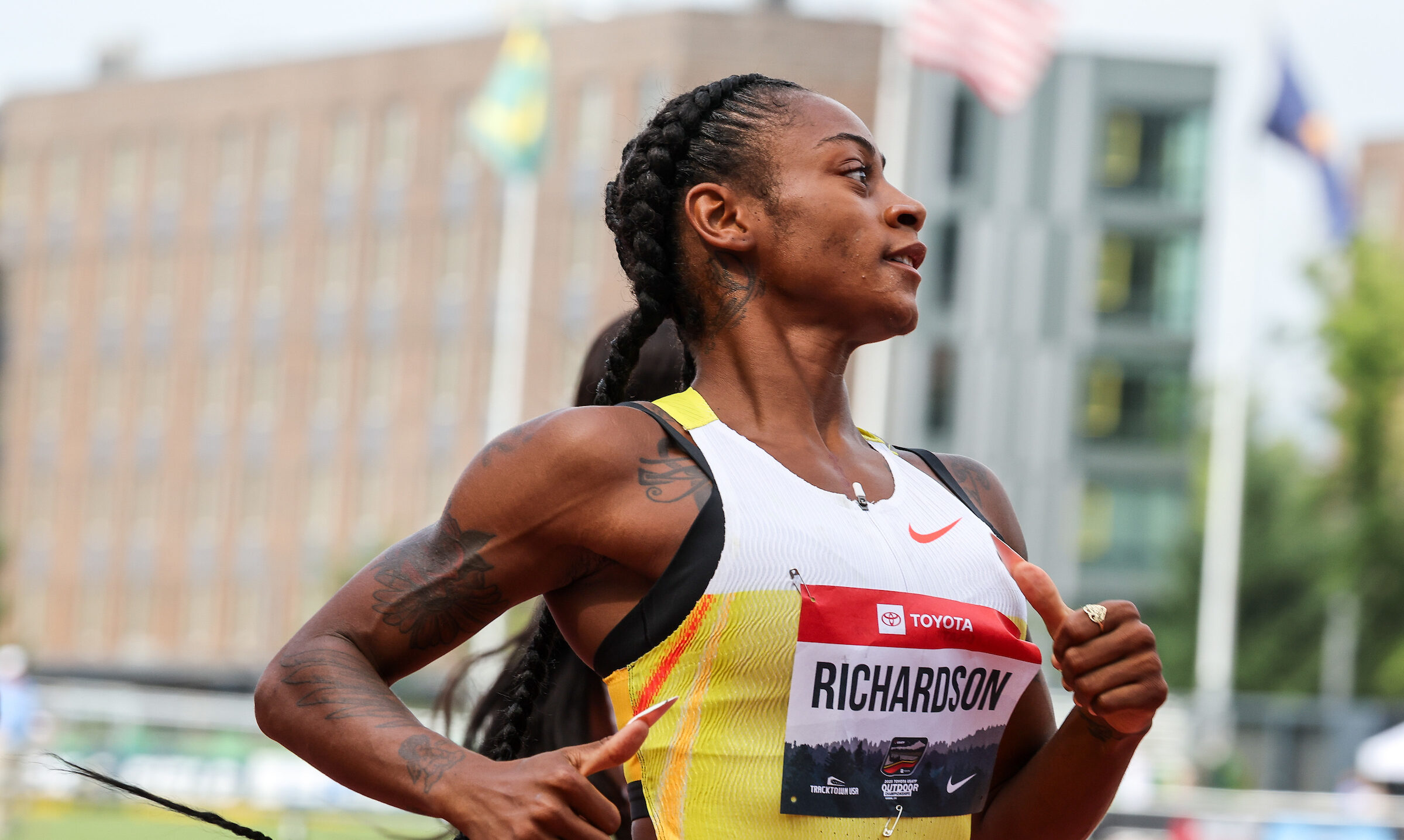 Richardson only ran one round of the 100 at USAs this year (Kevin Morris photo)
So of those 21 reigning champions, 10 (48%) just went through the motions by running an off event or withdrawing before the final. Seven (33%) competed in a different event where they tried to qualify for Worlds, with varying degrees of seriousness. Only four (19%) actually competed seriously in their primary event at USAs. Those aren’t great participation numbers for a group consisting of America’s biggest track stars.
One benefit of the bye is that it encourages doubling at Worlds. It was easier for Lyles to double at Worlds in 2023 knowing he wouldn’t have to run both the 100 and 200 at USAs. But the very best athletes have shown they can double in the 100/200 at a four-day USA meet (Kenny Bednarek did it this year). And some athletes who have the opportunity to double at Worlds, like McLaughlin-Levrone and Mu in 2023, still turn it down.
The problem here is one of incentives. Athletes are going to — quite understandably — do whatever they feel is best for them to prepare for the major championships. For many of these athletes, the incentive of a few thousand dollars in prize money isn’t enough to make them want to run the final at USAs. (It’s different in field events. Since the top field eventers don’t make as much as the top runners, almost all of them compete at USAs every year, whether they have the bye or not). But if you put a World Championship berth on the line, I guarantee they’d be out there.
***
The LetsRun.com solution, and why it works
LetsRun.com’s proposal to solve this problem is simple: get rid of the byes for defending world champions. The bye for winning the Diamond League final would remain in place.
This proposal would have the knock-on effect of adding drama to the final Diamond League meets of the season. Watching Yared Nuguse and Josh Hoey race for their World Championship lives this year seriously raised the stakes of meets like Silesia, Lausanne, and even the Diamond League final. Now imagine what it would have been like if Grant Holloway and Sha’Carri Richardson were in the same position.
I can already hear the complaints about this proposal. And I’ve got some answers for you.
Complaint: You can’t get rid of the bye. A champion deserves the opportunity to defend their title.
Of course they do. That’s why they’ve got the entire regular season to qualify. In the NFL, the Eagles don’t get an automatic berth in this year’s playoffs just because they won the Super Bowl last year. They have to earn their way in, just like everybody else.
But that isn’t even the right comparison. Because in track & field, we give the byes to the champions from two years ago. Even though we had an Olympics in between. So this would be the equivalent of the NFL giving the Chiefs a bye into the 2025 playoffs because they won the title in 2023.
There are sports other than football, you know. In golf, the reigning champion in each major gets to come back the next year and defend their title. If you win the Masters, you get to play every year for the rest of your life!
Yes, but golf doesn’t cap entrants by country. If golf created a self-imposed cap of four players per country, I imagine there would be some complaints about the “defending champion gets a bye” policy.
Complaint: What about athletes who get injured? Jakob Ingebrigtsen hasn’t competed since March — don’t you want him at Worlds this year?
Look, we all want the biggest stars at Worlds. But the vast majority of reigning champions qualify for Worlds already without the bye. Over the last four editions of Worlds, World Athletics has crowned 160 world champions across track, field, and the marathon. Of that number, 148 of them (92.5%) would have qualified for the next Worlds via standard or ranking.
Of the 12 (7.5%) that failed to qualify:
-two were injured and didn’t compete at Worlds
-one was injured and eliminated in the first round
-one didn’t qualify after retiring from track to focus on the marathon
-one did not qualify because they were suspended
That leaves seven athletes. Three of them (Antonio Watson, Pierce LePage, and Yulimar Rojas) have byes for the 2025 Worlds, so it’s too early to render a complete verdict in their cases. I’ll admit that the triple jump in Tokyo is more interesting if Rojas is in it — but only if she is fit. The fact that she has not competed since September 2023 suggests that she is not.
Of the other four who would not have qualified without the bye, two had middling results at Worlds — Christian Taylor failed to make the triple jump final in 2022, and Katarina Johnson-Thompson was 8th in the heptathlon that same year. The other two won gold, both in 2019: Mutaz Essa Barshim in the high jump and Muktar Edris in the 5,000.
But Edris also stopped racing two months before the qualifying window closed on September 6. Considering Edris ran 12:58 to win the world title on September 30, I’m confident he could have run 13:22 on September 6 if he did not have the bye.
The bottom line: if an athlete has been injured for so long that their only path to Worlds is via the bye, that usually means they are not going to be much of a factor at Worlds. Ingebrigtsen has not competed since March, but even without the bye, he would still have qualified for Worlds in both events this year — he has the standard in the 1500 and would qualify by ranking in the 5,000 (he’s currently #8 in the world).
Complaint: This is a biased US-centric proposal with no consideration for the rest of the world.
 Ingebrigtsen hasn’t raced since March but has a bye to Worlds in the 5,000 thanks to his victory in Budapest (Kevin Morris photo)
I admitted at the top that one of the main motivations behind this proposal is to make the US championships more competitive. I’m not hiding from that. But LRC’s proposal has very little impact on the rest of the world.
Most countries already have carve-outs in their selection policy for their biggest stars. USATF selects its team off a head-to-head trials race, but most other countries just aren’t deep enough in most events to justify such a system. Ethiopia will occasionally hold trials races, but good luck finding an official selection policy from their federation. Jamaica holds a trials every year and generally selects the top three in each event, but its selection policy allows for exemptions for its biggest stars. British Athletics already has a sort of bye in place in its selection policy by pre-selecting recent medalists. Kenya holds a trials for the first two places and reserves the third spot for a discretionary pick.
If World Athletics eliminates the bye, those federations will still be able to get their biggest names onto the World Championship team if they want them there. Alternately, eliminating the bye could incentivize them to hold legitimate trials where it’s top-three or bust in certain events. In which case, the sport picks up a few extra marquee races. A do-or-die Jamaican 100m final? Or Kenyan 1500m final? Sign me up.
If anyone should be complaining about this solution, it’s the American athletes. The current system already puts Americans at a disadvantage compared to someone like St. Lucia’s Julien Alfred, who doesn’t need to qualify through a trials like her American and Jamaican rivals. By removing the bye and forcing Americans to compete for three spots instead of four, it would be even harder for top Americans to qualify. But we do it that way every four years at the Olympic Trials — which also happens to be one of the most exciting meets in the sport. And as I recall, the American team has still fared pretty well at the last few Olympics.
***
So, could it happen?
Probably not. LetsRun.com asked World Athletics president Sebastian Coe last week whether WA would consider eliminating byes for reigning world champions.
“I don’t think we’d eliminate the bye for reigning world champions,” Coe said. “But I do think it’s ultimately up to the national federation to determine what its selection policy is. And whether that is being policed in one way or another, I don’t think that’s the role that World Athletics should take. Athletes are going to do what they think is in their best interest.”
USATF’s policy used to be that it would only select an athlete with a bye if that athlete competed at USAs (triple jumper Christian Taylor once flew 10,000 miles round trip to satisfy this requirement by intentionally fouling his only attempt at USAs). But USATF has grown more lenient recently. Now, USATF doesn’t require an athlete to compete at USAs at all in order to be selected with the bye.
USATF could, in theory, institute some sort of “honest effort” rule at USAs — if you want the bye to Worlds, you have to compete in every round of that event at USAs. But that could be difficult to enforce. And what happens if an athlete with a bye gets “injured” at USAs? An honest effort rule would make USAs more compelling, but ultimately, USATF’s aim is to send as many athletes as possible to Worlds. If USATF can send four, it is going to send four.
Coe also said he does not believe athletes with the bye are “abusing” the system by intentionally avoiding competition or showing up to Worlds when they clearly are not ready to compete. And he wants to make sure track & field’s biggest stars are at its biggest meet.
“They’re worthy of their place in the championships, you want to maintain the best in class if you possibly can,” Coe said. “…I think it is still, at this moment, not a bad thing to encourage.”
If we are going to keep the bye system, it should go to the country, not the athlete
Okay, so what about a tweak? If scrapping the bye entirely is too extreme, why not just award the bye to the country, rather than the athlete? A big star from a smaller country would still be guaranteed to be at Worlds. Meanwhile, a more competitive country like the US would get an extra entry and a more competitive national trials, with the top four finishers making it to Worlds. A top athlete like Lyles or Holloway would have a slightly easier path to Worlds (they’d only need to finish in the top four instead of top three) and the do-or-die nature of USAs would remain the same.
Is it fair that an athlete like Holloway could “unlock” the bye for the US but not actually use it for himself? Not really. But qualifying for Worlds is already an unfair process. Is it fair that Trey Cunningham, the fourth-fastest 110m hurdler on planet Earth this year (13.00 sb), won’t be at the World Championships but guys like Jeremie Lararadeuse of Mauritius (13.31 sb) and Gregory Minoue of Germany (13.46) will be simply because they represent different countries? No. But that’s why the US championships are so compelling.
Eliminate the bye, and the US championships get better while the World Championships stay great. That is a trade worth making.
What do you think? Talk about this article on our world-famous messsageboard / fan forum: LRC editorial: It’s time for World Athletics to eliminate the World Championship bye for defending champions .