In theory, yes, but I thought that isn’t how tariffs actually play out. In the next four years, Americans will shift to making all those goods in the United States that they typically imported? Who will be taking those factory jobs? Who will be paying a high enough wage for Americans to take those jobs?
The people taking those jobs will be workers who are working in retail, fast food, services, and other low paying jobs who are seeking a higher paying job. The labor market is similar to the goods and services market, the difference being when the wage goes up, the labor demand curve shifts to the right. This signals a job supply quantity at a designated wage has created a new job market demand. American companies and also foreign companies who rent land from American land lease agents, will both build firms and production factories and fields to create new products. In order to do this they need a domestic American workforce. The way to create a new workforce is to offer salaries, benefits, and perks that are higher and better than those that American workers are currently receiving. So you'll see American Walmart workers leave in droves to work higher paying jobs at an American energy company or Chinese owned clothing company down the street in their own hometown.
This would be impractical and irrational if alternative prices for imports produced by a foreign located workforce were the same as they've been: much cheaper. But the new outrageous 25% tariffs will allow for companies both American and otherwise to build in the U.S. if the comparative cost of doing so is much cheaper now. "It is morning in America".
In theory. But that’s never how it plays out. The workers in retail and fast food don’t end up taking those jobs. Where is the money coming from to build in the U.S.? The cost of the goods they be using to build will be significantly higher due to the tariffs. The comparative cost to building, etc. in the U.S. is not cheaper. It’ll be much higher due to the tariffs.
Tariffs are a fee paid by the importer, usually the company shipping these goods to the US.
The importer typically raises prices to offset the tariff. The increase is passed on to the retailer who passes it on to the consumer.
In a static system, if the tariff is $40, the consumer pays $40 more. However, world markets are NOT static. They are dynamic.
In the real world, the importer initially has a price advantage. The immediate effect of tariffs is to take away that price advantage. The importer must reduce prices to remain competitive. So, part of the tariff is paid by the importer. Unfortunately, domestic producers know this and increase their prices. The result is inflation. But, and this is important, the inflation is only for the imported goods that have been tariffed so the effect on overall US inflation is much less.
Worse for other country, reducing production is extremely disruptive for their importers. Company profits fall. Their stock prices fall. Workers are laid off. Tax revenue to the government from companies and workers is greatly reduced.
Now, here is the point that both sides of the debate seem to be missing. Tariffs are like Power Slap, the competition where two competitors take turns slapping each other. In Power Slap, the winner is the last competitor standing. When one side is way bigger and stronger than the other, the smart opponent concedes before the first slap is landed.
That's what we're seeing here. Trump is using the threat of tariffs to get other countries to change their economic policies towards the US. And... to get companies to relocate their manufacturing plants to the US. The US doesn't have to actually implement the tariffs... or not for very long. Or, the US can modify the tariffs as a concession to get the changes the US wants from the foreign nation.
Yes, it's likely that tariffs will cause a blip in consumer prices for some goods. However, there's a long-term strategy to lessen the US's dependency on these imports. In Canada's case, that's oil, natural gas, and auto parts.
If tariffs are good why did Trump just cancel them?
Tariffs are a fee paid by the importer, usually the company shipping these goods to the US.
The importer typically raises prices to offset the tariff. The increase is passed on to the retailer who passes it on to the consumer.
In a static system, if the tariff is $40, the consumer pays $40 more. However, world markets are NOT static. They are dynamic.
In the real world, the importer initially has a price advantage. The immediate effect of tariffs is to take away that price advantage. The importer must reduce prices to remain competitive. So, part of the tariff is paid by the importer. Unfortunately, domestic producers know this and increase their prices. The result is inflation. But, and this is important, the inflation is only for the imported goods that have been tariffed so the effect on overall US inflation is much less.
Worse for other country, reducing production is extremely disruptive for their importers. Company profits fall. Their stock prices fall. Workers are laid off. Tax revenue to the government from companies and workers is greatly reduced.
Now, here is the point that both sides of the debate seem to be missing. Tariffs are like Power Slap, the competition where two competitors take turns slapping each other. In Power Slap, the winner is the last competitor standing. When one side is way bigger and stronger than the other, the smart opponent concedes before the first slap is landed.
That's what we're seeing here. Trump is using the threat of tariffs to get other countries to change their economic policies towards the US. And... to get companies to relocate their manufacturing plants to the US. The US doesn't have to actually implement the tariffs... or not for very long. Or, the US can modify the tariffs as a concession to get the changes the US wants from the foreign nation.
Yes, it's likely that tariffs will cause a blip in consumer prices for some goods. However, there's a long-term strategy to lessen the US's dependency on these imports. In Canada's case, that's oil, natural gas, and auto parts.
If tariffs are good why did Trump just cancel them?
Prepare to hear the same Trumpers who only yesterday were touting tariffs as a brilliant economic policy that would revitalize the country and "Make America Great Again" do a complete 180 with no acknowledgment whatsoever that they have reversed their position.
I don't know how anyone thinks the Tariffs are a good idea. Actually, the Trump supporting base are poor and uneducated so they probably don't care about the markets.
The reason Trump is imposing tariffs on products from other countries is that when he lies that they are taxes paid BY the other countries, tons of people believe him. They then consider him a winner.
I can't stress this enough: SO. MANY. PEOPLE. still believe that tariffs are a tax that you can charge to other countries. These are people that don't fact-check, because they don't care that much. They see some headlines, they hear this or that from their neighbor; they think Trump is charging taxes to other countries, that he's bringing money into the US. They created the "External Revenue Service" to bolster this lie. That's it. That's the whole answer to why these tariffs are happening.
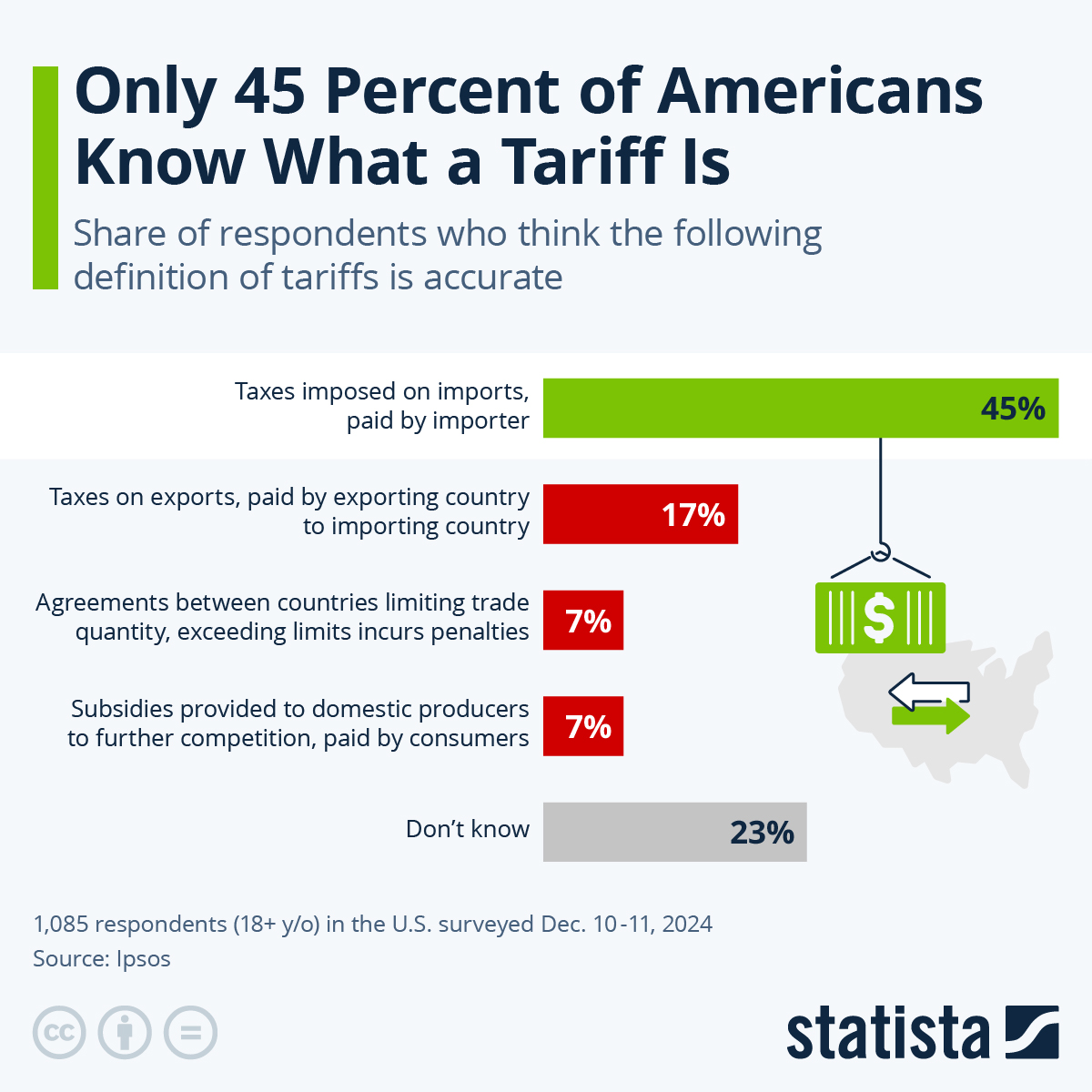
Very true and very unfortunate. Many, many people are uninformed and easily misled. According to some research, 55% of the U.S. population do not understand who pays tariffs.
Yes, a plurality (45%) of Americans correctly answered that tariffs, “Tariffs are taxes imposed by a country on goods and services imported from another country, paid by the importer, often leading to higher prices for consumers.” But that means that a majority were either wrong (31%) or just said they didn’t know (23%). A majority of Democrats (65%) got the question right, but only 35% of Republicans did.
If tariffs are good why did Trump just cancel them?
It's the back and forth to get concessions. 1. Trump threatens a tariff unless he gets concessions. 2. He gets concessions so he postpones the tariff. 3. The concessions aren't enough so he threatens the tariff again and doubles down by adding more to the tariff.
In short, you're looking at a tariff as if it's... well... just a tariff. A tariff isn't JUST a tax; tariffs are also negotiation tools to get rapid concessions on issues important to the United States that might never occur if left to politicians.
The back and forth with tariffs has already accomplished more in two months than the Biden Administration accomplished in four years. Look at what Canada has done in since the first tariff was threatened.
ChatGPT wrote:
1. Canada, fulfilling a promise made to U.S. President Donald Trump, appointed a senior intelligence official to the new post of fentanyl czar, saying he would coordinate the fight against smuggling of the drug. 2. In February 2025, the CBSA launched Operation Blizzard, a nationwide initiative targeting illegal contraband, with a particular focus on fentanyl and synthetic narcotics. This initiative involves increasing inspections of shipments entering and leaving Canada to intercept illicit substances more effectively. this operation, officers seized 56.1 grams of fentanyl across six incidents, reflecting a proactive approach to intercepting smaller, yet highly potent, quantities of synthetic opioids.These enhanced enforcement actions and the resulting seizures indicate a robust response to drug trafficking challenges, with the CBSA achieving higher interception rates than in previous years. - Source: Canada.ca 3. The Canadian government allocated CDN$1.3 billion to bolster border security. This investment includes enhancements such as aerial surveillance and improved coordination with U.S. law enforcement agencies, aiming to curb drug trafficking and undocumented migration while ensuring the free flow of goods. 4. Canada designated seven Latin American criminal groups, including Mexico’s Sinaloa Cartel and Jalisco New Generation Cartel, as terrorist entities under its Criminal Code. This designation provides law enforcement with additional tools to combat fentanyl trafficking by freezing assets and criminalizing support for these organizations.
I anticipate that these tariffs will continue to be modified as concessions are made. I anticipate that many companies with manufacturing facilities in Canada will announce plans to relocate or build new plants in the US in the coming months if tariffs are actually implemented.
This post was edited 1 minute after it was posted.
It's the back and forth to get concessions. 1. Trump threatens a tariff unless he gets concessions. 2. He gets concessions so he postpones the tariff. 3. The concessions aren't enough so he threatens the tariff again and doubles down by adding more to the tariff.
In short, you're looking at a tariff as if it's... well... just a tariff. A tariff isn't JUST a tax; tariffs are also negotiation tools to get rapid concessions on issues important to the United States that might never occur if left to politicians.
The back and forth with tariffs has already accomplished more in two months than the Biden Administration accomplished in four years. Look at what Canada has done in since the first tariff was threatened.
I anticipate that these tariffs will continue to be modified as concessions are made. I anticipate that many companies with manufacturing facilities in Canada will announce plans to relocate or build new plants in the US in the coming months if tariffs are actually implemented.
That's probably not what happened.
The CEO of Ford picked up the phone and told the Trump administration that he would have to send home most of his US staff if tariffs threatened the production.
I anticipate that next month the tariffs will be postponed again for another month. I am sure all these companies love a good dose of uncertainty.
If tariffs are good why did Trump just cancel them?
It's the back and forth to get concessions. 1. Trump threatens a tariff unless he gets concessions. 2. He gets concessions so he postpones the tariff. 3. The concessions aren't enough so he threatens the tariff again and doubles down by adding more to the tariff.
In short, you're looking at a tariff as if it's... well... just a tariff. A tariff isn't JUST a tax; tariffs are also negotiation tools to get rapid concessions on issues important to the United States that might never occur if left to politicians.
The back and forth with tariffs has already accomplished more in two months than the Biden Administration accomplished in four years. Look at what Canada has done in since the first tariff was threatened.
ChatGPT wrote:
1. Canada, fulfilling a promise made to U.S. President Donald Trump, appointed a senior intelligence official to the new post of fentanyl czar, saying he would coordinate the fight against smuggling of the drug. 2. In February 2025, the CBSA launched Operation Blizzard, a nationwide initiative targeting illegal contraband, with a particular focus on fentanyl and synthetic narcotics. This initiative involves increasing inspections of shipments entering and leaving Canada to intercept illicit substances more effectively. this operation, officers seized 56.1 grams of fentanyl across six incidents, reflecting a proactive approach to intercepting smaller, yet highly potent, quantities of synthetic opioids.These enhanced enforcement actions and the resulting seizures indicate a robust response to drug trafficking challenges, with the CBSA achieving higher interception rates than in previous years. - Source: Canada.ca 3. The Canadian government allocated CDN$1.3 billion to bolster border security. This investment includes enhancements such as aerial surveillance and improved coordination with U.S. law enforcement agencies, aiming to curb drug trafficking and undocumented migration while ensuring the free flow of goods. 4. Canada designated seven Latin American criminal groups, including Mexico’s Sinaloa Cartel and Jalisco New Generation Cartel, as terrorist entities under its Criminal Code. This designation provides law enforcement with additional tools to combat fentanyl trafficking by freezing assets and criminalizing support for these organizations.
I anticipate that these tariffs will continue to be modified as concessions are made. I anticipate that many companies with manufacturing facilities in Canada will announce plans to relocate or build new plants in the US in the coming months if tariffs are actually implemented.
Let’s call this $2B committed and 56 grams of fentanyl.
The markets lost 5%.
An absolutely atrocious deal.
None of this matters because people were literally saying yesterday how tariffs are necessary for the US economy. Now they are just a negotiating tactic. Both can’t be good! (Although one could be neutral about both, but that’s a level nuance inappropriate for LRC)
It’s quite clear they went into these tariffs with no plan. Crashed the markets. And extracted nothing of use from CAN or MEX in the whole 24 h they were in place.
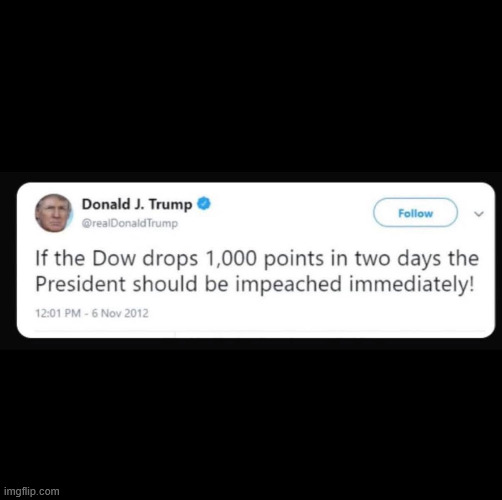
Imagine being dumb enough to think 1000 points in 2012 is the same as 1000 points in 2025...
The stupid people will run out of stocks soon and then the smart people will buy up all of the cheap stock and the market will rebound as it literally always has.
If you're freaking out over short term stock fluctuations you really shouldn't be involved with the market.
Trump telling us we need to be ready for a recession. Cool man. You’re president. Your goal should be to avoid making your citizens unemployed and poorer. Someone should let him know.
Imagine being dumb enough to think 1000 points in 2012 is the same as 1000 points in 2025...
The stupid people will run out of stocks soon and then the smart people will buy up all of the cheap stock and the market will rebound as it literally always has.
If you're freaking out over short term stock fluctuations you really shouldn't be involved with the market.
Imagine being dumb enough to believe a fake tweet from 2012 is real.
We’re getting some combination of the following in the next 4 years:
1) S&P 500 under 4000.
2) National debt above $50T.
3) Inflation above 7%.
I’m reasonably confident we can avoid 1 of the 3, but Trump may deliver the perfect trifecta.
Imagine being dumb enough to think 1000 points in 2012 is the same as 1000 points in 2025...
The stupid people will run out of stocks soon and then the smart people will buy up all of the cheap stock and the market will rebound as it literally always has.
If you're freaking out over short term stock fluctuations you really shouldn't be involved with the market.
Trump has managed 1000 in one day though, so he's doing pretty well in comparison.