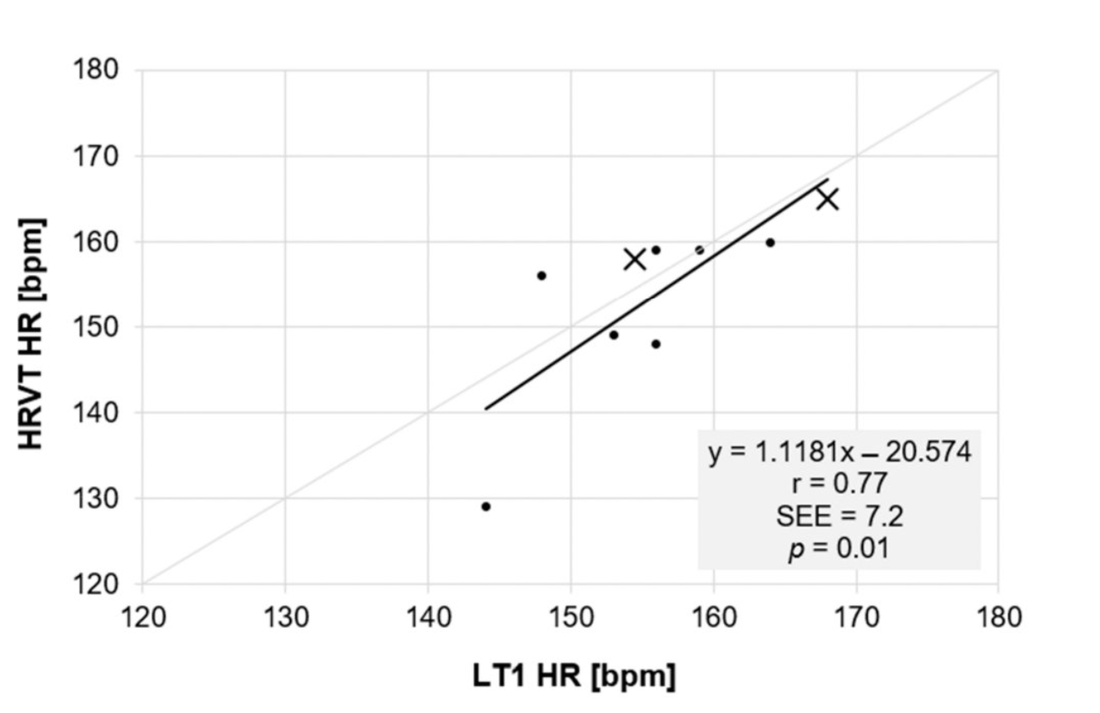
DFA a1 has come up here before. I'm not really training for anything specific at the moment so I thought it would be a good opportunity to experiment with it and also rope my usual victims as guinea pigs. This will help us get some good data via people who know their own lactate profiles and see if it's a good proxy, or even if it's just useful. Or even if it just ends up like Tymewear or running power, where it's useful for some individuals and seems to play nicely, or for others ends up in the bin.
Firstly, if anyone is doing this make sure you use the right equipment. I've tried it with a few monitors. Basically unless you have a Polar H10 I would say it's probably not worth bothering. I've tried with a Garmin HRM-Pro, a Coospo chest strap, all of which gave me two weeks of crap data back, so I gave up and bought the H10 a couple months ago. That was the first thing I did correctly. Also, wear a tight strap. When I didn't, I got noticeably more artifacts.
The second thing is to ignore the default values in the Garmin AlphaHRV app, especially for running. My cycling DFA a1 values are probably quite near to what the default values are, whether that's because a lot of the data and studies have come from cycling, I don't know. But running mine are significantly lower. If you have a different LTHR on the bike compared to running, like I do (mine is significantly higher running than on the bike), then it makes sense that your DFA a1 values will probably be different too since it's also based on heart rate data and the way you're moving around can affect the values. It was reasonably easy to work this out with the wealth of data I already have with regards to my LT1 and LT2.
The raw numbers themselves I don't see as important, but a bit like power it's whether they are consistent across a range of situations. So far, yes. I can run or ride to DFA a1. It remains pretty consistent to the goal of the run and then slightly drops off as I start to fatigue. This is where it can/could be useful. Important note: DFA a1 is not directly identical to lactate, but the cardiac/autonomic stress it reflects can still be a helpful proxy here. It'll be interesting to see how it plays out over the warmer summer and whether the data remains useful when HR starts to decouple for the same effort.
Overall I don't really see this as massively useful. I can probably just go and run at LT1 (although LT1 is probably the hardest for me to pitch, it's a smaller bullseye zone which is important if you are going to double than classic NSM runs which have a big target range), do a classic sub-threshold workout, or a full threshold/race workout just from feel and get there most of the time. But if it consistently works, it could be a really useful safeguard. Even at MLSS, it might indicate fatigue is setting in and that it's time to call it good for the day. It does on paper seem most useful for subthreshold or sweetspot reps that are runs or on the bike.
The flip side being that for short reps it's as useless as a warm Carling on a warm day. The first 60+ seconds of the reps there is a lag, so I just crop the laps in intervals to take out the initial part and keep the latter portions. Run 400s and just don't even bother. There's not enough clean data. Even for 800-1km repeats there's not a ton to work with.
RR data is also interesting on it. With the H10, smart recording and collecting HRV data enabled on the Garmin, the IQ AlphaHRV app can record RR. This seems much more sensible and accurate than Garmin native RR. I've even managed to roughly pitch where LT1 and LT2 are just using RR via the AlphaHRV app. You can see how different it is, as when you load up Garmin Connect after, it'll give you the usual Garmin RR graph but a second one in the Garmin IQ section that will look a lot less noisy. This is also the one that'll default and upload to intervals usually, about 90% of the time. Sometimes it hasn't. I don't know why. Anyway, as I mentioned above I just crop the laps and then see how DFA a1 and RR match up with what I would expect, given the intensity of the workout and the numbers being displayed. So far, pretty decent.
I've actually done a couple of runs now and a couple of rides, just using DFA a1 and RR on the screen, and the workouts ended up exactly at the pace or power I expected. However, as I mentioned before, I could have done this without all of that probably quite easily 90% of the time. But it's interesting to learn, play around, or even just gain some knowledge that might help others.
I know a couple of people, the usual suspects, already doing really clever things like building apps, but for me, as a simpleton, all I want to know is whether it's any good as a proxy for controlling intensity, or at least letting you know when that intensity is becoming too much.
The end ha ha