Has anyone been using DFA A1 as a metric to keep an eye that you're staying sub threshold in workouts? DFA (detrended fluctuation analysis) Alpha 1 is a HRV based aerobic and anaerobic threshold estimation method. Basically it works on the premise that your heart rate is a series of patterns and repeated sub patterns. But as you approach LT2 the sub patterns become more chaotic as your aerobic system becomes increasingly taxed. The good thing about it is that you don't actually need to know your threshold heart rate / state. This data point will tell you exactly that. For example 0.75 is your LT1 and 0.50 is your LT2.
> 1.0: Low-intensity, easy, or resting state; high parasympathetic activity.
0.75 - 1.0: Moderate intensity; approaching the aerobic threshold.
0.5 - 0.75: Zone 2 to Zone 3 transition; aerobic threshold (LT1) is typically at 0.75.
< 0.5: High intensity (Zone 3); anaerobic threshold (LT2) and above
In terms of NSM you'd want to keep subT reps between 0.75 - 0.60 for the most part, with your last rep ideally approaching 0.55.
The reason I bring it up, is because I had previously derived my subT paces from lactrace.com - based on a recent 5k time. Never really knew what my threshold hr was, I never had a decent monitor, just the Garmin wrist watch. Turns out the reps from lactrace are much too fast for me, and I'd been using the conservative end of the ranges given. While the reps felt good, and felt like a 6/10 effort, over time I was functionally over-reaching, crippling my nervous system, I ended up with sciatica over Christmas. I thought this was due to bad form, but having since gotten a Polar H10, and looking at my data in Runalyze, specifically DFA A1 - I could see straight away that my subT reps were beyond threshold. I'm not yet sure whether they were far beyond, or just a tad over, and things had just accumulated over a number of weeks. I'll spend the next while reducing pace, sticking to what I now believe to be my hr threshold and monitoring DFA A1 to see how close I get to 0.50 during reps.
As I had previously been dealing with it sciatica over Christmas, I eased off on the running to recover. I was just slowly starting to build back up, introducing workouts over the last few weeks.
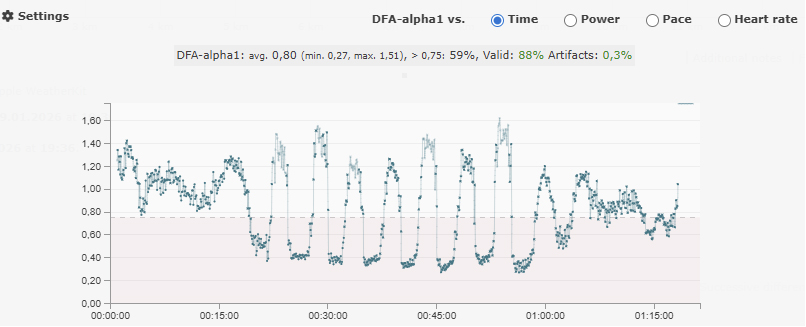
The link below is Monday night workout (screenshot from Runalyze). It's the first workout I'd done since getting my hands on the Polar H10 hrm, 8 x 1000m. As you can see above, I was really going over threshold, spending most of the last reps at 0.30. My heart rate during these reps stayed at 155-160bpm, this told me things were ok. But after the last few workouts leading up to the above, I had a bit of a flair up of sciatica once again. So I think this data point DFA A1 has the potential to be more useful than just looking at heart rate.
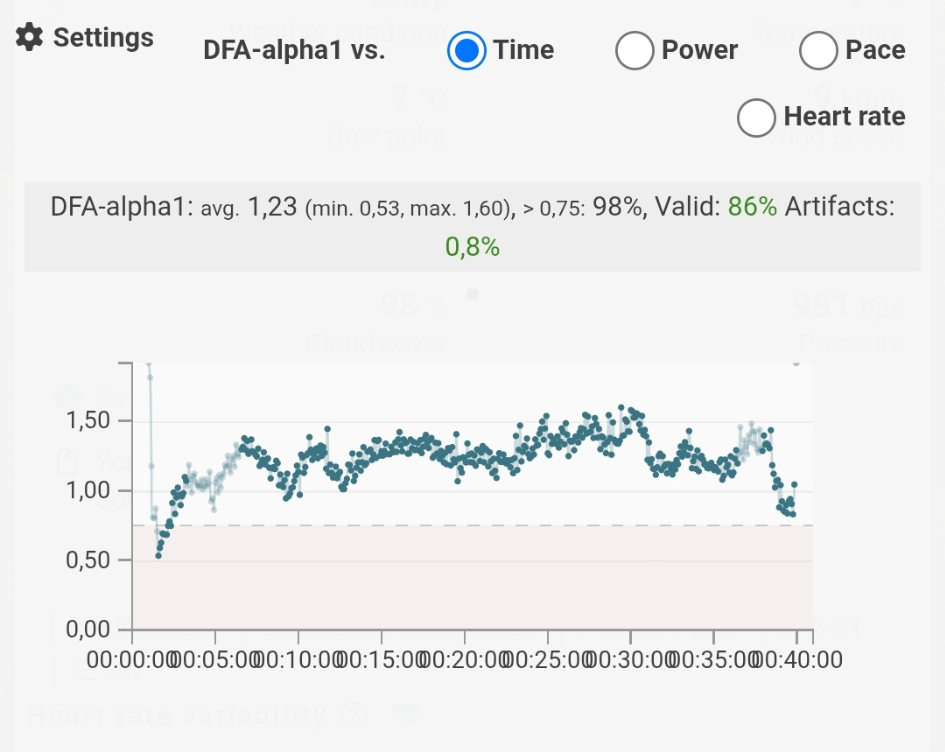
The link below is a VERY easy run last night, 8km, avg hr of 125bpm, hill at the start and end of run, average dfa a1 of 1.23.
DFA A1 just seems like another tool to help simplify things, which is why I thought it worth mentioning here. It seems like it could be the next best thing to a lactate meter. If you're not sure on your paces or hr zones, it will still tell you when you're over doing it.