i actually dont use intervals.icu so someone else would no doubt be better to answer
could just be the yo-yo in consistency when coming back from injury? sometimes that period when you start back to normal training can have some deceptive highs and lows til things get consistent
Thanks man. Can you elaborate on the 50:00 - 80:00 cycling also? Messed around with cycling back then but mostly just joyrides over alpine passes and a handful short hillclimbs.
Would a 3x20' be something to consider as a cross training workout?
i actually dont use intervals.icu so someone else would no doubt be better to answer
could just be the yo-yo in consistency when coming back from injury? sometimes that period when you start back to normal training can have some deceptive highs and lows til things get consistent
Thanks man. Can you elaborate on the 50:00 - 80:00 cycling also? Messed around with cycling back then but mostly just joyrides over alpine passes and a handful short hillclimbs.
Would a 3x20' be something to consider as a cross training workout?
definitely, just did that yesterday actually
really however you want to structure it, but for me if im thinking “LT1” i want the intervals to be at least 20:00, maybe up to 40:00, or if im very very confident where that line is just do a straight ride pitched maybe 10-20w under for 60:00-90:00 minutes
its just a slightly different approach with fatigue and fueling for the session vs sweetspot/threshold
this is all on a trainer with ERG so incredibly boring but youre always on the pedals and feels manageable
that parts a little more known for a lot of folks
the unknown is how the running side will pan out. lt1 for running im thinking either ‘longer’ reps 4x8:00/2:00 or just a straight tempo ish effort that is right under the line
ive had decent luck in the past with the straight tempo but never tried ‘pushing’ lt1 in interval fashion
either way, open to seeing what happens, even if its just a ‘base’ phase, im not overly concerned with performance in the short run since races are far off into the future at this point
This post was edited 35 seconds after it was posted.
Has anyone who's done this method for a while tried letting their CTL and performance plateau for a while, then added in 45/15 sessions or Magness's rhythm 200s to see if they made a tangible difference?
My off-season short intervals workout is 4-5x1000 + 6-10x200 on 300m jog cause main distance 800m in summer. Still dialling this in a bit, am fairly new to NSW.
To those interested in NSM for 800m, having second thoughts about this above combo.
One, directly after the sub-t part I’m feeling reasonably spent. Not the most zing left in the legs.
Two, read somewhere that going acidic would inhibit some of the aerobic gains from the workout. Probably Magness somewhere fwiw.
Tried the 200s after 8k easy today on a slight incline just to take the edge off mechanical stress a bit. Might be the ticket after all. Always feeling very fresh next day after workout and ready to go again. Realising this is somewhat similar to Ingebrigtsen X.
Curious about the validity of 7x 75-90 min easy runs. Typically, these will yield a 50-60 load for me, respectively. 350-420 weekly load.
On the flip, doing vanilla 320-340. Hypothetically, I'd be able to stack more load, and total volume would obviously be higher.
My question, is would this be more beneficial for someone who is specifically extremly aerobically underdeveloped, but has some speed (me)?
If you have natural speed you are probably a bit more on the FT end of the spectrum, and as per Stephen Seiler would benefit from some anaerobic capacity work to help aerobic development.
Curious about the validity of 7x 75-90 min easy runs. Typically, these will yield a 50-60 load for me, respectively. 350-420 weekly load.
On the flip, doing vanilla 320-340. Hypothetically, I'd be able to stack more load, and total volume would obviously be higher.
My question, is would this be more beneficial for someone who is specifically extremly aerobically underdeveloped, but has some speed (me)?
For every individual it depends. Only one way to find out I guess.
I myself have built fitness in the past with the Lt1 approach up to a point when starting out.
But since Seiler was mentioned, in his (in?)famous 2013 4*4 vs 4*8 vs 4*16 interval study the control group that only did low intensity did not really improve over 10 weeks or so. These were "trained" subjects.
As for other considerations, I would nevertheless opt for vanilla nsa for the simple reason that it fires on two cylinders when it comes to activating signalling pathways that elicit aerobic improvement in muscles, whereas the Lt1 approach only utilises the calcium pathway (after a while, anyway).This pathway is activated by contractions alone, so low intensity and volume drive it.
But then there is the PGC 1 alpha pathway that also drives mitochondrial growth, and requires higher intensities to be triggered.
Beside making sense from a practical POV, Nsa covers both bases from the mechanistic, signalling POV.
Curious about the validity of 7x 75-90 min easy runs. Typically, these will yield a 50-60 load for me, respectively. 350-420 weekly load.
On the flip, doing vanilla 320-340. Hypothetically, I'd be able to stack more load, and total volume would obviously be higher.
My question, is would this be more beneficial for someone who is specifically extremly aerobically underdeveloped, but has some speed (me)?
This method relies on load so there is an argument for however you create more load it is beneficial. However, this method also relies on consistency over the long term so would your suggestion still be producing more load over 6/12/18 months? Your ability to be consistent over the long term is probably more dependant on your personality than mentality or physiology. Could you really do nothing but easy running for the next 6 months??? If so, and more so that mixing in sessions, go for it. This is the risk of reducing training down to just numbers. Those numbers have to work for you and only you.
Just my opinion, but I think people get distracted by what they perceive their physiology to be way too soon. I dare say everyone below sub-elite are aerobically underdeveloped to some degree. Similarly, whether you have speed/endurance or ST/FT bias is unlikely to be important or even a factor until you are up to that level.
If you think a method could work for you (this method or another), try it, stick with it, refine it.
Curious about the validity of 7x 75-90 min easy runs. Typically, these will yield a 50-60 load for me, respectively. 350-420 weekly load.
On the flip, doing vanilla 320-340. Hypothetically, I'd be able to stack more load, and total volume would obviously be higher.
My question, is would this be more beneficial for someone who is specifically extremly aerobically underdeveloped, but has some speed (me)?
7 x 90 mins would be 10.5 hours of running - When you're calculating the load including subT is this running the same amount of time?
NSM is mostly about creating the highest, sustainable load for the time you have available - If you ran easy for 9 hours and kept 90 mins of subT what would the load be?
Modifying the Chinese Shoes Approach to Lower Mileage12/30/2025 9:42am EST5 months ago
Chinese shoes are significantly cheaper for U.S customers even with tariffs, and often offer better performance than mainstream western counterparts. I am making this thread with the hope that other people contribute with the...
Has anyone who's done this method for a while tried letting their CTL and performance plateau for a while, then added in 45/15 sessions or Magness's rhythm 200s to see if they made a tangible difference?
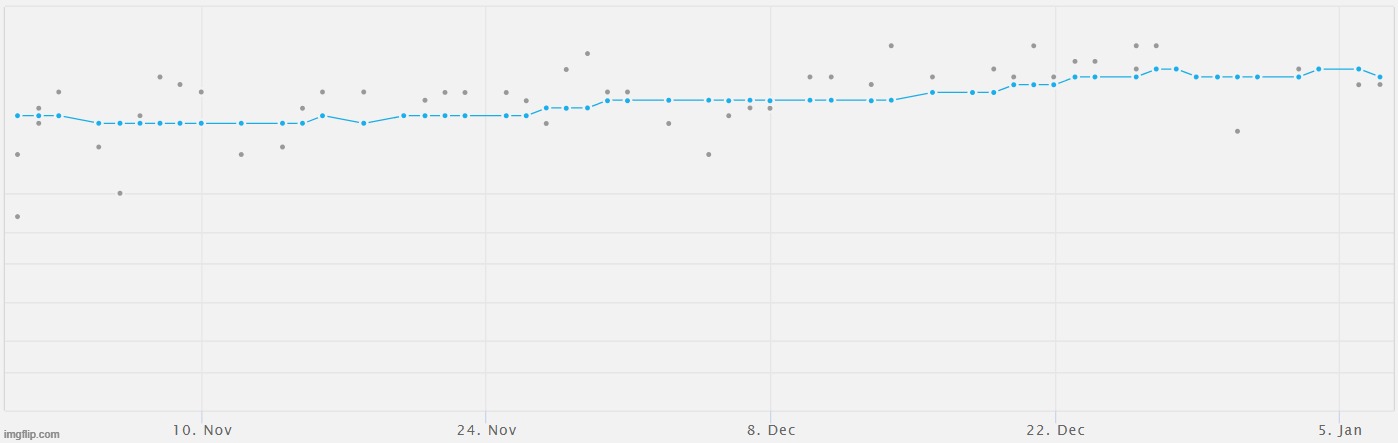
Might have something along those lines, see chart below. Did a sort of early funnel periodization base training in Nov (easy runs and short fast stuff). Started to mess with NSW in Dec, not really on schedule but trying some sessions while keeping some stride/hillsprint stuff.
Then, precisely on Dec. 22nd I did my last sprint/stride/hill session (until yesterday). Only NSW and easy after that. You see fairly obviously that before, I always had high-VDOT workouts (usually easy runs). Those over-average workouts kept coming for about one more week. The last 2 weeks there was not a single one. (The one very low point is a new years 5k trot, might have had other factors).
Has anyone who's done this method for a while tried letting their CTL and performance plateau for a while, then added in 45/15 sessions or Magness's rhythm 200s to see if they made a tangible difference?
Might have something along those lines, see chart below. Did a sort of early funnel periodization base training in Nov (easy runs and short fast stuff). Started to mess with NSW in Dec, not really on schedule but trying some sessions while keeping some stride/hillsprint stuff.
Then, precisely on Dec. 22nd I did my last sprint/stride/hill session (until yesterday). Only NSW and easy after that. You see fairly obviously that before, I always had high-VDOT workouts (usually easy runs). Those over-average workouts kept coming for about one more week. The last 2 weeks there was not a single one. (The one very low point is a new years 5k trot, might have had other factors).
Am adding those 200s (or 30-40s uphill variety) back and see what happens. As mentioned before I am trying NSW-style base towards 800m in summer.
What volume of the hills are you doing and when do you slot them in? A couple pages back another poster suggested 4 x 20s hills on the Monday which would likely work. 30-40s hills on, say, a Wednesday or Friday could be a bit tougher as your squeezing them in between the session days. The longer 30-40s hills are presumably a bit more taxing as well.
Curious about the validity of 7x 75-90 min easy runs. Typically, these will yield a 50-60 load for me, respectively. 350-420 weekly load.
On the flip, doing vanilla 320-340. Hypothetically, I'd be able to stack more load, and total volume would obviously be higher.
My question, is would this be more beneficial for someone who is specifically extremly aerobically underdeveloped, but has some speed (me)?
I trained like this a long time. Just 90 mins easy every day with a two hour long run.
The below is just my experience.
I don't think you will plateau in 8 weeks, or 8 months. It will make you very fit over a long period of time. You do have to be consistent and really crank the volume though.
But fitness and "race readiness" are two different things.
If you just jump into a 5k off this kind of training, your result will reflect maybe 94-95% of your fitness.
With NSM, if you just jump into a 5k, your result will reflect maybe 98-99% of your fitness. To me that is the big advantage of this system (there is also the time-optimization, which is a big plus for some people. I don't care about it because I have no life and a bs job, but the "race readiness" factor won me over).
If you are willing to spend a few weeks sharpening (you don't need a lot), it can be just as good though. Or just do a little bit of quality.
This type of training is as old as the hills. If you are interested, I would look into the ancient wisdom of the 60s/70s. Tom Osler in particular, and Ernst van Aaken. It could probably be argued that Tom Osler was the Moses of hobbyjoggers during the golden age, the sirpoc of his time. There is some line in his book (I don't have it on me) that really stands out, something like "many amateur runners will be best off just training like this (his base template) year-round without preparing for specific races".
Key to both of those guys is one short, relaxed time trial per week. Keeps you used to hard running and the mechanics good.
Keep in mind that there's a lot more knowledge now than there was back then. They didn't really know about threshold or tempo. Training was either all-out or jogging, nothing in-between. And there's some stuff in Van Aaken's book in particular that you obviously just throw in the garbage can (advocating for anorexia and sleep deprivation didn't age well). But also a lot of solid gold in this stuff.
I think if I were to do this today, I'd probably do some combo workout once a week, with something like some reps of Magness rhythm 200s + 15 minutes of volume at threshold or slightly higher (maybe 3x5mins or 4x4 mins), instead of the straight time trial. Or just a fartlek.
Or you could build in LT1 volume, then you basically have Lydiard. Or Hadd.
This post was edited 2 minutes after it was posted.
Curious about the validity of 7x 75-90 min easy runs. Typically, these will yield a 50-60 load for me, respectively. 350-420 weekly load.
On the flip, doing vanilla 320-340. Hypothetically, I'd be able to stack more load, and total volume would obviously be higher.
My question, is would this be more beneficial for someone who is specifically extremly aerobically underdeveloped, but has some speed (me)?
For every individual it depends. Only one way to find out I guess.
I myself have built fitness in the past with the Lt1 approach up to a point when starting out.
But since Seiler was mentioned, in his (in?)famous 2013 4*4 vs 4*8 vs 4*16 interval study the control group that only did low intensity did not really improve over 10 weeks or so. These were "trained" subjects.
As for other considerations, I would nevertheless opt for vanilla nsa for the simple reason that it fires on two cylinders when it comes to activating signalling pathways that elicit aerobic improvement in muscles, whereas the Lt1 approach only utilises the calcium pathway (after a while, anyway).This pathway is activated by contractions alone, so low intensity and volume drive it.
But then there is the PGC 1 alpha pathway that also drives mitochondrial growth, and requires higher intensities to be triggered.
Beside making sense from a practical POV, Nsa covers both bases from the mechanistic, signalling POV.
Make sense, of course, regarding varying intensities during training. However, if we're talking PGC 1A, that is always stimulated with exercise. Just the specific isoform varies as intensity is controlled, which then leads to varying adaptation.
Of course, at baseline, general contraction of the heart is going to drive gains, so I'm sure I would benefit from the increased easy volume.
I'm all for experimenting on myself and seeing what comes of tinkering. That being said, vanilla has given me gains and I don't think I'm quite ready to give up on it. Just curious on that extra level of individuality and if I can benefit from some specificity in my low end aerobic base (For ex. I just ran a 4:52 Mile and my most recent 8k was 29:13).
This post was edited 4 minutes after it was posted.
Might have something along those lines, see chart below. Did a sort of early funnel periodization base training in Nov (easy runs and short fast stuff). Started to mess with NSW in Dec, not really on schedule but trying some sessions while keeping some stride/hillsprint stuff.
Then, precisely on Dec. 22nd I did my last sprint/stride/hill session (until yesterday). Only NSW and easy after that. You see fairly obviously that before, I always had high-VDOT workouts (usually easy runs). Those over-average workouts kept coming for about one more week. The last 2 weeks there was not a single one. (The one very low point is a new years 5k trot, might have had other factors).
Am adding those 200s (or 30-40s uphill variety) back and see what happens. As mentioned before I am trying NSW-style base towards 800m in summer.
What volume of the hills are you doing and when do you slot them in? A couple pages back another poster suggested 4 x 20s hills on the Monday which would likely work. 30-40s hills on, say, a Wednesday or Friday could be a bit tougher as your squeezing them in between the session days. The longer 30-40s hills are presumably a bit more taxing as well.
Those 5x200 yesterday gave me a solid DOMS this morning despite being used to 6-7 runs a week (it settled quickly). That's after not touching speedwork for 2 weeks. My body works like that, I build and lose form quickly. Will probably try to build towards 8x200 gently uphill (with long walkdown) in January.
Generally I'm feeling fresh the day after workout, and a few 200s is nothing to worry about day before next workout when you're used to it. Just stay relaxed, don't strain them, let the speed come naturally and take long breaks (distance folks hate this cause it ruins their strava avg pace).
20s is probably quite low to trigger lactate foo (what would I know). 30-40s should give a solid injection to prepare the body for harder mid-d workouts later in the season. (bit off topic here prolly)
I have read about 20 pages of this thread so far and I am absolutely loving it. I plan to use this method for myself and if the group are interested, I would happily share my progress on this thread?
I am also a college coach and my main question is; has anyone used this system in a college or HS setting?
I currently work with very aerobically underdeveloped athletes and we have seen improvements but I think this system could get us even better. We are also a school that has a lot of hard, physically demanding majors (Physical Therapy, Nursing, Education) so we do not have the same time for training as say a big D1 or Adams State, Wingate etc who I know run the Double T method. I think it would also be an interesting case study for how the NSA works for 800-5000m focused athletes.
I have read about 20 pages of this thread so far and I am absolutely loving it. I plan to use this method for myself and if the group are interested, I would happily share my progress on this thread?
I am also a college coach and my main question is; has anyone used this system in a college or HS setting?
I currently work with very aerobically underdeveloped athletes and we have seen improvements but I think this system could get us even better. We are also a school that has a lot of hard, physically demanding majors (Physical Therapy, Nursing, Education) so we do not have the same time for training as say a big D1 or Adams State, Wingate etc who I know run the Double T method. I think it would also be an interesting case study for how the NSA works for 800-5000m focused athletes.
Core focus for NSW is 5k and up, so mid-d is not universally loved here for a reason. Would not oppose a separate NSW/mid-d thread if there was a critical mass. That's also my focus.
Strongly recommend to read the book.
This post was edited 34 seconds after it was posted.
Keep in mind the hypothesis of NSA is that improving load withinthe system is the main driver of performance. Comparing raw load between systems is not totally understood. 400 points of load on NSA is probably different than 400 points on just easy running, which is almost certainly different than 400 points of cross-training. Some people believe the models over-count load of easy running.
The question you have to ask yourself is for each individual, where are the gaps in their performance? Are they advanced enough that they will no longer benefit from singles? Since you noted that they are aerobically underdeveloped, singles should work just fine.
Secondly, since you have to perform and peak up to 3x per year, are you willing to risk athlete injury and burnout to squeeze a bit more performance, or do you want ~97% performance across the boards for all of your athletes safely? Thats the difference between traditional VO2 periodization and vanilla NSA.
Of course, college coaching is reliant on athlete and team performance. That's where coaches go to look for that extra percent, because that may be the difference between national qualifying or not.
I'd vote for NSA from the start as a freshman. Maybe they won't be a low stick runner their first or second year, but you'll eventually reach a point where you have consistently good upperclassmen. But you're playing the long game, which some coaches at D1 can't gamble with since their job is literally on the line.