I don’t like it that’s for sure and I let my representatives know but:
His improvement of the Democratic sabotaging of the country through opening the flood gates to illegals of unknown origin is worth the short term pain.
Had the drunk San Francisco glorified escort been elected, the democrats goal of destroying western civilization would have been assured.
12% of the population of places like Germany and Britain are now immigrants who didn’t come to the countries to be European but to make those countries them.
They tried it here too. That’s why when you see groups of them demonstrating, you rarely see an American flag.
Trump is changing that. We are in reprieve and may remain a first world country, well at least another four years.
Germany and Britain can’t say that. Freedoms are being taken away.
It can happen here too. Let freedom ring.
But the market…. Yeah, your right.
This post was edited 1 minute after it was posted.
Wall Street is right now wrestling with the fact that Trump's tariffs and massive layoffs of the federal workforce are going to lead the US straight to a recession, but at the same time companies will be able to dump toxic chemicals behind the local elementary school to increase profits, bust their unions, cheat on their taxes and defraud their investors with impunity now that DOGE will eliminate any sort of federal regulatory oversight. But at the end of the day, US consumer spending drives not just the US economy, but much of the world economy. Doing anything that harms US consumer spending is a prescription for a big recession.
And the really big problem with Trump's tariffs is that onshoring production is going to be a necessity in the next 10 years because China's demographic collapse is well underway and is going to devastate China's ability to continue to be the world's manufacturer. While other countries in SE Asia and India will be able to pick up the slack on production of cheap consumer goods, there are more advanced manufacturing that China does that cannot quickly shift to other labor markets. Basic computer chips that are needed to run everything from TVs to cars to smart appliances involve advanced manufacturing and take years to build out production capacity. The US will not be able to go it alone to rev up the mass production of microchips in the next 10 years. That is because the US is pretty much at full employment (that could change with a big recession) and US labor is pretty expensive. The US will need to work with Mexico and Canada in a coordinated industrial policy to take over the production of things like microchips from China. The best place to do that kind of manufacturing is along the Texas/Mexico border where there has already been a manufacturing boom in the auto sector. Mexico has a workforce that can fill the jobs and the US has the technical expertise to set up and run the factories. But if we are all going to spend the next 4 years fighting with each other, there will be no way we will be able to ramp up production in advance of China's demographic collapse.
The certainty with which you speak about things you know nothing about is amazing.
This would be great if the US wasn't in a trade war with Mexico and Canada. Every aspect of building these facilities will be more expensive because of the trade war with Mexico and Canada. And if the tariffs are still in effect when these facilities come online, they will struggle to make any profit as raw materials and intermediate manufacturing processes that can be done in Mexico will be very expensive. Oh, and the chips made in the US will be subject to high tariffs when sold into components that are made in Mexico. All completely counter productive to the point of putting any meaningful production out of these facilities (much less getting the doors open) into jeopardy.
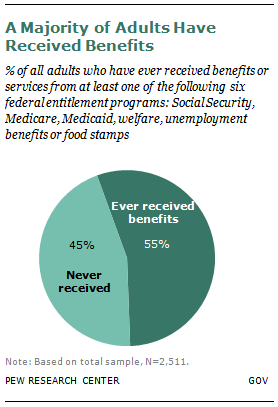
As for political characteristics, Democrats are more likely than Republicans or independents to have received poverty or unemployment assistance (47% vs. 34% and 41%, respectively).
As for political characteristics, Democrats are more likely than Republicans or independents to have received poverty or unemployment assistance (47% vs. 34% and 41%, respectively).
The problem isn't salaries, but how expensive everything in US is. And it will get even more expensive.
Yes, the low wages in US is extremely low, but look to Scandinavia. Our minimum-wage are much closer to average salary, and extremely few people make 100k USD. But at the same time the cost of living is much lower. If you will have to pay 25% more for stuff you need then it will be extremely expensive for you
The problem is salaries. The prices for staple and consumer goods are only high relative to the average consumer's disposable income. If the average American's disposable income rises say 28% over a 24 month period, he or she will be able to much more easily afford expenses and products even if inflation rises as high as 5.5%. The incentive to pay American workers in the continental U.S. will now be much better and more cost effective than companies paying a Chinese or Mexican Auto manufacturer the previous prices but including the new 25% tariffs. The historical inflation rate relative to tariff rates is much lower than people realize and consumers barely ever notice much more pain in spending at the store. Despite what you have been hearing, firms are reluctant to pass the tariff costs on to their customers, because there is too much of a risk of those customers somehow finding alternative cheaper options. The bulk of the cost saving by firms is normally done by having to invest less in maintenance and overhead fees and cutting worker benefits. They barely if at all raise customer product prices. In 2017 after Trump enacted tariffs to China, inflation only went up by an average half a percent for two quarters, and then wages rose as expected, and then inflation stabilized.
Finn, your RELATIVE cost of living is lower because as you freely just admitted your bottom percentage wages are considerably higher than the U.S. minimum wage. This is still true even though your overall percentage of affluence is much lower than it is in the U.S. To reiterate we won't have to pay 25% more for stuff at the store because the tariffs fees do not completely pass on to consumer goods finished prices, and small incremental price increases won't matter because the wages for the average American will be through the roof in about eight months once energy and manufacturing start building back in the U.S. Let me know if you need me to clarify.
You mean to tell me that outsourcing well-paying jobs wasn't good for the middle class? Who would have thought!
As for political characteristics, Democrats are more likely than Republicans or independents to have received poverty or unemployment assistance (47% vs. 34% and 41%, respectively).
The Invesco QQQ index fund is obviously tracking a different index than the S&P 500 index. It is tracking the Nasdaq, and I believe it is actually the largest 100 companies in the Nasdaq.
So, it is not correct to say it is beating the index, since it by definition is tracking a different index than the S&P 500.
The Nasdaq 100 index has outperformed the S&P 500 index for quite a number of years now.
The point of an index fund is diviersification.
It's perfectly reasonable to compare the performance of any index fund to any major index.
QQQ is also greatly outperforming the NASDAQ 100.
Wouldn't buy any product that POS sells. It's down quite a bit since the manatee returned to clog the DC sewer system in January for however long he lasts in office.
Inflation still out of control, market crashing, the world hating us even more, a non American foreigner not elected firing large government agencies, etc. anything else?
The problem is salaries. The prices for staple and consumer goods are only high relative to the average consumer's disposable income. If the average American's disposable income rises say 28% over a 24 month period, he or she will be able to much more easily afford expenses and products even if inflation rises as high as 5.5%. The incentive to pay American workers in the continental U.S. will now be much better and more cost effective than companies paying a Chinese or Mexican Auto manufacturer the previous prices but including the new 25% tariffs. The historical inflation rate relative to tariff rates is much lower than people realize and consumers barely ever notice much more pain in spending at the store. Despite what you have been hearing, firms are reluctant to pass the tariff costs on to their customers, because there is too much of a risk of those customers somehow finding alternative cheaper options. The bulk of the cost saving by firms is normally done by having to invest less in maintenance and overhead fees and cutting worker benefits. They barely if at all raise customer product prices. In 2017 after Trump enacted tariffs to China, inflation only went up by an average half a percent for two quarters, and then wages rose as expected, and then inflation stabilized.
Finn, your RELATIVE cost of living is lower because as you freely just admitted your bottom percentage wages are considerably higher than the U.S. minimum wage. This is still true even though your overall percentage of affluence is much lower than it is in the U.S. To reiterate we won't have to pay 25% more for stuff at the store because the tariffs fees do not completely pass on to consumer goods finished prices, and small incremental price increases won't matter because the wages for the average American will be through the roof in about eight months once energy and manufacturing start building back in the U.S. Let me know if you need me to clarify.
You mean to tell me that outsourcing well-paying jobs wasn't good for the middle class? Who would have thought!
lol 2002 called they want their talking points back
As for political characteristics, Democrats are more likely than Republicans or independents to have received poverty or unemployment assistance (47% vs. 34% and 41%, respectively).