Sirpoc is the national British Masters Champion at 5k and finished the last km in like 2:50 to drop the lead group and Cheetodust I would guess, is one of, if not the fastest master in his age group in the US. He's even older than sirpoc. Both into their 40s. If they aren't worrying about "optimising" and more focused on keeping the overall benefits, you probably shouldn't be worrying about it much either, in the grand scheme.
I found some of the poster boys of this method on Strava (sirpoc, grandma's guy, fodrunner, paulluttrell) and think following their training very inspiring and informative. But I just don't manage to find cheetodust. Since he is often named as one of the best runners in this thread, could anybody point me in a direction how to find him? I am not sure about forum etiquette and giving away people's real names but any help would be highly appreciated.
exactly, they mention cheetodust but no way of understanding who that is on Strava--the group is huge.
Are you currently running doubles? If not, would you be interested in running doubles? You can basically just jump straight into it considering your volume, if you're not used to doing much quality then build this up from like 15% of total time to 25% over the course of a few months or as the body allows.
If you still want to run 10 hours a week the 'method' would have you splitting some of your easy volume across double days instead of singles of 70+mins (exception for the long run)
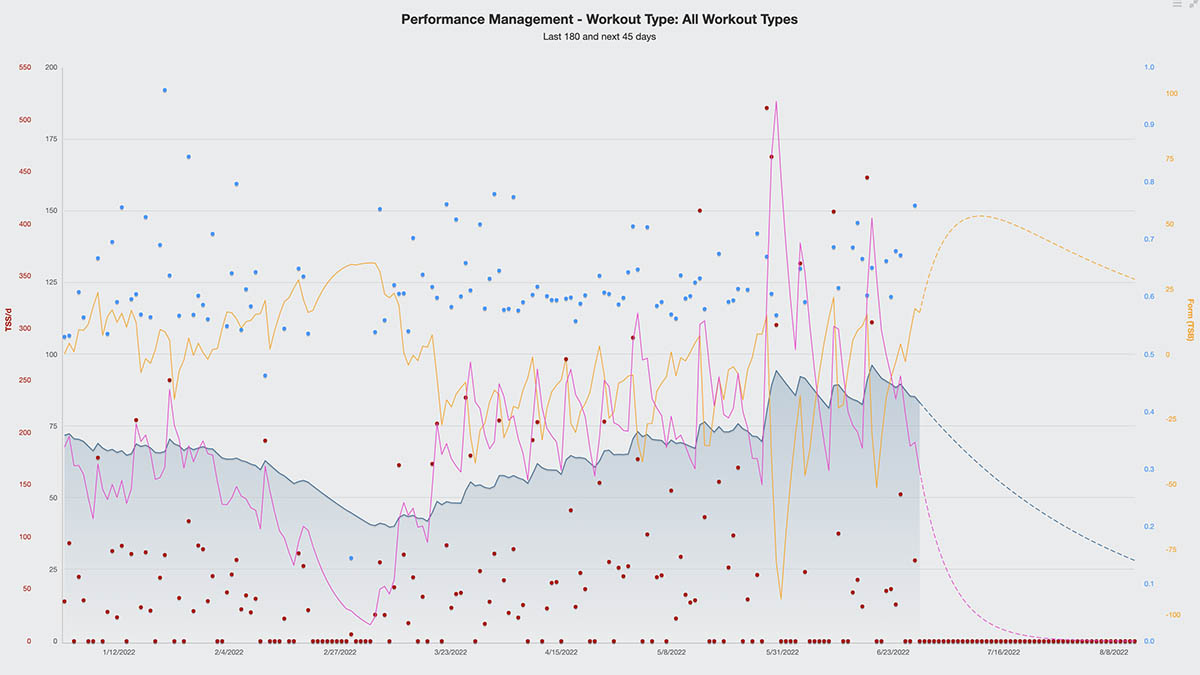
That's not quite how the load tracking works. At any given time, present to 6 weeks back is 50% of the calculation, and over 6 weeks is the other 50%. Basically a half-life of 6 weeks. So weeks 1-6 count toward 50%, weeks 7-12 count 25%, weeks 13-18 count 12.5%, etc.
So you'll continue to gain training load for several months.
According to this article, 6 weeks is the time constant, not the half-life.
I want to seriously consider the "LT1 every day" approach that sirpoc mentioned in the Jimmy Runs discussion with FOD (at 46:00ish) and has been discussed elsewhere (so I've heard though no luck finding anything concrete).
In the episode, sirpoc suggests this could be done on a 6 day a week schedule, so that's my starting point. In the simplest terms, that would be:
5 days of 25' at LT1 pace, with 20' warmup and 15' cooldown both at easy pace (being <70% MHR or however you measure your NSA easy run pace), plus 1 day rest or 35' at easy pace.
Total hours is 6 to 6.5, which is what made sense to me given the constraints though this can obviously be built out to 8 hours per week.
Either way, I'm aiming for a 62/38 division of easy to LT1 work. I think this is a safe adjustment to the traditional 80/20 (or 75/25) model given that the "work" in this case is not as strenuous.
You could vary it to be more or less LT1 pace work depending on the day (so, for example, alternating 20' and 30' LT1 days) though I don't see it needing much more variety than that. I sort of doubt the efficacy of breaking up the LT1 work into intervals. Whenever I've done work around LT1 turning point, 20' to 30' has seemed to be the ideal space of "working but not too hard" that is the aim here.
Welcome to any thoughts or suggestions (especially from the man himself!).
Hi all, very new here. One thing the book doesn't seem to cover is how to "convert" or transition to this training.
I've been doing pretty unstructured training for several years, about 10 hours per week by feel with progression, marathon effort, and fartleks basically whenever I feel like it. 2 hour long runs regularly. Very consistent with my training volume but less exposure to precise hard efforts.
I'd like to convert to NSM and follow the book to a "T", basically. I'm hoping to get to the 8 hour template from the book in the first few months of 2026 and then run that throughout the year.
Do you wizards think it's better for me to start off with:
1) running one of the lesser-volume templates, and then building up.
2) running the 8 hour template, but starting with lesser volume intervals. like doing 3x10 instead of 4x10, 4x6 instead of 6x6, etc. And then adding a rep every month or so.
3) run the 8 hour template at the prescribed volume immediately, but sandbag the paces for a few months (basically run the book paces as if my 5k time is a minute slower than it is (three levels in the book charts), and jump up a level once a month or so).
4) just jump in full blast and run the 8 hour template at the prescribed paces.
I am thinking the best is option 2 or 3, and I am leaning towards option #3. Does this sound sane? I feel like with #1 I'd be regressing my training load quite a bit, and #4 seems risky.
Export all your data from garmin or strava and upload it to intervals.icu then look at your average weekly load for the past 6 months and plan your next week to be a similar load
I want to seriously consider the "LT1 every day" approach that sirpoc mentioned in the Jimmy Runs discussion with FOD (at 46:00ish) and has been discussed elsewhere (so I've heard though no luck finding anything concrete).
In the episode, sirpoc suggests this could be done on a 6 day a week schedule, so that's my starting point. In the simplest terms, that would be:
5 days of 25' at LT1 pace, with 20' warmup and 15' cooldown both at easy pace (being <70% MHR or however you measure your NSA easy run pace), plus 1 day rest or 35' at easy pace.
Total hours is 6 to 6.5, which is what made sense to me given the constraints though this can obviously be built out to 8 hours per week.
Either way, I'm aiming for a 62/38 division of easy to LT1 work. I think this is a safe adjustment to the traditional 80/20 (or 75/25) model given that the "work" in this case is not as strenuous.
You could vary it to be more or less LT1 pace work depending on the day (so, for example, alternating 20' and 30' LT1 days) though I don't see it needing much more variety than that. I sort of doubt the efficacy of breaking up the LT1 work into intervals. Whenever I've done work around LT1 turning point, 20' to 30' has seemed to be the ideal space of "working but not too hard" that is the aim here.
Welcome to any thoughts or suggestions (especially from the man himself!).
I want to seriously consider the "LT1 every day" approach that sirpoc mentioned in the Jimmy Runs discussion with FOD (at 46:00ish) and has been discussed elsewhere (so I've heard though no luck finding anything concrete).
In the episode, sirpoc suggests this could be done on a 6 day a week schedule, so that's my starting point. In the simplest terms, that would be:
5 days of 25' at LT1 pace, with 20' warmup and 15' cooldown both at easy pace (being <70% MHR or however you measure your NSA easy run pace), plus 1 day rest or 35' at easy pace.
Total hours is 6 to 6.5, which is what made sense to me given the constraints though this can obviously be built out to 8 hours per week.
Either way, I'm aiming for a 62/38 division of easy to LT1 work. I think this is a safe adjustment to the traditional 80/20 (or 75/25) model given that the "work" in this case is not as strenuous.
You could vary it to be more or less LT1 pace work depending on the day (so, for example, alternating 20' and 30' LT1 days) though I don't see it needing much more variety than that. I sort of doubt the efficacy of breaking up the LT1 work into intervals. Whenever I've done work around LT1 turning point, 20' to 30' has seemed to be the ideal space of "working but not too hard" that is the aim here.
Welcome to any thoughts or suggestions (especially from the man himself!).
Sorry, should be 6 days of 25' , etc
That is essentially the MAF method. But even the MAF method would recommend more volume at LT1 than 30 mins/day.
I think just make sure you still break it up rather than being a continuous effort. I thought he suggested something like 4 x 10' off a minute every day somewhere, but I may be making that up.
Every time he suggested it he followed it up with "this would be a bad idea" though so be careful.
MAF is a mess, it would be more about dialing in based on a phisiological repeatable point, than any weird HR calcs.
In the early days where sirpoc and Hard2find were just throwing off ideas on Strava, when it was just a few hundred people, this was talked about. If you subscribe to the function, as spoken about earlier in the thread, the composition of workouts isn't important, it's the impact of load.
sirpoc made some very cool posts about how even the worst training system or use of time, versus the theoretical "best", with a very neutral middle ground between them, probably only swung +-10% in either direction of neutral ground, in terms of end performance, with the assumption it generated the same load. That's either a lot, but also not a lot, depending on your view.
Then they were playing around with best bang for buck, for even less time than this thread.
They threw out some numbers from what I remember and that in terms of daily TSS, it actually looked better bang for your buck on limited hours, than trying to work out an easy/ sub t ratio or reducing to 2 sessions a week.
It was all broken up into manageable chunks still. I think they concluded it was, in theory, a nice idea but nobody wanted to try it. Both seemed to think it would end badly, but if load is load, it might work if you don't break down, or even with limited hours, might be worth the gamble for someone to see.
It's a shame a lot of these posts are either forgotten, or totally lost on Strava somewhere.
MAF is a mess, it would be more about dialing in based on a phisiological repeatable point, than any weird HR calcs.
In the early days where sirpoc and Hard2find were just throwing off ideas on Strava, when it was just a few hundred people, this was talked about. If you subscribe to the function, as spoken about earlier in the thread, the composition of workouts isn't important, it's the impact of load.
sirpoc made some very cool posts about how even the worst training system or use of time, versus the theoretical "best", with a very neutral middle ground between them, probably only swung +-10% in either direction of neutral ground, in terms of end performance, with the assumption it generated the same load. That's either a lot, but also not a lot, depending on your view.
Then they were playing around with best bang for buck, for even less time than this thread.
They threw out some numbers from what I remember and that in terms of daily TSS, it actually looked better bang for your buck on limited hours, than trying to work out an easy/ sub t ratio or reducing to 2 sessions a week.
It was all broken up into manageable chunks still. I think they concluded it was, in theory, a nice idea but nobody wanted to try it. Both seemed to think it would end badly, but if load is load, it might work if you don't break down, or even with limited hours, might be worth the gamble for someone to see.
It's a shame a lot of these posts are either forgotten, or totally lost on Strava somewhere.
Some of that might even be in the thread read somewhere here? I remember it as well. It was quite interesting because it made me start to think that actually, all training is pretty similar in terms of response to load, it's how you recover that is the important bit. But that's where things aren't equal.
I vaguely seem to remember it came about when sirpoc was talking about how he was injured a decade or so ago, was off work also and couldn't ride outside, so just rode all day at a controlled intensity he could easily manage for around 3 hours, then just did again the next day and so on. How then even at that low intensity, he managed to increase load and actually managed to increase his FTP.
I think just make sure you still break it up rather than being a continuous effort. I thought he suggested something like 4 x 10' off a minute every day somewhere, but I may be making that up.
Every time he suggested it he followed it up with "this would be a bad idea" though so be careful.
I'm going back and forth on whether to break it up or not. My feeling is that it makes more sense to do a continuous effort given the decreased effort of that pace. Though I can also imagine doing, say, 2×15' off a minute would be effective. I'll have to try both out and see how the body responds.
MAF is a mess, it would be more about dialing in based on a phisiological repeatable point, than any weird HR calcs.
In the early days where sirpoc and Hard2find were just throwing off ideas on Strava, when it was just a few hundred people, this was talked about. If you subscribe to the function, as spoken about earlier in the thread, the composition of workouts isn't important, it's the impact of load.
sirpoc made some very cool posts about how even the worst training system or use of time, versus the theoretical "best", with a very neutral middle ground between them, probably only swung +-10% in either direction of neutral ground, in terms of end performance, with the assumption it generated the same load. That's either a lot, but also not a lot, depending on your view.
Then they were playing around with best bang for buck, for even less time than this thread.
They threw out some numbers from what I remember and that in terms of daily TSS, it actually looked better bang for your buck on limited hours, than trying to work out an easy/ sub t ratio or reducing to 2 sessions a week.
It was all broken up into manageable chunks still. I think they concluded it was, in theory, a nice idea but nobody wanted to try it. Both seemed to think it would end badly, but if load is load, it might work if you don't break down, or even with limited hours, might be worth the gamble for someone to see.
It's a shame a lot of these posts are either forgotten, or totally lost on Strava somewhere.
Thanks for the summary, I do remember reading some of this on the Strava group (I was also there in the early days) but it's impossible to find anything in there (thanks, awful Strava UI). There was a time where Hard2Find was dropping almost weekly gems on his thoughts and research. Wish it was properly archived somewhere...
Anyway, I am interested in the impact of load which is why this "LT1 pace" training idea is interesting to me. I can see it working in the right situation, though I imagine its even more of a balancing act than NSA regular in terms of managing workload and recovery.
I want to seriously consider the "LT1 every day" approach that sirpoc mentioned in the Jimmy Runs discussion with FOD (at 46:00ish) and has been discussed elsewhere (so I've heard though no luck finding anything concrete).
In the episode, sirpoc suggests this could be done on a 6 day a week schedule, so that's my starting point. In the simplest terms, that would be:
5 days of 25' at LT1 pace, with 20' warmup and 15' cooldown both at easy pace (being <70% MHR or however you measure your NSA easy run pace), plus 1 day rest or 35' at easy pace.
Total hours is 6 to 6.5, which is what made sense to me given the constraints though this can obviously be built out to 8 hours per week.
Either way, I'm aiming for a 62/38 division of easy to LT1 work. I think this is a safe adjustment to the traditional 80/20 (or 75/25) model given that the "work" in this case is not as strenuous.
You could vary it to be more or less LT1 pace work depending on the day (so, for example, alternating 20' and 30' LT1 days) though I don't see it needing much more variety than that. I sort of doubt the efficacy of breaking up the LT1 work into intervals. Whenever I've done work around LT1 turning point, 20' to 30' has seemed to be the ideal space of "working but not too hard" that is the aim here.
Welcome to any thoughts or suggestions (especially from the man himself!).
I asked Sirpoc about his thoughts on implementing the method as between my newborn and irregular work timetable I was struggling to implement the vanilla structure. I’m doing most of my running at 5 am and have had a constantly sore achilles that gets aggravated by 3 and 6 minute reps, so the slower absolute speeds are welcomed too.
Based on sirpoc’s response, I am running 5 sessions per week with a 90 minute long and a day off (or 30 minutes because I have a problem). For the sessions I alternate between 3 x 10’/90”, 4 x 8’/90” and 2 x 15’/90” with 10 mins easy warm up and 6 - 10 mins easy cool down. I have a cap of 85% max HR that I am staying just below on the last rep. My paces are generally a bit slower than marathon pace. For reference my last two 3 x 10’ ST sessions I averaged 3:43/km and I am running these sessions at around 4:00/km.
If I found myself extremely time crunched I would replace a session with 1 x 25’ here and there but I wouldn’t want to make a habit of it. I think the commonly cited advantage of splitting the ST sessions into intervals applies equally well here.
I have only been running this way for 2 weeks but I feel great and believe it is sustainable if you’re very conservative. I can hopefully share some more meaningful feedback in 6-8 weeks but I’m pretty buoyed by the results so far. That said, if I had more control in my life at the moment, I’d definitely stick to vanilla.
This post was edited 1 minute after it was posted.
Here is the thing though, who is going to put themselves through half a year or more of this? All through different types of races? Dial it in and work it out? That's when you realise what sirpoc had to go through to really make this work, give us the feedback and such a great guide for best bang for buck. This isn't a criticism, but it almost needs a check in post in 6 months, not 6-8 weeks. I'm keeping a keen eye as someone with less time next year available.
MAF is a mess, it would be more about dialing in based on a phisiological repeatable point, than any weird HR calcs.
In the early days where sirpoc and Hard2find were just throwing off ideas on Strava, when it was just a few hundred people, this was talked about. If you subscribe to the function, as spoken about earlier in the thread, the composition of workouts isn't important, it's the impact of load.
sirpoc made some very cool posts about how even the worst training system or use of time, versus the theoretical "best", with a very neutral middle ground between them, probably only swung +-10% in either direction of neutral ground, in terms of end performance, with the assumption it generated the same load. That's either a lot, but also not a lot, depending on your view.
Then they were playing around with best bang for buck, for even less time than this thread.
They threw out some numbers from what I remember and that in terms of daily TSS, it actually looked better bang for your buck on limited hours, than trying to work out an easy/ sub t ratio or reducing to 2 sessions a week.
It was all broken up into manageable chunks still. I think they concluded it was, in theory, a nice idea but nobody wanted to try it. Both seemed to think it would end badly, but if load is load, it might work if you don't break down, or even with limited hours, might be worth the gamble for someone to see.
It's a shame a lot of these posts are either forgotten, or totally lost on Strava somewhere.
I found some of the poster boys of this method on Strava (sirpoc, grandma's guy, fodrunner, paulluttrell) and think following their training very inspiring and informative. But I just don't manage to find cheetodust. Since he is often named as one of the best runners in this thread, could anybody point me in a direction how to find him? I am not sure about forum etiquette and giving away people's real names but any help would be highly appreciated.
exactly, they mention cheetodust but no way of understanding who that is on Strava--the group is huge.
I got 2nd behind Max at USA xc in Portland in the masters race. You can find me on Strava. Don’t expect an enlightened experience following me but all the data’s there. I accept folks requesting to follow. Good luck in your training. I have just surpassed two years straight of the exact same ‘vanilla’ sessions. With a month or so in year 1 trying hills and tossing them back out. Only now am I considering adding more load.
I want to seriously consider the "LT1 every day" approach that sirpoc mentioned in the Jimmy Runs discussion with FOD (at 46:00ish) and has been discussed elsewhere (so I've heard though no luck finding anything concrete).
In the episode, sirpoc suggests this could be done on a 6 day a week schedule, so that's my starting point. In the simplest terms, that would be:
5 days of 25' at LT1 pace, with 20' warmup and 15' cooldown both at easy pace (being <70% MHR or however you measure your NSA easy run pace), plus 1 day rest or 35' at easy pace.
Total hours is 6 to 6.5, which is what made sense to me given the constraints though this can obviously be built out to 8 hours per week.
Either way, I'm aiming for a 62/38 division of easy to LT1 work. I think this is a safe adjustment to the traditional 80/20 (or 75/25) model given that the "work" in this case is not as strenuous.
You could vary it to be more or less LT1 pace work depending on the day (so, for example, alternating 20' and 30' LT1 days) though I don't see it needing much more variety than that. I sort of doubt the efficacy of breaking up the LT1 work into intervals. Whenever I've done work around LT1 turning point, 20' to 30' has seemed to be the ideal space of "working but not too hard" that is the aim here.
Welcome to any thoughts or suggestions (especially from the man himself!).
From my understanding, wouldn't running right at LT1 every day pretty much be an easier version of the classic Lydiard base (running steady everyday) or similar to someone who just does easy runs too hard?
One of my friends was a 16:50 5k guy and he basically forced himself to run 6:30-6:40 pace (pretty much his LT1) every day and quickly progressed for about a 2 month period, breaking 15 that spring but then he flamed out and hasn't been able to improve since. I don't think it's sustainable long term and most people would probably agree
I asked Sirpoc about his thoughts on implementing the method as between my newborn and irregular work timetable I was struggling to implement the vanilla structure. I’m doing most of my running at 5 am and have had a constantly sore achilles that gets aggravated by 3 and 6 minute reps, so the slower absolute speeds are welcomed too.
Based on sirpoc’s response, I am running 5 sessions per week with a 90 minute long and a day off (or 30 minutes because I have a problem). For the sessions I alternate between 3 x 10’/90”, 4 x 8’/90” and 2 x 15’/90” with 10 mins easy warm up and 6 - 10 mins easy cool down. I have a cap of 85% max HR that I am staying just below on the last rep. My paces are generally a bit slower than marathon pace. For reference my last two 3 x 10’ ST sessions I averaged 3:43/km and I am running these sessions at around 4:00/km.
If I found myself extremely time crunched I would replace a session with 1 x 25’ here and there but I wouldn’t want to make a habit of it. I think the commonly cited advantage of splitting the ST sessions into intervals applies equally well here.
I have only been running this way for 2 weeks but I feel great and believe it is sustainable if you’re very conservative. I can hopefully share some more meaningful feedback in 6-8 weeks but I’m pretty buoyed by the results so far. That said, if I had more control in my life at the moment, I’d definitely stick to vanilla.
Very interesting, do give us an update, curious to see how it works out for you.
But what you've outlined here is different from what I'm thinking of. The paces I'm aiming for are around 76% max HR (or 10% to 15% slower than marathon pace). So quite a bit slower, which is why I'm inclined to not split up the work into reps (at your paces, it definitely makes sense to do reps). Also aiming for 6 sessions a week, again something that wouldn't be doable at your paces.
Regardless, I like that there is a range of options here that are being explored. What you've outlined is something in between vanilla NSA and the approach I'm referring to.
From my understanding, wouldn't running right at LT1 every day pretty much be an easier version of the classic Lydiard base (running steady everyday) or similar to someone who just does easy runs too hard?
One of my friends was a 16:50 5k guy and he basically forced himself to run 6:30-6:40 pace (pretty much his LT1) every day and quickly progressed for about a 2 month period, breaking 15 that spring but then he flamed out and hasn't been able to improve since. I don't think it's sustainable long term and most people would probably agree
I think if you were to take this one step farther, it would essentially amount to just doing easy runs too hard. This is definitely threading the line, which is why I believe this is trickier than vanilla NSA to pull off properly. But I could see it working well, even if just in the short term, hence my curiosity.
Help us build the best running shoe review site for a chance to win a LetsRun t-shirt.Help us build the best running shoe review site for a chance to win one of 10 LetsRun t-shirts.