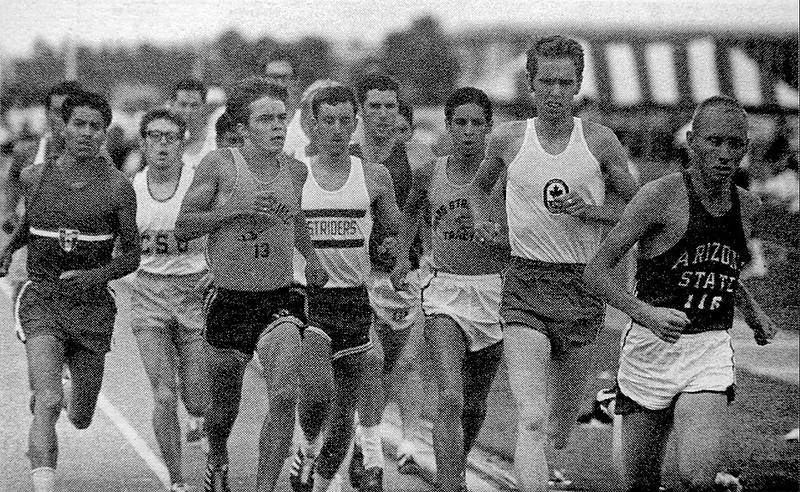
1969 AAU National Track and Field Championships 3-Mile, in Miami- Dade, Florida. My friend, Ingrid Skoog, posted this photo on a Google Plus circle we're in but thought you guys might get a chuckle out of it. Below is the bac...
The 1969 USA Outdoor Track and Field Championships men's competition took place on the new all weather running track on the north campus of Miami Dade College in the Westview area near Miami, Florida. The women's division hel...
I say no. Frank Shorter is by every measure a much more accomplished runner. He's not a mythic figure like Pre.
Pre was only 21 in Munich. Shorter won his medals at 25 and 29. Pre wasn’t even in his prime yet, and he finished 4th in the world. Ever see that pic of him preparing for ‘76? He was absolutely shredded. Of course, we’ll never know. We’re both speculating.
I’m sorry but the whole age and potential argument is a bad argument. 21 isn’t that young in distance running. A lot of times runners may even peak at that age. Viren was like the same age as Pre and nobody ever brings his age up because he in fact did win. There’s an endless list of African runners who never did much after 21. Jelian comes to mind. Beats Farah in 2011 at age 19 and nobody ever hears about him again. To say that Pre had all this improvement left is to make an assumption that history with the sport shows is wrong oftentimes.
Having said that… It is entirely possible Prefontaine could have win at both 5k and 10k in Montreal. It’s not a given by any means but by ‘75 he had improved his mile pb to 3:54 in that race against Wottle and he ran a 27:43 AR in his only 10k. So the evidence was that he was in fact improving, but to take his improvement as exponential certainty is just bad woulda shoulda coulda arguing based on the fact that a lot of runners peak at 21.
1970 USA Championships 3 mile, Shorter 1st, Pre 5th.
Pretty easy to find.
Yeah, I haven’t looked up the whole lists of race results in years and don’t feel like doing it at the moment but I think the Shorter-Pre win/loss record is something like;
2 wins Shorter
4 wins Pre
But they may have raced more than that. I would bet to guess not every result with both of them in the same race is necessarily easy to find.
1970 USA Championships 3 mile, Shorter 1st, Pre 5th.
Pretty easy to find.
Yeah, I haven’t looked up the whole lists of race results in years and don’t feel like doing it at the moment but I think the Shorter-Pre win/loss record is something like;
2 wins Shorter
4 wins Pre
But they may have raced more than that. I would bet to guess not every result with both of them in the same race is necessarily easy to find.
1970 aau 3 mile. What was the other win? What were Pre's 4 wins. Thanks in advance.
Shorter is definitely better than Pre. No question about that. An Olympic gold and silver, multiple Marathon Majors winner, and his PRs rivaled Pre’s at every distance.
Now having said that, Prefontaine was still great. American record holder at every distance from 2k to 10k and a high win record with seldom losses
This slogan is the surest proof Prefontaine was NOT great. If he were, you wouldn't be talking about 2000m and insinuating there are meaningful records in that range other than 5000m and 10,000m.
And you can't ignore the fact he never won against foreigners. Typically when one American beats all the others, and loses in world events, it's an "America sucks" era. He's the Bob Kennedy of his time.
A number of problems here. You’re making numerous assumptions, misunderstanding my post and what context it was in, setting a bar higher than what most of us are setting in this thread, and you are historically ignorant of the importance of what you deem to be the off distances. The 3 mile and 6 mile were frequently raced in the United States during Pre’s time and the AR at either distance was still valued. The 2k less so, but it still mattered then and still does now if you set the AR. And the 3k and two mile ARs were definitely valued then and still are now.
Yeah, I haven’t looked up the whole lists of race results in years and don’t feel like doing it at the moment but I think the Shorter-Pre win/loss record is something like;
2 wins Shorter
4 wins Pre
But they may have raced more than that. I would bet to guess not every result with both of them in the same race is necessarily easy to find.
1970 aau 3 mile. What was the other win? What were Pre's 4 wins. Thanks in advance.
So you are fixated on the win/loss record and ignoring the fact that it doesn’t matter. They were all races under 10,000m. Frank Shorter wouldn’t be expected to win those races. That’s like if Bekele were to lose in the steeple chase to George Beamish four times, but Beamish were to never race Bekele at any longer distance. For anyone to claim that George Beamish has had a better career than Bekele would be acute insanity. That person would need to be checked by a psychiatrist. It’s a similar thing with Pre and Shorter. It’s a competition record that is pretty much irrelevant. Nobody cares if Shorter lost to Pre at a random AAU 2 mile or even in the 3 mile at USAs. They are races that pale in comparison to the Olympics or Fukuoka. It’s not even close. Plus as somebody else mentioned, Shorter won USA XC four consecutive times and Prefontaine was nowhere to be seen in those races. Shorter>Pre. Admit it.
He is the guy that set off the running boom in this country. I have often wondered what Pre would have been like in his later years and if he would have aged well in the road racing era? We can assume he would have been rich because of Nike and its explosive growth. I think Frank and Marty did pretty well financially, but I think Pre would have parlayed it into more.
Yes, Schul, not Dellinger for gold. I really blew that one but it was Schul I had in mind. Thanks. And I agree IF Prefontaine had won gold in Montreal it would have been huge but would it have been huge enough for him to have become the cult figure he did? If so, why? Other huge things happened with US distance running, Schul (thanks again) and Mills in Tokyo, Shorter in Munich, Virgin's two wins at World Cross Country, and none of them became the cult figure Prefontaine did. I think Prefontaine's legacy would be very comparable to these other four guys' IF he won gold at Montreal which is a really big if.
I answered that question in my previous post, but I'll break it down a little more:
Promotion: As Nike's first track star, Nike would have made a big deal about Pre winning gold.
Context: 1976 was the middle of the running boom. Shorter is often credited with inspiring the running boom in the US with his win in 1972, building off the success of Bill Bowerman's 1966 booklet on jogging. A win by Pre in 1976 could have taken things to another level.
Competition Narrative: Just imagine the hype going into the 1976 Olympics with Pre as a contender for gold going up against the defending 5k-10k champion and the other top runners who were in that race. Imagine what Pre might have said in interviews prior to the competition. It would have been one of the most anticipated races of those Games.
Location: More Americans would have been able to attend the Games to watch Pre's race in Montreal than those who saw Mills and Schul in Tokyo or Shorter in Munich. More Americans seeing Pre's victory in person would mean more Americans experiencing that thrill live, more Americans raving about it, and Pre's legend growing from there.
Team USA Performance: Look at Team USA's domination in 1964 and compare that to how they did in 1976. The US men swept the 100, 200, and 400 (and they did it again in 1968). 1976 was the first year they didn't win gold in any of those events since 1908. Imagine the disappointment! With so few Americans winning gold on the track in 1976, a gold from Pre would have really stood out. And if Pre had won two in Montreal, like others are suggesting? Legend for life!
I’m sorry but the whole age and potential argument is a bad argument. 21 isn’t that young in distance running. A lot of times runners may even peak at that age. Viren was like the same age as Pre and nobody ever brings his age up because he in fact did win. There’s an endless list of African runners who never did much after 21. Jelian comes to mind. Beats Farah in 2011 at age 19 and nobody ever hears about him again. To say that Pre had all this improvement left is to make an assumption that history with the sport shows is wrong oftentimes.
Having said that… It is entirely possible Prefontaine could have win at both 5k and 10k in Montreal. It’s not a given by any means but by ‘75 he had improved his mile pb to 3:54 in that race against Wottle and he ran a 27:43 AR in his only 10k. So the evidence was that he was in fact improving, but to take his improvement as exponential certainty is just bad woulda shoulda coulda arguing based on the fact that a lot of runners peak at 21.
Pre was only 21 in Munich. Shorter won his medals at 25 and 29. Pre wasn’t even in his prime yet, and he finished 4th in the world. Ever see that pic of him preparing for ‘76? He was absolutely shredded. Of course, we’ll never know. We’re both speculating.
I’m sorry but the whole age and potential argument is a bad argument. 21 isn’t that young in distance running. A lot of times runners may even peak at that age. Viren was like the same age as Pre and nobody ever brings his age up because he in fact did win. There’s an endless list of African runners who never did much after 21. Jelian comes to mind. Beats Farah in 2011 at age 19 and nobody ever hears about him again. To say that Pre had all this improvement left is to make an assumption that history with the sport shows is wrong oftentimes.
Having said that… It is entirely possible Prefontaine could have win at both 5k and 10k in Montreal. It’s not a given by any means but by ‘75 he had improved his mile pb to 3:54 in that race against Wottle and he ran a 27:43 AR in his only 10k. So the evidence was that he was in fact improving, but to take his improvement as exponential certainty is just bad woulda shoulda coulda arguing based on the fact that a lot of runners peak at 21.
I think this comes from Kenny Moore’s Bowerman and The Men of Oregon. if I recall correctly, the 27:43 was 37s against the wind and 30s with the wind on a windy day.
Yes, Schul, not Dellinger for gold. I really blew that one but it was Schul I had in mind. Thanks. And I agree IF Prefontaine had won gold in Montreal it would have been huge but would it have been huge enough for him to have become the cult figure he did? If so, why? Other huge things happened with US distance running, Schul (thanks again) and Mills in Tokyo, Shorter in Munich, Virgin's two wins at World Cross Country, and none of them became the cult figure Prefontaine did. I think Prefontaine's legacy would be very comparable to these other four guys' IF he won gold at Montreal which is a really big if.
I answered that question in my previous post, but I'll break it down a little more:
Promotion: As Nike's first track star, Nike would have made a big deal about Pre winning gold.
Context: 1976 was the middle of the running boom. Shorter is often credited with inspiring the running boom in the US with his win in 1972, building off the success of Bill Bowerman's 1966 booklet on jogging. A win by Pre in 1976 could have taken things to another level.
Competition Narrative: Just imagine the hype going into the 1976 Olympics with Pre as a contender for gold going up against the defending 5k-10k champion and the other top runners who were in that race. Imagine what Pre might have said in interviews prior to the competition. It would have been one of the most anticipated races of those Games.
Location: More Americans would have been able to attend the Games to watch Pre's race in Montreal than those who saw Mills and Schul in Tokyo or Shorter in Munich. More Americans seeing Pre's victory in person would mean more Americans experiencing that thrill live, more Americans raving about it, and Pre's legend growing from there.
Team USA Performance: Look at Team USA's domination in 1964 and compare that to how they did in 1976. The US men swept the 100, 200, and 400 (and they did it again in 1968). 1976 was the first year they didn't win gold in any of those events since 1908. Imagine the disappointment! With so few Americans winning gold on the track in 1976, a gold from Pre would have really stood out. And if Pre had won two in Montreal, like others are suggesting? Legend for life!
Charisma: Some people just have it. Pre had it.
I will grant you the Nike publicity hype would have been massive. But I do not see any movies coming out if there's no fatal car crash. I think he'd still have been a big star and maybe a bit bigger one than Mills, Schul, Lindgren, and Liquori, but not that much more and not more than Shorter.
But you're basing all of this on something that may have happened but most likely would not have. Guys like Brendan Foster, Dick Quax, Rod Dixon, Klaus Peter Hildebrand, Ian Stewart, Carlos Lopes, among others could not beat Viren and all had better competitive records and/or faster times than Prefontaine did. So sure, if he won the 5 and 10 double he might be a legend above all others but even then there would not have been the movies and there wouldn't be the speculation about what might have been which is mostly why we have these discussions.
There's no "Liquori's Rock" or "Shorter's Rock" because neither of them killed themselves on such a rock. The big movie studios don't make movies about them because they didn't die in their primes. So I think the answer to the OP's question is that Pre would not be the legend that he became if he hadn't died young.
Exactly. (I just want to be clear that we're on the same side of this discussion.)
Pre is an LA legend already for what he did when he was alive and a fixture here. He came from the wilderness somewhere who cares. He was part of the L.A. oldden days. Because of Pre, Tommie Smith, John Carlos, Demus, Felix Sanchez, Quincy Watts, Sydney MacLaughin, etc. we have the LA2028 games again.
I will grant you the Nike publicity hype would have been massive. But I do not see any movies coming out if there's no fatal car crash. I think he'd still have been a big star and maybe a bit bigger one than Mills, Schul, Lindgren, and Liquori, but not that much more and not more than Shorter.
But you're basing all of this on something that may have happened but most likely would not have. Guys like Brendan Foster, Dick Quax, Rod Dixon, Klaus Peter Hildebrand, Ian Stewart, Carlos Lopes, among others could not beat Viren and all had better competitive records and/or faster times than Prefontaine did. So sure, if he won the 5 and 10 double he might be a legend above all others but even then there would not have been the movies and there wouldn't be the speculation about what might have been which is mostly why we have these discussions.
I could still see a movie happening if Pre won gold. A movie was made about Billy Mills back in 1983, so why not Pre? Looking at other sports, a movie was made about the father of the Williams sisters, and one was recently released about UFC fighter Mark Kerr. Those guys are still alive.
I agree it's all based on the big if. To be clear, I'm not saying Pre would have won gold if he hadn't died. The only athlete I'd confidently say would have won gold if circumstances had been different is Edwin Moses in 1980. But even he could have gotten sick or injured at the wrong time. Nothing is certain when we're talking about hypotheticals.
I'm just saying *if* Pre had won gold in 1976, he would have been a legend.
Here's how everyone ranked in the 1970s by # of World Rankings. Another way of looking at things:
World Rankings Marathon 1979 1st Bill Rodgers 10th Pfeffer (TSandoval, JWells AR) 1978 2nd Rodgers 1977 1st Rodgers 1976 2nd Frank Shorter (AR), 4th Kardong, 6th Rodgers 1975 1st Rodgers, 4th Hoag, 5th Flemming 1974 2nd Shorter (AR) 1973 1st Shorter (AR) 1972 1st Shorter AR, 5th Kenny Moore 1971 1st Shorter 1970 3rd Moore AR Summation 1. Frank Shorter (1st, 1st, 1st, 2nd, 2nd) AR OG OS 2. Bill Rodgers (1st, 6th, 1st, 2nd, 1st) 3. Kenny Moore (3rd, 4th) AR
World Rankings 10000 meters 1980 2nd Craig Virgin AR 1979 2nd Craig Virgin AR 1975 2nd Shorter 1974 5th Shorter, 10th Steve Prefontaine AR 1972 5th Frank Shorter AR (Greg Fredericks AR) Summation 1. Craig Virgin (2nd, 2nd) AR (2x) 2. Frank Shorter (5th, 5th, 2nd) AR (2x) 3. Steve Prefontaine (10th) AR
World Rankings 5000 meters 1978 2nd Marty Liquori 1977 1st Liquori AR 1976 x (Duncan MacDonald AR) 1975 3rd Liquori, 9th Prefontaine,10th Shorter 1974 4th Buerkle, 6th Steve Prefontaine AR, 10th Geis 1973 5th Steve Prefontaine AR 1972 4th Steve Prefontaine AR 1971 10th Steve Prefontaine AR (George Young AR) Summation 1. Marty Liquori (3rd, 1st, 2nd) AR (2x) 2. Steve Prefontaine (10th, 4th, 5th, 6th, 9th) AR (4x) 3. Dick Buerkle (4th) (WRi mile)
World Rankings 1500 meters 1979 3rd Scott, 7th Paige 1978 7th Scott (Buerkle WRi) 1977 9th Scott 1976 8th Wohlhuter 1975 5th Liquori, 7th Wohlhuter, 9th Popejoy 1974 5th Wohlhuter 1973 4th Wottle, 7th Hilton 1972 9th Ryun (AR) 1971 1st Liquori, 6th Jim Ryun (AR), 7th Von Ruden 1970 5th Labenz, 7th Liquori Summation 1. Marty Liquori (7th, 1st, 5th) 2. Steve Scott (9th, 7th, 3rd) 3. Rick Wohlhuter (5th, 7th, 8th)
World Rankings 800 meters 1979 3rd Robinson, 7th Paige 1978 4th Robinson 1977 4th Enyeart, 5th McLean, 7th Belger 1976 4th Wohlhuter 1975 3rd Wohlhuter, 4th Enyeart 1974 1st Wohlhuter AR WR, 9th Robonson 1973 1st Wohlhuter, 7th Wottle 1972 1st Wottle, AR WR 7th Wohlhuter 1971 9th Luzins, 10th Winzenried 1970 2nd Swenson, 5th Winzenried, 9th Collins Summation 1. Rick Wohlhuter (7th, 1st, 1st. 3rd, 4th) AR WR OB 2. Dave Wottle (1st, 7th) AR WR OG 3. James Robinson (9th, 4th, 3rd) Combined rankings 1. Frank Shorter 1st Marathon AR OG OS, 2nd 10000m AR (2x) 2. Marty Liquori 1st 1500m, 1st 5000m AR (2x) 3. Rick Wohlhuter 1st 800m AR WR OB, 3rd 1500m 4. Dave Wottle 2nd 800m AR WR OG 5. Craig Virgin 1st 10000m 6. Bill Rodgers 2nd Marathon 7. Steve Prefontaine 2nd 5000m AR (4x), 3rd 10000m AR 8. Dick Buerkle 3rd 5000m, (1 mile WRi) 9. Kenny Moore 3rd Marathon AR 10. James Robinson 3rd 800m