-
152
-
Trump is like a pitbull, once he goes for the throat that's a wrap.
55 -
Bagofsharks wrote:
Trump is like a pitbull, once he goes for the throat that's a wrap.
More like a dumb dog chasing cars.
74 -
this is it wrote:
Your stupid is showing again.
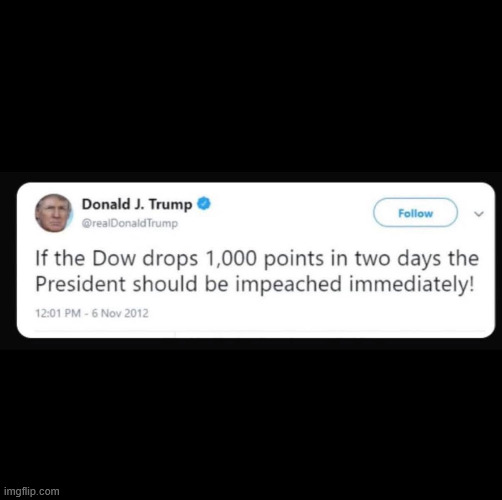
A 1000 point drop in 2012 is equivalent to a 7,000 point drop today.
39 -
This thread will age as well as the Down goes the Dow thread. The DJIA has risen an APR of roughly 9.5% since that time. It rises, it falls. All you are getting now is a good buy in opportunity. Stop acting like the sky is falling chicken little. I know, change is difficult. It’s not the end of the world.
33 -
TheAdultInTheRoom wrote:
this is it wrote:
Your stupid is showing again.
A 1000 point drop in 2012 is equivalent to a 7,000 point drop today.
Please list 5 things you did this week, red stater.
signed,
someone in a blue state who funds your life
62 -
TheAdultInTheRoom wrote:
seattle prattle wrote:
You are headed off course on this one.
1) An index fund tracks a particular index. So a small cap index fund is limited to strictly small caps, a large cap index fund is limited to strictly large cap stocks, an international company index fund is limited to strictly international companies, as represented by their respective indices. They are not diversified in the sense that they represent only a select portion of the overall stock market. If you want an index that represent all sectors, you would look to the total stock market index.
2) The Invesco QQQ Trust tracks the Nasdaq 100 Index (NDX) and it's performance is essentially identical.
Your assertion about the Invesco QQQ Trust beating the index is misguided and misleading.
If they are identical why do they have different names and why is their growth different?
QQQM is up 68.5% over the last 5 years.
QQQ is up 127% over the last 5 years.
The NASDAQ 100 is up 137% in the last 5 years.
QQQ is the Invesco Mutual Fund tracking the Nasdaq 100 index,
QQQM is their ETF tracking the same index.
The Nasdaq 100 index is the Index itself comprised of the 100 largest non-financial companies on the Nasdaq stock exchange.
They have different names because they are different entities, though they all track the same thing. And they have virtually the same performance, so double check your methodology and/or sources.
I'm not sure if this graph demonstrating their identical performance will post here, but I will give it a try, and if it looks like one line in the graph, don't be misguided, it is three lines that are so identical, they appear as one:
30 -
TheAdultInTheRoom wrote:
Precious Roy wrote:
Wall Street is right now wrestling with the fact that Trump's tariffs and massive layoffs of the federal workforce are going to lead the US straight to a recession, but at the same time companies will be able to dump toxic chemicals behind the local elementary school to increase profits, bust their unions, cheat on their taxes and defraud their investors with impunity now that DOGE will eliminate any sort of federal regulatory oversight. But at the end of the day, US consumer spending drives not just the US economy, but much of the world economy. Doing anything that harms US consumer spending is a prescription for a big recession.
And the really big problem with Trump's tariffs is that onshoring production is going to be a necessity in the next 10 years because China's demographic collapse is well underway and is going to devastate China's ability to continue to be the world's manufacturer. While other countries in SE Asia and India will be able to pick up the slack on production of cheap consumer goods, there are more advanced manufacturing that China does that cannot quickly shift to other labor markets. Basic computer chips that are needed to run everything from TVs to cars to smart appliances involve advanced manufacturing and take years to build out production capacity. The US will not be able to go it alone to rev up the mass production of microchips in the next 10 years. That is because the US is pretty much at full employment (that could change with a big recession) and US labor is pretty expensive. The US will need to work with Mexico and Canada in a coordinated industrial policy to take over the production of things like microchips from China. The best place to do that kind of manufacturing is along the Texas/Mexico border where there has already been a manufacturing boom in the auto sector. Mexico has a workforce that can fill the jobs and the US has the technical expertise to set up and run the factories. But if we are all going to spend the next 4 years fighting with each other, there will be no way we will be able to ramp up production in advance of China's demographic collapse.
The certainty with which you speak about things you know nothing about is amazing.
Trump is light years ahead of you.
Precious Roy is one of the most reasonable posters here.
Last time around Foxconn also promised Trump to build a big factory here in the US. It looks like it never really happened.
Tim Apple also promised Trump a $500 Billion investment, probably stuff which was already in the works anyway.At the end Trump is happy with these announcement but if nothing happens nobody ever follows up. This time it will be no different.
https://www.jsonline.com/story/money/business/2023/03/23/what-we-know-about-foxconn-in-wisconsin-and-how-we-got-there/70037738007/62 -
Meh. I will be fine. You won't, if you even have anything in the market Poor. My top stock is up 2000% since the IPO. I've dumped a lot of it over the years, bought a lot more when it went under $100 in 2022. Trading over $600 a share. Today was gym, lunch, and funsies. I drive by a couple office buildings daily, plenty of "educated" people in there wishing it was 5:00.
33 -
TheAdultInTheRoom wrote:
seattle prattle wrote:
You are headed off course on this one.
1) An index fund tracks a particular index. So a small cap index fund is limited to strictly small caps, a large cap index fund is limited to strictly large cap stocks, an international company index fund is limited to strictly international companies, as represented by their respective indices. They are not diversified in the sense that they represent only a select portion of the overall stock market. If you want an index that represent all sectors, you would look to the total stock market index.
2) The Invesco QQQ Trust tracks the Nasdaq 100 Index (NDX) and it's performance is essentially identical.
Your assertion about the Invesco QQQ Trust beating the index is misguided and misleading.
If they are identical why do they have different names and why is their growth different?
QQQM is up 68.5% over the last 5 years.
QQQ is up 127% over the last 5 years.
The NASDAQ 100 is up 137% in the last 5 years.
Not sure where you are getting your numbers ...
YTD QQQ - Neg. 2.77% QQQM - Neg. 2.71%
1 YR. - QQQ - 12.21% QQQM - 12.32%
3 Yr. - QQQ - 14.01% QQQM - 14.10%
Pretty much identical but QQQ has a slightly higher expense ratio.
11 -
TheAdultInTheRoom wrote:
marketperson wrote:
QQQ is a passive index fund. Tracks the nasdaq 100 INDEX.
I think you're looking at QQQM. QQQ is different.
No. QQQ is a passive nasdaq 100 tracker
30 -
TheAdultInTheRoom wrote:
marketperson wrote:
QQQ is just a passive index fund. The reference index is the NASDAQ 100. So, by definition, if QQQ owned it, it was in the NASDAQ 100 INDEX
The QQQM mimics the index with 90% of its funds allocated as they're weighted in the NASDAQ 100. The QQQ Trust weights the stocks from the index how they see fit and doesn't mimic the index.
Again you're demonstrating that you don't know what you're talking about.
Passive nasdaq100 tracker. You are just wrong. Simply and plainly wrong.
50 -
waaaaah boo hoo cry cry wrote:
The Democrat shtick is always to start screaming and crying that some disaster is happening. Then they exploit the panic to grab power.
It's literally their only tactic. They keep doing it over and over again until it works
You forgot calling everyone a racist.
21 -
QQQ vs. QQQM: The Similarities
Both funds track the Nasdaq-100 Index, which gives investors exposure to the 100 largest non-financial companies listed on the Nasdaq. It's no surprise to see the Magnificent Seven stocks dominating the top 10 holdings of each fund, but the allocation is nearly identical as of Feb. 27. QQQM allocates just a hair more of its total portfolio to the Magnificent Seven stocks (or the BATMMAAN stocks, if you add Broadcom Inc. (AVGO) to the dominant bunch of tech stocks).QQQ vs. QQQM: The Differences
While it's easier to spot similarities than differences in the beginning, it's possible to see a few differences if you take a closer look.
The first main difference is the expense ratio. QQQ has a 0.2% expense ratio, while QQQM has a lower fee level of 0.15%. In other words, you're giving up less of your gains with QQQM.
QQQM's lower expense ratio is notable, especially because it doesn't have as many assets as QQQ.
The original Nasdaq-100 ETF has $323.8 billion in total assets, compared with QQQM's $42.8 billion. Normally, ETFs with more assets under management have lower expense ratios because they can spread the costs across more capital.
QQQM also has a 30-day SEC yield of 0.57% and a 12-month yield of 0.61%, which are higher than QQQ's 0.54% SEC yield and 0.56% 12-month yield. A higher yield and a lower expense ratio may make QQQM feel like the obvious choice, but there are additional factors to consider.21 -
TheAdultInTheRoom wrote:
seattle prattle wrote:
You are headed off course on this one.
1) An index fund tracks a particular index. So a small cap index fund is limited to strictly small caps, a large cap index fund is limited to strictly large cap stocks, an international company index fund is limited to strictly international companies, as represented by their respective indices. They are not diversified in the sense that they represent only a select portion of the overall stock market. If you want an index that represent all sectors, you would look to the total stock market index.
2) The Invesco QQQ Trust tracks the Nasdaq 100 Index (NDX) and it's performance is essentially identical.
Your assertion about the Invesco QQQ Trust beating the index is misguided and misleading.
If they are identical why do they have different names and why is their growth different?
QQQM is up 68.5% over the last 5 years.
QQQ is up 127% over the last 5 years.
The NASDAQ 100 is up 137% in the last 5 years.
Wrong Again. As of today:
5y QQQ: 138.22%
5y nasdaq 100: 138.59%Which is what you would expect b/c QQQ is a nasdaq 100 tracker.
30 -
TheAdultInTheRoom wrote:
seattle prattle wrote:
The Invesco QQQ index fund is obviously tracking a different index than the S&P 500 index. It is tracking the Nasdaq, and I believe it is actually the largest 100 companies in the Nasdaq.
So, it is not correct to say it is beating the index, since it by definition is tracking a different index than the S&P 500.
The Nasdaq 100 index has outperformed the S&P 500 index for quite a number of years now.
The point of an index fund is diviersification.
It's perfectly reasonable to compare the performance of any index fund to any major index.
QQQ is also greatly outperforming the NASDAQ 100.
Wrong! QQQ and the NASDAQ100 have the same returns.
20 -
TheAdultInTheRoom wrote:
seattle prattle wrote:
The Invesco QQQ index fund is obviously tracking a different index than the S&P 500 index. It is tracking the Nasdaq, and I believe it is actually the largest 100 companies in the Nasdaq.
So, it is not correct to say it is beating the index, since it by definition is tracking a different index than the S&P 500.
The Nasdaq 100 index has outperformed the S&P 500 index for quite a number of years now.
QQQ is also greatly outperforming the NASDAQ 100.
You're just making stuff up. They have exactly the same returns.
40 -
marketperson wrote:
TheAdultInTheRoom wrote:
If they are identical why do they have different names and why is their growth different?
QQQM is up 68.5% over the last 5 years.
QQQ is up 127% over the last 5 years.
The NASDAQ 100 is up 137% in the last 5 years.
Wrong Again. As of today:
5y QQQ: 138.22%
5y nasdaq 100: 138.59%Which is what you would expect b/c QQQ is a nasdaq 100 tracker.
Yes, exactly, and consistent with what I have been saying as well.
And Sally's dive into differences and similarities between QQQ and QQQM demonstrate that their differences are very miniscule, pertaining to fees and such, stemming no doubt from the fact that one is a mutual fund and the other is an ETF, though they track the same thing and their performance is fundamentally the same, as one would expect.
20 -
TheAdultInTheRoom wrote:
seattle prattle wrote:
You are headed off course on this one.
1) An index fund tracks a particular index. So a small cap index fund is limited to strictly small caps, a large cap index fund is limited to strictly large cap stocks, an international company index fund is limited to strictly international companies, as represented by their respective indices. They are not diversified in the sense that they represent only a select portion of the overall stock market. If you want an index that represent all sectors, you would look to the total stock market index.
2) The Invesco QQQ Trust tracks the Nasdaq 100 Index (NDX) and it's performance is essentially identical.
Your assertion about the Invesco QQQ Trust beating the index is misguided and misleading.
If they are identical why do they have different names and why is their growth different?
QQQM is up 68.5% over the last 5 years.
QQQ is up 127% over the last 5 years.
The NASDAQ 100 is up 137% in the last 5 years.
Hahaha you dolt! QQQM is less than 5 years old.
Hahaha
20 -
Harambe wrote:
TheAdultInTheRoom wrote:
Your stupid is showing again.
A 1000 point drop in 2012 is equivalent to a 7,000 point drop today.
Please list 5 things you did this week, red stater.
signed,
someone in a blue state who funds your life
1. I trolled on LRC to own the libs.
2. I trolled on LRC to own the libs.
3. I trolled on LRC to own the libs.
4. I trolled on LRC to own the libs.
5. I trolled on LRC to own the libs.
Red stater who depends on government handout.
32