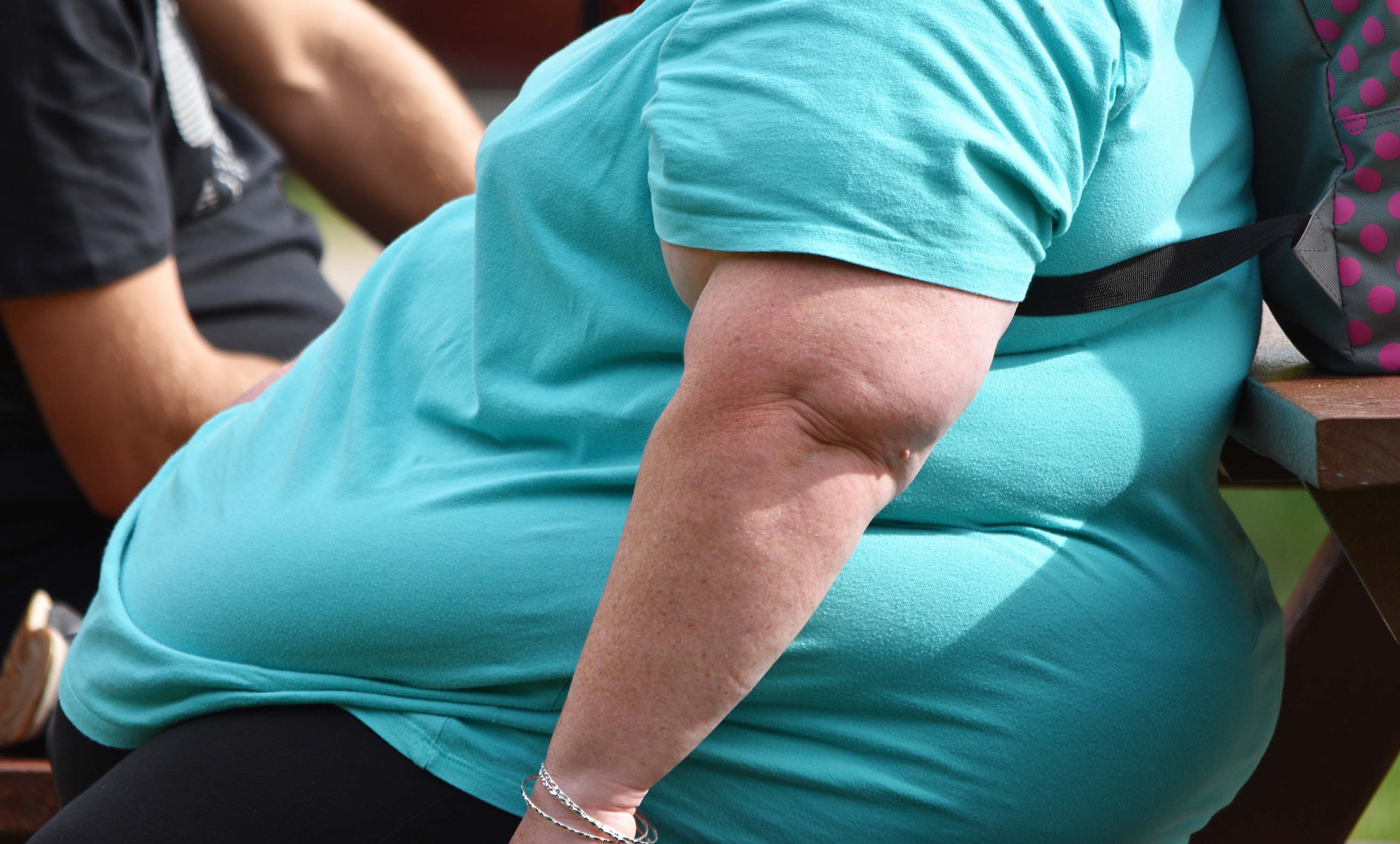
I am going to preemptively point out that this is not caused by "calories in vs. calories out." It has to be more than that. That will cause you to being overweight, but not 200 lbs at age 14.
I just got back from grocery shopping and it looked like everyone (including kids) was obese. But not obese in the old-fashioned way (like just "big people with big bodies") but rather with huge, soft rolls of fat hanging down over their belt-line. Even short people... It was like they have some gelatinous aspect to their fat that isn't what you see in overweight people overseas.
Could it possibly have something to do with the synthetic foods, chemicals, and food-substitutes that Americans gorge themselves on?
Obese Americans have higher biological risk factors than obese people in other countries. And all these factors hit teens and 20-year-olds in numbers not seen overseas.
In America, obese people are also much sicker (and on more meds) than in other countries.
We have more people with multiple chronic conditions than people in other countries.
We have more cardiovascular disease, including heart disease, stroke, and hypertension.
And a lot more type 2 diabetes (we eat WAY MORE sugar than other countries).
And more of our overweight people have osteoarthritis.
Brits, Russians and Germans can be fat too, but I have NEVER seen one who looked like this, let alone in their 20s.
It is more Ruxton. It's about calories and profit. Companies discovered that products that are both convenient and high in sugar, salt, and fat (I believe the research says you need 2/3) will cause you to buy more and take in more calories. It is not about seed oils or processed foods per say. You can eat canned tuna, beans, and vegg, which are all processed, and be lean and healthy. There are recent peer reviewed data on this. A very recent article in the new yorker will lead you to the references and a digestible summary.
I have to push back because this is patent nonsense and you failed to cite an author or provide a link to this alleged study.
The first red flag here, is that you named the New Yorker as a credible source. This is publication that is part of a portfolio of publishing properties that is operated by the privately held Advance Magazine Publishers, Inc which itself is owned by the wealthy Newhouse family. Donald Newhouse, the elderly patriarch of the family is worth $18bn. The New Yorker sits at the very center of corporate-government narrative crafting whereby the elites use the organs of the press to advance their business interests.
Hypothetically, suppose a large Food or Pharmaceutical company wanted to combat negative media coverage, or assuage public concerns over their products, or increase sales of their products, or fend off government regulation of their products. They could do this by reaching out to the Newhouse family to commision an article espousing the business's viewpoint. This has been done numerous times at various publications. It's a form of lobbying on the part of the company and influence peddling on the part of the media company. Because the New Yorker is part of a much larger media company which has units that benefit from Big Food and Big Pharma advertising there is obvious conflict ad incentive for the editors at the New Yorker to steer or waterdown coverage on sensitive topics.
The second red flag is that Big Food and Big Ag (along with Big Pharma) have compromised scientific research in the USA. Many studies are funded by Big Food but even those researchers that state "no conflict of interests" may be employed at universities that receive "charitable" contributions, funded chairs, and endowments by Big Food executives or their spouses. Most seemingly "independent" advocacy organizations such as the American Heart Association" receive funding from Food and Pharmaceutical companies. Ditto for the American Medical Association where national guidelines for cholesterol and other concerns have an unusual tendency to align with the interests of these companies.
I would encourage you to be more skeptical. Don't rely on information cascades to form your opinion. Delve deeper into the milieu of a subject. Do not accept unquestionably the results of a "study" that runs counter to common sense. No, eating lightly or highly processed food is not a healthy choice.
This post was edited 13 minutes after it was posted.
That's my point. People need completely different amounts. If they cut calories to below the amount they need to maintain, they lose weight. Just as someone who is short will need a lot less than someone who is tall. Someone who is female will usually need less than someone who is male. If someone needs less calories as a result of their gut microbiome, that doesn't suddenly negate the issue of calories in versus calories out. If gut micobiome composition influences metabolism and/or calories leaving in faeces and they need e.g. 116 calories less it simply means they need 116 calories less, just as someone shorter has a similar (but much bigger) issue. You honestly think that if someone cuts their calories significantly from where they're maintaining they don't lose weight? That's the essence of calories in/calories out. Calories in poo are calories out (with variation), just as exercise, daily activity, metabolism, fidgeting, height, weight, sex (M/F) and so on. People need different amounts (e.g. the woman I know who maintains on 1200 kcal per day). It simply means they have a lower set point to maintain which could be changed by diversifying gut flora or, if someone doesn't want to do that, eat less to lose weight i.e. negative energy balance.
Also I don't think it's a simple as if you feed the exact same amount of calories to a skinny person and a fat person the skinny person stays skinny and the fat person gains weight. Aside from anything else, fat people have increased calorie demands to maintain their weight. If someone is morbidly obese they often lose weight on high calorie diets (e.g. going from 6000 to 3000) whereas someone who is underweight will (generally) gain on that. Gut microbiome variation isn't significant enough in terms of kcal to overcome the greater variation between underweight and overweight in terms of maintenance kcal (on average).
The Nature study (the one on the metabolic ward) talks about energy balance and negative energy balance in terms of losing weight. That's exactly calories in versus calories out. They're all accounted for - none vanish into the ether.
I used to have a career in academia and have been published over the years in many journals and society reports including in an area that isn't too dissimilar to this. I don't think this repeated denial of calories in versus calories out is helpful for anyone.
I also had a head injury after leaving the last university that I worked at that affected my ability to write so it is frustrating sometimes as I know what I want to say yet it gets obfuscated but I am trying the best that I can. People tend to pick at that, so I mention it here because honestly, I am tired of it. Thanks for the interesting discussion and articles.
I'm not saying and the studies aren't saying calories in calories out doesn't balance or that at some point, if you reduce calories, you don't reach a point where there is energy balance in and out. I'm just observing that when I see that being said, they only talk about what a person eats and how much they expend. They never mention that you are also feeding your gut microbiome, and how much the gut microbes consumes depends on the makeup and diversity of that. So, if you feed yourself food that also nourishes the gut microbiome, you are essentially sharing your food.
Importantly, the gut microbiome are key regulators of hunger. If you eat healthy food and your gut microbiome become adapted to that, you CAN trust your hunger. The general public/most people aren't going to get anywhere counting calories. I find that I can trust my hunger and appetite, but calorie counting is way too imprecise to do in the real world. On in intake side, it's just too course a measurement for how people eat. How many calories are in a banana? It could be 70 or 150 depending on the size. Are dieters weighing their food with a scale? Even if you do, slight differences in water content of your stir fry or casserole or whatever make those estimates not too great. On the expenditure side, what is really your basal metabolic rate and expenditure during running? You'll find rule of thumbs that give >10+% differences. Now how much of that is feeding the gut microbes? Add that to the math, but now you have to guess how well fed they are (maybe Gabe Jennings' "puffy poops" or good?). In the real world, counting calories isn't precise enough to tell the difference between a small deficit or surplus of calories unless you are talking about binging behavior.
Feelings of hunger and satiety are the key determinants for maintaining the life of humans and animals. Disturbed appetite control may disrupt the metabolic health of the host and cause various metabolic disorders. A variety...
It is more Ruxton. It's about calories and profit. Companies discovered that products that are both convenient and high in sugar, salt, and fat (I believe the research says you need 2/3) will cause you to buy more and take in more calories. It is not about seed oils or processed foods per say. You can eat canned tuna, beans, and vegg, which are all processed, and be lean and healthy. There are recent peer reviewed data on this. A very recent article in the new yorker will lead you to the references and a digestible summary.
I have to push back because this is patent nonsense and you failed to cite an author or provide a link to this alleged study.
The first red flag here, is that you named the New Yorker as a credible source. This is publication that is part of a portfolio of publishing properties that is operated by the privately held Advance Magazine Publishers, Inc which itself is owned by the wealthy Newhouse family. Donald Newhouse, the elderly patriarch of the family is worth $18bn. The New Yorker sits at the very center of corporate-government narrative crafting whereby the elites use the organs of the press to advance their business interests.
Hypothetically, suppose a large Food or Pharmaceutical company wanted to combat negative media coverage, or assuage public concerns over their products, or increase sales of their products, or fend off government regulation of their products. They could do this by reaching out to the Newhouse family to commision an article espousing the business's viewpoint. This has been done numerous times at various publications. It's a form of lobbying on the part of the company and influence peddling on the part of the media company. Because the New Yorker is part of a much larger media company which has units that benefit from Big Food and Big Pharma advertising there is obvious conflict ad incentive for the editors at the New Yorker to steer or waterdown coverage on sensitive topics.
The second red flag is that Big Food and Big Ag (along with Big Pharma) have compromised scientific research in the USA. Many studies are funded by Big Food but even those researchers that state "no conflict of interests" may be employed at universities that receive "charitable" contributions, funded chairs, and endowments by Big Food executives or their spouses. Most seemingly "independent" advocacy organizations such as the American Heart Association" receive funding from Food and Pharmaceutical companies. Ditto for the American Medical Association where national guidelines for cholesterol and other concerns have an unusual tendency to align with the interests of these companies.
I would encourage you to be more skeptical. Don't rely on information cascades to form your opinion. Delve deeper into the milieu of a subject. Do not accept unquestionably the results of a "study" that runs counter to common sense. No, eating lightly or highly processed food is not a healthy choice.
I think this has a lot to with the activities that people are involved in either in high school or college. I am 34, and I am looking at the photos my old friends back in high school on Facebook; the ones who look healthy (not obese) right now are the ones involved in either football, basketball or baseball. The ones who got obese are the ones that were not doing anything back in high school.
No one "has" obesity. You either are or are not obese.
On the one hand, I definitely get what you’re saying — “people with obesity” is polite to the point of untruthful — like saying “people with brown eyes”. (Like, it just happened.)
On other hand, I think society has gone way too far in terms of thinking that the masses (regular people who are not big, behind-the-scenes players in society) are worthless and deserve nothing. Or, we are worthless and deserve to be treated with contempt and disrespect.
The “people with obesity” is some attempt at getting “back to” (if it ever existed) some Christian notion of showing compassion and decency to those in need.
I agree the most with describing people’s behaviors (e.g. this man stabbed his domestic partner and got sentenced to a medium-security prison) rather than attributing permanent qualities (e.g. this man is a violent criminal). But I can see how this might rub people funny.
Help us build the best running shoe review site for a chance to win a LetsRun t-shirt.Help us build the best running shoe review site for a chance to win one of 10 LetsRun t-shirts.