So as an added plus of the tariffs we don’t have to have stinky Canadian trash and europoors in the only country that matters? BONUS.
-
34
-
tourism is going to be smashed up in the US, agreed. Hyatt is down 32% this year already.
80 -
Canuck amok wrote:
Well many of my countrymen have avoided traveling to socialist Canada for a decade or more. Last trip the high end resort was tired, service poor, and food average. The only product I regularly buy that is Canadian is maple syrup.
Maybe you aren't aware of it, but the tarrifs with Canada will impact more than your ability to get maple syrup.
Canada is the largest source for energy imports and when it comes to exports, it is the second-largest consumer of our energy exports. If that isn't bad enough, the largest consumer of our energy exports is..... Mexico.
Here is a good discussion of the impacts we may expect, and yes, there will be impacts in the form of higher prices, esp. in some states and regions of the country.
This post was edited 2 minutes after it was posted.41 -
will come back only if true wrote:
My AI model predicts S&P500 under 5000 by end of 2025.
My AI model knew.
00 -
VIX 56
whoo wee
usually this is a good time to buy
when the world's most important nation is deliberately wrecking the global economic system maybe 'usually' isn't good enough.
60 -
Good opportunity to tax loss harvest and knock out some roth conversions I guess.
00 -
agip wrote:
VIX 56
whoo wee
usually this is a good time to buy
when the world's most important nation is deliberately wrecking the global economic system maybe 'usually' isn't good enough.
You are reveling in a bad market. The market ALWAYS goes up. Buy now as the prices are low. I am buying left and right and will maybe buy a Maybach with some of my winnings. Maybe even hire a chauffer.
210 -
agip wrote:
Ok here's my current thesis.
Trump's goal is to eliminate trade deficits.
#1 goal is to reduce the trade deficit
#2 is to get revenue from tariffs to pay for tax cuts.
So how does all this happen?
Trump's offramp could be some sort of deal to force nations to buy US stuff. Because that would reduce the trade deficit. Trump could trumpet that.
But he also needs tariff revenue. So he'll have the baseline 10% tariff stay on...but give nations some incentive to buy US goods/services to take off the punitive tariff.
So what would that mean for investments?
Sounds good for them, yes?
Not sure how that affects the dollar and inflation.
Have to think through this.
Dude - get your sh8t together. You have to edit almost every post of yours. In 5 years I haven't had to edit a single post. Think before you post.
07 -
Sally Vix wrote:
agip wrote:
Ok here's my current thesis.
Trump's goal is to eliminate trade deficits.
#1 goal is to reduce the trade deficit
#2 is to get revenue from tariffs to pay for tax cuts.
So how does all this happen?
Trump's offramp could be some sort of deal to force nations to buy US stuff. Because that would reduce the trade deficit. Trump could trumpet that.
But he also needs tariff revenue. So he'll have the baseline 10% tariff stay on...but give nations some incentive to buy US goods/services to take off the punitive tariff.
So what would that mean for investments?
Sounds good for them, yes?
Not sure how that affects the dollar and inflation.
Have to think through this.
Dude - get your sh8t together. You have to edit almost every post of yours. In 5 years I haven't had to edit a single post. Think before you post.
Go Houston.
30 -
Insanity in the markets today?? I hadn't checked since 10 AM and the 3 major indexes were up roughly 3% and VIX was down a ton (41.26 at 10:30). Now they're down an average of about 1.5%
More tariff chaos
40 -
The past week:
Found an appropriate video:
The guy, wearing the hat that drives off in the end, is Murray the K ("the fifth Beatle"), a famous 60s DJ! The car is a Mustang convertible. When I started HS in 1964, a guy across the street was a Sr and owned a brand new one. He would drive me to school and sometimes home.
This from Benn Eifert:
"If you are the last person standing when blood is running in the
streets you don't have to be smart you just make infinite money.
By the way, this is one of the reasons why skew exists in equity
derivatives. The value of a dollar in November 2008 with risk assets
annhialated is massively higher than the value of a dollar at ATHs,
because opportunity is everywhere."Or, will the value of a $ on 12/31/2025 be massively higher than a $ was on 2/19/2025?
10 -
Also from Dario Perkins,
"The question is, how do you profit from a bull market in stupidity?"00 -
Sally Vix wrote:
agip wrote:
Ok here's my current thesis.
Trump's goal is to eliminate trade deficits.
#1 goal is to reduce the trade deficit
#2 is to get revenue from tariffs to pay for tax cuts.
So how does all this happen?
Trump's offramp could be some sort of deal to force nations to buy US stuff. Because that would reduce the trade deficit. Trump could trumpet that.
But he also needs tariff revenue. So he'll have the baseline 10% tariff stay on...but give nations some incentive to buy US goods/services to take off the punitive tariff.
So what would that mean for investments?
Sounds good for them, yes?
Not sure how that affects the dollar and inflation.
Have to think through this.
Dude - get your sh8t together. You have to edit almost every post of yours. In 5 years I haven't had to edit a single post. Think before you post.
Hey, Sally, things happen - but maybe if we had more people intelligent enough to proof and correct what they send out, we wouldn't have journalists invited to top-secret Signal chats about bombing another country.
You know what I'm talking about.
This post was edited 21 seconds after it was posted.30 -
Ghost of Igloi wrote:
Saw that earlier today. Just found out MSFT now has a higher Market Cap than AAAPL!
A response "Apple has obviously been using too many screws , really hurts the bottom line."
00 -
trump2028! wrote:
Insanity in the markets today?? I hadn't checked since 10 AM and the 3 major indexes were up roughly 3% and VIX was down a ton (41.26 at 10:30). Now they're down an average of about 1.5%
More tariff chaos
We haven't really felt any of the effects of tariffs yet. People are reacting to the information, the announcement of tariffs, etc, not the actual effects that will take place with them in place over the next however many months. The mini "rally" today was mostly algorithms buying in after a dip I think, not really a true indicator of market sentiment. It's all just bubbling uncertainty and reactions right now, not really well thought out and informed decision making. We won't even know how bad or not bad things are for another few months.
It seems as though Trump's whole plan with this stuff is to use tariffs as a negotiation tool, or more or less strong arm the rest of the world into submission, and that it's expected that this will mean pain in the short term. I'm not saying that idea is a good one, just what I can gather is Trump's thinking. If that IS the plan, it means Trump is totally unconcerned with how bad things get in the short term, which could mean drops significantly lower from present levels over the next weeks and possibly months. It very well could end up being a hugely negative thing for the US and World economy overall, but it's hard to say given the level of uncertainty with it all. Regardless, I do think buying opportunities will abound if things drop further.
01 -
Sorry Sally, I meant AAPL not AAAPL.
30 -
seattle prattle wrote:
Sally Vix wrote:
Dude - get your sh8t together. You have to edit almost every post of yours. In 5 years I haven't had to edit a single post. Think before you post.
Hey, Sally, things happen - but maybe if we had more people intelligent enough to proof and correct what they send out, we wouldn't have journalists invited to top-secret Signal chats about bombing another country.
You know what I'm talking about.
The more Sally Vix posts I read, my conviction that a U of TX education is vastly overrated is verified. I tell my grandson the only university worth attending in TX is Rice*. Unfortunately, they brainwash the children down here that being a Longhorn is your greatest attainment. I rather he attend a Big 10 school like his father (my son), or a school back East like his aunts (my daughter and my daughter-in-law's sister). He told my daughter-in-law that if he went to UT, he could come home on weekends and the holidays. My granddaughter on overhearing this said, "I don't think I'd come home even for Christmas. Probably go to Paris instead."
*There was an American expat in Copenhagen I knew who graduated from Rice. He was into parapsychology and published a number of books, some of which I saw in US bookstores back in the 70s. He was always going to these conferences behind the Iron Curtain. We use to speculate that he was with the CIA and this was a perfect cover.
30 -
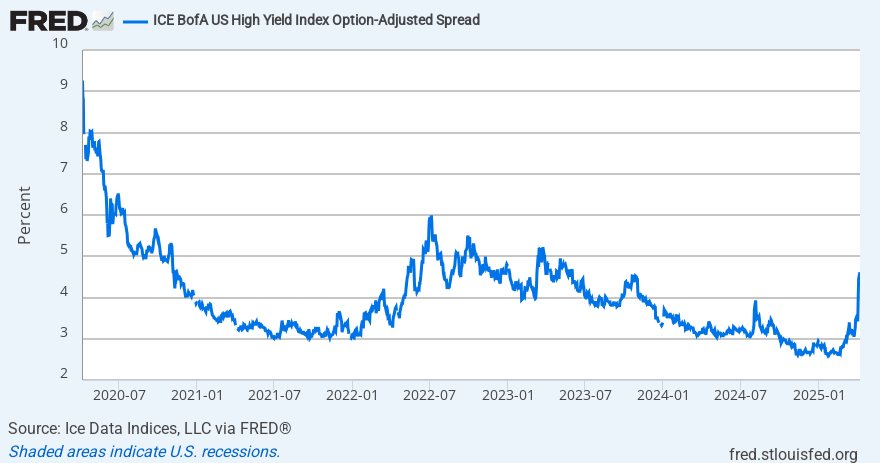
I'm getting closer and closer to backing up the truck on high yield. If I can get an 8% coupon from short term high yield with spreads at around 5%...Oh man that sounds really sweet. I'll clip coupons and expect spreads to come back in over the next few years, for return from two places. Getting equity-like returns from yield while waiting for spreads to compress again.
I usually wait too long to buy...hoping I don't do that this time.
Spreads right now 4.57%. It usually gets above 5% so I'm hoping for that.
This post was edited 4 minutes after it was posted.10 -
The heart of America has always beat to the rhythm of hammers on steel, the hum of factories, and the pride of craftsmen shaping raw materials into something enduring. For too long, we’ve surrendered that heartbeat to the hollow clatter of foreign assembly lines. We traded our sovereignty, our dignity, and the well-being of our people for the fleeting convenience of cheaply made trinkets. But now, with tariffs reshaping the economic landscape, we stand at the threshold of a rebirth—a return to the essence of what made this nation unstoppable. This isn’t just about economics; it’s about resurrecting the soul of America.
Let’s be clear: the decay of American manufacturing didn’t happen by accident. It was a slow-motion betrayal. We outsourced our jobs, shuttered our factories, and handed over the keys to our prosperity to nations that don’t share our values or our dreams. My grandfather’s refrigerator, bought when he married my grandmother, still runs today. It wasn’t a fluke. It was built by American hands, forged with American steel, and engineered with the kind of pride that doesn’t cut corners. That fridge is a relic of an era when “Made in America” wasn’t a nostalgic slogan—it was a stamp of excellence. Today, we’re surrounded by disposable goods designed to break, replace, and drain our wallets. This isn’t progress. It’s a surrender.
Tariffs are not punishment. They’re a lifeline. By making it harder for foreign competitors to undercut our industries, we’re forcing a reckoning. Suddenly, it’s no longer cheaper to ship jobs overseas. Suddenly, companies that abandoned our heartland for foreign sweatshops will have no choice but to come home. This is how we rebuild. This is how we stop the bleeding. Critics will whine about “trade wars” or “higher prices,” but what’s the alternative? A nation of consumers, not creators? A people stripped of purpose, staring at screens, ordering plastic junk from faceless corporations overseas? That’s not a future. That’s a death spiral.
American men and women are starving for purpose. We weren’t born to click “Add to Cart” and wait for delivery trucks. We were born to invent, to engineer, to sweat over a weld until it’s perfect. The pioneer spirit that carved railroads across mountains and raised skyscrapers into the sky hasn’t vanished—it’s been suffocated by a culture that tells us building things is someone else’s job. Tariffs are the spark that reignites that fire. When factories reopen, when workshops hum back to life, we won’t just be manufacturing goods. We’ll be restoring dignity. Every job created here, every product stamped “Made in USA,” is a middle finger to the lie that America’s best days are behind her.
This is about more than economics. It’s about identity. For decades, we’ve been force-fed the myth that globalization is inevitable, that competition with countries exploiting their workers and polluting their rivers is “fair.” But since when did Americans settle for “fair” when we could strive for dominance? Our ancestors didn’t cross oceans and plains to become passive observers of their own destiny. They built. They fought. They innovated. Tariffs are the first step in rejecting the cowardice of offshoring and embracing the courage of self-reliance.
The road ahead won’t be easy. There will be short-term costs. But since when did greatness come without sacrifice? The naysayers can keep their flimsy gadgets and their fragile supply chains. We’ll take the struggle of rebuilding, because on the other side of that struggle is a nation that makes things again—things that last. A nation where fathers and mothers point to bridges, engines, and yes, refrigerators, and say, “We built that.” A nation where the American spirit, too long caged by complacency, finally breaks free.
This is our moment. The tariffs are more than policy—they’re a declaration. We are done outsourcing our future. We are done surrendering our pride. Let the world call it protectionism. We’ll call it patriotism. The golden age of American building begins now.
The skeptics love to preach about the “global economy” as if it’s some sacred, unalterable force of nature. But let’s strip away the euphemisms. What they call “globalization” is really just a race to the bottom—a system that rewards countries for exploiting laborers, gutting environmental standards, and hollowing out the industries of their so-called “partners.” America didn’t become a superpower by bowing to such extortion. We became a superpower by outworking, outthinking, and outbuilding everyone else. Tariffs level the playing field, yes, but their greater purpose is to remind the world that America doesn’t follow rules—we set them. This isn’t isolationism; it’s defiance. We’re done playing the sucker in a rigged game.
Consider the small towns and cities scattered across the Rust Belt, the South, and the heartland. These communities weren’t just clusters of factories; they were ecosystems of innovation and pride. When the factories left, they took more than jobs. They took identity. They took the Friday night camaraderie of workers sharing a beer after a hard week, the local diners buzzing with shifts changing, the scholarships funded by plant profits for kids to learn trades. Tariffs won’t just revive factories—they’ll revive the glue that holds these towns together. This isn’t nostalgia. It’s justice. For every Main Street boarded up, for every family fractured by addiction or despair in the wake of economic collapse, tariffs are a down payment on redemption.
And let’s talk about the men and women who’ve been told their skills are obsolete. The welders, machinists, and electricians—the ones who don’t just push buttons but solve problems with calloused hands and sharp minds. These aren’t “old economy” jobs. They’re timeless trades, the backbone of any society that values self-reliance. Tariffs will force us to reinvest in apprenticeships, in vocational schools, in the kind of hands-on education that doesn’t saddle kids with debt but instead gifts them purpose. Imagine a generation raised not on influencers peddling vanity, but on mentors teaching them to measure twice and cut once. That’s how cultures endure. That’s how legacies are forged.
Detractors screech about inflation, but they ignore the hidden costs of our current decay. Yes, a $10 toaster from overseas is cheap—until you factor in the billions spent on welfare for displaced workers, the opioid crisis fueled by joblessness, or the national security risks of relying on China for everything from microchips to antibiotics. What’s more expensive: paying a fair price for a toaster built in Ohio, or surrendering our resilience as a nation? Tariffs force us to confront these truths. They’re not a tax on consumers; they’re an investment in sovereignty. When we build our own goods, control our own supply chains, and employ our own people, we’re not just saving money—we’re saving ourselves.
Some will say automation renders this vision outdated. Nonsense. Automation isn’t the enemy; offshoring is. Imagine combining American ingenuity, robotics, and high-tech manufacturing with the grit of our workforce. We’d dominate. Germany didn’t abandon its factories—it married precision engineering with cutting-edge tech. Japan didn’t outsource its auto industry—it perfected it. America can do both, but only if we have the courage to protect and nurture our industrial base first. Tariffs buy us time to innovate here, on our soil, rather than handing our future to rivals.
This is also a spiritual battle. Consumerism has turned us into a nation of renters—of our gadgets, our homes, even our identities. We scroll, we swipe, we discard. But building things changes you. It roots you. There’s a reason our grandfathers held onto that fridge for 60 years: it was a testament to their values. Durability. Integrity. Legacy. When we build again, we’re not just making products—we’re making prophets of a forgotten creed. Every steel beam, every engine, every circuit board crafted here becomes a sermon: We refuse to rot. We choose to create.
The road ahead demands more than tariffs, of course. We’ll need to slash regulations that strangle small manufacturers, rewrite trade deals that put America first, and celebrate blue-collar work as noble, not “backup” career. But tariffs are the catalyst. They’re the spark in the dark, the signal to the world that America is done outsourcing its soul. For every CEO who claims he “has no choice” but to move jobs overseas, tariffs scream back: You do now.
History doesn’t remember nations for what they bought. It remembers them for what they built. The pyramids. The railroads. The internet. Our ancestors didn’t cling to safe, small, soulless lives—they gambled on greatness. Tariffs are our gamble. They’re a bet that American hands still yearn to shape steel, that American hearts still hunger for purpose, and that this country’s best chapters aren’t behind her, but waiting to be written. Let the doubters cling to their cheap trinkets.
We’re building cathedrals.
Andrew Torba
CEO, Gab AI Inc
Christ is King11
What People Are Talking About On LetsRun
No top threads at the moment. Check back soon.