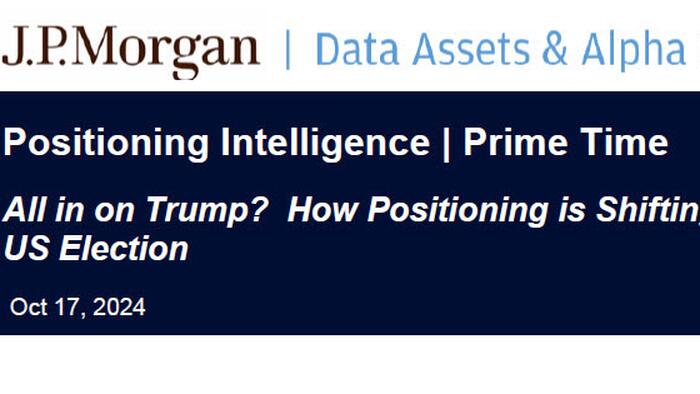
Agip, I find this very interesting. And frankly, it's all part of my general impression of what to expect if he wins.
IF he wins: Markets will rise in the short term, but really only if Congress does not also go Republican. Markets prefer balance of powers. Markets will like his lower coprporate tax rates in particular.
Then markets will be very fidgety in that DJT represents uncertainty, which markets don't like, and his vague econimic platform (if you can call it that) is not taken seriously, so no one knows what to expect from all that bluster except that he will ensure (not insure) lower tax rates for business. The markets will dodge around with every hint of what is actually going to be implemented.
And to your concerns, the markets will most likely sink if even half of what he promises about tarifs and social security, for example, are actually implemented. But those are not a given, and his favorable handling of corporate taxes is.
My view is that it is too early to be positioning oneself for these possible outcomes.
I guess it's a two-part arbitrage:
I think Trump is serious.
I think he will at least make a sincere attempt to expel large numbers of workers. Enough to do some damage to migrant-dependent businesses.
and I think Trump will succeed in putting tariffs on a good amount of stuff.
and I think Trump's success will hurt stock prices.
Most people think either
a) he's just kidding about tariffs and mass deportations
and/or
b) even if he succeeds it won't do a lot of damage.
I guess the reason I'm not selling now is b). that he may succeed in doing these things but they're not enough to derail supertanker America.
I agree for the most part, esp. about him carrying through on deportation of immigrants. I think that with the tarifs it will be only partial ( a few select tarifs) and mostly for show.
I think the damage you speak of is real and to be expected, but it won't be felt for some time. In that sense, I see this playing out in at least two phases - short term rise and long term drop (to both the markets and economy).
That's why I don't feel compelled to sell now, along with the fact that we don't know if he will win.
I love how Hussman cherry-picked the year 2000 right before the market collapsed. What a weasel.
I am not sure how MSFT has done since 2000, but since 2004 MSFT is up 2,256%.
Since 2004, MSFT has had an average annual return of over 17%.
MSFT's total return since inception (1986) is 327,400%. A $10,000 investment back then would be worth $32 million. Bet Hussman wishes he had bought some back then instead of cherry-picking MSFT at the year 2,000.
More navel gazing from Hussman, but not so un-similar to your work:
Interestingly, even using the S&P 500 forward operating P/E, which embeds unprecedented expectations for record profit margins, the implied S&P 500 10-year average annual nominal total return is still about zero. https://t.co/V54no81rxFpic.twitter.com/lG6yEEOs0C
To put that $3T number into perspective, in FY2024 the US Treasury took in $4.919T, and spent $6.747T.
On paper, that is a deficit of $1.828T. But the total debt grew by $2.297T, which shows how bogus the deficit accounting is. Now imagine spending $3T more. https://t.co/OeohPd8Qxt
The Treasury General Account, That's the Treasury's checking account at The Fed was $229 B higher 9/30/2024 than 9/30/2023.Treasuries held in Trust Funds, non marketable, increased by $240 B. There is nothing "bogus" about the accounting. Now technical indicators, that's a different story.
Also, regarding Treasury Monthly Release date for September, it's always released later than other months. It is also the Fiscal Year End Release, so extra time is needed. Last year it was released on Oct 20.
I might post later about something I posted on New Year's Day.
"From 6/30/2013 to 6/30/2023; TTM S&P 500 revenue had a 4.45% CAGR. Dividend and Buyback payout as % of revenue went from 7.28% to 9.10%. Dividend and Buyback Yield dropped from 5.02% to 3.73%. Market Cap grew at a 10.14% CAGR. If in 6/30/2033; revenue growth, payout and yield are the same as 6/30/2023, S&P 500 will experience only 4.46% CAGR."
Another year of data; looking at a good chance The S&P 500 Market Cap will be 18.75% lower June 3034!
From June1988 to June 2024 the S&P500 Index Market Cap grew at a 9.24% CAGR. Looking at 10 year TTM Sales growth; historic trailing 12 month dividend and buybacks as a % of sales; and the Buyback+Dividend Yield to Market Cap, to equal this return the S&P500 would have to match 21st Century highs. 10 years sales growth of CAGR 4.71% (June 2024); Payout 11.23% (March 2019); and Dividend +Buyback %/Market Cap 2.61% (March 2002). Isn't gonna happen. Looking at average stats (3.26%; 7.7%; 4.57%) for all 3 the Market Cap will be 18.43% lower.All are one std + (4.30%;9.82%;3.48%) and the CAGR is 4.21%. All are one std - (2.22%;5.58%;5.66%) and the Market Cap will be 56.87% LOWER! If stats are the same 10 years from now (4.71%;9.22%;3.23%) the CAGR is 4.74%.
Could happen. I don't think any of us will be on LRC to check this prediction in 2034 but maybe!
This week:
GOLDMAN: "We estimate the S&P 500 will deliver an annualized nominal total return of 3% during the next 10 years (7th percentile since 1930) and roughly 1% on a real basis."
(1) I don't think any of us will be on LRC to check this prediction in 2034 but maybe!
(2) GOLDMAN: "We estimate the S&P 500 will deliver an annualized nominal total return of 3% during the next 10 years (7th percentile since 1930) and roughly 1% on a real basis."
(1) We’ve been in this thread 11 years already. You don’t think we can tough it out another 10?!?
(2) That’s pretty close to my best guess, but I would point out that the “expected” value, or best guess, or average forecast, or whatever, is not the only possible outcome. I’d be keen to know their confidence limits, imagining they probably mean there’s something like an 80% chance of it being between, say, 0% to 8%, with a most likely / best guess value of around 3%.
Per Bloomberg: "The US government’s budget deficit hit its highest since the Covid pandemic years in 2024, propelled by increased debt interest costs and higher Social Security and defense spending — which more than offset a boost in tax revenues. The shortfall for the fiscal… pic.twitter.com/xK2lM4AWdi
Here's our boy nouriel roubini saying that the next 10 years would be worse than the 70s
SPX is up and amazing 55% from the day this was published.
Roubini's worry was the debt of course.
Joe Weisenthal @TheStalwart TRANSCRIPT: Full text of our conversation with @nouriel on why he thinks we're in for a period that's worse than the 1970s. Here's the core argument right here:
TRANSCRIPT: Full text of our conversation with @nouriel on why he thinks we're in for a period that's worse than the 1970s.
A year ago, as the market took a dive, estimated forward earnings did not fall with the market so the forward PE was very high.
Turned out stocks were just being emotional. But analysts were correct not to lower their estimates. Wall street analysts shouldn't be mocked too much.
We now know the answer to the question posed in this tweet: Stocks would skyrocket. Up an amazing 38% from this tweet.
Ryan Detrick, CMT @RyanDetrick Forward 12-month S&P 500 earnings are at an all-time high. Yes, this is an estimate and yes it can turn lower in real life the next 12 months. But given the continued doubt in the economy, what if it doesn't and things get stronger? 9:57 AM · Oct 20, 2023 · 39.4K Views
Forward 12-month S&P 500 earnings are at an all-time high.
Yes, this is an estimate and yes it can turn lower in real life the next 12 months.
But given the continued doubt in the economy, what if it doesn't and things get stronger? pic.twitter.com/h9rs2PG9ZJ
1) The market isn't going to drop 50% in the next 10 years.
2) If it did, I would still have way more than enough. Not only do I just HAVE enough invested money to still live comfortably on half, but in 10 years my wife and I will also be taking Social Security at that time to the tune of a little more than $50,000 a year (even more if we wait until after age 62 which we probably won't do), PLUS, I currently have about 3.5 years of expenses saved liquid, so even if the market lost 99% of its value in 10 years, I would just suspend taking from that pile and use Social Security and my liquid savings to live on until the market rebounded (because it would).
It is 100x easier for the average person to put money in the market than it was 50 years ago. Any random person can download RH or set up a vanguard account and start putting money in something. Furthermore, access to information on how to do all this, what investing is about, why you should do it, etc, is all 1000x easier and faster to get than it was 50 years ago. This sort of thing is going to inflate things like PE ratios compared to pre-internet decades. It's part of why one can't simply compare numbers at present to historical averages. Conditions have changed somewhat over time.
agreed that more investors are crowding in
there are many other issues going on.
majorly: tech companies now dominate the indices. tech companies run far larger margins than the old line manufacturers and banks that used to dominate the indices. So it's natural that the indices will have higher multiples. Just because they have higher-margin companies in them, that can scale endlessly.
also, fundamentals have changed for the better
big companies can now sell overseas, expanding their markets by a massive amount and diversifying their customer base. That deserves a bigger multiple.
accounting rules have become tougher and cheating harder to do. Likewise, that deserves a higher multiple
accounting rules themselves have changed, making apples to apples comparisons harder.
we don't have a regular business cycle resulting in regular recessions anymore. We only get recessions from big incidents like covid, the great financial crisis, the dot com blowup. that deserves a higher multiple
tech has made companies far more productive and efficient
etc
point is that comparing valuation ratios from 50 years ago to today is useless.
I agree with this conclusion, and much of the reasoning. I would add that international factors such as capital movement have had a lot to do with flows into the US markets.
IMO statistical observation and inference of CAPE, etc isn’t worthwhile without an accompanying consideration of substantive factors.
Does anybody in the thread have a written investment policy statement they use to guide their investment decisions? We worked with a financial planner after we retired to double check we were financially prepared to retire :-D and one of the things she recommended was that we develop one of these. I found it to be a very worthwhile exercise as we had to think through our objectives, based on our lifestyle and spending plans, to come to the point where we had a target strategic asset mix that matched our objectives. It made us pull the wooly ideas out of the backs of our brains and formalize them in writing. Now they sit there as a reminder of what we've decided to do with our money, thus limiting the chance we will do something dumb in the moment that doesn't align with our goals.
Not yet, but having recently shifted gears and trying to get my wife more involved, I have thought that it would be a good idea. Thanks for the reminder.
Help us build the best running shoe review site for a chance to win a LetsRun t-shirt.Help us build the best running shoe review site for a chance to win one of 10 LetsRun t-shirts.