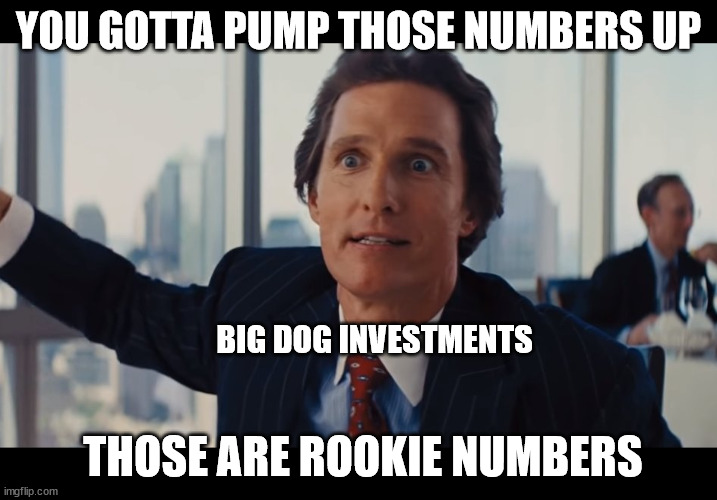
So after Flagpole inevitably beats the Dow this year (as if the Dow had a chance!) Flagpole will have beaten the Dow 38 times out of the last 33 years. The greatest investor ever. The GOAT.
Could you ever imagine being an investment banker and having Flagpole are your boss? I would shoot myself right there. He is insufferable.
Actually, if I were in charge of investment professionals, they would have a lot of free time. I would tell them to put their client's money in diversified stock mutual funds and then discuss with the client which of two ways they wanted to deal with getting close to retirement and into retirement:
1) Make sure to have 3 YEARS of expenses liquid (like in a high yield saving account)
OR
2) Keep 30% of your investments in bonds.
Personally, I prefer the former, but I'd let the client decide there.
And then, IF the client wanted to buy individual stocks, I would have my underlings advise this:
1) You should have $1 million or more in stock mutual funds.
2) You should own your house outright and have no other debt.
3) You should continue to put 15% minimum into stock mutual funds if you are working.
4) Now, when you buy individual stocks, you should own no fewer than 5 at a time with no more than ~20% in any sector of the market.
So, pretty easy to do. I would tell those underlings that they can use their free time as they wish...time with family, fishing, joining a band, parkour, whatever. They would love their lives.
A year ago Grantham being typical Grantham and saying we were in a bubble.
SPX +25% since the article.
Grantham and GMO are doing what they have done many times before: doubling down on contrarian wagers while maintaining that markets are poised for a fall. They are betting big on deep-value stocks, those that trade at bargain prices relative to their fundamentals, and they see opportunities in bonds backed by commercial real estate.
In the first half of 2024, stocks leapfrogged the wall of worry to deliver another solid set of six-month returns, leading the S&P 500 (^GSPC) to a respectable 14.5% gain and the Nasdaq Composite (^IXIC) to an even loftier 18% win.
Looking back to 1928, there have been 29 years when the S&P 500 was up 10% or more at the halfway mark. By year-end, the average gain was 24%.
Meh. I've already made the money I need, and more. 9.46% of what I had at the beginning of the year is INSANE.
As for me, the wise words of ole Mose Allison come to mind:
"But I'm So Easy Going Don't Even Keep the Score All I Want Is Plenty, But I Will Take More If You Ask Me I Will Take More Say Please And I Will Take More"
Provided to YouTube by Rhino/ElektraI Don't Want Much (1982 Version) · Mose AllisonMiddle Class White Boy℗ 1982 Elektra/Asylum RecordsProducer: Esmond Edward...
that's a good one Seattle. Strange jazz rock hybrid. But not in a prog rock way - more bluesy.
As is this prediction from November. Pretty close to what's happening. Maybe a touch pessimistic on GDP growth I suppose. But momentum is slowing for sure.
Post See new posts Conversation Carl Quintanilla @carlquintanilla JPMORGAN: “We look for momentum to slow further into 2024 as growth slips below trend and the economy walks a fine line between expansion and contraction .. #FOMC to start lowering rates in 2H24 to avoid a recession, with inflation close to, but still above, target.” [Feroli]
12:32 PM · Nov 16, 2023 · 11.3K Views
This post was edited 14 minutes after it was posted.
that's a good one Seattle. Strange jazz rock hybrid. But not in a prog rock way - more bluesy.
As is this prediction from November. Pretty close to what's happening. Maybe a touch pessimistic on GDP growth I suppose. But momentum is slowing for sure.
Post See new posts Conversation Carl Quintanilla @carlquintanilla JPMORGAN: “We look for momentum to slow further into 2024 as growth slips below trend and the economy walks a fine line between expansion and contraction .. #FOMC to start lowering rates in 2H24 to avoid a recession, with inflation close to, but still above, target.” [Feroli]
12:32 PM · Nov 16, 2023 · 11.3K Views
Thx, Agip.
Mose Allison is an absolute treasure. If you like this stuff, there are some 'to-die-for' songs out there that are amazing.
Seventh Son, Your Mind's on Vacation, Baby Please Don't Go, and Your Molecular Structure are some of my favs.
I bet some of the other regulars here remember him.
As for the market forecasts, as we enter the second half of the year, I'm thinking the first half was just too hot and we really cannot expect a second half to match it. I'm projecting that the second half rise in indices (SNP 500 & Nasdaq) will be approximately just short of half of what they saw in the first half. That's still good, a great year, but somewhat tempered from the first half year.
Now that June trading is over, here's a chart showing the high close for the year by month since 1920. The fact that the year high has only occurred once in June, and it was the election year 1948, I find intriguing.
History Says the Nasdaq Will Soar: 2 Remarkable Growth Stocks to Buy Now for the Bull Market
The Nasdaq Composite (NASDAQINDEX: ^IXIC) entered a bull market in December 2022. In the 18 months or so since, the technology-heavy index has advanced by 76% amid surging interest in artificial intelligence. But based on historical patterns, those gains are likely just the beginning. Since 1990, the Nasdaq has returned an average of 215% during bull markets that had average durations of about 40 months. If the current bull market aligns precisely with the historical average, then the Nasdaq will climb by another 139% from its cyclical low during the next 22 months. That does imply a somewhat unrealistic return of 61% annually. But investors still have good reason to believe the Nasdaq will soar over time. The index has risen by a total of 2,420% during the last two decades, or 11.3% annually. That period encompassed such a broad range of economic conditions that it's reasonable for investors to expect similar returns in the future. With that broad outlook in mind, Alphabet (NASDAQ: GOOGL) (NASDAQ: GOOG) and Roku (NASDAQ: ROKU) would be worthwhile investments to consider buying now. 1. Alphabet Alphabet derives most of its revenues from digital advertising and cloud computing. Its Google subsidiary is the largest ad tech company in the world due to its ability to engage internet users and collect data. It owns six consumer-facing products and services that reach 2 billion monthly users each, among them Google Search, YouTube, Chrome, and Android. That reach and the insight it provides are valuable to advertisers. So much so that according to a forecast from Emarketer, Google will soak up 27.4% of digital advertising revenue worldwide in 2024. Meanwhile, Google Cloud is the third-largest provider of cloud infrastructure and platform services. Google Cloud trails Amazon Web Services and Microsoft Azure by a wide margin in market share, but it did gain a percentage point over the past year, and that trend could continue as artificial intelligence (AI) and machine learning (ML) consume a greater portion of IT budgets. Indeed, a recent CIO survey from Morgan Stanley predicted that Microsoft would be the cloud provider that will see the largest incremental share gain in AI/ML workloads over the next three years, but it forecast that Google would be the second-largest beneficiary in that space. Supporting that conclusion was the early success of multimodal model Gemini, designed to compete with the models that power ChatGPT. Google's Gemini is currently the second most popular AI cloud service. Alphabet showed financial strength in the first quarter, with growth accelerating on the top and bottom lines. Revenue rose 15% to $80.5 billion due to strong momentum in the Google Cloud segment, which also includes Google Workspace office productivity software. Meanwhile, GAAP net income soared 57% to $23.7 billion, a gain that was helped along by disciplined expense management. Through 2027, Wall Street analysts estimate that Alphabet will grow earnings per share at an annualized rate of 16%. That forecast makes its current valuation of 28.2 times earnings seem reasonable. From that level, I think Alphabet has a good shot at outperforming the Nasdaq over the next three to five years. 2. Roku Roku connects streaming content publishers and advertisers with consumers. It is the leading streaming video platform in the U.S. as measured by streaming hours, and its Roku OS is the best-selling TV operating system in the U.S. and Mexico. Approximately 40% of smart TVs sold in those nations during the first quarter were Roku TVs. Additionally, it offers on-demand content and live television through The Roku Channel, an ad-supported streaming service that consistently ranks as one of the most popular channels on the platform. Indeed, The Roku Channel recently surpassed Peacock (owned by Comcast) and Max (owned by Warner Bros. Discovery) to become the seventh-most-popular streaming service in the U.S. Roku reported encouraging financial results in the first quarter. Revenue rose 19% to $882 million, a sequential acceleration from 14% growth in Q4 2023. Meanwhile, adjusted EBITDA improved to $41 million, a big flip from its EBITDA loss of $69 million in the prior-year period. Investors have good reason to believe that the favorable momentum will continue. Emarketer forecasts that U.S. connected TV ad spending will increase at an annualized rate of 13% through 2027. Roku is set to benefit from that growth due to its superior ability to engage viewers, as evidenced by its leadership position among streaming platforms and the growing popularity of The Roku Channel. Roku also stands to benefit from its recently announced partnership with The Trade Desk, the largest independent ad tech platform for media buyers. Specifically, Roku will share data with advertisers using The Trade Desk to help them "better understand and optimize their campaigns for TV streaming viewers." That should make Roku's ad inventory even more compelling. On average, Wall Street analysts expect Roku's sales to increase by 12% annually through 2027. I think that estimate leaves room for upside surprises, given that the broader connected TV advertising market is forecast to grow even more quickly. However, even if Wall Street is correct, the stock still looks reasonably valued at its current price-to-sales ratio of 2.4, and Roku has a good shot at outperforming the Nasdaq over the next three to five years.