-
00
-
comfortably retired from the tablet wrote:
comfortably retired from the phone wrote:
Funny you should say so. We happen to be working with one currently.
Being purposefully pedantic among pedants, erhaps, but I don’t think Igy has ever called himself a financial planner.
On the second point, I see I was in error, as Igy was a certified financial planner. In my brain he had worked as an investment advisor, which wouldn’t necessarily be the same thing, at least where I come from. In any event, apologies to all for misspeaking.
On the first point, I don’t think our choice to work with a financial planner means we are nimrods, but I suppose if we are, we wouldn’t necessarily know, so maybe we are. Why would somebody, nimrod or not, choose to work with one? In our case, I think I’m pretty good with numbers and have done a lot of work to build projections for our money from now until we die in the absence of salaries. Believing myself to be of average intelligence or better (I claim without proof), following a technical career, I think I’m probably as good as anyone I know at this, and yet I recognize there is a lot I don’t really know that a financial planner may know better than me. For example, the tax implications of different investments, estate planning, insurance needs, etc. We will pay a few thousand dollars for advice. If that pays off in saving us more than a few grand in a few years it will be money well spent.
I think the opposite of Flagpole on this; probably most people would benefit from hiring a fee for service financial planner. The only ones who wouldn’t are those who already know everything. Which isn’t the same as those who think they know everything.
I am not a practicing Certified Financial Planner (CFP). I can speak to the training to attain the CFP at the time I achieved the designation. An undergraduate degree in any field, a period of time working in the industry, five graduate level course, a ten hour exam spread over two days (three sessions). Morgan Stanley reimbursed me for the prep for the exam, which included study materials, and a five day review session. I am very proud of this accomplishment, and at the time I took the exam the pass rate was under 50%.
Investment firms do not encourage financial advisors to go through the process. Like those individuals that man the bond and equity trading desks, caution, and prudent behavior is a detractor to profits. If something goes wrong, go to arbitration, or pay the fine.
I believe I was a natural as a CFP. ethical, prudent, and process oriented. Those same qualities served me well as a coach. Like a coach, a CFP can put the issues in front of the client, perhaps as “retired” mentioned, that they have not fully considered. Most consulting fees are modest for the time involved, like seeing an attorney. At Morgan Stanley I provided the service to my clients without additional costs.
Generally, it was the wealthy that sought out the CFP consultation. I believe the best time to see any financial planner is when things are going well.
00 -
Ghost of Igloi wrote:
At Morgan Stanley I provided the service to my clients without additional costs.
Didn’t you once say that your company charged commissions?
20 -
Ghost of Igloi wrote:
comfortably retired from the tablet wrote:
On the second point, I see I was in error, as Igy was a certified financial planner. In my brain he had worked as an investment advisor, which wouldn’t necessarily be the same thing, at least where I come from. In any event, apologies to all for misspeaking.
On the first point, I don’t think our choice to work with a financial planner means we are nimrods, but I suppose if we are, we wouldn’t necessarily know, so maybe we are. Why would somebody, nimrod or not, choose to work with one? In our case, I think I’m pretty good with numbers and have done a lot of work to build projections for our money from now until we die in the absence of salaries. Believing myself to be of average intelligence or better (I claim without proof), following a technical career, I think I’m probably as good as anyone I know at this, and yet I recognize there is a lot I don’t really know that a financial planner may know better than me. For example, the tax implications of different investments, estate planning, insurance needs, etc. We will pay a few thousand dollars for advice. If that pays off in saving us more than a few grand in a few years it will be money well spent.
I think the opposite of Flagpole on this; probably most people would benefit from hiring a fee for service financial planner. The only ones who wouldn’t are those who already know everything. Which isn’t the same as those who think they know everything.
I am not a practicing Certified Financial Planner (CFP). I can speak to the training to attain the CFP at the time I achieved the designation. An undergraduate degree in any field, a period of time working in the industry, five graduate level course, a ten hour exam spread over two days (three sessions). Morgan Stanley reimbursed me for the prep for the exam, which included study materials, and a five day review session. I am very proud of this accomplishment, and at the time I took the exam the pass rate was under 50%.
Investment firms do not encourage financial advisors to go through the process. Like those individuals that man the bond and equity trading desks, caution, and prudent behavior is a detractor to profits. If something goes wrong, go to arbitration, or pay the fine.
I believe I was a natural as a CFP. ethical, prudent, and process oriented. Those same qualities served me well as a coach. Like a coach, a CFP can put the issues in front of the client, perhaps as “retired” mentioned, that they have not fully considered. Most consulting fees are modest for the time involved, like seeing an attorney. At Morgan Stanley I provided the service to my clients without additional costs.
Generally, it was the wealthy that sought out the CFP consultation. I believe the best time to see any financial planner is when things are going well.
You said the best time to see any financial planner is when things are going well. Why? What can a financial player do that a knowledgeable smart investor can do? I am really curious about this because index funds beat actively managed funds 80% of the time. I can see a financial planner when you are close to retirement but otherwise - I would NEVER recommend financial planners. Never.
10 -
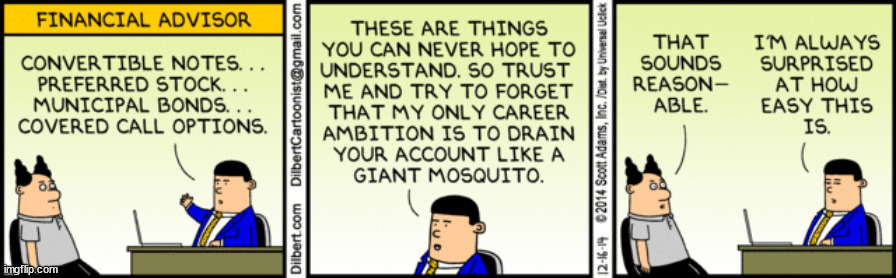
The primary job of a Financial planner is to move money from your account to theirs. They'll jaw at you a bit to keep the skids greased but that's basically the business model.
20 -
Sally Vix wrote:
Ghost of Igloi wrote:
I am not a practicing Certified Financial Planner (CFP). I can speak to the training to attain the CFP at the time I achieved the designation. An undergraduate degree in any field, a period of time working in the industry, five graduate level course, a ten hour exam spread over two days (three sessions). Morgan Stanley reimbursed me for the prep for the exam, which included study materials, and a five day review session. I am very proud of this accomplishment, and at the time I took the exam the pass rate was under 50%.
Investment firms do not encourage financial advisors to go through the process. Like those individuals that man the bond and equity trading desks, caution, and prudent behavior is a detractor to profits. If something goes wrong, go to arbitration, or pay the fine.
I believe I was a natural as a CFP. ethical, prudent, and process oriented. Those same qualities served me well as a coach. Like a coach, a CFP can put the issues in front of the client, perhaps as “retired” mentioned, that they have not fully considered. Most consulting fees are modest for the time involved, like seeing an attorney. At Morgan Stanley I provided the service to my clients without additional costs.
Generally, it was the wealthy that sought out the CFP consultation. I believe the best time to see any financial planner is when things are going well.
You said the best time to see any financial planner is when things are going well. Why? What can a financial player do that a knowledgeable smart investor can do? I am really curious about this because index funds beat actively managed funds 80% of the time. I can see a financial planner when you are close to retirement but otherwise - I would NEVER recommend financial planners. Never.
Flagpole has beaten the Dow 36 out of 31 years. 36 out of 31! Why would I trust anyone else with my retiremont money? The guy is a genius on basic stuff but the world's greatest investor.
20 -
wondering wrote:
Ghost of Igloi wrote:
At Morgan Stanley I provided the service to my clients without additional costs.
Didn’t you once say that your company charged commissions?
How Morgan Stanley Compensates Your Financial Advisor
With the exception of compensation in connection with residential
mortgage loans, your Financial Advisor’s compensation is based primarily
on the fees and commissions that you pay us.20 -
Sally Vix wrote:
Ghost of Igloi wrote:
I am not a practicing Certified Financial Planner (CFP). I can speak to the training to attain the CFP at the time I achieved the designation. An undergraduate degree in any field, a period of time working in the industry, five graduate level course, a ten hour exam spread over two days (three sessions). Morgan Stanley reimbursed me for the prep for the exam, which included study materials, and a five day review session. I am very proud of this accomplishment, and at the time I took the exam the pass rate was under 50%.
Investment firms do not encourage financial advisors to go through the process. Like those individuals that man the bond and equity trading desks, caution, and prudent behavior is a detractor to profits. If something goes wrong, go to arbitration, or pay the fine.
I believe I was a natural as a CFP. ethical, prudent, and process oriented. Those same qualities served me well as a coach. Like a coach, a CFP can put the issues in front of the client, perhaps as “retired” mentioned, that they have not fully considered. Most consulting fees are modest for the time involved, like seeing an attorney. At Morgan Stanley I provided the service to my clients without additional costs.
Generally, it was the wealthy that sought out the CFP consultation. I believe the best time to see any financial planner is when things are going well.
You said the best time to see any financial planner is when things are going well. Why? What can a financial player do that a knowledgeable smart investor can do? I am really curious about this because index funds beat actively managed funds 80% of the time. I can see a financial planner when you are close to retirement but otherwise - I would NEVER recommend financial planners. Never.
Nice post. I would really love to see how a financial planner ever beats an index fund. They never do. Never.
10 -
Sally Vix wrote:
Sally Vix wrote:
You said the best time to see any financial planner is when things are going well. Why? What can a financial player do that a knowledgeable smart investor can do? I am really curious about this because index funds beat actively managed funds 80% of the time. I can see a financial planner when you are close to retirement but otherwise - I would NEVER recommend financial planners. Never.
Nice post. I would really love to see how a financial planner ever beats an index fund. They never do. Never.
Sally, I think you could benefit from investigating what a financial planner does. They do more than pick mutual funds. Okay? Honestly, it would take about five minutes and a google search to find out.
00 -
seattle prattle wrote:
Sally Vix wrote:
Nice post. I would really love to see how a financial planner ever beats an index fund. They never do. Never.
Sally, I think you could benefit from investigating what a financial planner does. They do more than pick mutual funds. Okay? Honestly, it would take about five minutes and a google search to find out.
10 -
Sally Vix wrote:
Ghost of Igloi wrote:
I am not a practicing Certified Financial Planner (CFP). I can speak to the training to attain the CFP at the time I achieved the designation. An undergraduate degree in any field, a period of time working in the industry, five graduate level course, a ten hour exam spread over two days (three sessions). Morgan Stanley reimbursed me for the prep for the exam, which included study materials, and a five day review session. I am very proud of this accomplishment, and at the time I took the exam the pass rate was under 50%.
Investment firms do not encourage financial advisors to go through the process. Like those individuals that man the bond and equity trading desks, caution, and prudent behavior is a detractor to profits. If something goes wrong, go to arbitration, or pay the fine.
I believe I was a natural as a CFP. ethical, prudent, and process oriented. Those same qualities served me well as a coach. Like a coach, a CFP can put the issues in front of the client, perhaps as “retired” mentioned, that they have not fully considered. Most consulting fees are modest for the time involved, like seeing an attorney. At Morgan Stanley I provided the service to my clients without additional costs.
Generally, it was the wealthy that sought out the CFP consultation. I believe the best time to see any financial planner is when things are going well.
You said the best time to see any financial planner is when things are going well. Why? What can a financial player do that a knowledgeable smart investor can do? I am really curious about this because index funds beat actively managed funds 80% of the time. I can see a financial planner when you are close to retirement but otherwise - I would NEVER recommend financial planners. Never.
Sally, if you and Flagpole keep this up I will block you both and never acknowledge you two again. I never piled on you in 2022, especially in the end. Same goes to Flagpole. I even said I agreed with most of Flagpole’s comments. I even acknowledge closer to 3,000 will not happen in 2023, perhaps 2024. I avoided the Dow stuff for the most part. Then the harassing troll is back in full force. I have left this thread before when this nonsense got intolerable.
This post was edited 8 minutes after it was posted.01 -
Ghost of Igloi wrote:
I have left this thread before when this nonsense got intolerable.
Igy views opinions that differ from his as “nonsense”.
I’m calling his bluff (again) on leaving the thread. He never truly leaves.
10 -
this is it wrote:
wondering wrote:
Didn’t you once say that your company charged commissions?
How Morgan Stanley Compensates Your Financial Advisor
With the exception of compensation in connection with residential
mortgage loans, your Financial Advisor’s compensation is based primarily
on the fees and commissions that you pay us.And Igy wanted us to believe he was a fiduciary. 😂
10 -
Sally Vix wrote:
Sally Vix wrote:
You said the best time to see any financial planner is when things are going well. Why? What can a financial player do that a knowledgeable smart investor can do? I am really curious about this because index funds beat actively managed funds 80% of the time. I can see a financial planner when you are close to retirement but otherwise - I would NEVER recommend financial planners. Never.
Nice post. I would really love to see how a financial planner ever beats an index fund. They never do. Never.
Being pedantic again, to try to cut through some confusion. A fee for service financial planner, at least in the sense I intend, is paid by the client to give specific advice. That may include some investment advice, at some degree of detail. I met with four such people before choosing one and none of them were licensed to trade securities. None of them sold products. None of them take commissions for referrals. But they do know people they can refer me to if we want, for example, advice from an estate lawyer or an investment broker to manage our investments.
I would not, at this stage of life, work with a financial planner affiliated with a bank or paid by an investment firm and offering free financial planning advice. We’ve done that a couple of times in recent years, and both times the free advice was a lost leader to get you to hand over your investments fir their management, which is where their real money lies, at least if your portfolio is big enough to grab their attention. Not suggesting ours is.
When you don’t pay for a product, usually the product is you. When you pay an advisor fair value for specific advice, there is a better chance of their incentives being aligned with your objectives.20 -
comfortably retired from the tablet wrote:
Sally Vix wrote:
Nice post. I would really love to see how a financial planner ever beats an index fund. They never do. Never.
Being pedantic again, to try to cut through some confusion. A fee for service financial planner, at least in the sense I intend, is paid by the client to give specific advice. That may include some investment advice, at some degree of detail. I met with four such people before choosing one and none of them were licensed to trade securities. None of them sold products. None of them take commissions for referrals. But they do know people they can refer me to if we want, for example, advice from an estate lawyer or an investment broker to manage our investments.
I would not, at this stage of life, work with a financial planner affiliated with a bank or paid by an investment firm and offering free financial planning advice. We’ve done that a couple of times in recent years, and both times the free advice was a lost leader to get you to hand over your investments fir their management, which is where their real money lies, at least if your portfolio is big enough to grab their attention. Not suggesting ours is.
When you don’t pay for a product, usually the product is you. When you pay an advisor fair value for specific advice, there is a better chance of their incentives being aligned with your objectives.I think that is a judicious response. In most cases paying a commission would be more cost affective than a fee based account. I wouldn’t expect an attorney to work for free, or an accountant, even though many of their services could be accessed online. Several of the posters here would not be a good fit for a financial services firm, some competent alone, others psychologically unstable. You might, but unlikely to find stock jockeys at a Morgan Stanley. They don’t want your business, or an index fund investors. I always passed on the number at Schwab or Fidelity to those individuals.
01 -
Ghost of Igloi wrote:
In most cases paying a commission would be more cost affective than a fee based account.
How about at firms like Morgan Stanley that reportedly charge fees AND commissions?
10 -
Continuing in the same theme to flesh out the topic, a financial planner should be helping you with a lot more than rate of return. That’s only one of several variables that will affect your long term financial well being. Some of the others, apart from portfolio design, include income, assets, taxation, spending (and associated lifestyle objectives) and estate intentions. Decisions on, for example, when can you retire with a comfortable lifestyle, without risk of running out of money, need to consider much more than the size and growth of your investments. For some people, that might be far less important then income and spending, for example. Still others may need to preserve or grow a family legacy for future generations.
In our case, we have fairly optimistic spending plans for the early years of retirement while we are presumably still healthy. We will happily pay an expert to help us with tax planning (which will include some advice on portfolio design) to optimize our chances of being able to spend as much as we hope for as long as we plan without running out. I suppose we may be nimrods wanting to buy that advice, but in our assessment the value proposition is real and significant.
I spent my career selling opinions and advice (not financial…) so maybe I’m hard wired to see the potential value in good advice from people who know more than me.
10 -
This is all very interesting, and timely in my case.
While i have never felt it beneficial to seek out the help of a financial planner, now, entering retirement phase, there are many decisions concerning when to draw income and when to defer it, when and if and how much to convert IRAs to Roth IRAs, and the implications of each of these so as to minimize moving into higher tax brackets and into income levels that would trigger higher medicare premiums. There are ways to defer income and to minimize RMDs from IRAs through Roth Conversions that can minimize tax obligations, and while I think I have these figured out, a reality check from a fee based financial planner may be prudent.
Thanks for listening if you've made it this far, to what is likely the most boring thing I've ever written in my life.
00 -
Gruntz wrote:
Ghost of Igloi wrote:
Your boasting that you have more wealth in paper assets may be true. I likely have more wealth than you in art, precious metals, jewels, or automobiles. It is also true I may have a lot nicer house, a prettier wife, and certainly a more pleasant personality. I may even have a higher net worth than you.
I don’t think Flagpole is a racist, homophobe, or transphobe. So you’ve got him on those counts, too!
Word. Gonna stop responding to Igy for a while. We all know he's full of sh!t, so my pointing it out really doesn't change anyone's mind as we're all on the same page there.
As I've said before, I don't post in this thread much like I did in the early days of this thread, because I've already won the game. Once in a while I poke my head in just to stir the pot a bit, but I likely won't be back in this thread now until the end of September when I will make a post about how the S&P 500 is doing...you know, since Igy called me out and declared it would be at or near 3,000 by the end of this year. Maybe it will be. We will see, and I'll record how it goes from here until the end of the year...on a monthly basis.
30 -
Ghost of Igloi wrote:
Sally Vix wrote:
You said the best time to see any financial planner is when things are going well. Why? What can a financial player do that a knowledgeable smart investor can do? I am really curious about this because index funds beat actively managed funds 80% of the time. I can see a financial planner when you are close to retirement but otherwise - I would NEVER recommend financial planners. Never.
Sally, if you and Flagpole keep this up I will block you both and never acknowledge you two again. I never piled on you in 2022, especially in the end. Same goes to Flagpole. I even said I agreed with most of Flagpole’s comments. I even acknowledge closer to 3,000 will not happen in 2023, perhaps 2024. I avoided the Dow stuff for the most part. Then the harassing troll is back in full force. I have left this thread before when this nonsense got intolerable.
Keep what up? Sally asked reasonable questions. He didn't say anything bad about you at all. Thin skin?
10