OK, fair enough. Just pulled up the post for fun. It was a valuation call at the time, just as I am currently unsuccessfully shorting Tech and Sox, but successfully invested in EM Bond CEFs. Fortunately the later my largest position.
The Emerging Market Bond CEF performance over most timeframes in the last year are not appreciably better or worse than the S&P500 performance, but vastly worse than that of the Nasdaq over most all timeframes.
It raises the question if it would been any different than just investing in a plain Jane S&P fund.
You are likely correct on the current performance assumptions. My experience is up 13.45% on EMD and 16.44% on FAX. I have tactically bought, sold, and reinvested distributions. The funds trade at a 12% discount to NAV, distributions currently 9.5% EMD and 12% FAX.
I disagree that I would be better off in either of the two domestic funds, considering what I believe about valuations. I do have some experience with these funds going back over several decades in client accounts. My belief is a falling dollar, valuations, EM fundamentals, will preserve income, and drive capital appreciation.
This post was edited 7 minutes after it was posted.
New mortgage math is brutal. Say you buy a $1m house with $200k down at a 7% rate ($800k mortgage). Over the first three years you pay $193k ($5,322/mo.) After those $193k of payments your $800k mortgage is now at $774.5k. You paid $166k in interest, $25.5k in principle.
There’s nothing “new” about that. For decades mortgage lenders have structured their loans so that payments were interest heavy in the early years. Did you seriously not know that?
New mortgage math is brutal. Say you buy a $1m house with $200k down at a 7% rate ($800k mortgage). Over the first three years you pay $193k ($5,322/mo.) After those $193k of payments your $800k mortgage is now at $774.5k. You paid $166k in interest, $25.5k in principle.
There’s nothing “new” about that. For decades mortgage lenders have structured their loans so that payments were interest heavy in the early years. Did you seriously not know that?
Huh? No, it is a function of the interest rate. Did you not know that?
For decades mortgage lenders have structured their loans so that payments were interest heavy in the early years. Did you seriously not know that?
What are you even talking about? “Structured” their loans?
I'm familiar with what Johannes is referring to and it is a real gut punch when you see the breakdown spread over the life of the loan. Rather than try to explain it in my bumbling manner, I will quote from the Consumer Federal Protection Bureau's website:
"With a typical fixed-rate loan, the combined principal and interest payment will not change over the life of your loan, but the amounts that go to principal rather than interest will. Here’s how it works: In the beginning, you owe more interest, because your loan balance is still high. So most of your monthly payment goes to pay the interest, and a little bit goes to paying off the principal. Over time, as you pay down the principal, you owe less interest each month, because your loan balance is lower. So, more of your monthly payment goes to paying down the principal. Near the end of the loan, you owe much less interest, and most of your payment goes to pay off the last of the principal. This process is known as amortization."
The amount you borrow with your mortgage is known as the principal. Each month, part of your monthly payment will go toward paying off that principal, or mortgage balance, and part will go toward interest on the loan. Interes...
What are you even talking about? “Structured” their loans?
I'm familiar with what Johannes is referring to and it is a real gut punch when you see the breakdown spread over the life of the loan. Rather than try to explain it in my bumbling manner, I will quote from the Consumer Federal Protection Bureau's website:
"With a typical fixed-rate loan, the combined principal and interest payment will not change over the life of your loan, but the amounts that go to principal rather than interest will. Here’s how it works: In the beginning, you owe more interest, because your loan balance is still high. So most of your monthly payment goes to pay the interest, and a little bit goes to paying off the principal. Over time, as you pay down the principal, you owe less interest each month, because your loan balance is lower. So, more of your monthly payment goes to paying down the principal. Near the end of the loan, you owe much less interest, and most of your payment goes to pay off the last of the principal. This process is known as amortization."
Oh amortization. Maybe it is me? How else do typical loans work? An auto loan works the same way. Now a balloon loan, or interest, only, or some other variation, yes. The point remains that high interest is driving how little principal is being paid off.
My first home was in 1979 with a note of 11.99%. However, the house was purchased for $14,500, and the payment was $175 a month. It was a small house, one bedroom, single car garage, about 850 square feet. At that time my wife and I never paid more than $200 to rent an apartment. The note was 20 year fixed. Rented it most of the years until paid off.
Is this a new idea for folks on here? I don’t want to be rude or disrespectful, but I’m a little surprised that folks don’t seem to understand the basics of simple debt financing. I was perplexed by Johannes’ use of “structured” in this context because I would have assumed that folks understand that interest owed is a direct function of the outstanding principal. There is no evil plan involved, just straightforward math.
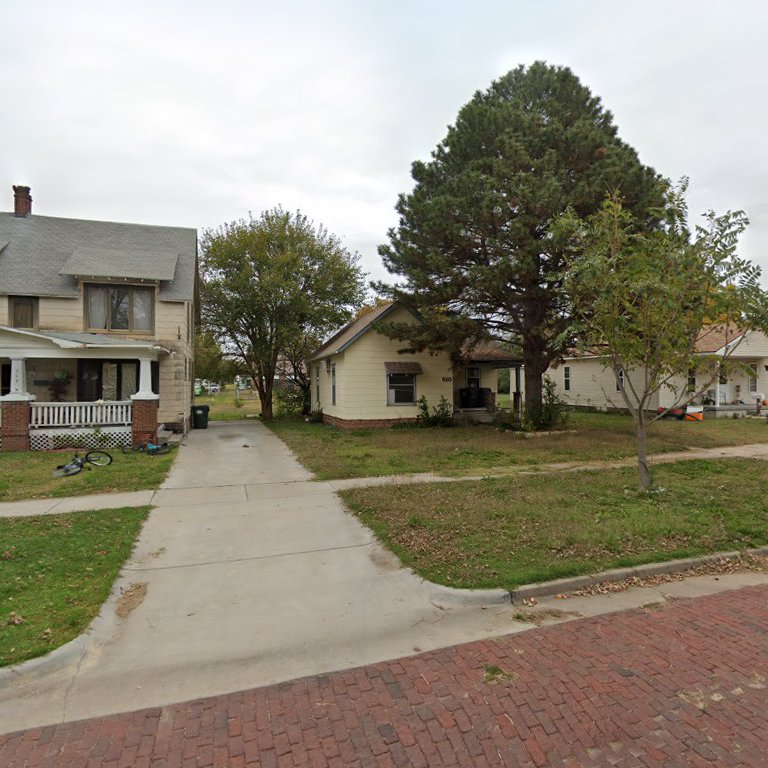
Even smaller than I remember, 688 square feet. The yard was in much better shape when I owned it. The large pine tree was a live Christmas tree I planted spring after our first year there. I paid five dollars and it was no more than five feet tall.
I'm familiar with what Johannes is referring to and it is a real gut punch when you see the breakdown spread over the life of the loan. Rather than try to explain it in my bumbling manner, I will quote from the Consumer Federal Protection Bureau's website:
"With a typical fixed-rate loan, the combined principal and interest payment will not change over the life of your loan, but the amounts that go to principal rather than interest will. Here’s how it works: In the beginning, you owe more interest, because your loan balance is still high. So most of your monthly payment goes to pay the interest, and a little bit goes to paying off the principal. Over time, as you pay down the principal, you owe less interest each month, because your loan balance is lower. So, more of your monthly payment goes to paying down the principal. Near the end of the loan, you owe much less interest, and most of your payment goes to pay off the last of the principal. This process is known as amortization."
Oh amortization. Maybe it is me? How else do typical loans work? An auto loan works the same way. Now a balloon loan, or interest, only, or some other variation, yes. The point remains that high interest is driving how little principal is being paid off.
My first home was in 1979 with a note of 11.99%. However, the house was purchased for $14,500, and the payment was $175 a month. It was a small house, one bedroom, single car garage, about 850 square feet. At that time my wife and I never paid more than $200 to rent an apartment. The note was 20 year fixed. Rented it most of the years until paid off.
So, the strategy is, to make extra payments. But as I understand it, the borrower needs to make it clear that the extra payments are "to go towards principal", not just paying the next mortgage payment early (which would effectively put that extra payment toward principal and interest as per the repayment schedule).
I will admit, that when you see the repayment schedule and how loaded it is towards repayment of interest first (with little going towards the principal), it seems that it has been structured to take advantage of the borrower. Only upon reading the rational given (above) by the CFPB did I understand the real mechanics of it.
Even smaller than I remember, 688 square feet. The yard was in much better shape when I owned it. The large pine tree was a live Christmas tree I planted spring after our first year there. I paid five dollars and it was no more than five feet tall.
Even smaller than I remember, 688 square feet. The yard was in much better shape when I owned it. The large pine tree was a live Christmas tree I planted spring after our first year there. I paid five dollars and it was no more than five feet tall.
Brick. Hoisington was a railroad town for workers into early years of 20th century. My wife worked weekends at a dinner club, while finishing her degree week days. She had a uniform of short skirt and higher heeled flats. Disco ball and all at the club. One night her car broke down, on the edge of town, took the shoes off ran home barefoot in stockings.
This post was edited 3 minutes after it was posted.
In Kansas at that time they had very strict drinking laws. At this club, Kennedy’s Claim, you brought in your own bottle of hard liquor. They would keep it there, and mix the drink for you. Here is a funny remembrance from 2019, somethings haven’t changed:
“Kennedy's Claim is the name of a comparatively new private club in Great Bend. Two members that I know of are a Republican Holyrood couple, which dispelled my idea that possibly one had to be a Democrat to belong.”
This post was edited 1 minute after it was posted.
Quick lesson on “simple” debt financing, recognizing that loans can be structured in less simple form.
When you borrow a certain amount at a certain interest rate, you pay off the loan over time by paying down the principal (the amount owed before you add interest). Each payment will include interest, calculated based in the agreed interest rate and the principal at the time of the payment. The rest of the payment goes to reducing the principal. When the principal reaches zero, the loan is paid off.
The time it takes to pay down the loan - commonly called the amortization period - depends, generally, on the amount borrowed, interest rate and size of payment. In order to amortize a $300k mortgage at 5% over 25 years instead of 30 years, you would pay $1745 monthly versus $1601, for example. You could be much more aggressive and pay it down in 10 years at about $3174 monthly. In choosing a long amortization period, one is deliberately deciding to pay mostly interest in the early years of the loan. This is not the bank scheming o cheat you, this is the bank letting you owe them money for a long time. With the understanding that you pay interest on the amount you owe.
There are more complicated payment schedules that might tweak the balance between interest and principal at each payment, and variable interest rates add another level of complexity I won’t address.
Igy’s original point, challenged by Johannes, was that the days of cheap money are gone for now. Many on this thread haven’t experienced high interest rates. Some of us have, and understand the pressure this will put on a lot of people. While I don’t share Igy’s alarmist sentiment about imminent crash around the corner, I do believe there are strong headwinds that will affect rate sensitive market sectors.
The house I currently live in I could not afford at current market prices, and certainly not at the current mortgage rates. If current mortgage rates last for any length of time, I would assume prices will come down, or construction will be of much smaller homes. My wife and I grew up in homes that average around 1200 square feet, which was typical in the 1950s. Her home had one bathroom for five people. That was similar to our house up to age ten.
The house I currently live in I could not afford at current market prices, and certainly not at the current mortgage rates. If current mortgage rates last for any length of time, I would assume prices will come down, or construction will be of much smaller homes. My wife and I grew up in homes that average around 1200 square feet, which was typical in the 1950s. Her home had one bathroom for five people. That was similar to our house up to age ten.
Got a modest house in a neighborhood and area we wanted to live in many years ago, fixed it up and maintained it with all my own labor, and saved and invested rather than buying more house than we needed. Now we not only have a house we love and cherish, we have resources derived from taking care of what we have been lucky enough to acquire, which would allow us to buy up if we chose. But why buy into that trap?
On average, AutoNews reports that 3.58 percent of 18 to 29-year-olds and 2.62 percent of 30- to 39-year-olds have been late on their auto loans by at least 90 days. For some context, just 2.13 percent of all borrowers are late. Keep in mind, these numbers are overall. In the first quarter of 2023, 4.55 percent of 18- to 29-year-olds were at least 90 days late. 3.66 percent of 30- to 39-year-olds were equally late. We haven’t seen numbers like these since The Great Recession.
Probably few of us will be interested to read all this, but it's a long tweetstorm from bill ackman a year ago on his guesses about inflation and interest rates. Lots to work with so hard to evaluate. I find ackman annoying - he clearly thinks he is brilliant but his writing and ideas are junior grade.
Anyway.
Ackman's ideas from a year ago:
Fed would keep rates higher than most think: Correct
The curve indicates recession: No recession
Fed is forever burned by 70s experience of cutting rates too soon so they will keep rates higher for longer: Correct
In response to today’s CPI print which showed broad-based and accelerating inflation, short-term FF futures moved upward implying peak FF of 3.68% by 12/22 with the @federalreserve immediately thereafter cutting rates to reach 2.9% by 1/24. Implicitly the market expects a more
Help us build the best running shoe review site for a chance to win a LetsRun t-shirt.Help us build the best running shoe review site for a chance to win one of 10 LetsRun t-shirts.