this thread irritates me because people are acting like running is more complicated or talent-based than it actually is. it's a simple sport - if you run more you will get faster, at a recreational level.
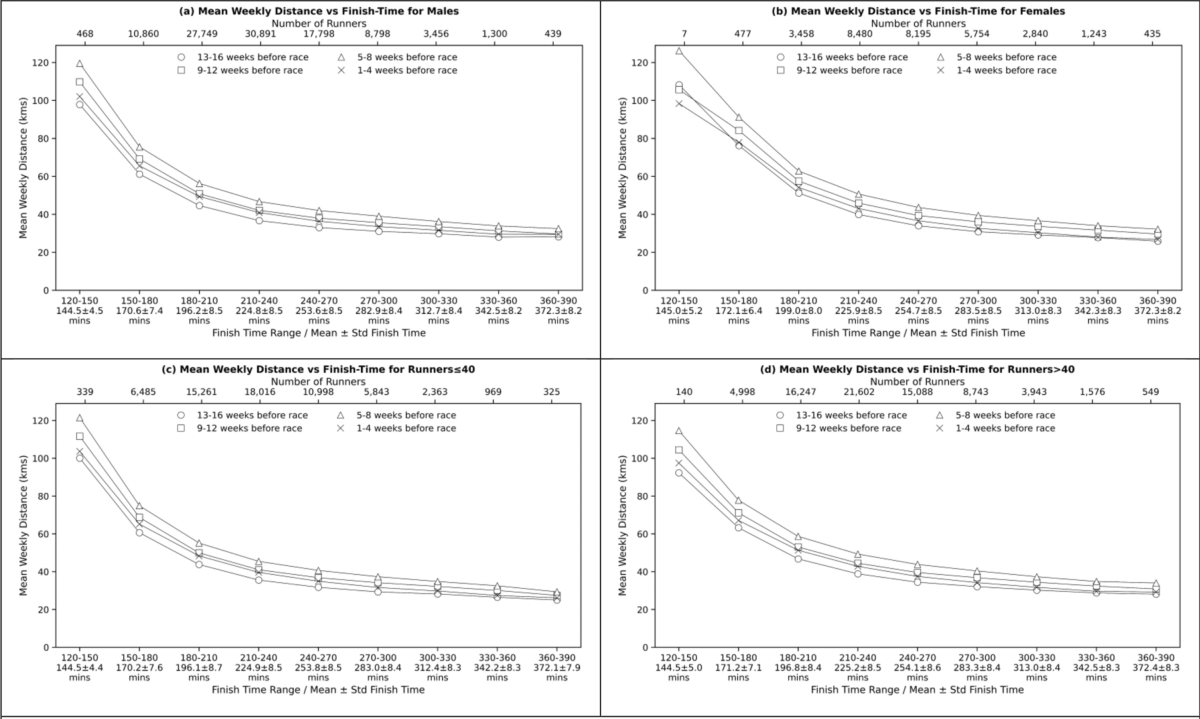
the typical 3-hour runner averages roughly 75-80k per week in the 16 weeks before a marathon. that that is a fact. look at the chart above based on thousands of data points.
there is a bit of a plateau around 3 hours, but there is also the fact if you are running a lot more than that, you are a lot more likely to be going faster than 3 hours, that is also a fact.
you can call me an idiot, a clown, thick-headed all you want, but running is a simple sport and if people ran more, they'd run faster.
this is from the paper i mentioned earlier, and it has as good data as there has ever existed for marathon runners.
4.1 Training volume as a hallmark of marathon running
The analysis of training characteristics in this large sample of marathon runners revealed
differences in the training characteristics between runners with different finishing
times.
A key finding was that the best runners within the dataset, those with
marathon times of 120-150 min, accumulated a training volume of ~107 km·week-1,
which was ~60% higher than the training volume of runners within the next
performance group (marathon times of 150-180 min), and over three-fold higher
than those with slow marathon times (e.g., marathon time of >270 min; Figure
1, Figure 2, Figure 3).
Furthermore, there were strong, negative relationships
between marathon finishing time and markers of training volume, such as total
training distance, training time, or active days (Figure 5). The regression
analyses demonstrated that markers of training volume, including total running distance,
number of active days, or distance covered in long runs were typical features
of runners with fast marathon times.
The finding that marathon performance in a
large heterogenous group of runners is strongly associated with a high training
volume is consistent with previous literature from elite marathon runners. For
example, up to 59% of world class long distance running performance can be
predicted by total volume of training [30], and very high training volumes of 160-220
km·week-1 have been reported in elite marathon runners [18].
The current study suggests that training
volume is also a key determinant of marathon performance in recreational
runners. Combined with previous studies, these data suggest that high training
volume is a hallmark of successful marathon performance.