By all accounts, DK was to the gills...
Komen is still better than Jakob
Pro News/Info/Results
-
20
-
100 percent, does anyone wonder why Kenyans fell in the track distances
11 -
Salvitore Stitchmo wrote:
Redonculous Maximus wrote:
LOL. very naive.
Really - you want to have a discussion on track and field spikes? Why don't you tell me what you think you know.
LOL I don’t care who the F you think you are. You claim the spikes have little or no impact in the middle distances, you’re a fool and you’re drinking your own Koolaid. Go back to your mom’s basement you flat earther.
I love watching Jakob and I am rooting for him. But to claim that it’s just the pacing lights is truly idiotic.
LOL
55 -
Gfhjnb wrote:
Billy123 wrote:
This^
Komen raced during the most juiced period of distance running, when there was no good test of EPO, so any record during that time is suspect. You should view any record from then as worthy of doubt. He had a short career, didn’t even compete in the Olympics, and overall accomplished less than Jakob has thus far.We’re all witnessing the most juiced period of distance running. You think people are running 7:17 on good ol’ fashioned gumption and moxie? LRC “Komen ran 3000m WR during the height of EPO *wink” also LRC “All hail the new clean WR holder!” Nothing to see here.
I think what we’re witnessing here is:
1 Super spike
2 Wavelights
3 Better/lighter/softer training shoes to minimise injury and allow for more training
4 AlSal likely paved the way for a more ‘scientific approach’ to getting closer to the line without crossing it - i.e., grey area PEDs
All these factors combined are probably offsetting the impact of more aggressive testing - i.e., less full-throttle EPO.
Without these, Jakob doesn’t go sub 7:20. Same for all these other performers: Kipyegon, Hull, Hocker, Kerr, Sedjati, Hodgkinson, Mu, etc., etc. Honestly, I’m all for it (including number 4). It’s more entertaining. But let’s just not be fools.
92 -
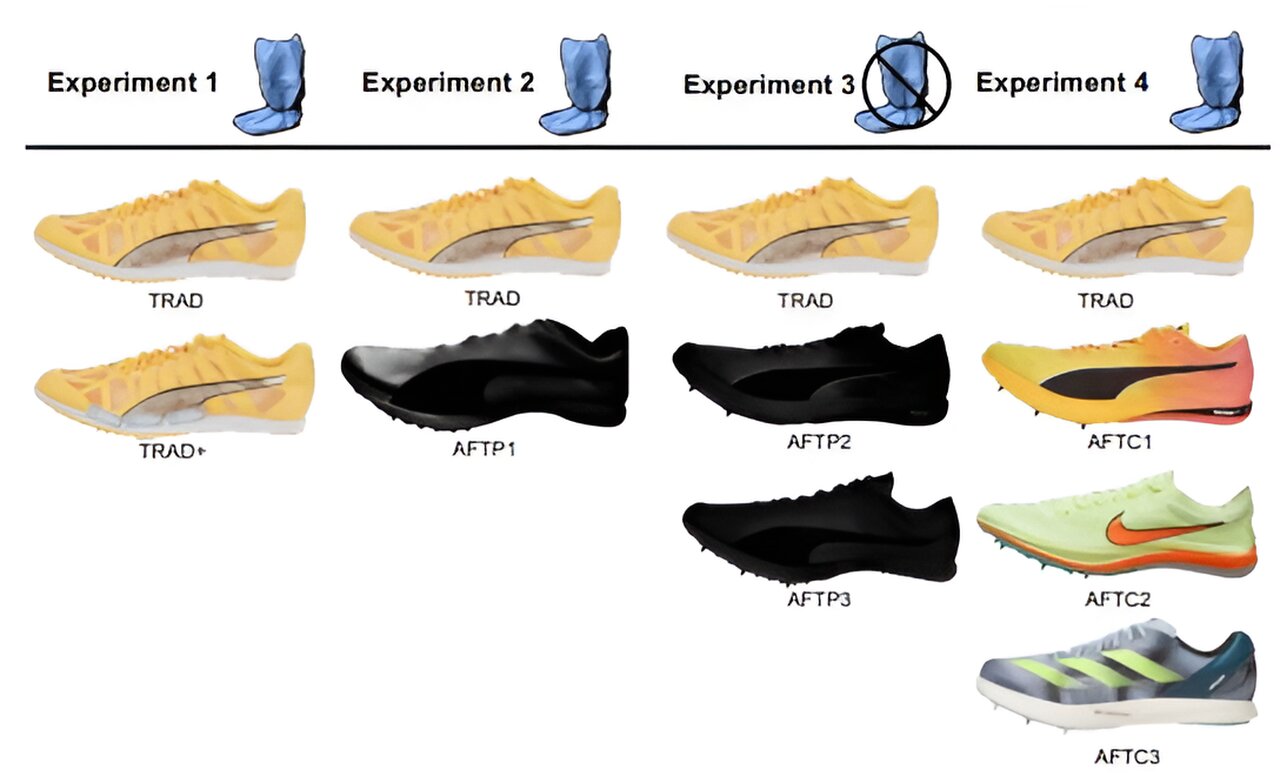
If Ingebrigtsen and Komen had been running in identical weather conditions, with identical shoes, on identical tracks, with identical pacing, who would have produced a better performance? We can only guess. But for those who are skeptical of the influence that the track spike technology introduced in 2019 (following on distance shoe technological revolutions introduced in 2016), there have been several studies that have attempted to investigate the effects of new track spike technology (especially the carbon fiber plates) on performance.
Research report #1 can be found here:
. This is a report of a "preprint" (i.e., pre-publication) of studies carried out in three labs in Spain, the U.S., and Canada.)Research report #2 is here:
https://www.researchgate.net/publication/373373930_Advanced_spike_technology_enhances_sprinting_speed
August 27, 2023, This report comes from researchers in Cologne, GermanyResearch report #3 is here:
This is the newest report, coming out just before the Olympics, on July 29, 2024. It is from the University of Massachusetts, Amherst.All of the above investigations demonstrated that the effect of the superspikes on performance is real, but quantifying it remains challenging, especially because effects vary from one name brand to the next and from one athlete to the next.
The following is not a research paper but rather a summary article that explains some of the reasons for why superspikes do indeed improve performances.
Did Ingebrigtsen run faster for the 3000 meters this past weekend than he would have wearing pre-2019 track spikes? All the research points to an answer of "yes." The mystery, however, is the question of "How much faster?"
00 -
i do it for you
00 -
Track Fan Fan wrote:
If Ingebrigtsen and Komen had been running in identical weather conditions, with identical shoes, on identical tracks, with identical pacing, who would have produced a better performance? We can only guess. But for those who are skeptical of the influence that the track spike technology introduced in 2019 (following on distance shoe technological revolutions introduced in 2016), there have been several studies that have attempted to investigate the effects of new track spike technology (especially the carbon fiber plates) on performance.
Research report #1 can be found here:
. This is a report of a "preprint" (i.e., pre-publication) of studies carried out in three labs in Spain, the U.S., and Canada.)Research report #2 is here:August 27, 2023, This report comes from researchers in Cologne, Germany
Research report #3 is here:
This is the newest report, coming out just before the Olympics, on July 29, 2024. It is from the University of Massachusetts, Amherst.All of the above investigations demonstrated that the effect of the superspikes on performance is real, but quantifying it remains challenging, especially because effects vary from one name brand to the next and from one athlete to the next.
The following is not a research paper but rather a summary article that explains some of the reasons for why superspikes do indeed improve performances.
Did Ingebrigtsen run faster for the 3000 meters this past weekend than he would have wearing pre-2019 track spikes? All the research points to an answer of "yes." The mystery, however, is the question of "How much faster?"
About 6 seconds faster,minimum.
00 -
come on, dude aint even black man
00 -
was epo even that easy to get by those days
00

What People Are Talking About On LetsRun
No top threads at the moment. Check back soon.