An Unreliable Website and a Dubious Comparison
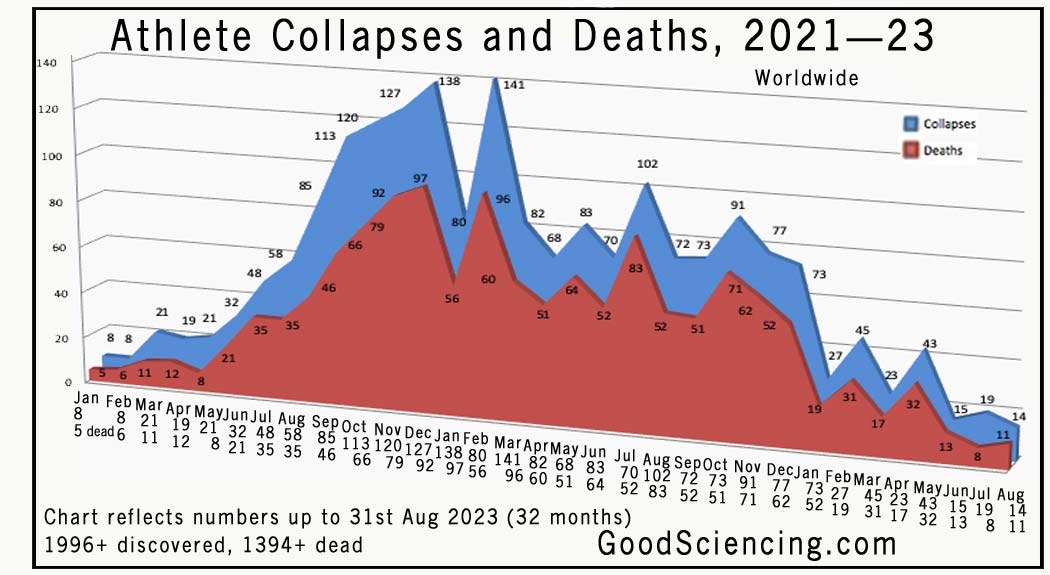
As we said, an anonymous website called Good Sciencing is one of the primary sources used to make the claim about a surge in sudden deaths among athletes. The site retains the same problems we identified when we first wrote about it soon after it showed up online in late 2021. Regardless, its use by anti-vaccine activists has continued to spread. Now it’s the source of the information in the letter to the editor cited by both Wheeler and Gold.This recent version of the claim compares the number of athletes listed on the website with numbers compiled in an unrelated 2006 paper, which sought to develop a system to screen athletes for heart problems in order to reduce the number of sudden cardiac deaths in sports.
In the Gold and Wheeler tweets, a highlighted portion of McCullough’s letter to the editor says that 1,101 athletes have died since January 2021, citing the Good Sciencing list. The letter then cites the 2006 study to say that the same number had died in the 38-year period covered by the paper. Gold and Wheeler emphasized the part equating that to about 29 deaths per year, implying there had been 1,101 athlete deaths in the previous year compared with an average of 29 athlete deaths per year before the COVID-19 vaccines were introduced.
But, as we said, the Good Sciencing list and the 2006 paper use different criteria for age, athletic affiliation, cause of death and the sources used to record the deaths.
The Good Sciencing website counts deaths from any cause for all ages among those who were listed in media reports to have some association with sports, including professional athletes, hikers, retirees and coaches.
The 2006 paper counted sudden cardiac deaths among athletes younger than 35 years old that had appeared in English-language academic literature in a 38-year period starting in 1966.
So, comparing those numbers doesn’t mean much, since they’re measuring different things.
There is also an important difference in the sources used to record the number of deaths. Because the 2006 paper drew only from deaths reported in academic literature, the total number is limited. The paper itself notes that its “most important limitation” is that sudden cardiac death in young athletes “as reported in the published and studied papers is certainly underestimated.”
It goes on to say that “the lack of national or international registers and the uncertainty of the number of athletes involved forms the basis of this problem.”
We found the same problem in reporting on this issue, too. The only functioning repository collecting information on athlete deaths in all sports that we could find in the U.S. was the National Center for Catastrophic Sport Injury Research.
The Minneapolis Heart Institute had once run the U.S. National Registry of Sudden Death in Athletes, but it’s no longer maintaining the registry, the institute’s Dr. Kevin Harris told us in a phone interview.
While it was still functioning, that registry was used in a 2009 paper that assessed the incidence of sudden death in U.S. athletes who were 39 and younger. It found that the most common cause of death was “due to underlying (and predominantly unsuspected) cardiovascular disease,” which accounted for more than half of cases, but other causes included blunt trauma and heat stroke. Most of those cardiovascular deaths — 93% — were among athletes who were 25 or younger and the total number of those deaths each year was under 100.
“We spent a lot of time tabulating death rates in young athletes,” Dr. Barry Maron, the lead author of the paper, told us in a phone interview.
If there were a significant increase, “we’d know about it,” Maron said. “Kids would be dropping left and right. There hasn’t been that kind of increase.”
As we said, the Good Sciencing list is based on a broad definition of what constitutes the sudden death of an athlete and includes people with a tenuous relationship to sports and people who died of things like cancer and bacterial meningitis.
“How do you rebut something like that?” Maron said. “It’s like they make up the numbers.”