Anyone here consider that women might be interested in reading Kara’s book?
-
83
-
There's nothing interesting about successful runners, their training, or anything like that. Great, you run fast. No one cares.
What is interesting is their life story. If they come from stable families, go to good universities, become pros, win things, and retire I just don't care enough to read about them.
If they suffer abuse, we're part of a usive teams like anything Salazar, orhad interesting lives outside of running like Zátopek it is interesting.
56 -
samcallan wrote:
Kara Goucher has a book coming out. I have met Kara a couple of times. Seems nice enough. Her accomplishments are certainly impressive.
At the same time, nothing of what I know about her (or almost any other elite runner) would compel me to buy a biography on any of them. Aside from her medals she is mostly known for being part of the Salazar scandal. A scandal that is pretty well documented already.
In thinking on this, I was trying to think of the runners whose lives I think are interesting enough to warrant a book. I came up with Roger Bannister, Billy Mills, and Louie Zamperini. I have had the great luck to have met all three although I cannot say I spent a ton of time with any. Bannister is interesting in part because he was the first to do something, but to me it was what he did after and even the idea of being in medical school (and doing some research that interests me while there) is part of the appeal. I will say Perfect Mile to me is a great read but I also did not see enough about Santee or Landy to warrant a book just about as individuals.)
Mills gets in for his being a Native American. I almost added Jim Thorpe, but I do not think of his as a "runner". Track athlete yes (and the greatest American athlete of the 20th century in my book).
Zamperini---my fondness for him cannot be measured. But my interest in him is more because of his experience in WW2 and also the life he led after more than his track accomplishments. If WW2 never happens and Zamperini goes on to win a lot of medals and maybe set some WRs, I don't think I would be interested in an entire book on him.
Again, I enjoy reading about runners. A chapter in a book or a long form article about an individual runner, but a book? Not many are going to reach that threshold for me.
As soon as I hit "Create thread" I will probably think of another runner or two who might fit the bill for me.
Anyone come to mind for you? And this needs to be someone well known and regarded as a runner, not a well known person who runs.
Lopez Lomong's autobiography is great!
50 -
Maybe2 wrote:
Anyone here consider that women might be interested in reading Kara’s book?
I’m a woman and I have NO interest in reading Kara’s book or Fleshman’s dreck. Deena Kastor’s was pointless too. I really liked Bill Rodger’s Marathon Man though.
510 -
Hahahahahano wrote:
Maybe2 wrote:
Anyone here consider that women might be interested in reading Kara’s book?
I’m a woman and I have NO interest in reading Kara’s book or Fleshman’s dreck. Deena Kastor’s was pointless too. I really liked Bill Rodger’s Marathon Man though.
I read Fleshman's book and thought it was quite interesting. The divorce news clarified a feeling I was getting from the last part of the book.
I recommend Lorraine Moller's memoir if you can find it.
50 -
I tend to like reading the biographies of distance runners from the 70s and 80s, just to get a better understanding of their training.
BTW - it seems like your main criterion (along with a number of others on this thread) for warranting a running biography, is if the subject has some left-wing grievance angle to milk. Haven't people had enough of that sh*t already?
55 -
bduwushshsg wrote:
There's nothing interesting about successful runners, their training, or anything like that. Great, you run fast. No one cares.
What is interesting is their life story. If they come from stable families, go to good universities, become pros, win things, and retire I just don't care enough to read about them.
If they suffer abuse, we're part of a usive teams like anything Salazar, orhad interesting lives outside of running like Zátopek it is interesting.
I'd be interested reading about Beardsley. He's had his struggles. I respect that.
There are runners in the influencer community that are fast but their lives have been an upward trajectory with no setbacks--it happens. See the quote about stable families and education above!
00 -
nofanks wrote:
samcallan wrote:
Kara Goucher has a book coming out. I have met Kara a couple of times. Seems nice enough. Her accomplishments are certainly impressive.
At the same time, nothing of what I know about her (or almost any other elite runner) would compel me to buy a biography on any of them. Aside from her medals she is mostly known for being part of the Salazar scandal. A scandal that is pretty well documented already.
In thinking on this, I was trying to think of the runners whose lives I think are interesting enough to warrant a book. I came up with Roger Bannister, Billy Mills, and Louie Zamperini. I have had the great luck to have met all three although I cannot say I spent a ton of time with any. Bannister is interesting in part because he was the first to do something, but to me it was what he did after and even the idea of being in medical school (and doing some research that interests me while there) is part of the appeal. I will say Perfect Mile to me is a great read but I also did not see enough about Santee or Landy to warrant a book just about as individuals.)
Mills gets in for his being a Native American. I almost added Jim Thorpe, but I do not think of his as a "runner". Track athlete yes (and the greatest American athlete of the 20th century in my book).
Zamperini---my fondness for him cannot be measured. But my interest in him is more because of his experience in WW2 and also the life he led after more than his track accomplishments. If WW2 never happens and Zamperini goes on to win a lot of medals and maybe set some WRs, I don't think I would be interested in an entire book on him.
Again, I enjoy reading about runners. A chapter in a book or a long form article about an individual runner, but a book? Not many are going to reach that threshold for me.
As soon as I hit "Create thread" I will probably think of another runner or two who might fit the bill for me.
Anyone come to mind for you? And this needs to be someone well known and regarded as a runner, not a well known person who runs.
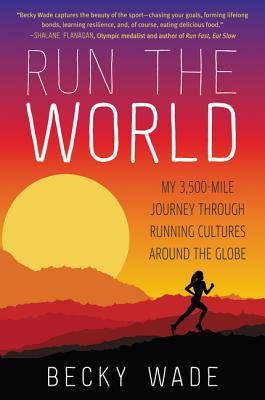
A tell all, like what drugs they were using, would get me to buy KG's bio. You are right though that sporting bios can be a bit boring. Duel in the Sun about Beardsley and Salazar was interesting. The most boring bio I have read was titled Run the World, and was Becky Wade's story of spending a year travelling and running moderate to low mileage while doing nothing really interesting (just basking in being a moderately wealthy white girl who happens to run) basically. Imagine if your typical instagram blogger ran 60 miles a week.
I read the premise on Amazon and it looked interesting (Run the World). But if she's had it easy her whole life, it would be hard to read it and not have that in the back of my mind. Goodreads reviewers are more critical than Amazon reviewers and you get a fuller sense of how the book is.
She's a good writer though, and based on the preview, has technical writing ability.
10 -
nofanks wrote:
samcallan wrote:
Kara Goucher has a book coming out. I have met Kara a couple of times. Seems nice enough. Her accomplishments are certainly impressive.
At the same time, nothing of what I know about her (or almost any other elite runner) would compel me to buy a biography on any of them. Aside from her medals she is mostly known for being part of the Salazar scandal. A scandal that is pretty well documented already.
In thinking on this, I was trying to think of the runners whose lives I think are interesting enough to warrant a book. I came up with Roger Bannister, Billy Mills, and Louie Zamperini. I have had the great luck to have met all three although I cannot say I spent a ton of time with any. Bannister is interesting in part because he was the first to do something, but to me it was what he did after and even the idea of being in medical school (and doing some research that interests me while there) is part of the appeal. I will say Perfect Mile to me is a great read but I also did not see enough about Santee or Landy to warrant a book just about as individuals.)
Mills gets in for his being a Native American. I almost added Jim Thorpe, but I do not think of his as a "runner". Track athlete yes (and the greatest American athlete of the 20th century in my book).
Zamperini---my fondness for him cannot be measured. But my interest in him is more because of his experience in WW2 and also the life he led after more than his track accomplishments. If WW2 never happens and Zamperini goes on to win a lot of medals and maybe set some WRs, I don't think I would be interested in an entire book on him.
Again, I enjoy reading about runners. A chapter in a book or a long form article about an individual runner, but a book? Not many are going to reach that threshold for me.
As soon as I hit "Create thread" I will probably think of another runner or two who might fit the bill for me.
Anyone come to mind for you? And this needs to be someone well known and regarded as a runner, not a well known person who runs.
A tell all, like what drugs they were using, would get me to buy KG's bio. You are right though that sporting bios can be a bit boring. Duel in the Sun about Beardsley and Salazar was interesting. The most boring bio I have read was titled Run the World, and was Becky Wade's story of spending a year travelling and running moderate to low mileage while doing nothing really interesting (just basking in being a moderately wealthy white girl who happens to run) basically. Imagine if your typical instagram blogger ran 60 miles a week.
That's a good point about wealth and privilege--some take it for granted. That said, she was a 2:30 marathoner at CIM and VERY fast. Could have been an American great with the right timing...
02 -
I can't help but notice that most of the posters think the male authors have stories worth telling, but the female authors don't.
71 -
welp... wrote:
I can't help but notice that most of the posters think the male authors have stories worth telling, but the female authors don't.
So? That's just because the authors made the choice in believing their own story was worth telling.. Some are, some are not. That's just the way it is.
23 -
Paige Turner wrote:
Five autobiographies of note from my collection.
Edwards, Harry The Struggle That Must Be: An Autobiography
Read this book in conjunction with Track in the Forest (previously mentioned) and The Last Protest: Lee Evans in Mexico City by Frank Murphy for a better understanding of the 1968 turbulence.Johnson, Rafer The Best that I Can Be
The man is a legend, but I finished his autobiography thinking he could have been a superhero.Kastor, Denna Let Your Mind Run: A Memoir of Thinking My Way to Victory
Read this alongside Coach Vigil’s biography mentioned above as they have interlocking episodes.Lomong, Lopez Running for My Life
Incredibly sad story of the plight of refugees. Read it together with John Brant’s similar biography of Julius Achon, The Boy Who Runs.Snell, Peter No Bugles No Drums
Lydiard fans appreciate this work.Switzer, Kathrine Marathon Woman
Avoid this work of self-promotion.Trying to find a affordable copy of "No Bugles No Drums" is impossible.
10 -
pretzel man wrote:
Paige Turner wrote:
Five autobiographies of note from my collection.
Edwards, Harry The Struggle That Must Be: An Autobiography
Read this book in conjunction with Track in the Forest (previously mentioned) and The Last Protest: Lee Evans in Mexico City by Frank Murphy for a better understanding of the 1968 turbulence.Johnson, Rafer The Best that I Can Be
The man is a legend, but I finished his autobiography thinking he could have been a superhero.Kastor, Denna Let Your Mind Run: A Memoir of Thinking My Way to Victory
Read this alongside Coach Vigil’s biography mentioned above as they have interlocking episodes.Lomong, Lopez Running for My Life
Incredibly sad story of the plight of refugees. Read it together with John Brant’s similar biography of Julius Achon, The Boy Who Runs.Snell, Peter No Bugles No Drums
Lydiard fans appreciate this work.Switzer, Kathrine Marathon Woman
Avoid this work of self-promotion.Trying to find a affordable copy of "No Bugles No Drums" is impossible.
There are some biographies that are really hard to find and expensive when they do hit the secondary market. Some that come to mind:
No Bugles, No Drums
A Clean Pair of Heels (Murray Halberg)
The Unforgiving Minute (Ron Clarke)
Running Wild (Gordon Pirie)
The Four Minute Mile (hardcover, UK printing?)
00 -
OP can't think of a woman with an interesting enough life to warrant writing an autobiography. Welcome to LRC.
94 -
Don Juan wrote:
David Goggins has a new book out right now. It’s basically part of the SHAM( self help and actualization) movement.
Goggins is a grifter. Basically a braggart who tries to convince people how “hard” he is.
21 -
welp... wrote:
I can't help but notice that most of the posters think the male authors have stories worth telling, but the female authors don't.
I would argue, that up until the 1980s, most women distance runners had a tougher road to navigate to become top athletes. Until 1984, the longest distance in the Olympics for them 3000m, and that trickled down to the NCAA and high school level. Many a story of HS girls running with the boys' team because they didn't have a girls' squad. Early reasons were; it was not ladylike to run, women's uterus can fall out, etc. All prevented talented girls from pursuing a 'pro' career.
An early pioneer was Dr Joan Ullyot (book - Women's Running), who pioneered to add the marathon to the Olympics. Although there might not be as many bio's on women running, Amby Burfoot has 'First Ladies of Running', and 'The Silence of Great Distance', Frank Murphy, which has chapters on many groundbreaking women runners.
40 -
So would Hiltz write 2 or 3 books?
54 -
welp... wrote:
I can't help but notice that most of the posters think the male authors have stories worth telling, but the female authors don't.
I'd be interested in reading about Kara, no sarcasm. She was adopted early on, and as an adoptee myself, I would relate. Lauren also seems interesting.
I'd read a book about Edna Kiplagat too or Joanie--those women have great stories to tell. Like how Joanie got ready for the '84 Oly gold race in LA and how that cemented her legacy.
50 -
samcallan wrote:
Kara Goucher has a book coming out. I have met Kara a couple of times. Seems nice enough. Her accomplishments are certainly impressive.
At the same time, nothing of what I know about her (or almost any other elite runner) would compel me to buy a biography on any of them. Aside from her medals she is mostly known for being part of the Salazar scandal. A scandal that is pretty well documented already.
In thinking on this, I was trying to think of the runners whose lives I think are interesting enough to warrant a book. I came up with Roger Bannister, Billy Mills, and Louie Zamperini. I have had the great luck to have met all three although I cannot say I spent a ton of time with any. Bannister is interesting in part because he was the first to do something, but to me it was what he did after and even the idea of being in medical school (and doing some research that interests me while there) is part of the appeal. I will say Perfect Mile to me is a great read but I also did not see enough about Santee or Landy to warrant a book just about as individuals.)
Mills gets in for his being a Native American. I almost added Jim Thorpe, but I do not think of his as a "runner". Track athlete yes (and the greatest American athlete of the 20th century in my book).
Zamperini---my fondness for him cannot be measured. But my interest in him is more because of his experience in WW2 and also the life he led after more than his track accomplishments. If WW2 never happens and Zamperini goes on to win a lot of medals and maybe set some WRs, I don't think I would be interested in an entire book on him.
Again, I enjoy reading about runners. A chapter in a book or a long form article about an individual runner, but a book? Not many are going to reach that threshold for me.
As soon as I hit "Create thread" I will probably think of another runner or two who might fit the bill for me.
Anyone come to mind for you? And this needs to be someone well known and regarded as a runner, not a well known person who runs.
I agree and disagree.
I have read a crazy number of running biographies and autobiographies. Most are worthwhile reads even if the author's writing style is not that great (this applies mostly to self-published, non-ghost written autobiographies) because in many cases it gives a view into the state of running at a certain point in time.
As for Kara, as the OP says, she seems nice enough. However, she and her "Go Girl" followers are the only people that don't give credit to Salazar and his grey area methods for her successful (but far short of iconic) running career.
21 -
I’d like to see Hiltz write one - it’s so empowering to see they win the US female indoor championships even though they isn’t a womxn
05
What People Are Talking About On LetsRun
No top threads at the moment. Check back soon.