because he was a freak !!! National x country champion and according to sprint coach i spoke to from N.Z Snell could have won the National 200 M title if he chose to . What we will never know is whether or not he would have thrived even more under a different coach. Watch his explosive kick in the 1964 1500 M ... now thats a change of gear that we have rarely seen since (Steve Ovett could do It)
Snell is a bit weird in that he didn’t really start training til 18. But you look at his 1:54 or so before meeting Lydiard and it is crazy how fast some people are with almost zero training.
He excelled at a number of sports in his schooldays and was apparently already an outstanding tennis player. Running came quite late. Halberg said Snell's giftedness was such he would have been great at anything he turned to.
Doping was unknown in md and distance running then. There were no drugs known then to increase endurance. Blood doping didn't appear till the '70's. The '50's and early '60's were still the era of amateur sport. Little more than a glorified hobby. It was, in many ways, a more naive era. I remember it. I grew up in it.
You're still naïve. And your drug obsession poisons every one of the innumerable threads you post on.
Those are great recollections and interesting insights. Snell exemplified Lydiard's thinking that beyond a necessary given level of speed - which Snell had - endurance was crucial even for an 800 runner. It was that that enabled Snell to beat faster runners - and better survive gruelling rounds of competition in the Olympics. For those who had the privilege of either seeing him race or watching the movietone reports of Tokyo or his races in the US in '63, an abiding memory is of an explosive power that destroyed his competitors at the close of a race. There's never been anything that quite rivalled seeing his black singlet leave a field of internationals standing.
Doping was unknown in md and distance running then. There were no drugs known then to increase endurance. Blood doping didn't appear till the '70's. The '50's and early '60's were still the era of amateur sport. Little more than a glorified hobby. It was, in many ways, a more naive era. I remember it. I grew up in it.
You're still naïve. And your drug obsession poisons every one of the innumerable threads you post on.
You obviously have failed to see how the world has changed in more than half a century. The "drug obsession" is with those who use it - whose numbers you couldn't count - and not those who identify it.
Because it was going to be a world record attempt - on 2 records in the same race - the track had to be measured beforehand to ensure it was accurate. So - no.
Look at how it was all periodized, the science still holds up
Not really. Lydiard's periodization shifted between wild extremes. Nobody in the world trains even remotely that way today. Modern training is actually far LESS periodized, with a little bit of everything, almost all year long, but shifts in primary emphasis. There are several big benefits to this approach:
1) You can run pretty fast races almost any month of the year. Obviously this matters more now, with more opportunities to make a living at running and easy, fast transport to the far corners of the globe. But even in Lydiard's time, Halberg would complain that he was running on fumes by the end of a tour and that he needed to get back to marathon training to rebuild.
2) Better improvement from year to year. If you never get too far away from any kind of training, then you can maintain what you've built. While certain types of training might be deemphasized for periods of time, you're still doing enough to maintain what you built.
3) Less injury risk. Extreme shifts in emphasis mean that the body is periodically being shocked with fairly novel stimuli that it's not ready for.
You're still naïve. And your drug obsession poisons every one of the innumerable threads you post on.
You obviously have failed to see how the world has changed in more than half a century. The "drug obsession" is with those who use it - whose numbers you couldn't count - and not those who identify it.
But you're constantly glorifying drugs whilst pretending to be anti doping.
Look at how it was all periodized, the science still holds up
Not really. Lydiard's periodization shifted between wild extremes. Nobody in the world trains even remotely that way today. Modern training is actually far LESS periodized, with a little bit of everything, almost all year long, but shifts in primary emphasis. There are several big benefits to this approach:
1) You can run pretty fast races almost any month of the year. Obviously this matters more now, with more opportunities to make a living at running and easy, fast transport to the far corners of the globe. But even in Lydiard's time, Halberg would complain that he was running on fumes by the end of a tour and that he needed to get back to marathon training to rebuild.
2) Better improvement from year to year. If you never get too far away from any kind of training, then you can maintain what you've built. While certain types of training might be deemphasized for periods of time, you're still doing enough to maintain what you built.
3) Less injury risk. Extreme shifts in emphasis mean that the body is periodically being shocked with fairly novel stimuli that it's not ready for.
So who is going to repeat Snell's Olympic 800/1500 Golds in the 21st Century?
You're still naïve. And your drug obsession poisons every one of the innumerable threads you post on.
You obviously have failed to see how the world has changed in more than half a century. The "drug obsession" is with those who use it - whose numbers you couldn't count - and not those who identify it.
I’m not discounting the fact that drugs, micro dosing and such, have invaded the sport. Or even just grey zone supplements like thyroid medication (though if hard, prolonged distance running depresses the thyroid, it could be argued TUEs are merely normalizing function, kind of like iron storage).
But I think you underestimate the advantages conveyed by the new shoes and the bicarb. You seem to have settled on no more than a one second advantage in a mile race for the shoes. But fellow Kiwi and bronze medalist Nick Willis says something completely different, and multiple research studies have shown the shoes aid performance by as much as up to 3%. Perhaps more importantly, the shoes enable quicker recovery from hard efforts, almost like a steroid of sorts.
I mean, the latest sub-2:08 marathon at Los Angeles from a relative unknown… is the dude doping as you would assert? Or do the shoes just really help, in racing and training, but most notably over the marathon distance?
I’ve seen the shoes with my own eyes enable 4 second PRs in the 1600 and 8 second PRs in the 3200 amongst our local high school kids. I was there during the transition. And it correlates well with how much sheer depth there is now. 8:50 is the new sub 9:00.
He ran roughly 100 miles per week and only during base phase or as Lydiard referred to it as marathon phase.
He didn't always run 100 miles per week. Also, Lydiard athletes didn't include short easy supplemental runs as "training," so could have been more. Also, he was a tennis and cricket player. Snell became a competitive orienteer in retirement and was good at table tennis. As an exercise physiologist, he was asked if he would change anything about his training and his answer was, "no, very little."
All of Lydiard athletes ran a periodized program. But, you can throw 100 miles per week at the wall and not do as well, so there is more to it. The long runs were not gentle and rolling 20 milers. It was 22 miles and with over 300m of elevation gain to the height of the run before descending.
There is a hill phase after the marathon phase. While Coe was in the gym on machines, Lydiard athletes were on the hills, which is run specific exercise and more dynamic. After the hill phase came the anaerobic phase. Here is a key issue. Many age-groupers out there will run an anaerobic session or two every week, 52 weeks of the year. This is a horrible way to train.
Periodization that is well thought out is key thereby peaking for your key races.
Snell's 1:44 is worth at least 1:42 on a rubber track. Now, give him the best track surface in the world, super spikes and Maurten bicarb. Human physiology has not changed in thousands of years. This boy would win gold today.
Where did you get the idea Peter's life was very running centric and he wasn't working a real full time job? He was a surveyor. All Arthur's guys had real full time jobs throughout their careers.
I am not saying he didn't have any jobs but I think he did most of that surveying work after he retired from racing.
I do remember that he had a sinecure with a cigarette company after he retired as well, and during his career generally didn't have to "go into the office" from 8am to 5pm year round like the rest of us.
He didn't work 40 hours a week when he was at the top of his game because the people he worked for recognized his potential and talent and were creative with his hours, so to speak.
None of this is what Peter or Arthur told me. They all worked full time for most of their careers. They may have had employers who were generous with allowing them time off when they left the country to race but when they were home they all had full time jobs. Late in his career he and Arthur did get hired by Rothmans, a cigarette company. I don't really know what they did for Rothman's on a daily basis. I think it was mostly to give talks. Arthur would say "You shouldn't smoke but if you're going to for the love of God smoke Rothmans." But Peter passed his surveyor's licensing exam right after high school and went to work as one almost immediately.
Some of Arthur's guys did change jobs looking for one that was compatible with serious running. Halberg did a couple different things before eventually settling in at a brewery. Bill Baillie had been a boat builder but switched to taxi driving because taxi drivers set their own hours. Ray Puckett had some sort of farm, I think it might have been a pig farm. Barry Magee owned a grocery store. But they all had normal jobs. There really was no choice back then.
If you have a source for this idea that Peter had a running centric life and didn't work full time I'd love to see it.
Those are great recollections and interesting insights. Snell exemplified Lydiard's thinking that beyond a necessary given level of speed - which Snell had - endurance was crucial even for an 800 runner. It was that that enabled Snell to beat faster runners - and better survive gruelling rounds of competition in the Olympics. For those who had the privilege of either seeing him race or watching the movietone reports of Tokyo or his races in the US in '63, an abiding memory is of an explosive power that destroyed his competitors at the close of a race. There's never been anything that quite rivalled seeing his black singlet leave a field of internationals standing.
Peter told me that he was once invited to a conference John Chapman had organized to look at the matter of why US distance runners consistently were out kicked at end of championship races. He told me Chapman had brought in a lot of sprint types, sprint coaches and actual sprinters, who all talked about ways to improve the speed of our distance people.
Peter told me they were "rearranging deck chairs on the Titanic. They all have enough speed to kick as well as their competitors. What they are missing is enough endurance to be able to get to that speed at the end of a race." Peter himself was, I believe, the second slowest finalist in the Rome 800 but won with his kick because his superior endurance allowed him to finish at closer to his best speed than his competitors could.
To your third point, Arthur recognized the possibility for getting hurt if you switched suddenly from doing only relatively easy paced distance runs to fast work was fairly high. His answer to that was the hill phase. It was supposed to be a transitional phase between the base phase and the interval phase which gave the muscles a workload that was more like what they'd have when doing reps.
You obviously have failed to see how the world has changed in more than half a century. The "drug obsession" is with those who use it - whose numbers you couldn't count - and not those who identify it.
I’m not discounting the fact that drugs, micro dosing and such, have invaded the sport. Or even just grey zone supplements like thyroid medication (though if hard, prolonged distance running depresses the thyroid, it could be argued TUEs are merely normalizing function, kind of like iron storage).
But I think you underestimate the advantages conveyed by the new shoes and the bicarb. You seem to have settled on no more than a one second advantage in a mile race for the shoes. But fellow Kiwi and bronze medalist Nick Willis says something completely different, and multiple research studies have shown the shoes aid performance by as much as up to 3%. Perhaps more importantly, the shoes enable quicker recovery from hard efforts, almost like a steroid of sorts.
I mean, the latest sub-2:08 marathon at Los Angeles from a relative unknown… is the dude doping as you would assert? Or do the shoes just really help, in racing and training, but most notably over the marathon distance?
I’ve seen the shoes with my own eyes enable 4 second PRs in the 1600 and 8 second PRs in the 3200 amongst our local high school kids. I was there during the transition. And it correlates well with how much sheer depth there is now. 8:50 is the new sub 9:00.
You can see the effect of the Lydiard training on the ability to kick when you watch the 5000 or 3 mile from the 1962 Commonwealth Games in Perth. Halberg's explosive acceleration away from Clarke and Bruce Kidd looks very Snell-like.
He was one of the greatest runners of all-time, so that helps. He was, at the time, the GOAT of the middle distances.
The high mileage was periodized. So he didn't run 100 miles the week he ran the 1:44. Lydiard had them running high mileage but also doing other things as well.
His lifestyle was very running-centric at a time when the idea of a "pro runner" was still a couple decades away. He could run a lot of doubles because he wasn't working a real full-time job for most of his years at the top.
The grass tracks are firm/hard like the grass courts at Wimbledon, England. They are obviously very slow compared to a super track like BU or the streets of Valencia, but they aren't like running on a cross country course.
Finally, he was a strength-based runner who thrived with lots of training. He wasn't a 400-800 guy, but rather an 800-1500 guy (as we see from his Olympic results).
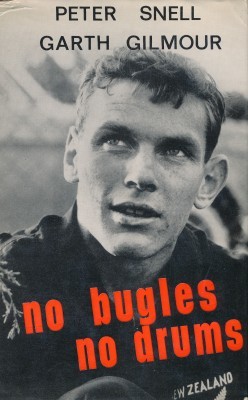
You can get all this information in the amazing book called No Bugles, No Drums.
Does anyone know where to get a reprint copy of this? I have been looking for this and a few other classic running books but it seems everything is a fairly expensive original off of Amazon. This and a few Jim Ryun books have been on my wish list for a while but I am holding out that there exist some cheaper paperback copies rather than nearly $100 originals used on Amazon. I've even tried scouring some vintage book stores in my area but their running selection is disappointingly sparse.
5
0
Do you know anything about the sport....or anything else?
You can see the effect of the Lydiard training on the ability to kick when you watch the 5000 or 3 mile from the 1962 Commonwealth Games in Perth. Halberg's explosive acceleration away from Clarke and Bruce Kidd looks very Snell-like.
Clarke's training could be described as a lot of Lydiard without the speedwork.