Jay Johnson
-
928
-
true bit also wrote:
Jefe in the CO wrote:
Taken down by a couple disgruntled runners. Not sure how much longer they intended to stay anyway as CU was getting out recruited on a regular basis - so maybe it was time for a change.
I was under the impression that body composition analysis was a better alternative to caliper tests? Now they can't even do that without worrying who will be negatively impacted by the results.
Brosnan will now need to decide whether he wants to coach at FSU or CU.
a bod pod is better than a caliper test but its also not necessary which is the issue. Reducing someone down to a number is just such a high risk/low reward thing and unnecessary. You risk your runner developing a bad relationship with food or their health and the reward is what? Athletes need to have a healthy relationship with food to be able to properly fuel their bodies to get the full benefits of their workouts and training. All a number does is make them want to lower that number regardless of whether its actually an issue holding them back or not.
It’s just a data point. People act like getting on a scale or measuring body composition is an implicit judgement or an act of aggression. The truth is that’s a projection stemming from self-esteem issues already existing in the athlete. If the athlete isn’t mentally stable enough to rationally evaluate and utilize information that directly impacts performance, they aren’t up to the job of elite-level competition.
1732 -
They should hire CeCe Telfer. It would be the most Boulder hire ever.
1019 -
Joe Bosshard
1118 -
27 minutes wrote:
I could see Chris Solinsky get some interest.
Young, knowledgeable, with past experience working under/with Jerry. He also clearly did well setting Parker Valby up for success at UF.A blue blood program is going to try to hire him at some point, Colorado would be smart to get him before he’s locked in elsewhere
The Valby grad transfer to CU mania has started.
314 -
Seth James Demoor
276 -
agip wrote:
I've always wondered if wetmore's talk about losing weight and flattering Adam Goucher's thinness in Running with the Buffaloes would eventually hurt Wetmore. I bet it did.
If anything happens to a CU athlete all a lawyer has to do is bring out a copy of Buffaloes and say 'but the U knew this was going on for decades! why didn't CU stop it?'
That book is a smoking gun, in this sense.
The book isn’t a smoking gun. It’s a book that’s roughly 2 1/2 decades old, about a team from 26 years ago. It has a lot more to do about the culture of the program in the past 5-10 years (read investigation brief attached). The program has progressively produced less results, lost top recruits, and has been littered with speculation. I also believe Coach Burroughs was a larger problem than Coach Wetmore, but they are a pair, and the two of them have sealed their own fate.
353 -
I highly doubt Dathan Ritzenheim is interested in the position. 1) They talk on coffee club about keeping the team relatively small, and him wanting time to be one-on-one with all of his athletes. 2) He's seen how well trying to balance both has gone for Jerry Schumacher
662 -
but also... wrote:
true bit also wrote:
a bod pod is better than a caliper test but its also not necessary which is the issue. Reducing someone down to a number is just such a high risk/low reward thing and unnecessary. You risk your runner developing a bad relationship with food or their health and the reward is what? Athletes need to have a healthy relationship with food to be able to properly fuel their bodies to get the full benefits of their workouts and training. All a number does is make them want to lower that number regardless of whether its actually an issue holding them back or not.
It’s just a data point. People act like getting on a scale or measuring body composition is an implicit judgement or an act of aggression. The truth is that’s a projection stemming from self-esteem issues already existing in the athlete. If the athlete isn’t mentally stable enough to rationally evaluate and utilize information that directly impacts performance, they aren’t up to the job of elite-level competition.
Students come in to these programs at 18 years old. Technically adults, yeah, but very young (and impressionable) adults. REDS and eating disorders are common in the sport, and learning proper fueling is absolutely necessary to be at the elite level. Expecting these young adults to come in with this much mental strength and know-how is ridiculous. College is a time for learning and growing in your sport.
753 -
THIS IS YOUR REMINDER THAT ROBERT JOHNSON OF OREGON WAS FIRED FOR THE SAME THING - BODY FAT TESTING.
The crazy part is that the DEXA scan that Oregon and Colorado used is literally a BONE DENSITY test that also happens to measure body fat. These tests PREVENT stress fractures, they DO NOT make them more likely.
5010 -
daily reminder wrote:
THIS IS YOUR REMINDER THAT ROBERT JOHNSON OF OREGON WAS FIRED FOR THE SAME THING - BODY FAT TESTING.
The crazy part is that the DEXA scan that Oregon and Colorado used is literally a BONE DENSITY test that also happens to measure body fat. These tests PREVENT stress fractures, they DO NOT make them more likely.
I don’t believe that Wetmore is no longer the CU coach merely for engaging in the practice of DEXA scans.
572 -
I know NAU assistant coach Jarred Cornfeld is very happy where he is but if Colorado calls it might be an offer he can't refuse. in the distance running universe Colorado is one of those head coaching jobs like Duke basketball or Alabama football. highly sought after and rarely available.
plus he coaches Elise Cranny who lives/trains in Colorado. and her making the Olympics might be the confidence boost Cornfeld needed to realize he's ready to step up and be a head coach.
565 -
They should seriously consider Siemers given all he's accomplished at Mines. He's one the best coaches in cross country regardless of Division.
491 -
I don't usually think that credentials should matter for debates on LetsRun, but I do think that anyone commenting on the dynamics of coaches monitoring and attempting to steer athletes' weight needs to tell us why they understand how it works.
I actually ran D1, and I can tell you two important things. First, athletes' ideal weight, composition, and appearance for elite competition can vary wildly from person to person. Appearances and numbers are deceiving, and tell only one small part of an athlete's physiological story. However, I will add the important caveat that weight can matter for performance, and that there are smart and nuanced ways to approach this topic with athletes. Second, when coaches monitor or make comments about an athlete's weight, they are honing in on only a very small part of that athlete's physiological story and doing so in a way that will probably cause some psychological distress to that athlete or another who overhears.
Commenters in this thread–on both sides of the debate–will quickly expose their lack of knowledge of the real-life, on-the-ground dynamics of elite distance running and coaching. Wanton speculators without experience should demonstrate some humility on this topic.
7512 -
Is Damon Martin interested?
77 -
I doubt she’s interested/certified, but Jenny Simpson would be an interesting pick, or Emma Coburn. Both CU alums at the end of their competitive careers (Emma doesn’t seem ready to admit that yet though). Hiring a woman would definitely start a new era. They might suck at first but I think Jenny in particular could grow into a great coach. She always seemed thoughtful and relatable to me.
This post was edited 35 seconds after it was posted. Reason provided: Fewer words1431 -
I wonder if Wetmore retire from the sport or continue coaching elsewhere.
71 -
RossiCheated wrote:
There are already posts saying that he did nothing wrong (regarding the body composition testing) and that high-level distance running success depends on having a low body fat, and posts saying that it probably went well beyond that (how did he influence athletes to be thin?).
The report is public and can be accessed here, so people can actually read it and not speculate. (I admit I have not read it, so I choose not to speculate.)
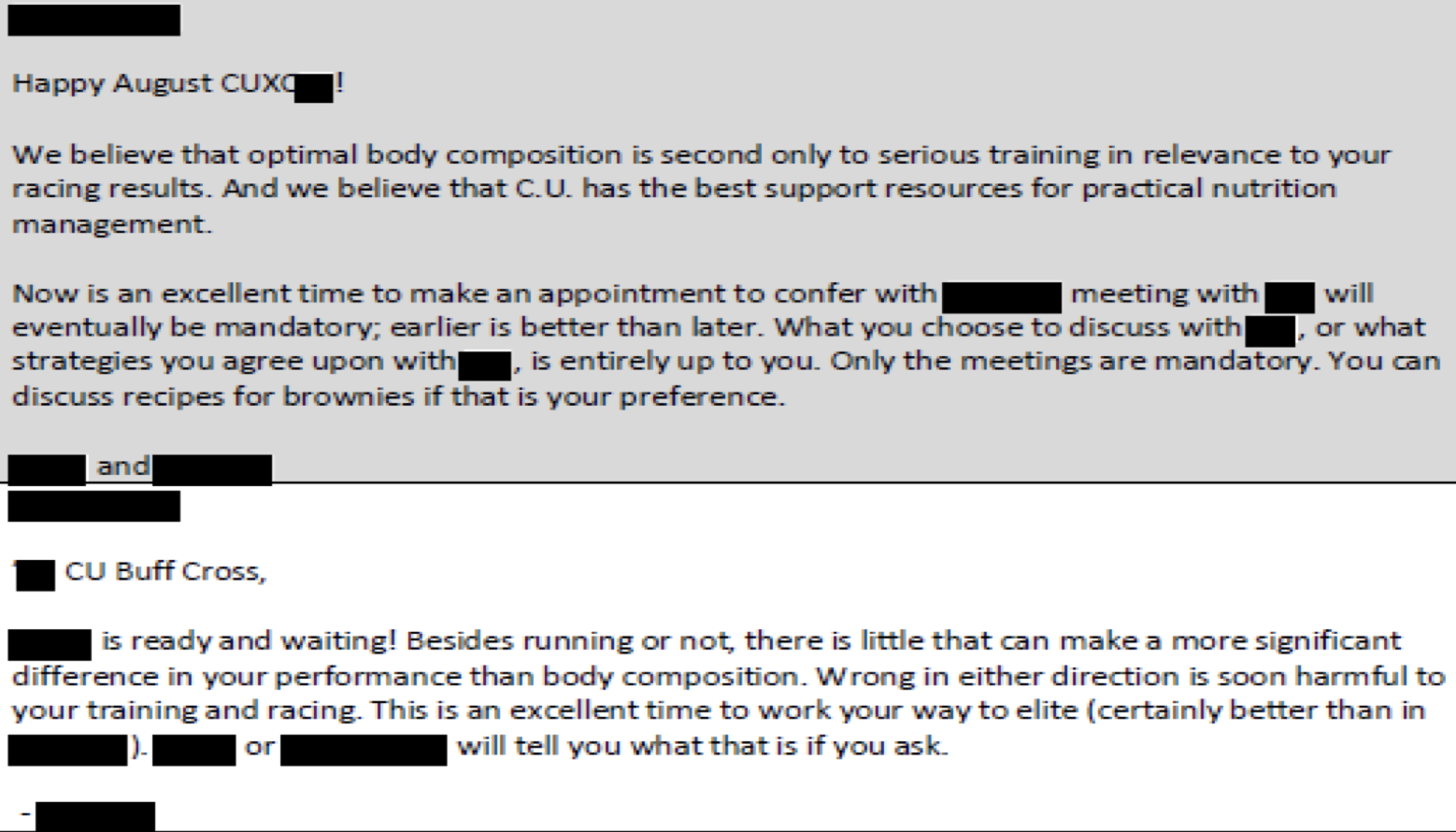
I skimmed the report, and wrote down some major takeaways. I only wrote things down that were common themes mentioned 3+ times or based on large data.
-the majority of athletes characterized the body fat composition testing as mandatory
-Burroughs made snide remarks about weight during testing
-main suggestions from Burroughs were to eat less, go hungry, etc.
-both coaches told athletes they needed to work off weight/“sugar” after holiday breaks
-4 people developed eating disorders, several (5+) say previous ones worsened
-Wetmore made them take weekly body fat composition tests as punishment for losing at nationals one yearIn general, they said:
-lack of mental health resources and focus
-injury prevention and treatment was overall good
-several students reported being diagnosed with mental health problems after leaving (PTSD, depression, anxiety)
-the women’s team was viewed as far more toxic/problematic than the men’s
-the document contains about 50% students who didn't have an issue and 50% that did682 -
but also... wrote:
true bit also wrote:
a bod pod is better than a caliper test but its also not necessary which is the issue. Reducing someone down to a number is just such a high risk/low reward thing and unnecessary. You risk your runner developing a bad relationship with food or their health and the reward is what? Athletes need to have a healthy relationship with food to be able to properly fuel their bodies to get the full benefits of their workouts and training. All a number does is make them want to lower that number regardless of whether its actually an issue holding them back or not.
It’s just a data point. People act like getting on a scale or measuring body composition is an implicit judgement or an act of aggression. The truth is that’s a projection stemming from self-esteem issues already existing in the athlete. If the athlete isn’t mentally stable enough to rationally evaluate and utilize information that directly impacts performance, they aren’t up to the job of elite-level competition.
NCAA is not elite-level competition. A small minority get to and/or move on to the elite level.
178
1 post was removed from this page.
What People Are Talking About On LetsRun
No top threads at the moment. Check back soon.