It’s tough to correct someone who’s too vague to even be wrong.
Sports Science literature is full of reductive jibberish. Athletes and coaches deserve so much better.
Athletes and coaches mostly ignore sports "science" mental masturbation. The day-to-day of coaching is not really about what's the best threshold to use.
The problem with MLSS is that it has an arbitrary definition, i.e. less than a 1 mM increment in blood lactate between 10 and 30 min. In the paper below it is outlined in very detail that CV is a) higher as MLSS and b) it is better suited as there is no arbitrary definition.
A must read for anyone interested at least in MLSS.
MLSS is not arbitrary at all. If you think mlss can be determined from an incremental ramp test, that’s where you’re wrong.
the only way to actually determine mlss is to do several constant rate tests with each test lasting 30-60 minutes.
you cannot determine mlss from a ramp test with any precision, unless you make the slope of the ramp nearly flat.
level, CV is not a metabolic steady state. CV has no physiological basis. It’s not a universal threshold at all. It’s just the max work you can do over various durations.
The problem with MLSS is that it has an arbitrary definition, i.e. less than a 1 mM increment in blood lactate between 10 and 30 min. In the paper below it is outlined in very detail that CV is a) higher as MLSS and b) it is better suited as there is no arbitrary definition.
A must read for anyone interested at least in MLSS.
MLSS is not arbitrary at all. If you think mlss can be determined from an incremental ramp test, that’s where you’re wrong.
the only way to actually determine mlss is to do several constant rate tests with each test lasting 30-60 minutes.
you cannot determine mlss from a ramp test with any precision, unless you make the slope of the ramp nearly flat.
level, CV is not a metabolic steady state. CV has no physiological basis. It’s not a universal threshold at all. It’s just the max work you can do over various durations.
You don't understand how MLSS is defined in science and you seem to have a lack of understanding.
Above I provided the offical definition from MLSS, i.e. less than a 1 mM increment in blood lactate between 10 and 30 min. That has nothing to do with a ramp test. Your definition of MLSS is your own invention and has nothing to do with the offical definition of MLSS.
3
7
Endurance Running Italian Coach demighty@libero.it
The percentages system has the usual flaw, it’s fine for people who are champions, but for normal people, it has undervalued rhythms, for example, it results in a slow run in a mortifying way. First, it must be pointed out that the human velocity profile is not linear but logarithmic. also for different areas, from 50 meters up to the marathon there are logarithmic zones that are different for both human characteristics in general and for the characteristics of the individual athlete.
Lex, is the idea that people should be training closer to CV, or just to have a common reference point. If it's just a common reference point, I don't see how it's better than using. race paces. Most athletes know their race paces and how their race paces feel. Or they can use a calculator to estimate a race pace they haven't run, or can run X seconds slower/faster than another pace. Here's how I see it going:
Coach Lexel: today we're running 400m reps at 98% of CV pace.
Athlete: what's that?
Coach Lexel: It's about 10k pace
Athlete: ok 400m reps at 10k pace.
...
Athlete: wait, I've never run a 10k, only a 5k. Can I just run 4-5 sec/lap slower than 5k pace.
Coach Lexel: No %CV is better and more accurate.
Athlete: CV is how fast I can run for about 30 minutes right?
Coach Lexel: Not exactly, but close enough.
Athlete: Wait coach, I ran that 8k TT in 30' a few weeks ago I'll use that as my CV pace.
Coach Lexel: No, you can only predict your CV from races that last less than 23'. We're going to have to have to have you run time trials at 1200m, 3600m and 5400m.
* Athlete runs those time trials over the next week and sends them to coach lexel. (The athlete also ran a 7k time trial but it took 24'50" so they had to throw it out.)
Coach Lexel: I conducted a linear regression on your TT results using a multi-parameter model and have determined your CV is 6:05 per mile.
Athlete: Wow coach you're so smart, and to think i was going to use 6:02 pace! I would have been training in the severe zone instead of the heavy zone and possibly died!
Coach Lexel: Exactly!... (Rambles for 30 minutes about MLSS and Metabolic thresholds and ventilatory maximums. It gets dark out so the athlete can't do their workout and they have to go home.)
If I am looking to do 20-40 mins of quality aerobic work, the pace I can do for say 30mins or 60mins is a bit more correlated than something like a 8min time trial. Think about these 2 athletes
4:00 mile/8:00 3k/14:20 5k/30:20 10k
4:08mile/8:05 3k/ 14:00 5k/29:00 10k
They are going to have basically the same vv02 pace. If they are going to be doing 6*1mile with 60s rest, should they be at the same pace or should the guy with better endurance run faster? I would vote for the second guy running faster...
Yes i agree, the second guy should run a little bit faster as his CV is a little bit faster. I would also bet that his VO2max is a little bit higher as the other guy, if measured in the labor.
I would bet his vo2max is lower and his threshold/running economy is slightly higher.
The point is if you use CV or vvo2( or anything else), you are getting different numbers.
If you use CV the first guy might be doing something like
66s for vvo2 max work, 76s for threshold
Use vvo2 you would get
64s vv03 and 73s threshold.
It is unclear if either of those is better than
64s for the vvo2 and 76s threshold you would get by using race paces..
Now race paces work well when talking about good athletes of somewhat similar ability. The difference in intensity between a 13 min 5k and 16 just isn't that huge. Now a 13min 5k and a 25min 5k? At some point you need to draw the line...
Lex, is the idea that people should be training closer to CV, or just to have a common reference point. If it's just a common reference point, I don't see how it's better than using. race paces. Most athletes know their race paces and how their race paces feel. Or they can use a calculator to estimate a race pace they haven't run, or can run X seconds slower/faster than another pace. Here's how I see it going:
Coach Lexel: today we're running 400m reps at 98% of CV pace.
Athlete: what's that?
Coach Lexel: It's about 10k pace
Athlete: ok 400m reps at 10k pace.
...
Athlete: wait, I've never run a 10k, only a 5k. Can I just run 4-5 sec/lap slower than 5k pace.
Coach Lexel: No %CV is better and more accurate.
Athlete: CV is how fast I can run for about 30 minutes right?
Coach Lexel: Not exactly, but close enough.
Athlete: Wait coach, I ran that 8k TT in 30' a few weeks ago I'll use that as my CV pace.
Coach Lexel: No, you can only predict your CV from races that last less than 23'. We're going to have to have to have you run time trials at 1200m, 3600m and 5400m.
* Athlete runs those time trials over the next week and sends them to coach lexel. (The athlete also ran a 7k time trial but it took 24'50" so they had to throw it out.)
Coach Lexel: I conducted a linear regression on your TT results using a multi-parameter model and have determined your CV is 6:05 per mile.
Athlete: Wow coach you're so smart, and to think i was going to use 6:02 pace! I would have been training in the severe zone instead of the heavy zone and possibly died!
Coach Lexel: Exactly!... (Rambles for 30 minutes about MLSS and Metabolic thresholds and ventilatory maximums. It gets dark out so the athlete can't do their workout and they have to go home.)
nice :)So much time invested.
I mean a communication system about an intensity effort which is transferable from athlete to athlete. E.g. a marathon race pace description is not transferable from athlete to another athlete, as someone runs it in 2h and the other in 5h. It is clear that this is not the same effort.
You can also use a 5k race (its relatively close to CV) and estimate CV by using Tinmans calculator
I would bet his vo2max is lower and his threshold/running economy is slightly higher.
The point is if you use CV or vvo2( or anything else), you are getting different numbers.
If you use CV the first guy might be doing something like
66s for vvo2 max work, 76s for threshold
Use vvo2 you would get
64s vv03 and 73s threshold.
It is unclear if either of those is better than
64s for the vvo2 and 76s threshold you would get by using race paces..
Now race paces work well when talking about good athletes of somewhat similar ability. The difference in intensity between a 13 min 5k and 16 just isn't that huge. Now a 13min 5k and a 25min 5k? At some point you need to draw the line...
You know your athletes better than me. I would definetely use %CV over %vVO2max, as it is more individual.
Do you send your kids from time to time to a labor? I would still take a VO2max bet at any time. Athlete B is higher. :)
This post was edited 1 minute after it was posted.
LT2 is mlss. You can determine mlss from a series of constant rate tests. It’s a thing that exists. You can’t really see it from a ramp or graded exercise test.
So CV is a performance threshold. It should occur around metabolic mlss. For me, through, I can only hold CP for about 30 minutes. Mathematically, that’s a correct duration based on the models. So CP/CV has a time to exhaustion attached to it.
The problem with MLSS is that it has an arbitrary definition, i.e. less than a 1 mM increment in blood lactate between 10 and 30 min. In the paper below it is outlined in very detail that CV is a) higher as MLSS and b) it is better suited as there is no arbitrary definition.
Another defect of the percentage systems and with reference to a run time is that they do not keep count that the races are in meters and not in time and therefore the workouts are calibrated to perform a total volume that is based on distance, not on times.
This fact makes training for a distance result in speeds that make them impossible.
I give anexample, in Italy, Giorgio Rondelli made to carry out throughout the season to Cova and Panetta workouts as type 25 x 400 meters with 200 meters rest jog.
This training started already in winter, but uphill (recovery 400 meters jog downhill) at speeds below VO2max. In spring it passed to the track with the speed always under the VO2max, but with the progress of the form it was arrived to unfold it to the VO2max speed. For simplicity we consider the VO2max equal to their record on 3000 meters which is about 7'42".
In the summer Cova and Panetta reached the peak of the form and they were able to carry out this training faster than VO2max and then it became a lactic work, to be precise a work of lactic resistance. Now we take an amateur who runs 3000 meters in 12' and compare his VO2max to 7'42" wanting to use a time system. 12*60 = 720”. 720/3000*400= 96". He covers 400 meters in 96", we make 94" because in a test of 7'42" he runs slightly faster than in 12'. Cova and Panetta at their VO2max run every fraction of 400 meters in 61"6. Cova and Panetta at their VO2max (with rest of 200 mt jog) will have supported a total effort of 61"6 x 25 = 1540", while the amateur at his VO2max will have done a total work of 2350"!!!!! and this is impossible, the amateur after a certain number of tests will have to lower his speed.
Seeing it on the time, the amateur with tests of 61"6, will have covered only 262 meters with total work of 25 x 262= 6553 mt !!!! in front of the complete work of 10000 meters of Cova and Panetta. The amateur will be able to keep his VO2max for all 25 tests buthe will have done an incomplete work. This is why the main factor must always be metric and not in time. In the logarithmic curves I wrote above, we start from the meters in the abscissa axis and then wanting to pass to the percentages they are transformed into percentages meters and not in time of run.
This post was edited 4 minutes after it was posted.
The problem with MLSS is that it has an arbitrary definition, i.e. less than a 1 mM increment in blood lactate between 10 and 30 min. In the paper below it is outlined in very detail that CV is a) higher as MLSS and b) it is better suited as there is no arbitrary definition.
A must read for anyone interested at least in MLSS.
Very strange that you think 50-60 mins is arbitrary, 1mM is arbitrary, but 23 or 25-30 mins isn’t arbitrary.
It has nothing to do with strange, there is an official definiton of MLSS which is arbitrary. Even if you do not accept it or believe it, it is still there and there is no conspiration ongoing. As mentioned CV lands in the area of 25-30min, but is not defined that way.
Another defect of the percentage systems and with reference to a run time is that they do not keep count that the races are in meters and not in time and therefore the workouts are calibrated to perform a total volume that is based on distance, not on times.
This fact makes training for a distance result in speeds that make them impossible.
I give anexample, in Italy, Giorgio Rondelli made to carry out throughout the season to Cova and Panetta workouts as type 25 x 400 meters with 200 meters rest jog.
This training started already in winter, but uphill (recovery 400 meters jog downhill) at speeds below VO2max. In spring it passed to the track with the speed always under the VO2max, but with the progress of the form it was arrived to unfold it to the VO2max speed. For simplicity we consider the VO2max equal to their record on 3000 meters which is about 7'42".
In the summer Cova and Panetta reached the peak of the form and they were able to carry out this training faster than VO2max and then it became a lactic work, to be precise a work of lactic resistance. Now we take an amateur who runs 3000 meters in 12' and compare his VO2max to 7'42" wanting to use a time system. 12*60 = 720”. 720/3000*400= 96". He covers 400 meters in 96", we make 94" because in a test of 7'42" he runs slightly faster than in 12'. Cova and Panetta at their VO2max run every fraction of 400 meters in 61"6. Cova and Panetta at their VO2max (with rest of 200 mt jog) will have supported a total effort of 61"6 x 25 = 1540", while the amateur at his VO2max will have done a total work of 2350"!!!!! and this is impossible, the amateur after a certain number of tests will have to lower his speed.
Seeing it on the time, the amateur with tests of 61"6, will have covered only 262 meters with total work of 25 x 262= 6553 mt !!!! in front of the complete work of 10000 meters of Cova and Panetta. The amateur will be able to keep his VO2max for all 25 tests buthe will have done an incomplete work. This is why the main factor must always be metric and not in time. In the logarithmic curves I wrote above, we start from the meters in the abscissa axis and then wanting to pass to the percentages they are transformed into percentages meters and not in time of run.
Some comments here:
If you say e.g. 20 X 1min @97%CV, both the professional and the amateur does 20 minutes at the same effort. The distance they cover is the result of the speed they have, not vice versa. You have to do it by time not distance. The amateur can reduce the number of reps if needed but not the intensity.
3000m is not suitable as a general definition of vVO2max, because one runner does it at 8min the other at 12min. That is a problem. Bilat et al found an inverse relationship between tlim (time a runner can hold at vVO2max) with performance. So it is better to define it by time. You can do a 5min all-out for pros, 6min for the good hobby jogger and 7min for the avg Joe. Its way better to define it by time as by distance.
3
6
Endurance Running Italian Coach demighty@libero.it
No, that’s the problem, the amateur will have done an insufficient training to cover the VOLUME training for THAT SPECIFIC DISTANCE that is preparing. That is why training for a specific distance comes very close to a standardization in different schools.
NO the focus was not to define if the 3000 metric approximate or not the VO2 max, but if the 3000 metric meter expresses a factor useful to define the parameter that places in the expression of intensity, the standardization of the training volume/intensity.
No, that’s the problem, the amateur will have done an insufficient training to cover the VOLUME training for THAT SPECIFIC DISTANCE that is preparing. That is why training for a specific distance comes very close to a standardization in different schools.
NO the focus was not to define if the 3000 metric approximate or not the VO2 max, but if the 3000 metric meter expresses a factor useful to define the parameter that places in the expression of intensity, the standardization of the training volume/intensity.
What you said is true, the amatuer did insufficient volume, but that's because they aren't as good.. they just need to get better if they want to do more volume. Just because a hobby jogger wants to do a marathon, doesn't mean they should build up to 20 miles at marathon race pace like some pros do, 16 miles will be all they can handle.. and 20*5 = 100, while say 16*6 = 96, so about the same amount of time. Yes, the marathon requires more to be a pro, (for some coaching methods) but for an amateur, that is a great workout.
So I agree with lexel, going by %CV for duration of time is much better and more applicable. I also agree with your earlier post that it is not linear 90%CV for an elite is different than 90%CV for an amateur because their race paces are spaced out differently, meaning the efforts will not match up, however, two amateurs of similar ability saying they did one workout at 90%CV to another amateur who did a similar, but not exact same, workout at 89%CV will make much more sense when discussing training.
Basically, again, I agree with lexel that for similar level of athletes, talking in an agreed upon format (one idea being %CV) is much better and useful for sharing ideas.
No, that’s the problem, the amateur will have done an insufficient training to cover the VOLUME training for THAT SPECIFIC DISTANCE that is preparing. That is why training for a specific distance comes very close to a standardization in different schools.
But it's not about volume though. It's about metabolic stress.
4k worth of running at 10k pace is still going to provide a stimulus. Your form will be cleaner at the end of the workout, too (this is especially important for beginners).
4
1
Endurance Running Italian Coach demighty@libero.it
No, that’s the problem, the amateur will have done an insufficient training to cover the VOLUME training for THAT SPECIFIC DISTANCE that is preparing. That is why training for a specific distance comes very close to a standardization in different schools.
But it's not about volume though. It's about metabolic stress.
4k worth of running at 10k pace is still going to provide a stimulus. Your form will be cleaner at the end of the workout, too (this is especially important for beginners).
No, it's not about metabolic stress.
Running is a skill as you implied in your second paragraph. To improve your performance you need to improve efficiency and endurance. The 'metabolic stress' is an inevitable consequence of sustained effort.
2
1
Endurance Running Italian Coach demighty@libero.it
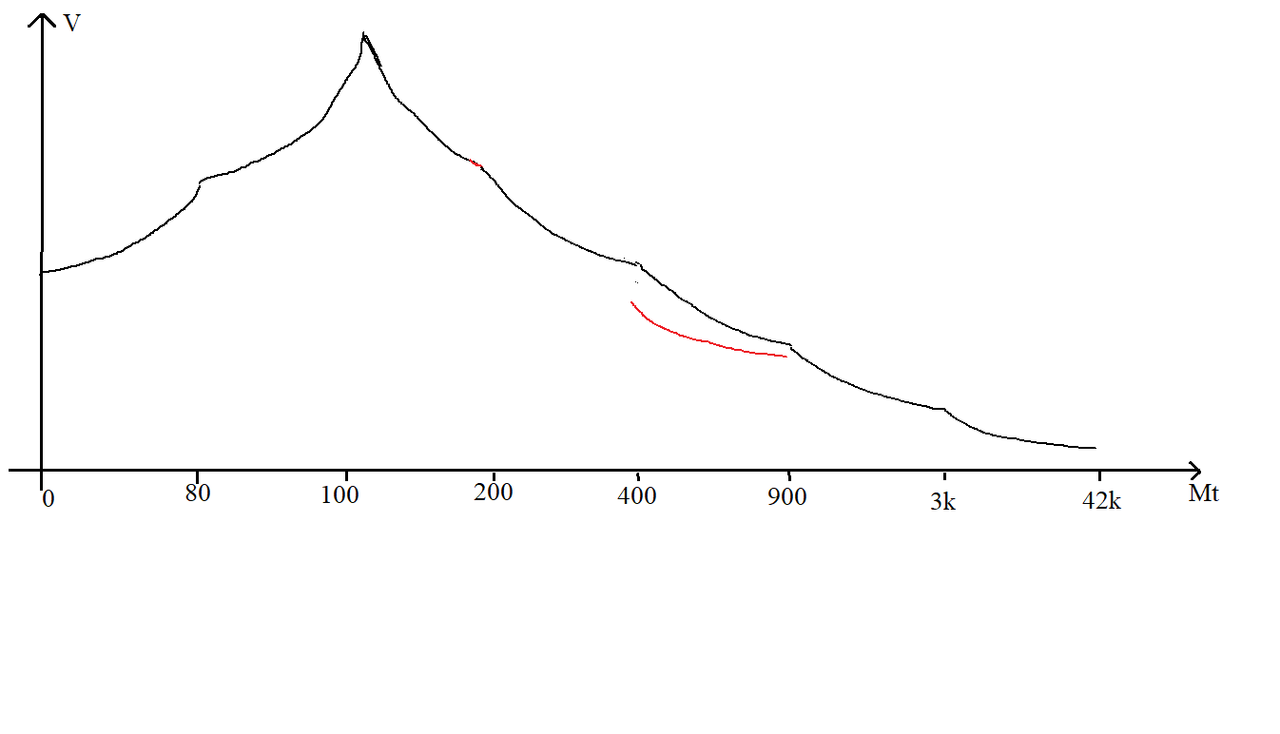
This is the profile of human velocity, with high correlation zones Mt/V: 10-80 mt 80-100 mt. 100-200 mt. 200-400 mt. 400-900 mt. 900 mt-3k. 3k-42k. (Obviously in figure the meters are not to scale, but it is to understand the different areas). Beyond each zone there is loss of correlation and another logarithmic curve is needed. Not by chance the cusps are, for example, the 80 mt (alactic threshold) and 3k (VO2Max zone). Obviously this is an athlete who does not exist because he would have the speed of Bolt and the resistance of Kipchoge. The red curve instead is a real athlete, specialist of 800 meters, and in the 400-900 meters, note how the curve is shifted downwards because he expresses speeds lower than van Niekerk -Rudisha...
But the translation is not enough...note how it is also rotated towards the extreme of 900 meters... because it has better characteristics on 900 meters than on 400 meters...being a specialist of 800 meters. Actually, to be even more precise, his 400-900 curve zone must be divided into two further curves: one from 400 to 800 meters and one from 800 to 900 meters with a peak on 800, because it begins to worsen slightly already around the 900 mt.
Any forum for runners is full of threads where it’s unclear which intensity or which threshold is meant. There are several definitions of a threshold LT1, LT2, VT1, VT2, LTH, Aet, AnT, 2mmol, 4mmol, MLSS etc. and every person has a different meaning or understanding of it. This is subpar for any communication. Cycling had the same problem and they came up with the FTP (functional threshold power which is defined as the power output an athlete can sustain for 60min). Cyclists now talk in % of FTP (however a problem with that is that 60min is arbitrary). Something similar is missing or not commonly used for running. In this respect running is 10-20 year behind in communication.
A possible solution for this communication problem can be the introduction of a real metabolic threshold as a reference point. This reference point should be not arbitrary.
My suggestion is to use the critical velocity (CV) and the % of it (%CV) to describe intensities in running. Examples: 30min@85%CV; 6x5min@95%CV; 60min easy@70%CV …
Critical velocity is a real metabolic threshold and has its scientific value. It’s about the speed someone can hold for about 25-30minutes. See below papers and videos for more details. To use CV seems to be even better as MLSS (maximum lactate steady state). Also, not all people use a lactate meter. For professional runners 10k pace is almost CV, for hobby jogger 10k pace is a little bit slower than CV, as they need a longer time for that distance (>30 min). Introduction videos:
I ran a 1/2, not all out, maybe at 80% due to the heat and as an experimental test to learn pacing, in 1:37:06. So what you are saying is to use current CV--should I use the CV using the 1:37 1/2 time or can I use a higher CV of my true race time in better conditions? (1:34)?
Help us build the best running shoe review site for a chance to win a LetsRun t-shirt.Help us build the best running shoe review site for a chance to win one of 10 LetsRun t-shirts.