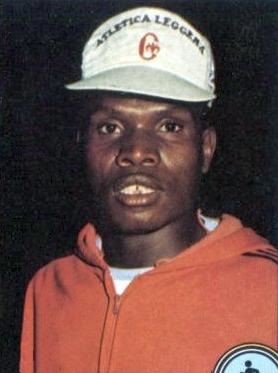
1980, when Salazar won NYC, you had to be there. It's literally like Hocker showing up, and winning Western States.
The 24 months that followed, he was the greatest distance runner in the world, easy.
Lopes was coming on, clearly, and bluffing from NYC 82 on, but few realized it. Only after Salazar started losing overseas, and Lopes took World XC, did things seem clear. Oddly, in mid-82, the only question was the order you'd see in LA - Salazar, Decastella, or Seko?
That was Salazar's 'era'. NY 1980 to NY 1982. During that period he was one of the very best in the world. Before and after, not so much. So it goes I guess, you can never know what your career arc will look like.
Probably the period he destroyed his body with whatever doping scheme he could come up with. Who knows, but I don't trust his brief self-declared greatness.
Alberto's calling card was his mental toughness. But he had no finishing speed. I saw him tow the Nyambui and the UTEP crew through the '79 and '81 NCAA 10,000's and then they dusted him in the final 800. He would not have medaled in the '80 Olympics 10,000. His marathoning is a bit different, as he was the top dog for awhile; he didn't run well at the '84 LA Oly marathon; not sure if it was the heat or not, but Lopes was dominant that day while AS finished around 10th.
No finishing speed, second that. I saw Nyambui sprint away in the Millrose 5K back in '81. Al Sal had no answer. Much like when Virgin was destroyed by Yifter in Montreal '79.
There's no doubt (in my mind, at least) that Rono and Lopes rank above Salazar on the list of all-time legends. But Rono's prime was pre-1980 and the hot streak that really made Lopes a legend was post-1982. As someone else said earlier in the thread, there's a reasonable argument to be made that Salazar was the top long-distance runner in the world for a brief period around 1980-82.
The best illustration of that, for me, was reading Deek's autobiography. As Deek emerged as a star (around 1981-82), it seemed like he really wanted a shot at Salazar, who he viewed as the top guy in the world at the time. When he finally raced (and beat) Salazar in Rotterdam in 1983, that made Deek the uncontested top dog (albeit only until the Olympics!).
Salazar certainly wasn't dominant in the way, say, Geb and Bekele were in their respective eras. And his reputation was probably greater than his actual accomplishments thanks to the U.S. media hype machine. But it's not totally crazy to say that there was a brief period of time when many knowledgeable observers would have ranked him as the top guy in the world.
Of course Alberto was NEVER the top all around distance runner in the world as Rono owned him but if you want to say Alberto was the top marathoner for a couple years that may be…however 2 years is not an era and Alberto was not even top 3 distance runner in his era.
I would argue in those two years of Boston Marathon and New York City Marathons he did not face Lopes Deek, Seko, Ikangaa, and the up and coming Steve Jones in 84.
That second place world xc was incredible if the course was measured properly (33:44) but it was second.
To lay claim you are the best of your “era” means you had to beat the best over a period of time. Not his fault they were choosing other Marathons but…
I was a big fan of his. He boldly predicted that he would win the NYC marathon. That obviously ruffled many feathers. After the race he said he had run 10Ks that felt harder. (If I recall, he was a 5th-year senior but had no XC eligibility left.) He set the marathon debut record. Then he predicted he would break the world record.
At a time that running 2:09 was a rarity, he thought he could do it and went for it. I think it caused a paradigm shift with many of the marathoners at the time.
Alberto Salazar’s First Great Race | Runner's World (runnersworld.com)
Rono without a doubt. Unfortunately he had to go through the US college system unlike Kenyans now who can get contracts and proper management. Imagine what he could have done without having to run under a coach like Chaplin who ran him all over the place.
I would say that if Rono ran in the 2000's he would basically been Haile Gebrselassie.
Rono was unbeatable for a season, then very good for a few weeks another summer or so. Lopes won in LA, then set the WR the next spring, and won a few World XC races. Two years, really, he was it. Salazar was unbeatable for just over two years, not a whole lot differences here.
If Kenya doesn’t boycott the Moscow Olympics then Rono’s story would be so different.
In 1978 he went to Australia in February and ran 27:48 for 10k on the track. That spring and summer he set four World Records. In February of 1980 he went back to Australia and ran 27:31. I remember reading the result and thinking to myself what will he do this summer sub 13:00 and sub 27:00. Two maybe three Gold Medals? Then a few weeks later the boycott was announced and Kenya and the USA would not be going to the Olympics. The Henry Rono story ending would take a different route.
"The peak of Rono's running career was the 1978 season. In a span of only 81 days, he broke four world records: 10,000 m (27:22.5), the 5000 m (13:08.4), the 3000 m steeplechase (8:05.4), and the 3000 m (7:32.1); an achievement unparalleled in the history of distance running."
"He lowered the 10,000 record by almost eight seconds, the 5000 by 4.5, the steeplechase by 2.6, and the 3000 by a full three seconds. That August, he also won the 5000 m and 3000 m steeplechase gold medals at the Commonwealth Games in Canada at Edmonton. Among his other performances was a steeplechase / 5000 m double in one day during qualifying at the NCAA championships at the University of Oregon at Eugene's Hayward Field."
"He set meet records in both events, turning in an 8:18 and 13:22. The former took six seconds off the NCAA meet record for the steeplechase. When he ran the steeplechase final the next day, he won in 8:12.39, taking another six seconds off the steeplechase mark. He won 10,000 m and 3000 m steeplechase gold medals in July at the All-Africa Games."
Henry Rono (born 12 February 1952, in Kapsabet) is a Kenyan retired track and field athlete who specialised in various long-distance running events. Although he never competed at the Olympics, Rono is remembered as one of the...
"The peak of Rono's running career was the 1978 season. In a span of only 81 days, he broke four world records: 10,000 m (27:22.5), the 5000 m (13:08.4), the 3000 m steeplechase (8:05.4), and the 3000 m (7:32.1); an achievement unparalleled in the history of distance running."
"He lowered the 10,000 record by almost eight seconds, the 5000 by 4.5, the steeplechase by 2.6, and the 3000 by a full three seconds. That August, he also won the 5000 m and 3000 m steeplechase gold medals at the Commonwealth Games in Canada at Edmonton. Among his other performances was a steeplechase / 5000 m double in one day during qualifying at the NCAA championships at the University of Oregon at Eugene's Hayward Field."
"He set meet records in both events, turning in an 8:18 and 13:22. The former took six seconds off the NCAA meet record for the steeplechase. When he ran the steeplechase final the next day, he won in 8:12.39, taking another six seconds off the steeplechase mark. He won 10,000 m and 3000 m steeplechase gold medals in July at the All-Africa Games."
Certainly one of the best, and on the right day the best.
Owned the marathon AR for almost two decades until we imported a Moroccan ringer.
When did Alberto have the AR? Boston does not count.
I sit corrected. Salazar had the fastest marathon time by an American for almost 20 years (but not an AR).
Did have ARs in 5000, 10000, and 8K though. And briefly “had” the AR in marathon until they figured NY was slightly short. Salazar held many ARs such as 5000, 10000,
"The peak of Rono's running career was the 1978 season. In a span of only 81 days, he broke four world records: 10,000 m (27:22.5), the 5000 m (13:08.4), the 3000 m steeplechase (8:05.4), and the 3000 m (7:32.1); an achievement unparalleled in the history of distance running."
"He lowered the 10,000 record by almost eight seconds, the 5000 by 4.5, the steeplechase by 2.6, and the 3000 by a full three seconds. That August, he also won the 5000 m and 3000 m steeplechase gold medals at the Commonwealth Games in Canada at Edmonton. Among his other performances was a steeplechase / 5000 m double in one day during qualifying at the NCAA championships at the University of Oregon at Eugene's Hayward Field."
"He set meet records in both events, turning in an 8:18 and 13:22. The former took six seconds off the NCAA meet record for the steeplechase. When he ran the steeplechase final the next day, he won in 8:12.39, taking another six seconds off the steeplechase mark. He won 10,000 m and 3000 m steeplechase gold medals in July at the All-Africa Games."
Salazar can say that he was the best in the world at his peak, which fine for those 2 years you were maybe the best marathoner and nothing more. He was never the best on the track at any distance. To say you were the greatest in the world of that era is ridiculous. One person doesn't get to define what an era is. A 3 marathon streak is not an era. You're the greatest ever in November 1982 and then two summers later you're getting killed at the Olympics. Just more trash coming from this guy.
The article linked by the OP is 10 years old, so it’s not like Salazar recently made this claim. In any case, it was an absurd claim. He won 50% of his marathons. Almost all his 10 best times at 5000 meters and 10,000 meters were losses. So, probably the “greatest” American long distance runner for a very brief “era” of a few years, but that’s it. Not even the best collegiate runner during his NCAA career.
The Greatest Marathoner from Oct 1980 to Oct 1982, yes. The best overall in '82 over the 5-10-marathon combo, yes. He was 1 - 1 against Rono in '82 over 10K, if I recall correctly. He also ran a US 5000 and 10000 track record in '82, but he was not ranked #1 in the 10 by T&FN. Too bad he overtrained, as it cut short his peak years. If he'd had a coach as good as he was to become, he'd have medaled in the marathon in '84. Gold? Hard to say, Carlos Lopez and John Treacy were tenacious dudes!
He has correctly been brought to account for sexual violations. I hope for his sake he can face this and get help. I'd been an enthusiastic supporter his entire career, it's a sad end for his involvement in the sport.
1980, when Salazar won NYC, you had to be there. It's literally like Hocker showing up, and winning Western States.
The 24 months that followed, he was the greatest distance runner in the world, easy.
Lopes was coming on, clearly, and bluffing from NYC 82 on, but few realized it. Only after Salazar started losing overseas, and Lopes took World XC, did things seem clear. Oddly, in mid-82, the only question was the order you'd see in LA - Salazar, Decastella, or Seko?
I think even in 1982 we knew enough to know that two years is a long time.
Help us build the best running shoe review site for a chance to win a LetsRun t-shirt.Help us build the best running shoe review site for a chance to win one of 10 LetsRun t-shirts.