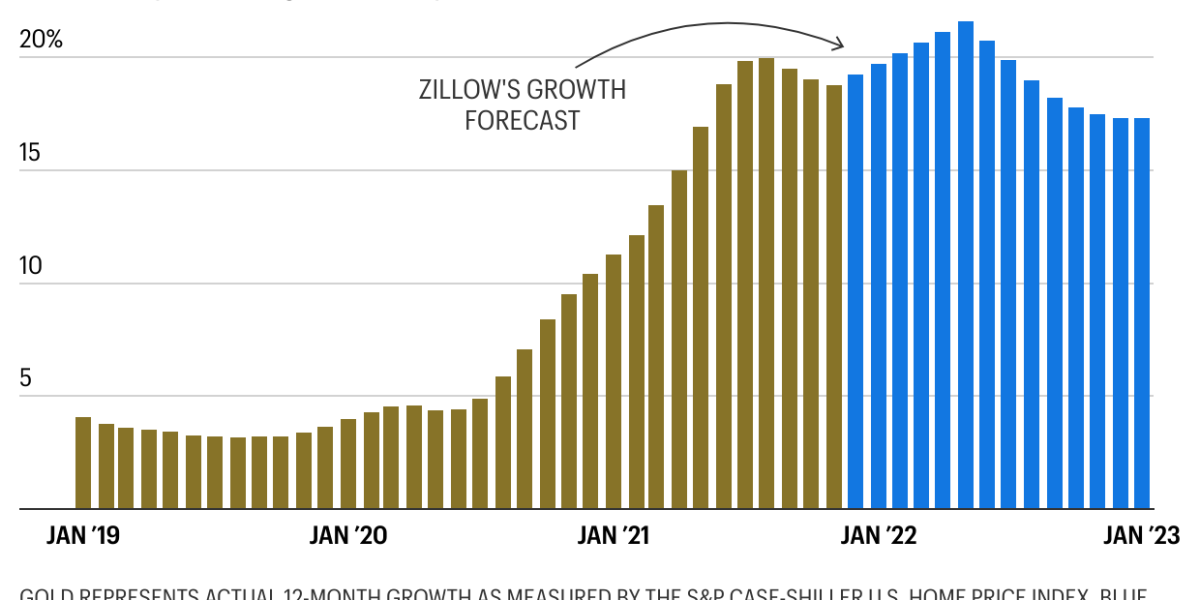
It's different because the prices are really high now. Right now people are less likely to have gotten what is historically a good deal.
Historically low supply and crazy prices might contribute to remorse. When there are bidding wars as the rule, paying well over asking, one can imagine this is going to result in some panic purchasing and or regret. Tough time. I feel for anyone who has to move. Our house has doubled in value, but guess what...if we sell, we cant buy anything better! I dont know how young people are doing it. Getting close to 6 figures for down payment as the rule rather than exception. I know I didnt have that cash for years after graduation, many years.
Well, when did it become a requirement to buy a house straight out of college? I'm older, my goal was to buy a house by the time I was 30. That was 8 years out of college, and I did what most people in those circumstances did -- I lived in an apartment and saved. I bought my first home knowing full well it wasn't the end destination, but a step toward it. It was smaller, no garage, neighborhood was further away from work, etc. I don't know when this changed -- at some point the mantra became "rent it throwing money away" and recent graduates lived with their parents to save money for a house. Or their parents fronted them a downpayment. Usually that house wasn't a starter house either, it was something that to me would have been one or two steps down the line.
Historically low supply and crazy prices might contribute to remorse. When there are bidding wars as the rule, paying well over asking, one can imagine this is going to result in some panic purchasing and or regret. Tough time. I feel for anyone who has to move. Our house has doubled in value, but guess what...if we sell, we cant buy anything better! I dont know how young people are doing it. Getting close to 6 figures for down payment as the rule rather than exception. I know I didnt have that cash for years after graduation, many years.
Well, when did it become a requirement to buy a house straight out of college? I'm older, my goal was to buy a house by the time I was 30. That was 8 years out of college, and I did what most people in those circumstances did -- I lived in an apartment and saved. I bought my first home knowing full well it wasn't the end destination, but a step toward it. It was smaller, no garage, neighborhood was further away from work, etc. I don't know when this changed -- at some point the mantra became "rent it throwing money away" and recent graduates lived with their parents to save money for a house. Or their parents fronted them a downpayment. Usually that house wasn't a starter house either, it was something that to me would have been one or two steps down the line.
The difference is that nowadays houses in an area will go from $636k to $2m from 2015-22 as I showed. That means, if you had $120k in 2015, you could either use that for 20% down on a house and you make $1.5m on the house or you put it in the stock market and it "only" doubles to $240k over the same period of 2015-22. With this equation, there's no reason to save for a house because you always get the most house if you buy right now however much you need to expand your budget.
Of course down payment doesn't matter in a super hot environment.
Hypothetically, if a house is up for sale for $1 and you make $1,000,000/year but aren't willing to throw down $1 up front, I'm sure a bank will be happy to sell you the house on payments of $0.04/yr.
Less hypothetically, if a house is up for sale for $500k and you have $500k cash to buy and your income is $70k/yr, you won't win the house if someone with $0 cash and $250k/yr income and equal interest in buying the house, because they'll bid it up to around $800k because your ability to pay a $300k loan is somewhere around the same as their ability to pay a $800k loan, and of course the bank gets more interest payments from them than from you.
I know very little about the real estate/financing field but that's interesting.
Why don't the banks look at it like a bird in the hand sort of thing? In other words, there's no guarantee that the $250k/yr client will have that income in the future. What if they lose their job and have to default a decade or so down the line way before $300K in payments is made? They'd foreclose and the bank will never collect close to that $800K. Whereas the outright cash buyer with $500K is a done deal.
I believe it. I think it's very specific to the pandemic because people panic-bought everything, including homes, and thought teleworking would mean they could move further out and then realized that sucked.
I love my home but I bought in 2018 and didn't over pay for it.
Of course down payment doesn't matter in a super hot environment.
Hypothetically, if a house is up for sale for $1 and you make $1,000,000/year but aren't willing to throw down $1 up front, I'm sure a bank will be happy to sell you the house on payments of $0.04/yr.
Less hypothetically, if a house is up for sale for $500k and you have $500k cash to buy and your income is $70k/yr, you won't win the house if someone with $0 cash and $250k/yr income and equal interest in buying the house, because they'll bid it up to around $800k because your ability to pay a $300k loan is somewhere around the same as their ability to pay a $800k loan, and of course the bank gets more interest payments from them than from you.
I know very little about the real estate/financing field but that's interesting.
Why don't the banks look at it like a bird in the hand sort of thing? In other words, there's no guarantee that the $250k/yr client will have that income in the future. What if they lose their job and have to default a decade or so down the line way before $300K in payments is made? They'd foreclose and the bank will never collect close to that $800K. Whereas the outright cash buyer with $500K is a done deal.
You need to look at it from the seller's perspective. The bank gets nothing with a cash buyer except maybe a few $ in fees.
But the high income buyer without the cash can potentially pay more by borrowing. The buyer will get the cash either way so it's a no brainer to take the $800k offer over the $500K one.
I know very little about the real estate/financing field but that's interesting.
Why don't the banks look at it like a bird in the hand sort of thing? In other words, there's no guarantee that the $250k/yr client will have that income in the future. What if they lose their job and have to default a decade or so down the line way before $300K in payments is made? They'd foreclose and the bank will never collect close to that $800K. Whereas the outright cash buyer with $500K is a done deal.
You need to look at it from the seller's perspective. The bank gets nothing with a cash buyer except maybe a few $ in fees.
But the high income buyer without the cash can potentially pay more by borrowing. The buyer will get the cash either way so it's a no brainer to take the $800k offer over the $500K one.
Of course down payment doesn't matter in a super hot environment.
Hypothetically, if a house is up for sale for $1 and you make $1,000,000/year but aren't willing to throw down $1 up front, I'm sure a bank will be happy to sell you the house on payments of $0.04/yr.
Less hypothetically, if a house is up for sale for $500k and you have $500k cash to buy and your income is $70k/yr, you won't win the house if someone with $0 cash and $250k/yr income and equal interest in buying the house, because they'll bid it up to around $800k because your ability to pay a $300k loan is somewhere around the same as their ability to pay a $800k loan, and of course the bank gets more interest payments from them than from you.
I know very little about the real estate/financing field but that's interesting.
Why don't the banks look at it like a bird in the hand sort of thing? In other words, there's no guarantee that the $250k/yr client will have that income in the future. What if they lose their job and have to default a decade or so down the line way before $300K in payments is made? They'd foreclose and the bank will never collect close to that $800K. Whereas the outright cash buyer with $500K is a done deal.
I believe in Jamin's scenario both buyers can pay $800K but one of them borrows the full amount and the other only borrows $300K. There is more of a risk for the bank with the large borrower but it doesn't matter much when home values are appreciating. Even if the borrower defaults the bank can sell the home for a profit and they will earn more in interest in the meantime.
The problem is if/when the market goes south. Then the bank with the $800K outstanding loan will be stuck with a property that is underwater with a larger loss to write off. This is, of course, what happened on a massive scale in 2008. Are we due for a repeat?
Of course down payment doesn't matter in a super hot environment.
Hypothetically, if a house is up for sale for $1 and you make $1,000,000/year but aren't willing to throw down $1 up front, I'm sure a bank will be happy to sell you the house on payments of $0.04/yr.
Less hypothetically, if a house is up for sale for $500k and you have $500k cash to buy and your income is $70k/yr, you won't win the house if someone with $0 cash and $250k/yr income and equal interest in buying the house, because they'll bid it up to around $800k because your ability to pay a $300k loan is somewhere around the same as their ability to pay a $800k loan, and of course the bank gets more interest payments from them than from you.
You’re focusing on the debt-to-income ratio, while the loan-to-value ratio is actually a better measure of default risk and recovery value to the lender. Banks would rather make two loans for $300k each on two $800k properties than one loan for $600k on one property (even if the person buying this one property has the same income as the other two buyers combined). If housing prices go down, the borrowers with more equity in the property (low LTV ratio) are much less likely to default, and even if they do the bank can more likely recover its full principal.
I know very little about the real estate/financing field but that's interesting.
Why don't the banks look at it like a bird in the hand sort of thing? In other words, there's no guarantee that the $250k/yr client will have that income in the future. What if they lose their job and have to default a decade or so down the line way before $300K in payments is made? They'd foreclose and the bank will never collect close to that $800K. Whereas the outright cash buyer with $500K is a done deal.
I believe in Jamin's scenario both buyers can pay $800K but one of them borrows the full amount and the other only borrows $300K. There is more of a risk for the bank with the large borrower but it doesn't matter much when home values are appreciating. Even if the borrower defaults the bank can sell the home for a profit and they will earn more in interest in the meantime.
The problem is if/when the market goes south. Then the bank with the $800K outstanding loan will be stuck with a property that is underwater with a larger loss to write off. This is, of course, what happened on a massive scale in 2008. Are we due for a repeat?
Historically low supply and crazy prices might contribute to remorse. When there are bidding wars as the rule, paying well over asking, one can imagine this is going to result in some panic purchasing and or regret. Tough time. I feel for anyone who has to move. Our house has doubled in value, but guess what...if we sell, we cant buy anything better! I dont know how young people are doing it. Getting close to 6 figures for down payment as the rule rather than exception. I know I didnt have that cash for years after graduation, many years.
Agree. Same situation, if we sold our house, we couldn't get anything comparable. Our home has more than doubled in value since 2013. I had buyer's remorse back in 2013 "we paid too much" ... now, we couldn't or wouldn't want to afford our own house. I am getting to the age where retirement is on the radar, with visions of selling and moving to a less expensive area - paying cash for something and putting the rest to supporting retirement.
While I like the higher home value, I will not like the higher property taxes when the next assessment comes around.
Nailed it. Big problem in places like Colorado where no one wants to leave the state. No one can afford to sell though because they can't get anything better than what they currently have. So there's zero inventory.
Most home owners publicly boast about it, and privately whine about it. Constantly.
A friend of mine's condo flooded. Insurance won't cover it, as she had moved out just over a month earlier and her policy changed. She will have to pay $20-40k out of pocket to cover the damages.
She moved into a century home that needs a lot of work, and now she just whines she is "hemorrhaging money."
I hardly ever hear people whine about owning a home. Seriously I don't. She chose to buy an old azz home so that's on her. I haven't had to do anything that wasn't optional since we bought our in 2014 (that incidentally has more than doubled in value from 600K to at least 1.25M).
Main thing is location. we live in a cul de sac which means no thru traffic. And it feels totally safe. The big deal is everyone here is a owner, you do not want to be anywhere around rentals, have been there and it always sucks.
Bought this place knowing we were surrounded by fellow owners and it has a built in room in back for the wifes day care biz, and a huge two car garage for my Fortress of Solitude, big back yard with an orange tree and a lemon tree, wife into hummingbirds.
Thrilled and won't be moving. Down to owing around 76, 000.
The main thing is you don’t want to be near a home daycare. You don’t purchase in a residential area for someone to take it upon themselves to zone it for commercial use.
I believe in Jamin's scenario both buyers can pay $800K but one of them borrows the full amount and the other only borrows $300K. There is more of a risk for the bank with the large borrower but it doesn't matter much when home values are appreciating. Even if the borrower defaults the bank can sell the home for a profit and they will earn more in interest in the meantime.
The problem is if/when the market goes south. Then the bank with the $800K outstanding loan will be stuck with a property that is underwater with a larger loss to write off. This is, of course, what happened on a massive scale in 2008. Are we due for a repeat?
Ah ha. Got it.
How often are banks the ones selling the home? Aren't the vast majority sold by the current owners? Beyond the appraisal value the bank gets no say in who the seller wants to see to. This seems to only be applicable to foreclosures.
Help us build the best running shoe review site for a chance to win a LetsRun t-shirt.Help us build the best running shoe review site for a chance to win one of 10 LetsRun t-shirts.