This has been studied. Don't remember the numbers off the top of my head, but you are wrong. Calves contribute only a small amount of the locomotive effort. Much more of it is produced by the quads and hams. Makes sense given those muscles are much larger. Other muscles involved too of course.. Calves were something like 10%.
Wrong.
We know from Dr. Rich Willy (2019) that the calf complex is extremely important, attributing up to 50-60% of force production when running.
EMG studies have shown the soleus in particular is the powerhouse for runners, finding it produces up to 6.5-8 times body weight of force during running. Studies have also found soleus force production remains largely consistent throughout low, moderate and high running speeds. This is unlike the hamstring muscle which is required more as running speed increases (Dorn et al., 2012).
Rich is the physical therapist and scientist behind Montana Running Lab. An internationally known researcher and speaker on clinically effective treatments of common running-related injuries, he has more than 20 years’ experience as a clinician and 10 years as a professor of physical therapy.
so if the calves are producing the same force on slow runs as fast runs, a lot of the development power gained in them must be through long runs, as they are getting so much more repetition. Is it reasonable to think a lot of the gains you make through high mileage come from the gains made through the calves?
I was just talking to somebody the other day about how when im very high mileage, my "easy runs" are at a relative faster pace than usual, even though my legs feel they're running through sand. Mentally I feel like im running a very slow pace, but I look at my watch im actually kind of moving. Maybe it's the calves have a good spring to them, while the rest of the legs are dead tired.
Anybody who has spent time in the weight room knows the calves respond to extreme repetition compared to other body parts.
This has been studied. Don't remember the numbers off the top of my head, but you are wrong. Calves contribute only a small amount of the locomotive effort. Much more of it is produced by the quads and hams. Makes sense given those muscles are much larger. Other muscles involved too of course.. Calves were something like 10%.
Wrong.
We know from Dr. Rich Willy (2019) that the calf complex is extremely important, attributing up to 50-60% of force production when running.
EMG studies have shown the soleus in particular is the powerhouse for runners, finding it produces up to 6.5-8 times body weight of force during running. Studies have also found soleus force production remains largely consistent throughout low, moderate and high running speeds. This is unlike the hamstring muscle which is required more as running speed increases (Dorn et al., 2012).
Rich is the physical therapist and scientist behind Montana Running Lab. An internationally known researcher and speaker on clinically effective treatments of common running-related injuries, he has more than 20 years’ experience as a clinician and 10 years as a professor of physical therapy.
"Dr. Rich Willy (2019)" looks like a citation, but is in fact all but worthless. If you want to support your claim, give real references to the papers.
We know from Dr. Rich Willy (2019) that the calf complex is extremely important, attributing up to 50-60% of force production when running.
EMG studies have shown the soleus in particular is the powerhouse for runners, finding it produces up to 6.5-8 times body weight of force during running. Studies have also found soleus force production remains largely consistent throughout low, moderate and high running speeds. This is unlike the hamstring muscle which is required more as running speed increases (Dorn et al., 2012).
Rich is the physical therapist and scientist behind Montana Running Lab. An internationally known researcher and speaker on clinically effective treatments of common running-related injuries, he has more than 20 years’ experience as a clinician and 10 years as a professor of physical therapy.
"Dr. Rich Willy (2019)" looks like a citation, but is in fact all but worthless. If you want to support your claim, give real references to the papers.
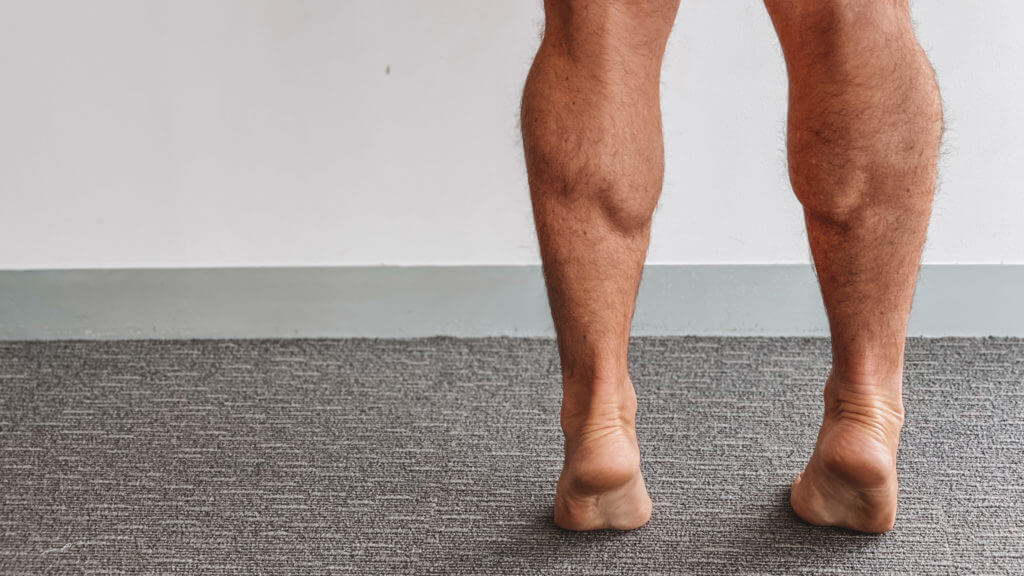
Runners *don't* have small calves, at least not in comparison to the rest of their bodies. Many elite runners have lower legs that seem like they should belong to a bigger person; that's true of both sprinters and distance runners, especially in the soleus. (But elite runners are small/thin/light people, so they're not going to have bodybuilder calves.)
The reason runners don't have giant calves is because the ultimate goal in running is to have ankles that are as stiff as possible, so that the calf works through only a very short range of motion on each stride. The smaller the range of motion, the less hypertrophy will occur. Ideally, for running, you want very strong calves, but only in a very limited range of motion (so that your ankles are very stiff).
This post was edited 2 minutes after it was posted.
Reason provided:
Add detail.
We know from Dr. Rich Willy (2019) that the calf complex is extremely important, attributing up to 50-60% of force production when running.
EMG studies have shown the soleus in particular is the powerhouse for runners, finding it produces up to 6.5-8 times body weight of force during running. Studies have also found soleus force production remains largely consistent throughout low, moderate and high running speeds. This is unlike the hamstring muscle which is required more as running speed increases (Dorn et al., 2012).
Rich is the physical therapist and scientist behind Montana Running Lab. An internationally known researcher and speaker on clinically effective treatments of common running-related injuries, he has more than 20 years’ experience as a clinician and 10 years as a professor of physical therapy.
so if the calves are producing the same force on slow runs as fast runs, a lot of the development power gained in them must be through long runs, as they are getting so much more repetition. Is it reasonable to think a lot of the gains you make through high mileage come from the gains made through the calves?
I was just talking to somebody the other day about how when im very high mileage, my "easy runs" are at a relative faster pace than usual, even though my legs feel they're running through sand. Mentally I feel like im running a very slow pace, but I look at my watch im actually kind of moving. Maybe it's the calves have a good spring to them, while the rest of the legs are dead tired.
Anybody who has spent time in the weight room knows the calves respond to extreme repetition compared to other body parts.
1. Ideally the calves act nearly isometrically, or at least in a very short range of motion, while running; however they must indeed transmit/accommodate higher forces while running faster because the total force impulse must be roughly the same but the ground contact is shorter.
2. High mileage is somewhat similar to "time under tension" in the gym -- it is known that long times under tension encourage the strengthening of collagenous tissues (like the Achilles tendon). So high mileage will make the whole lower leg system (foot/ankle/calves) tighter and stiffer, and this improves everything from maximal velocity to running economy. (This is the same fundamental reason that rock climbers get forearm tendon hypertrophy.)
so if the calves are producing the same force on slow runs as fast runs, a lot of the development power gained in them must be through long runs, as they are getting so much more repetition. Is it reasonable to think a lot of the gains you make through high mileage come from the gains made through the calves?
I was just talking to somebody the other day about how when im very high mileage, my "easy runs" are at a relative faster pace than usual, even though my legs feel they're running through sand. Mentally I feel like im running a very slow pace, but I look at my watch im actually kind of moving. Maybe it's the calves have a good spring to them, while the rest of the legs are dead tired.
Anybody who has spent time in the weight room knows the calves respond to extreme repetition compared to other body parts.
1. Ideally the calves act nearly isometrically, or at least in a very short range of motion, while running; however they must indeed transmit/accommodate higher forces while running faster because the total force impulse must be roughly the same but the ground contact is shorter.
2. High mileage is somewhat similar to "time under tension" in the gym -- it is known that long times under tension encourage the strengthening of collagenous tissues (like the Achilles tendon). So high mileage will make the whole lower leg system (foot/ankle/calves) tighter and stiffer, and this improves everything from maximal velocity to running economy. (This is the same fundamental reason that rock climbers get forearm tendon hypertrophy.)
For running, I believe most of the aerobic adaptations other than the heart and lungs are in the muscle fibers of the Soleus which we know is mainly slow twitch. It’s also a flat muscle. So, you don’t see much in the way of hypertrophy.
And yeah, there’s also a conditioning effect that comes from time under tension.
This post was edited 1 minute after it was posted.
Calves are pretty much the only muscles that get worked
Peak force on the soleus is about 7x bodyweight and is at around 8min/mi I believe. Anything faster will not increase this number but rather tax the hamstring, quads and gastroc.
Peak force on the soleus is about 7x bodyweight and is at around 8min/mi I believe. Anything faster will not increase this number but rather tax the hamstring, quads and gastroc.
Anyone who has ever had hamstring issues [sigh] knows it’s only when you get into the speed work paces does it become an issue.
I think runners will tend to have good calves. I had no calves when I was a distance runner, but I had no muscle and high body fat and my biomechanics were heel striking.
after lifting and sprinting for years since, I trained and ran an 8k run and my calves were destroyed for days after, because I weighed 15 lbs more than in high school, and I ran a lot more on the ball of my feet than I'd previously done. My calves actually have definition now, but they're only 13-13.5 inches around
if ur calves are the main movers, your mechanics are bad. Glutes glutes glutes
Two pages and no one has mentioned anatomical slings. They are the most important factor in locomotion. Quads, glutes, hammy's and calves are just supporting actors.