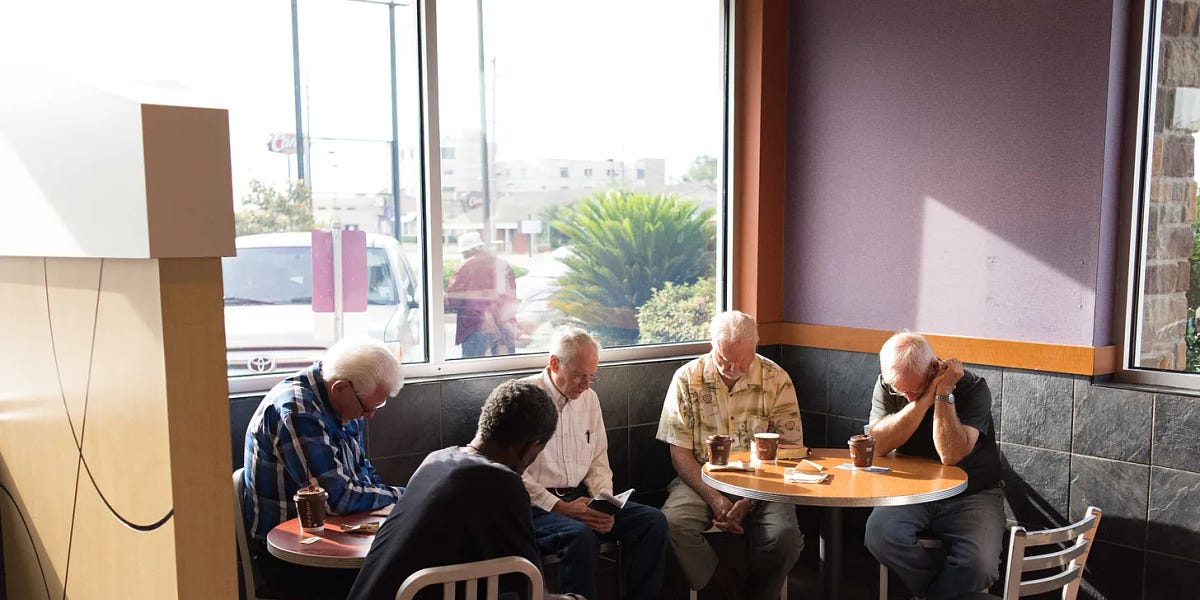
There are so many alternatives to Starbucks. It's a fry cry from the position of leverage the longshoremen and teamsters hold. People will just go to one of the other 17 coffee places around the corner.
My wife would go to Starbucks if they charged $20 a cup. You don't understand the hold that Starbucks has on people.
I can get the senior coffee at McD for 89 cents with unchallenged refill.
Also, because I am smartly dressed, I can loiter there for an hour or more.
One nice thing about Starbucks (at least in the PNW) is that most locations are very nice. All of my kids will meet their friends there, do homework, drink hot chocolate, and spend an hour talking. It is a good place for them to hang out. Leather chairs, wood tables, nice lighting.
Nobody in my family has ever "loitered for an hour in a McDonald's" nor would I encourage that. I'd rather have them pay $4.95 for a hot chocolate or mocha at Starbucks while doing their homework than sit in the dirty carnival lights of a McDonald's.
p.s. If I need to meet up with the people I mentor outside of work, I am not going to meet them at a McDonald's either. So for adults it provides a good place to have an informal talk.
I guess it depends on how you define loitering. But that was not the point.
My point was that nobody who is normal would sit for an hour in a McDonald's in a yellow plastic booth under florescent lights while smell of burger grease wafted through the air.
Normal people do go to Starbucks and work on their laptops or talk to a friend for an hour.
A lot of people find that paying $4.75 for coffee is worth it if they can work on their laptops and send some emails. Would you do that at an Carl's Junior or a Dairy Queen? That would be weird.
you said it. who's gonna go to school if you can just get a job at 16 that will pay you to have a nice living.
And honestly, most people make 15 an hour or more these days. Many fast food type places are closer to 20. You can live off that. Problem is everybody wants what everybody else has.
Try living on a pay of close to $20 per hour.
Ok. Simple math.
Somebody with no qualifications, no skills, no degree makes $20 an hour.
So how much more does a shift supervisor make? A manager?
How is this sustainable for any business to effectively staff?
Why does somebody with no skillset deserve $20 an hour?
I can get the senior coffee at McD for 89 cents with unchallenged refill.
Also, because I am smartly dressed, I can loiter there for an hour or more.
One nice thing about Starbucks (at least in the PNW) is that most locations are very nice. All of my kids will meet their friends there, do homework, drink hot chocolate, and spend an hour talking. It is a good place for them to hang out. Leather chairs, wood tables, nice lighting.
Nobody in my family has ever "loitered for an hour in a McDonald's" nor would I encourage that. I'd rather have them pay $4.95 for a hot chocolate or mocha at Starbucks while doing their homework than sit in the dirty carnival lights of a McDonald's.
p.s. If I need to meet up with the people I mentor outside of work, I am not going to meet them at a McDonald's either. So for adults it provides a good place to have an informal talk.
I agree with you on McDonalds, but all kinds of people actually do “loiter” at Starbucks for a very long time. I don’t go there anymore because I think their coffee sucks and it’s expensive, but I would never hang out for more than 20 min or so because I would feel like I’m taking someone else’s seat.
Some people absolutely cannot do without their Starbucks, as it’s one of the iconic liberal brands, but the good news for those of us who don’t like it is we can go to any number of other cafes in town that aren’t under constant threat of unionizing and that don’t just make commoditized crappy seasonal drinks.
Side question, if someone works a full-time job, should they still be "poor" or should people who work full-time be able to make a living wage?
If not, then why would anyone take these jobs? I understand (and agree) with you that they are easy jobs in terms of the educational level needed to do them, but it seems like it is possible to work full time and still be poor. That feels weird to me.
Are we okay with that? Work 40 hours a week, do a good job at work each day, and still be poor?
Most baristas are neither bread winners for the family nor are they trying to earn a living. It’s a good college or high school job that pays $20/hr+ with tips. The people who truly work there for a career (5%) will eventually move up to be assistant managers, managers, regional managers, or franchisees.
I worked at McDonalds actually as a sixteen year old (best thing that could’ve ever happened to me) and then delivered pizzas all through college and even after to help pay for school. Never demanded a “livable wage.” People who aren’t cut out for traditional school can make enormous money as plumbers, electricians, medical sonographers, etc. Or working for UPS. I just had a young looking 55-year old come out the other day to replace my garage door. He told me it was his second to last day, that he had been with the company since age 18 and was retiring with a fat pension.
There are all kinds of situations like this. One of my kids works at a pizza place right now making $19/hr with tips, but it’s an extra money job. It’s not a career. And I would completely discourage her from ever being part of a union in such a low skilled and not dangerous position. Ludicrous.
Jobs in my area typically pay $20 an hour. If they can meet all their staffing needs on that kind of money, then they keep paying $20 an hour.
The kinds of jobs that pay $20 an hour, are often the grunt work that allows those higher on the earning pyramid to earn much more. So, in the hotel business, the housekeepers might earn $20 an hour.
Would people want to come on vacation if they were not given a clean room to stay in? Would they be willing to pay $275 a night if there were no housekeepers to put sheets on the bed or wipe urine off the toilet?
If housekeepers cannot walk to work, then they have to have a car, or get a ride. Cars are not free.
Housekeepers are not invincible — they often look to be in poor health, same health probs as the rest of us. Their pay needs to cover medical costs, whether they choose to go out of pocket ones, or do health insurance.
Side question, if someone works a full-time job, should they still be "poor" or should people who work full-time be able to make a living wage?
If not, then why would anyone take these jobs? I understand (and agree) with you that they are easy jobs in terms of the educational level needed to do them, but it seems like it is possible to work full time and still be poor. That feels weird to me.
Are we okay with that? Work 40 hours a week, do a good job at work each day, and still be poor?
You bring up good points, that are of course millenia old, but the problem has always been, who decides how much the wages should be and for what jobs and where?
It would be perfectly just and ethical that a janitor is paid say 40 grand a year with benefits and a pension. But if his employer, say a hospital, is coerced to pay him that much, the employer will make cuts to let's say medical equipment and beds. So the patient or consumer loses. The employer wants to make as much money as possible and will only make less if he is forced by the government with higher wages for his employees. The employer will do anything possible to maintain profit margins.
So your choices are these:
to allow a robust free market where firms and employees can pay what they want and whereby the low wage employees will work for them or go to another firm to improve wages and working conditions. Normally the consumer wins because the firm can direct more revenue to product and service quality at a cheaper price.
Or
The government regulates employee compensation through a minimum wage regardless of the employer's budget or goals. The employee gets paid more but the customer loses out because the firm has to now make cuts in product and service quality.
Side question, if someone works a full-time job, should they still be "poor" or should people who work full-time be able to make a living wage?
If not, then why would anyone take these jobs? I understand (and agree) with you that they are easy jobs in terms of the educational level needed to do them, but it seems like it is possible to work full time and still be poor. That feels weird to me.
Are we okay with that? Work 40 hours a week, do a good job at work each day, and still be poor?
That’s not a refutable question without a precise definition of “poor”. I’d say the answer is Yes for what in my mind is poor. Baristas can live on what they make. Some people in any society have to be poor because people’s abilities and luck are not the same.
Side question, if someone works a full-time job, should they still be "poor" or should people who work full-time be able to make a living wage?
If not, then why would anyone take these jobs? I understand (and agree) with you that they are easy jobs in terms of the educational level needed to do them, but it seems like it is possible to work full time and still be poor. That feels weird to me.
Are we okay with that? Work 40 hours a week, do a good job at work each day, and still be poor?
You bring up good points, that are of course millenia old, but the problem has always been, who decides how much the wages should be and for what jobs and where?
It would be perfectly just and ethical that a janitor is paid say 40 grand a year with benefits and a pension. But if his employer, say a hospital, is coerced to pay him that much, the employer will make cuts to let's say medical equipment and beds. So the patient or consumer loses. The employer wants to make as much money as possible and will only make less if he is forced by the government with higher wages for his employees. The employer will do anything possible to maintain profit margins.
So your choices are these:
to allow a robust free market where firms and employees can pay what they want and whereby the low wage employees will work for them or go to another firm to improve wages and working conditions. Normally the consumer wins because the firm can direct more revenue to product and service quality at a cheaper price.
Or
The government regulates employee compensation through a minimum wage regardless of the employer's budget or goals. The employee gets paid more but the customer loses out because the firm has to now make cuts in product and service quality.
Fair enough but, by way of example, the McDonalds where I live is offering $19 per hour to start (I don’t live in a HCOL city but a suburb which is growing rapidly and whose costs are rising). That is the market setting the minimum wage. Inside a year, that same employee is making, what, $21-22 per hour? That’s what they have to pay to attract employees. No government regulation needed for that. These baristas aren’t working at a nuclear facility or window washing the outside of skyscrapers for crying out loud. That’s a different situation.
By the way, if you’re a reasonable person like me, you leave nice tips in your hotel room for the maids and you hire maids for your own house at about $60 per hour plus. But I’m a conservative and I believe in being charitable, not tithing to the government as much as is arbitrarily demanded and then them “being charitable” with my tax dollars after they waste 50% of it on bureaucratic constipation.
You bring up good points, that are of course millenia old, but the problem has always been, who decides how much the wages should be and for what jobs and where?
It would be perfectly just and ethical that a janitor is paid say 40 grand a year with benefits and a pension. But if his employer, say a hospital, is coerced to pay him that much, the employer will make cuts to let's say medical equipment and beds. So the patient or consumer loses. The employer wants to make as much money as possible and will only make less if he is forced by the government with higher wages for his employees. The employer will do anything possible to maintain profit margins.
So your choices are these:
to allow a robust free market where firms and employees can pay what they want and whereby the low wage employees will work for them or go to another firm to improve wages and working conditions. Normally the consumer wins because the firm can direct more revenue to product and service quality at a cheaper price.
Or
The government regulates employee compensation through a minimum wage regardless of the employer's budget or goals. The employee gets paid more but the customer loses out because the firm has to now make cuts in product and service quality.
Fair enough but, by way of example, the McDonalds where I live is offering $19 per hour to start (I don’t live in a HCOL city but a suburb which is growing rapidly and whose costs are rising). That is the market setting the minimum wage. Inside a year, that same employee is making, what, $21-22 per hour? That’s what they have to pay to attract employees. No government regulation needed for that. These baristas aren’t working at a nuclear facility or window washing the outside of skyscrapers for crying out loud. That’s a different situation.
By the way, if you’re a reasonable person like me, you leave nice tips in your hotel room for the maids and you hire maids for your own house at about $60 per hour plus. But I’m a conservative and I believe in being charitable, not tithing to the government as much as is arbitrarily demanded and then them “being charitable” with my tax dollars after they waste 50% of it on bureaucratic constipation.
In your McDonalds example, that is not really the market setting a minimum wage. That is the firm realizing that employees in that area will not work those jobs for less than 19 bucks per hour. McDonalds could choose to pay as low as the state minimum wage, but McDonalds clearly sees in this case that doing so will lead to staffing shortages, high turnover, higher training costs, and lost sales revenue. It’s a decision based on local information the firm is using to maintain a staff at the lowest wage they can pay, in this case 19 bucks an hour. This is profit maximization strategy, not the same thing as paying a compulsory wage.
My point was that nobody who is normal would sit for an hour in a McDonald's in a yellow plastic booth under florescent lights while smell of burger grease wafted through the air.
Jobs in my area typically pay $20 an hour. If they can meet all their staffing needs on that kind of money, then they keep paying $20 an hour.
The kinds of jobs that pay $20 an hour, are often the grunt work that allows those higher on the earning pyramid to earn much more. So, in the hotel business, the housekeepers might earn $20 an hour.
Would people want to come on vacation if they were not given a clean room to stay in? Would they be willing to pay $275 a night if there were no housekeepers to put sheets on the bed or wipe urine off the toilet?
If housekeepers cannot walk to work, then they have to have a car, or get a ride. Cars are not free.
Housekeepers are not invincible — they often look to be in poor health, same health probs as the rest of us. Their pay needs to cover medical costs, whether they choose to go out of pocket ones, or do health insurance.
That’s the pragmatic answer.
This is another issue that cascades from the one at hand, but since you mentioned hotels...
I was just in a hotel. Speaking of housekeepers, my hotel room (major chain that you've heard of) had handprints all over the mirror, a dirty table, an unclean bathroom, and my kid found old French fries under the desk.
Many people want to "go" to work and collect that 20, but they're not working for it.
I can tell twenty similar stories about retail experiences, but so could everyone here most likely.
The reason I don't like Starbucks is because it's the quintessential bastion of all things woke and liberal. The baristas are all purple haired gender fluid-ers, who somehow believe it works out financially for them to get paid more than the managers and the executives/franchisees. The only way I will ever step foot into a Starbucks is if a robot will make my coffee. A robot won't strike, and it won't leave its phone number and a heart smiley face on my coffee cup like all the so called male baristas do.
There are so many alternatives to Starbucks. It's a fry cry from the position of leverage the longshoremen and teamsters hold. People will just go to one of the other 17 coffee places around the corner.
Mechanical Engineers have made six-way robots cranes to replace Longshoremen.
Can’t wait for all the entitled administrators and secretaries to be replaced by AI. They could’ve been replaced years ago
If they start making 80K i'm applying. Braindead easy and don't take any work stress home with you from the office. I'd gladly take a 50k pay decrease for that for a while.