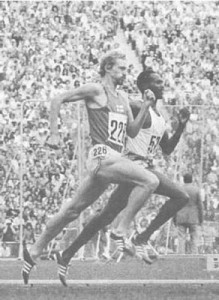
Snell ran 1:44 on grass over 60 years ago, then in Tokyo he ran over all comers, including Kiprugut and Kerr, not exactly the whitest fellas out there.
To carve 1.4s off the then world 800 record and 1.7s off the half mile (in the same race) in 1962 was quite some feat. And on grass. You have to wonder what that would have been on mondo and in super spikes. Add to that a kick of unprecedented power. And he was an amateur with a day job. If you can remember the early '60's it's easy to understand the awe that he inspired.
That’s what I really like about this era of coaching 50s-70s. They were true coaches, used their eyes and learned from what they were doing.
I have seen so many coaches (of all events) that don’t know anything about coaching. They are going directly from a book or slide presentation from a coaching convention. The art of coaching has been lost, read everything you can but then go see what the team can handle.
One crazy Norwegian went on a running quest in the 90s and we got double threshold from it. No one cared until the IG brothers made it a global trend.
I remember one coach being asked why X athlete was running so many miles. Their response was the athlete gains a lot of weight without the miles. Other athletes were trim, didn’t need to burn the calories.
8th - three quarter mile - 880 in 1.56 and final 440 as he felt
9th - 440 - 55s - 4 times 100yds - full
10th - 2 times 1 mile - half effort.
11th - 3 times 220 - full effort
12th - 10 times 440 - av 58.5
13th - Long run
14th - 10 miles morning - 4 times 150yds - 6 times 50yds
15th - 2 times 880 - windy and wet - 2m2s and 2m 1.7
16th - 10 miles morning - 3 miles - 14m 12s
17th - 6 times 440 - 58s
18th - 3 times 220 all out.
19th - three quarter mile - 3m 0.5s
20th - 20 mile - half effort
21st - One hour jog
22nd - 6 times 220 stride outs
23rd - One hour jog
24th - Flew to Sydney - 6 times 220 stride outs
25th - 660 - 1m19s
26th - Flew Japan
(jogged most mornings in Japan for 1 hour)
17th - the hour jog
28th - 20 times 220 stride outs
29th - 1 mile of 50yd dashes.
30th - three quarter mile - 2m.56s
October
1st - 2 hour run - strong and even
2nd - 4 times 440
3rd - 6 times 880 - half effort - av 2m5s
4th - 1 mile - 4m2s
5th - 10 times 220 stride outs
6th - Sprint training over 150yds
7th - 800mts fast - 1.47.1
8th - 1 hour jog
9th - 880 in 50yd dashes
10th - 1 hour jog
11th - 3 times 220 full
12th - 1 hour jog
13th - half an hour jog
14th - 800mt heat - 1m49s
15th - 800mt semi - 1m46.9
16th - 800mt final - 1m45.1
17th - 1500mt heat - 3m46.6
18th - 1 hour jog
19th - 1500mt semi - 3.38.8
20th - 1 hour jog
21st - 1500mt final - 3.38.1
Well done. One of the things not commonly understood about Lydiard is that the recommended conditioning phase ("100 mpw") was only 3 months. Snell said that the only time in his career he achieved that mileage was in the lead-up to Tokyo.
Lydiard developed his training philosphy from the successes of prior coaches like Cerutty, and a lot of his own trial and error. He did so in the era before we had the current level of scientific understanding of aerobic and anaerobic metabolism. Rather than being "discredited", Lydiard's coaching has been refined with the added knowledge of metabolic biochemistry and tools like heart monitors, lactate testing and other scientific advances that allow coaches to know more precisely the impacts of training that Lydiard had to estimate from just a stopwatch and personal observation of his athletes.
Lydiard didn't develop his methods from Cerutty. They were contemporaries but Lydiard's methods were developed from his own running in the early '50's and with his early proteges like Halberg. I doubt he was aware of Cerutty until Elliott's successes in the late '50's.
The accretion of scientific knowledge you refer to has explained much of why his methods worked, but it also shows that practical application and experience are better for doing things than theorising about how they could be done.
Arthur would have known of Cerutty before 1960. Sometime in the mid 50s Bill Baillie and Bill Roger moved to Australia for a while and worked with Cerutty when they were there. They didn't stay all that long but long enough to have gotten an idea of what Cerutty did, Baillie later said it wasn't all that different from what Arthur did. So both coaches would have known of each other before either really hit it big.
That said, there were three big influences on Arthur's thinking aside from his own experimentation. One was a physiologist called F.A.M. Webster who wrote an exercise physiology book in the 1930s (I think.) A big idea from the book was a line that said something like millions of humans could run a 440 in a minute but none could run a mile at that speed, therefore we know humans have the speed to run a four minute mile but lack the endurance to do so. A second was an older guy, Jack Donlan I think he was called, who belonged to Arthur's athletic club who once took Arthur for a run of five miles or so and pretty much ran Arthur, who was playing rugby at the time and not training for running, into the ground. The third was Zatopek who influenced so many runners and coaches. Arthur, like van Aaken, was mostly impressed by the huge training volumes he was doing productively, much bigger than most runners and coaches at the time believed possible.
Lydiard had to contend with a different opposing training approach than pros do today. Back then it was all interval 400s, racing 50 times a year, going to the well constantly, etc. Nowadays there are very, very few elites that are going above an 8/10 more than 20 times per year. Most workouts are viewed as a maintenance and building exercise, rather than a truly hard effort. One 8-9/10 workout a week along with one or two 6-7/10 workouts, the rest just mileage, is much more in line with Lydiard's base-building principles than it would seem.
Was he wrong about doing stamina work "for as long as possible?" I see so many recommendations for doing interval training. Lydiard was against most of that.
Even Lydiard prescribed intervals at times.
But yes, Lydiardism has long since been discredited. Nobody uses Lydiard training in the modern era and certainly not 800 guys.
Discredited by be over stating the case.. Training philosophies evolve. The actual implementations evolve. However, the basic principles of Lydiard remain directionally true.Build an aerobic base, build some strength, sharpen your anaerobic capacity, build your speed.
Now people try to keep strength up all the time, they use more than just steady running to build aerobic base, they keep touch with their speed year round. The one thing that is common between lydiard and current training is to watch carefully the amount of anaerobic training you do.
Can you do pure lydiard training today an be successful? Probably. Or at least up to a point? Can you do better by incorporated what we've learned over the past 50 years? Certainly.
You can also do worse than lydiard, and you can see by US High School performance in the 90's.
Lydiard didn't develop his methods from Cerutty. They were contemporaries but Lydiard's methods were developed from his own running in the early '50's and with his early proteges like Halberg. I doubt he was aware of Cerutty until Elliott's successes in the late '50's.
The accretion of scientific knowledge you refer to has explained much of why his methods worked, but it also shows that practical application and experience are better for doing things than theorising about how they could be done.
Arthur would have known of Cerutty before 1960. Sometime in the mid 50s Bill Baillie and Bill Roger moved to Australia for a while and worked with Cerutty when they were there. They didn't stay all that long but long enough to have gotten an idea of what Cerutty did, Baillie later said it wasn't all that different from what Arthur did. So both coaches would have known of each other before either really hit it big.
That said, there were three big influences on Arthur's thinking aside from his own experimentation. One was a physiologist called F.A.M. Webster who wrote an exercise physiology book in the 1930s (I think.) A big idea from the book was a line that said something like millions of humans could run a 440 in a minute but none could run a mile at that speed, therefore we know humans have the speed to run a four minute mile but lack the endurance to do so. A second was an older guy, Jack Donlan I think he was called, who belonged to Arthur's athletic club who once took Arthur for a run of five miles or so and pretty much ran Arthur, who was playing rugby at the time and not training for running, into the ground. The third was Zatopek who influenced so many runners and coaches. Arthur, like van Aaken, was mostly impressed by the huge training volumes he was doing productively, much bigger than most runners and coaches at the time believed possible.
I didn't say Arthur wouldn't have known of Cerutty till 1960. Elliott became the best miler in the world in 1958. Arthur's charges, like Halberg and Baillie, were achieving international profiles by 1954. If they met Cerutty they didn't indicate they had been influenced by him. I don't recall Arthur mentioning Cerutty in his writing about his own methods. Arthur produced a stable of runners; Cerutty would largely be unknown but for one. That said, there were similarities in their methods. This was probably because they both based their ideas on experience. Hard work was at the heart of it.
This post was edited 31 seconds after it was posted.
I don't know how well the two of them got on or how well they knew each other. Arthur told me once the "Old Perce was a showman." I've read some things Cerutty has written and I can see similarities, the biggest one being an emphasis on developing endurance as the starting point. Arthur was much better organized in terms of how he presented his system. Cerutty seemed as much interested in developing a philosophy as in producing champion athletes and he did at least domestically but none had the kind of success Elliott had and maybe he just lucked out there. Ron Clarke said that his, Ron's, grandmother could have coached Elliott to a gold medal. If not for Elliott I doubt many people would know who Cerutty was.
He confused "aerobic capacity" with "aerobic endurance".
For that reason, he believed that racing limited physiological development. Which obviously isn't true. That can be a short term limitation, sometimes, but not long term.
He also, per himself and many of those who worked with him, appeared to violate a lot of the principles attributed to him (kind of a misnomer since it's just the interpretation of his training). Lydiard's charges did quite a few hard workouts almost every week and a lot of those longer endurance runs were much harder than easy pace or effort. His approach kind of ran his guys into the ground.
And it's worth noting many of his top runners didn't last long, nor did he get any real new blood working with him after the 1960's. He caught lightning in a bottle with guys like Peter Snell. Historically, Lydiard was on the right track as to what training is most effective, but he didn't quite figure out a lot of keys that others who came after him and adopted his ideas have figured out since.
He confused "aerobic capacity" with "aerobic endurance".
For that reason, he believed that racing limited physiological development. Which obviously isn't true. That can be a short term limitation, sometimes, but not long term.
He also, per himself and many of those who worked with him, appeared to violate a lot of the principles attributed to him (kind of a misnomer since it's just the interpretation of his training). Lydiard's charges did quite a few hard workouts almost every week and a lot of those longer endurance runs were much harder than easy pace or effort. His approach kind of ran his guys into the ground.
And it's worth noting many of his top runners didn't last long, nor did he get any real new blood working with him after the 1960's. He caught lightning in a bottle with guys like Peter Snell. Historically, Lydiard was on the right track as to what training is most effective, but he didn't quite figure out a lot of keys that others who came after him and adopted his ideas have figured out since.
Arthur always said his runners did as much or more fast running as anyone did when they were doing that sort of work and that they could do that because they had developed their aerobic capacities better than their competition. Yes, his guys sometimes did a lot of hard sessions but only for the very limited times of year when that was their focus. Hard sessions did not violate his principles. Near year round hard sessions did. .
The pace on their long runs could not have been all that imposing. He usually ran with his guys on the long runs. In say, 1960, he was 43. His best marathon was 2:38. How hard could it have been for guys who'd done things like four minute miles and 2:20 like marathons? His advice to anyone about pacing on distance runs was just "enjoy yourself." On shorter runs, 10-15 miles there was some pace pushing. Barry Magee told me they routinely would do 10 mile runs where they went five miles "out" at about six minute pace and came "back" at around 5:20.
He never liked it when people said he advocated long, slow, distance. He always said that his runners ran as fast as they could without getting out of breath. But another way of saying that was that his runners ran as slowly as they needed to to avoid getting out of breath. pretty
"His top runners didn't last long." That was pretty common in the amateur years. Snell retired when he was fairly young. I think Halberg did too. Davies probably would have lasted longer but had Achilles trouble that kept him from running hard or much. Bill Baillie kept running until early this century. Barry was cranking out 2:40 marathons when he was well into his sixties. Jeff Julian won the pre Olympic Marathon in Tokyo and was still winning domestic marathons in the late seventies.
No, Lydiard wasn't directly coaching anyone to Olympic medals after 1964. He stopped coaching in New Zealand shortly after Tokyo. He was briefly Mexico's national distance coach. That didn't go well and he moved on to be national coach in Finland and then Denmark both of which went well but he was advising coaches rather than coaching directly. He was back in New Zealand by 1973 and coached Richard Tayler to the 10,000 gold at the '74 Commonwealth Games and in the 80s got several girls from the high school where his wife taught to international class. He coached Paul Ballinger to a 2:10 marathon and a win at Fukuoka but by 1966 or so he was mostly done with direct coaching.
Lydiard's training method involves developing the athlete's different energy systems in four different sequential phases. He designs training programs so that the athlete is ready for the next phase only after completing one phase.
Longer strides: Lydiard employed many different combinations of distance and repetitions in his programmes. As you progress through the phases of training you can change the 10x100m workout to 4x300m or 3x200m; the permutations are endless but generally don’t stride any longer than about 25 seconds strides as this will start to induce an acidosis similar to what intervals create and make it difficult to maintain relaxed form.
He confused "aerobic capacity" with "aerobic endurance".
For that reason, he believed that racing limited physiological development. Which obviously isn't true. That can be a short term limitation, sometimes, but not long term.
He also, per himself and many of those who worked with him, appeared to violate a lot of the principles attributed to him (kind of a misnomer since it's just the interpretation of his training). Lydiard's charges did quite a few hard workouts almost every week and a lot of those longer endurance runs were much harder than easy pace or effort. His approach kind of ran his guys into the ground.
And it's worth noting many of his top runners didn't last long, nor did he get any real new blood working with him after the 1960's. He caught lightning in a bottle with guys like Peter Snell. Historically, Lydiard was on the right track as to what training is most effective, but he didn't quite figure out a lot of keys that others who came after him and adopted his ideas have figured out since.
Lightening certainly seemed to strike Lydiard a lot: Peter Snell, Murray Halberg, Bill Bailie, John Davies, Richard Tayler ... he must have been really unlucky
Hardly. Rudusha ran far less per week, no long runs and had trouble keeping his weight up.
Lydiard wrote that much of the mileage Snell did was to help keep his weight down; in the modern era great 800/1500 runners run closer to 100km/week not 100mi and are far more careful with nutrition periodization and avoiding overtraining. Anybody running 1:44 800 these days is disappointed with anything over 3:35 1500.
It certainly worked for Snell. You can't deny that.
Yes but who was Snell racing. Pretty much white folk from the first world. Would or does Lydiard training stack up in the 21st century. Nope.
Who are Wanyonyi amd Arop racing? Most talented athletes in the West go into soccer or other sports that pay 1,000 x more for being 100th best in the world than athletics does for being best in the world.
Snell's era was the baby boomer era. Snell could have been a pro tennis player but he chose track. That would never happen now.
1:44.3 on grass 60 years ago. Just the gel would apparently turn that into a 1:42.
I met Arthur Lydiard in the 90s. He told me (a 4:30 miler) that I could break 4:00 in the mile. Made me realize that he told everyone that they could break 4:00 in the mile. That was probably one of the secrets of his coaching--he inspired people. BTW, I went out and ran 90 mile weeks and got stress fractures and never broke 4:30.