+1
Scientist: We have no idea how supershoes work but they do...
Running Shoes/Running Gear
Shoes
-
03
-
All the cheat-shoe apologists coming out of the woodwork. They’ll deny the advantage as long as they can wear cheat-shoes in every race. If they were ever made illegal, you’d see grown men at every level crying. If they don’t work stop spending money on them.
510 -
Lady of the Lake Coach wrote:
Not much science to it.
They are only slightly beneficial on road surfaces. They do not help on trail or grass or track surfaces.
Anyone who thinks they help on any surface besides a hard concrete road is out of their mind.
Anyone who has put on a pair of super shoes and walked 10 ft. in them knows that they work... Maybe they don't work for walk/joggers or terrible shufflers, and that could be your issue.
Adidas now has a trail pair which have won numerous major ultra/mountain races.
82 -
hmm m wrote:
There are countless research studies and whole labs (like the UMass Integrative Locomotion Lab) dedicated towards understanding the science behind advanced footwear technology (AKA "supershoes"). Just because you/this person doesn't understand, doesn't mean there's no science behind them.
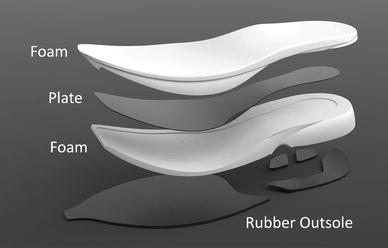
If you talk to the people at the UMass Integrative Locomotion Lab, you'll find that they too aren't sure how supershoes works. Of course it's not correct to say that they have "no idea" how they work, but they don't understand it. Wouter, who heads the lab, did a study a few years ago using a table saw to slice right through the carbon plate of a Vaporfly in six places. Amazingly, that basically didn't affect the running economy values of the shoe! That completely undermines the explanations involving longitudinal bending stiffness. And yet the shoes don't work without a carbon fiber plate.
Lots of people have various theories about how the shoes work, and many of those theories probably have a kernel of truth. But the fact is that no one is entirely sure why they work so well.
76 -
umberto wrote:
If you talk to the people at the UMass Integrative Locomotion Lab, you'll find that they too aren't sure how supershoes works. Of course it's not correct to say that they have "no idea" how they work, but they don't understand it. Wouter, who heads the lab, did a study a few years ago using a table saw to slice right through the carbon plate of a Vaporfly in six places. Amazingly, that basically didn't affect the running economy values of the shoe! That completely undermines the explanations involving longitudinal bending stiffness. And yet the shoes don't work without a carbon fiber plate.
Lots of people have various theories about how the shoes work, and many of those theories probably have a kernel of truth. But the fact is that no one is entirely sure why they work so well.
Most lay people both underestimate and overestimate how much scientists do understand and don’t understand about their subject matter. Only someone with decent research experience can appreciate that dichotomy.
124 -
Old Runner wrote:
Why do so many tank on this topic? SHOES are an advantage over the natural way of running, which would be without shoes. When rubber came along for the soles of the shoes as well as lighter materials, the shoes became more advanced and provided benefit over previous shoes that didn't use these materials. Shoes have now taken ANOTHER advancement in technology. But this one is bad? Now, if the "unfairness" is tied to availability, I would tend to agree that all athletes should have equal access to the tech. But I wholeheartedly disagree that it's an advantage that shouldn't be allowed. If it is, then get rid of all shoes.
What if it is proven that the same exact shoe gives one pro a 2% benefit, but gives another pro a 10% benefit?
34 -
No need to let the other person they are wrong so many times. Be a bit nicer.
11 -
umberto wrote:
hmm m wrote:
There are countless research studies and whole labs (like the UMass Integrative Locomotion Lab) dedicated towards understanding the science behind advanced footwear technology (AKA "supershoes"). Just because you/this person doesn't understand, doesn't mean there's no science behind them.
If you talk to the people at the UMass Integrative Locomotion Lab, you'll find that they too aren't sure how supershoes works. Of course it's not correct to say that they have "no idea" how they work, but they don't understand it. Wouter, who heads the lab, did a study a few years ago using a table saw to slice right through the carbon plate of a Vaporfly in six places. Amazingly, that basically didn't affect the running economy values of the shoe! That completely undermines the explanations involving longitudinal bending stiffness. And yet the shoes don't work without a carbon fiber plate.
Lots of people have various theories about how the shoes work, and many of those theories probably have a kernel of truth. But the fact is that no one is entirely sure why they work so well.
Someone at Nike certainly understands how they work.
31 -
as real good supershoes wrote:
Laase wrote:
Remember when you made a video about them? That was greatness.
yeah, how did it go again? He was like, "wow, as I ran a mile without supershoes and pushing a baby stroller in 9 minutes, as then I not push baby stroller with supershoes and run a mile in 8 minutes."
And we are all like, um, yeah, okayGet your facts straight, it was a dog stroller!
01 -
highschool physics teacher wrote:
tickle time wrote:
A modern track is more responsive than a road.
Sounds like you need to grab a dictionary and look up the definition of the word responsive. Not only are you wrong, but you are absolutely wrong. Not only are you wrong, but you are also incorrect.
Responsive, in a shoe sense, means that the shoe itself is bendable and flexible. I.e.- the nike free. This is not what we are talking about.
Responsive, in the sense we are talking about, means "boingy." The idea behind carbon plated shoes is that the carbon "boings" the runners step up and forward, and does not absorb the shock like a cushion does. This is exactly why super shoes are not effective on track surfaces or any other soft surface.
A running track would absorb all of the runners shock and pressure of each step and defeat the entire purpose of wearing a carbon plated supershoe.
Again, not onlybare you wrong. But you are absolutely wrong. Not only are you wrong, but you are also incorrect.
How old are you?
01 -
The high stack = longer legs = longer strides part might not be that beneficial (or at all beneficial) as it still requires more muscle activation to take advantage of the increased length. This factor likely varies a ton between athletes. My understanding of the research so far is that the bounce is the main benefit of the new foam, and the main benefit of the tall stack is having more of the right kind of foam gives more bounce, and does do without much increase in weight because the foam is so light.
31 -
CO Coach wrote:
Someone at Nike certainly understands how they work.
It's possible - they're very secretive. But there's no guarantee that they actually understand it. The carbon plate design emerged from previous work at the University of Calgary (and Adidas) that assumed the benefit of a curved carbon fiber plate was that it would save energy that's otherwise wasted bending the big toe joint. That's probably true to a degree, but that effect isn't big enough to explain how well the shoes work. It may well be that in playing around with a few different design options - curved carbon plate, new ultralight foams - they stumbled on a configuration that worked extremely well without understanding why it worked so well. If you look at the explanations that Nike's shoe people (like Geng Luo) offered when the Vaporfly first came out, you see that it's a hodgepodge of different theories, which fits with the idea that they were as surprised and confused as everyone else.
21 -
There’s a whole industry of “repurposed drugs” - drugs designed to do one thing, later found mostly by dumb luck and later confirmed by science to also do something else, in many cases the unintended effects is more useful and more profitable than the original purpose. In many cases we still don’t fully understand the underlying mechanisms involved even years after the drug has been approved for the new use.
11 -
That science alert article seems really lite on science.
The benefit of carbon shoes seems pretty obvious to me. The plate and foam provide a lot of energy return to propel the foot up and into the next stride. Isn't that all it is?
21 -
well you want to transfer momentum forward
you want the minimum of weight
you want maximum elasticity
you want the shoe to fit
you want the least friction enabling momentum to be transferred
you want to land, in a similar way that a baseball catches a ball on landing
an increase in elevation may help, 2 inches or some such, with great care taken to the above.
the spike configuration need to optimize the above.
of course i'm a scientist and have no idea.
see percy cerutti, gordon pirie, and al sal on these topics.
and the super shoe manufacturers have are getting it right.
====== conclusion ==============
reset the record books, and use the new shoes, where there will be less wear and tear, forget about the elites, how about running for decades at a decent pace, without stupid shoe induced injury.
01 -
umberto wrote:
hmm m wrote:
There are countless research studies and whole labs (like the UMass Integrative Locomotion Lab) dedicated towards understanding the science behind advanced footwear technology (AKA "supershoes"). Just because you/this person doesn't understand, doesn't mean there's no science behind them.
If you talk to the people at the UMass Integrative Locomotion Lab, you'll find that they too aren't sure how supershoes works. Of course it's not correct to say that they have "no idea" how they work, but they don't understand it. Wouter, who heads the lab, did a study a few years ago using a table saw to slice right through the carbon plate of a Vaporfly in six places. Amazingly, that basically didn't affect the running economy values of the shoe! That completely undermines the explanations involving longitudinal bending stiffness. And yet the shoes don't work without a carbon fiber plate.
Lots of people have various theories about how the shoes work, and many of those theories probably have a kernel of truth. But the fact is that no one is entirely sure why they work so well.
This is a fantastic and informative post, the best one on the thread. At this moment, it has 3 upvotes (one of them mine) and 4 downvotes.
21 -
I am quite fast runner and they don't work for me. Tried over 15 carbon shoes. All mess up my cadence and I get tired after 1km. Did 3km tempo run and 2016 Adios 3 was 8s per km faster than light 23 Takumi Sen 7. Some others are even worse. Like Puma Deviate Elite 2, NB elite v2
01 -
Here's a seemingly logical take from the xero guy. (Read it, suspend barefoot shoes judgement until after)
11 -
The actual . He does not say "We have no idea how they work." That is the interpretation of the OP. As Mr. Dyer says in his article, scientists know a lot, but there are significant holes in the knowledge. Others on this stream have mentioned Wouter Hoogkamer, now professor at U Mass Amherst. He was first author on . That paper and other studies have shown that supershoes reduce the energy needed to run fast, i.e. they improve running economy (less oxygen is needed per kilogram of body mass at a given speed). They found the original Nike supershoe improved running economy by 4% compared to the then-best non-supershoes from Nike and Adidas.* Since races are decided by fractions of a percent, a 4% improvement in running economy is a big deal. Mechanical testing of the shoes showed that they store more energy with each landing, and they return a greater fraction of the stored energy on takeoff. These two effects mean the supershoes can return about twice as much energy from each landing as non-supershoes.
The improvement in running economy is a pretty good first step in understanding how supershoes work, and the greater return of stored energy is a good step at understand why the running economy is better with supershoes. Are there still questions about the details of how they work? Yes, of course. But to say "we have no idea how they work" is not at all correct.
*They added 50 g of lead pellets to the supershoes to make them the same weight as the Adizeros. If they hadn't, the improvement in running economy would have been even more than 4%.
21 -
It's been pretty well understood for quite some time that cushioning increases running economy and distal weight decreases it.
Most of the "springing" of each stride comes from the leg's active and passive mechanics. The former is metabolically costly, the latter, while metabolically free, still fatigues over the course of a race. If you can offload some of that work onto an inert material like foam, you lesson the oxygen cost of running in the short term and the physical fatigue in the long term.
20


What People Are Talking About On LetsRun
No top threads at the moment. Check back soon.