why does the woman who forfeited define herself as her brother's sister?
that is a bit demeaning to women isnt it; to be defined by your male sibling?
Two sexes, either with or without a Y chromo, forever. She can't become a brother to brother by choosing it, nor can he become a sister to her, the whole sibling relationship dynamic determined by being the same or opposite sex as your sibling.
Top male players are significantly better than top female players.
Yep, same with Chess.
Chess, at least, must have to do with the lack of women getting into the game. If 95% of those who take the game seriously in school are boys, men are going to dominate the game.
Judit Polgar was ranked top 10 overall at some point in her career. That shouldn't happen if there was a real difference in sexes.
I've always wondered why certain sports/games have separate competitions by gender or sex... Pool, Darts, Chess have already been mentioned here. I'll add Rifle/Shooting, Archery. Locally there's a pinball club that hosts women's tournaments. It's pinball, why would women need a separate division? Maybe it's more a marketing thing?
No problem, if you don’t play, you obviously don’t get to win. Funny that some LR rando wants “female athletes” to do his bidding so he can feel better.
Also, pool, really? What’s the excuse, upper body strength? Breasts coming in the way? Daintier fingers?
Consider Chesterton’s Fence, described by G. K. Chesterton himself as follows:
There exists in such a case a certain institution or law; let us say, for the sake of simplicity, a fence or gate erected across a road. The more modern type of reformer goes gaily up to it and says, “I don’t see the use of this; let us clear it away.” To which the more intelligent type of reformer will do well to answer: “If you don’t see the use of it, I certainly won’t let you clear it away. Go away and think. Then, when you can come back and tell me that you do see the use of it, I may allow you to destroy it.”
Chess, at least, must have to do with the lack of women getting into the game. If 95% of those who take the game seriously in school are boys, men are going to dominate the game.
Judit Polgar was ranked top 10 overall at some point in her career. That shouldn't happen if there was a real difference in sexes.
I think it's more complex than that. There are around 2000 Grandmasters and 40 of those are women. Judith Polgar got to No. 8 in the rankings and that is the only ever top ten ranking by a woman. The top rated woman at the moment is rated at 115 in the world and the next is at 336.
There are ten times as many male players as female, but even accounting for that we should have and should be seeing a greater number of female outliers doing well by now.
Look! It's another in a never-ending list of anti-trans LR Threads. Same old crap yet again. What an embarrassing site this is.
It is a national newspaper, headline story - now international. Sorry to spoil your transparently lame attempt to portray it as fringe/backwater Lets Run obsession.
Chess, at least, must have to do with the lack of women getting into the game. If 95% of those who take the game seriously in school are boys, men are going to dominate the game.
Judit Polgar was ranked top 10 overall at some point in her career. That shouldn't happen if there was a real difference in sexes.
I think it's more complex than that. There are around 2000 Grandmasters and 40 of those are women. Judith Polgar got to No. 8 in the rankings and that is the only ever top ten ranking by a woman. The top rated woman at the moment is rated at 115 in the world and the next is at 336.
There are ten times as many male players as female, but even accounting for that we should have and should be seeing a greater number of female outliers doing well by now.
Not so fast. Your observation has to be tempered with statistical significance taking into account group size differences and also how ELO ratings work. It is still possible there is some innate difference between top men and women in chess but the existing empirical data does not refute the null hypothesis that there isn’t any difference.
“Why is this a key argument? It’s really quite simple. Let’s say I have two groups, A and B. Group A has 10 people, group B has 2. Each of the 12 people gets randomly assigned a number between 1 and 100 (with replacement). Then I use the highest number in Group A as the score for Group A and the highest number in Group B as the score for Group B. On average, Group A will score 91.4 and Group B 67.2. The only difference between Groups A and B is the number of people. The larger group has more shots at a high score, so will on average get a higher score. The fair way to compare these unequally sized groups is by comparing their means (averages), not their top values. Of course, in this example, that would be 50 for both groups – no difference!”
If you want to compare chess achievements between men and women, writes Professor Wei Ji Ma of NYU, given their vastly unequal numbers, it is a very bad idea to focus on the top male and female players. If you do you will nee...
I think it's more complex than that. There are around 2000 Grandmasters and 40 of those are women. Judith Polgar got to No. 8 in the rankings and that is the only ever top ten ranking by a woman. The top rated woman at the moment is rated at 115 in the world and the next is at 336.
There are ten times as many male players as female, but even accounting for that we should have and should be seeing a greater number of female outliers doing well by now.
Not so fast. Your observation has to be tempered with statistical significance taking into account group size differences and also how ELO ratings work. It is still possible there is some innate difference between top men and women in chess but the existing empirical data does not refute the null hypothesis that there isn’t any difference.
“Why is this a key argument? It’s really quite simple. Let’s say I have two groups, A and B. Group A has 10 people, group B has 2. Each of the 12 people gets randomly assigned a number between 1 and 100 (with replacement). Then I use the highest number in Group A as the score for Group A and the highest number in Group B as the score for Group B. On average, Group A will score 91.4 and Group B 67.2. The only difference between Groups A and B is the number of people. The larger group has more shots at a high score, so will on average get a higher score. The fair way to compare these unequally sized groups is by comparing their means (averages), not their top values. Of course, in this example, that would be 50 for both groups – no difference!”
There are downvotes for this post, but I read the article, and it is a convincing analysis, plus written by a professor in a statistical field. I've always thought that the gender gap in chess was irrefutable, but this article suggests that it might not be. A lot more analysis would need to be done before making definitive conclusions, but for chess (unlike, say, running), I'm willing to hear arguments that the sexes are indeed equal.
i pity a guy who has to compete vs girls, how damn sad is this loser? Had to imagine......look dad (holding up a trophy) I won. Dad knowing his son had to beat girls so he fakes it......good job son.
Very sad situation. no son of mine is competing vs girls, ain't going to happen.
Father of the year award goes to your father for raising such a bigot
There are a very few exceptions in which it would ok for a trans woman to compete against biological women. This is one of them. You don't need testosterone to be good at pool.
Not so fast. Your observation has to be tempered with statistical significance taking into account group size differences and also how ELO ratings work. It is still possible there is some innate difference between top men and women in chess but the existing empirical data does not refute the null hypothesis that there isn’t any difference.
“Why is this a key argument? It’s really quite simple. Let’s say I have two groups, A and B. Group A has 10 people, group B has 2. Each of the 12 people gets randomly assigned a number between 1 and 100 (with replacement). Then I use the highest number in Group A as the score for Group A and the highest number in Group B as the score for Group B. On average, Group A will score 91.4 and Group B 67.2. The only difference between Groups A and B is the number of people. The larger group has more shots at a high score, so will on average get a higher score. The fair way to compare these unequally sized groups is by comparing their means (averages), not their top values. Of course, in this example, that would be 50 for both groups – no difference!”
There are downvotes for this post, but I read the article, and it is a convincing analysis, plus written by a professor in a statistical field. I've always thought that the gender gap in chess was irrefutable, but this article suggests that it might not be. A lot more analysis would need to be done before making definitive conclusions, but for chess (unlike, say, running), I'm willing to hear arguments that the sexes are indeed equal.
Oh some people know me as one of the few regulars transympathetic posters—not a popular opinion around here— and have a spontaneous involuntary reaction to slam the downvote button on anything I write. :)
It’s a good article and a sound analysis. It’s far from clear there’s an innate talent gap in chess.
There are a very few exceptions in which it would ok for a trans woman to compete against biological women. This is one of them. You don't need testosterone to be good at pool.
No. Testosterone is not the end of the story. Have you played pool professionally? Biological men (trans women) are taller, broader shoulders, longer arm span, bigger hands and stronger. They can make a more powerful break shot due to their strength and get better positioning because of their advantages. Women should absolutely have their own league.
I think it's more complex than that. There are around 2000 Grandmasters and 40 of those are women. Judith Polgar got to No. 8 in the rankings and that is the only ever top ten ranking by a woman. The top rated woman at the moment is rated at 115 in the world and the next is at 336.
There are ten times as many male players as female, but even accounting for that we should have and should be seeing a greater number of female outliers doing well by now.
Not so fast. Your observation has to be tempered with statistical significance taking into account group size differences and also how ELO ratings work. It is still possible there is some innate difference between top men and women in chess but the existing empirical data does not refute the null hypothesis that there isn’t any difference.
“Why is this a key argument? It’s really quite simple. Let’s say I have two groups, A and B. Group A has 10 people, group B has 2. Each of the 12 people gets randomly assigned a number between 1 and 100 (with replacement). Then I use the highest number in Group A as the score for Group A and the highest number in Group B as the score for Group B. On average, Group A will score 91.4 and Group B 67.2. The only difference between Groups A and B is the number of people. The larger group has more shots at a high score, so will on average get a higher score. The fair way to compare these unequally sized groups is by comparing their means (averages), not their top values. Of course, in this example, that would be 50 for both groups – no difference!”
Like everything else- just add a non-binary division (or whatever the preferred nomenclature would be for the division). Sure, it's another layer of getting sponsor money/prizes, but any contributor truly wanting to preserve women's competition will pony up. If not, then they've shown you who they really are with regard to women's competition.
Not so fast. Your observation has to be tempered with statistical significance taking into account group size differences and also how ELO ratings work. It is still possible there is some innate difference between top men and women in chess but the existing empirical data does not refute the null hypothesis that there isn’t any difference.
“Why is this a key argument? It’s really quite simple. Let’s say I have two groups, A and B. Group A has 10 people, group B has 2. Each of the 12 people gets randomly assigned a number between 1 and 100 (with replacement). Then I use the highest number in Group A as the score for Group A and the highest number in Group B as the score for Group B. On average, Group A will score 91.4 and Group B 67.2. The only difference between Groups A and B is the number of people. The larger group has more shots at a high score, so will on average get a higher score. The fair way to compare these unequally sized groups is by comparing their means (averages), not their top values. Of course, in this example, that would be 50 for both groups – no difference!”
I don't disagree with anything in the article. But we see a similar pattern in math tests. The average scores for boys and girls are about the same, but boys outnumber girls significantly at the top end. And that cannot be explained by the participation numbers, since about the same number of boys and girls take the tests. I don't know the difference is biological or environmental, but boys have flatter distribution of scores than girls.
Not so fast. Your observation has to be tempered with statistical significance taking into account group size differences and also how ELO ratings work. It is still possible there is some innate difference between top men and women in chess but the existing empirical data does not refute the null hypothesis that there isn’t any difference.
“Why is this a key argument? It’s really quite simple. Let’s say I have two groups, A and B. Group A has 10 people, group B has 2. Each of the 12 people gets randomly assigned a number between 1 and 100 (with replacement). Then I use the highest number in Group A as the score for Group A and the highest number in Group B as the score for Group B. On average, Group A will score 91.4 and Group B 67.2. The only difference between Groups A and B is the number of people. The larger group has more shots at a high score, so will on average get a higher score. The fair way to compare these unequally sized groups is by comparing their means (averages), not their top values. Of course, in this example, that would be 50 for both groups – no difference!”
I don't disagree with anything in the article. But we see a similar pattern in math tests. The average scores for boys and girls are about the same, but boys outnumber girls significantly at the top end. And that cannot be explained by the participation numbers, since about the same number of boys and girls take the tests. I don't know the difference is biological or environmental, but boys have flatter distribution of scores than girls.
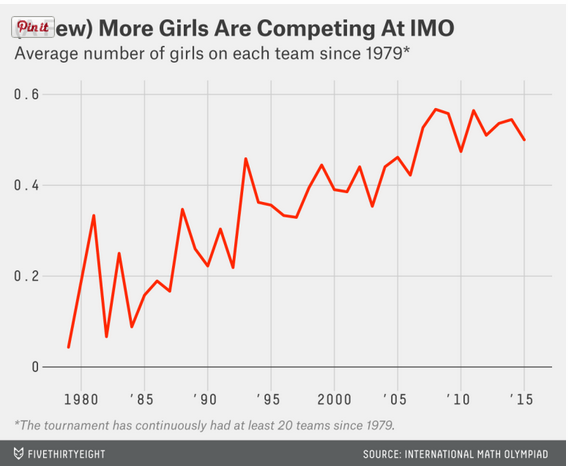
I think you mean boys have more variance (or less flat a distribution) in math scores, i.e., the highest percentile scores for boys are higher than girls but the averages are comparable (so the weakest boys must be commensurately weaker than the weakest girls), and yes, that can not be explained by participation numbers, so it is probably innate — assuming both boys and girls want to excel at math olympiads equally badly — though Larry Summers got fired as Harvard president for saying roughly that in a room full of women professors. FWIW, boys outperform girls by 20 points (out of a total of 252 points) at IMO, so about 8%, which is frighteningly even if coincidentally close to athletic advantage.
Unlike math scores, the chess finding of apparent top-level disparity is well explained by participation disparity.
Last week, a U.S. team won the International Math Olympiad for the first time in 21 years. But the U.S. team, like many others in the competition, was all male.
Semantics and obfuscation. The "participation disparity" is the exact same thing - only people good at chess participate on a scorable level. If you were reasoning honestly, you'd admit the likelihood that women generally are so ill-equipped for things like chess, they don't even try.
Someone a bit earlier said the "null hypothesis" is no difference between men and women. That's an arbitrary designation and a shifting-burden fallacy. So much empirical evidence points to them being different, you cannot presume the opposite.
An entire intellectual generation has been lost to politically-motivated wishful thinking.
Help us build the best running shoe review site for a chance to win a LetsRun t-shirt.Help us build the best running shoe review site for a chance to win one of 10 LetsRun t-shirts.