Yes but the leaf blower the janitor at the battery factory uses runs on gas… so thus green electric vehicles are just a myth stupid libs.
Ya know, there are battery powered leaf blowers, so you'll just have to come up with another misdirection in your failed attempt to stop progress.
It's not progress. It will fail big time, wait for it. Biden (Lyin Biden) and who is ever actually in charge can push it all they want, it's NOT practical, period.
No news as to whether standard home 240VAC 30AH circuits used throughout the world (including Japan, USA, North America) can charge the new Solid State Battery. This is a mandatory requirement Toyota has been working towards for decades. Discuss.
Yes but the leaf blower the janitor at the battery factory uses runs on gas… so thus green electric vehicles are just a myth stupid libs.
The 24 downvotes I got here indicates people thought I was serious?
I was just mocking the “if it isn’t 100% perfect, it’s actually bad” line you get from the skeptics of many things.
I work in batteries and led commercialization for one of Toyota's main start up rivals in solid-state battery development.
1) solid-state is great and offers the promise for both higher safety and greater energy density (more energy per unit weight / volume), but the devil is always in the details
2) to someone's earlier comment on 240V charging... this is completely independent of battery chemistry. We charge batteries all over the world with different voltages, amps, and frequency supplied by the grid.
3) solid-state batteries, for the most part, will not be suited for grid storage applications and as such will be much better off powering electric vehicles & mobile power applications (i.e. anything that moves)
4) batteries & EVs are here to stay. They are 3x more efficient than ICEs and can be nearly fully decarbonized if we push for a cleaner grid and supply chain (they are getting close in some areas)
Lithium polymer is Li-ion. It is an outdated term originally used to describe polymer packaging. Unfortunately, that term has stuck some 20 years later. There are also polymers used in some types of solid-state batteries that could outperform Li-ion but it is all in development and nowhere near prime time.
Incredible development. Toyota-Honda-Subaru will be shipping entire robotic factories that assemble customizable Solid State vehicles priced for 3rd World consumers.
There are lots of companies out there developing the nextgen batteries. The current lithium ion batteries will probably be obsolete by 2030. In addition to solid state batteries, there are also big advancements coming in salt/saline batteries and lithium air batteries. Solid state probably has the best chance at becoming the industry standard because of range and charging performance. But the saline batteries have the potential to be very cheap and also have great potential for energy storage on both a commercial and residential level.
Toyota has actually fallen way behind on EVs and has stayed with hybrids and ICEs at the expense of having a full line of EVs ready to go to market when the other automakers have theirs ready. I think pursuing solid state batteries is just a way for Toyota to convince shareholders that they just need to be patient because Toyota will have a superior product when they enter the market.
Ya know, there are battery powered leaf blowers, so you'll just have to come up with another misdirection in your failed attempt to stop progress.
Where does the electricity used to charge those batteries come from?
In reality, it is a coal-powered leaf blower.
The beauty of electric is that there's many sources: coal, nuclear, solar, wind, hydro. Some are clean and some are not. But at least we won't be at the mercy of single countries who can screw up the oil market and cause the price of gasoline to double plus cause inflation. Unless you work in oil, electric is 100% great for America and I dont understand why so many on the right are fighting it.
Without a reasonable way to charge and without a suitable range, EVs have been impractical for the vast majority of drivers. By 2026 finally we will have a suitable EV that's a no brainer. Japanese military industries has spent over 60 years developing robots that make their own offspring, more robots, and integrate thousands of robots into robotic flexible manufacturing plants to assemble complex toxic weapon systems deep underground and at sea. Deploying thousand of robotic localization factories on every nation on Earth is unique and places the Japanese EVs decades ahead of other countries.
Japanese military industries has spent over 60 years developing robots that make their own offspring, more robots, and integrate thousands of robots into robotic flexible manufacturing plants to assemble complex toxic weapon systems deep underground and at sea.
You are one looney mother. When Fukushima melted down, Japan had to use U.S.-made robots to get images from inside the reactors. Japan didn't have any robots that could do that.
Japan is good at making cutesy toy robots and assembly-line robots but not so good at producing robots with other real-world applications.
Where does the electricity used to charge those batteries come from?
In reality, it is a coal-powered leaf blower.
The beauty of electric is that there's many sources: coal, nuclear, solar, wind, hydro. Some are clean and some are not. But at least we won't be at the mercy of single countries who can screw up the oil market and cause the price of gasoline to double plus cause inflation. Unless you work in oil, electric is 100% great for America and I dont understand why so many on the right are fighting it.
"Tough guys don't do math. Tough guys deep fry chicken for a living." -Stand and Deliver
Apparently, American patriots don't drive electric. American patriots fund Saudi Arabia and Russia and stink up American air.
Stand and Deliver - Tough Guys Don't Do Math: Mr. Escalante (Edward James Olmos) singles out resident tough guy Angel (Lou Diamond Phillips) while teaching t...
Where does the electricity used to charge those batteries come from?
In reality, it is a coal-powered leaf blower.
In the US, 40% of electricity is renewable and only 20% comes from coal.
Not to mention that gas leaf blowers (mostly two-strokes) are extremely inefficient and dirty. They leave 30% of the fuel unburned, and they emit high levels of nitrous oxide (which is hundreds of times more potent as a greenhouse gas than CO2) and CO.
I'm against silly, performative "green" initiatives that don't pass any kind of cost/benefit analysis, but gas lawn tools are an actual problem with a real impact. We should stop using them as soon as is practical.
I work in batteries and led commercialization for one of Toyota's main start up rivals in solid-state battery development.
1) solid-state is great and offers the promise for both higher safety and greater energy density (more energy per unit weight / volume), but the devil is always in the details
For fun go back and read the battery articles from 30 years ago about all the battery changes that will be revolutionary. Basically only Li-ion made it. Over the past 15 years we have had dozens more battery breakthroughs . But so far we have just seen slow steady refinement.
And it isn't just batteries. Go read up on display tech. LCDs and OLEDs made it. The other half dozen never made it out of the prototype phase...
And it should be pointed out that in general if you have a 700mi battery, you would almost certainly be better off cutting it in half and having a 350mi battery that weighs half as much and costs a half as much. That is where the mass market is not cars you can drive for 10 hours straight...
Toyota has actually fallen way behind on EVs and has stayed with hybrids and ICEs at the expense of having a full line of EVs ready to go to market when the other automakers have theirs ready. I think pursuing solid state batteries is just a way for Toyota to convince shareholders that they just need to be patient because Toyota will have a superior product when they enter the market.
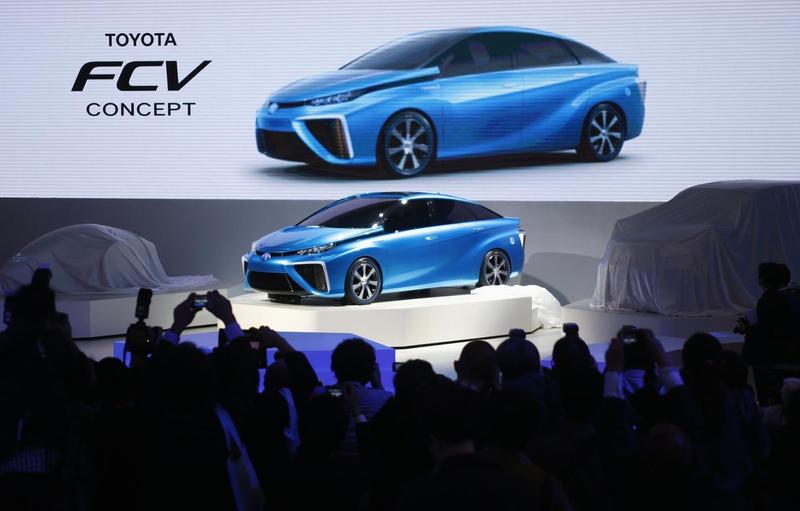
Toyota, for the past decade or more, has been chasing hydrogen fuel cells as the technology to replace ICEs. Even ignoring the problems at the vehicle level, clean hydrogen generation and distribution infrastructure are enormous barriers to acceptance. Most industry analysts are baffled at Toyota's technology emphasis.
Toyota, for the past decade or more, has been chasing hydrogen fuel cells as the technology to replace ICEs. Even ignoring the problems at the vehicle level, clean hydrogen generation and distribution infrastructure are enormous barriers to acceptance. Most industry analysts are baffled at Toyota's technology emphasis.
Nothing to be baffled about. It's the the same reason cars are moving to EVs now: government money. The Japanese government has provided a lot of it in fuel cell research/development subsidies over the years. From 2014:
Japan is readying subsidies to help Toyota Motor Corp 7203.T and key suppliers take the lead in hydrogen-powered fuel cell vehicles that could top $400 million over the next several years if the most bullish projections for the technology play out.
Japan is readying subsidies to help Toyota Motor Corp and key suppliers take the lead in hydrogen-powered fuel cell vehicles that could top $400 million over the next several years if the most bullish projections for the tech...
Help us build the best running shoe review site for a chance to win a LetsRun t-shirt.Help us build the best running shoe review site for a chance to win one of 10 LetsRun t-shirts.